
Hard Suction Hose
PVC helix-reinforced drafting hose · 1½"–6" · 10 ft sections · Full-vacuum drafting from static water sources
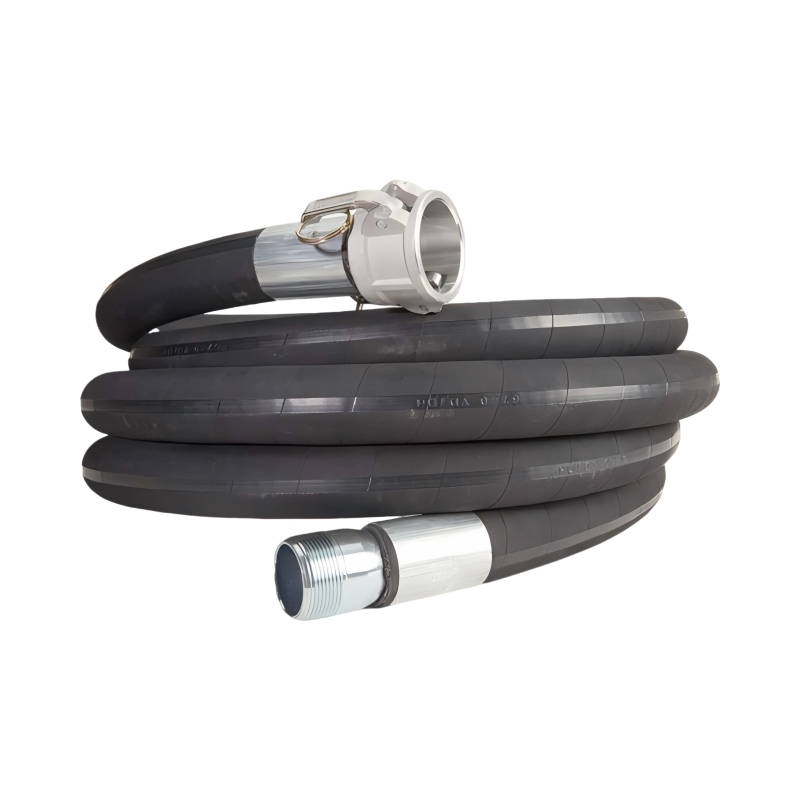
Helix-Reinforced Hard Suction Hose for Drafting Operations
CA-FIRE hard suction hose is engineered for one job: drafting water from a static source into a fire-engine pump under full vacuum. A flexible PVC tube with a rigid PVC helix ribbing produces a hose that resists vacuum-collapse, holds its round profile while the pump pulls water from a lake, river, pond, dry hydrant or portable folding tank, and stays flexible enough to route around obstacles on the fire-ground.
Available in 1½", 2", 2½", 3", 4", 4½", 5" and 6" internal diameter, in standard 10 ft (3 m) or 20 ft (6 m) sections. Three product grades cover every operational role: Black opaque for general drafting service, Black/Clear with transparent sidewall stripe so the pump operator can visually verify water flow and strainer condition during drafting, and Long-Handle for fast manual coupling on larger LDH-class sizes.
What Is Hard Suction Hose?
A hard suction hose — also called a drafting hose, suction hose, flexible suction hose, or fire engine suction hose — is a rigid-walled flexible hose specifically engineered to withstand full vacuum rather than internal pressure. The hose is used exclusively for drafting operations: when a fire engine pump creates vacuum to lift water from a static water source (lake, river, pond, swimming pool, dry hydrant, portable folding tank, cistern, well) up into the pump inlet.
The critical engineering challenge is vacuum collapse resistance. Standard fire hose is built to hold internal pressure; under vacuum, the soft jacket of an attack hose would crumple shut and stop water flow. Hard suction hose solves this with a flexible PVC tube reinforced by a rigid PVC helix coil — the helix holds the hose open under up to 29 inches of mercury (Hg) vacuum, so water flow is uninterrupted regardless of pump inlet pressure.
Hard suction is required equipment on every fire engine per NFPA 1901. Most engines carry two or three 10-foot sections of suction hose stored on the side of the truck, ready to deploy at any rural or non-pressurized water source. The hose works together with a foot valve and strainer at the source end to prevent debris from entering the pump.
⚠ Important — Hard suction hose is for drafting only. This hose is built for vacuum, not pressure. It is not intended for hydrant pressure, supply-line service, head pressure from above-ground holding tanks, or attack-line use. For pressurized supply from a hydrant, use Fire Hydrant Hose or Rubber-Covered LDH. Hard suction hose may safely be used for drafting from floating strainers, dry hydrants, or below-ground storage tanks where pressure stays at or near atmospheric.
Three Hard Suction Variants
CA-FIRE produces hard suction hose in three product variants optimized for different operational roles. All three share the core PVC tube + PVC helix construction; the differences are in the sidewall, the coupling type and the size range.
Black / Clear Suction Hose
Black Solid Suction Hose
Long-Handle Suction Hose
Construction
Hard suction hose construction is engineered around one principle: the wall must resist collapse under full vacuum while remaining flexible enough to route from the source to the pump intake. The three-element construction is the result of decades of fire-service R&D and is now the global industry standard.
Inner PVC Tube
Flexible PVC tube — smooth, low-friction interior so water flows with minimum drag. The tube is bonded directly to the rigid helix coil during extrusion.
Rigid PVC Helix Coil
The critical component. A continuous PVC ribbing spiraled around the outside of the tube, embedded in the wall. This rigid coil prevents the hose from collapsing under up to 29 in Hg vacuum.
Outer PVC Cover
Outer PVC layer encapsulates the helix coil. Black for general service; black with clear stripe for visual flow verification. UV and abrasion resistant; service temperature −20 °C to +65 °C.
Full Specifications — Hard Suction Hose
Standard length is 10 ft (3 m); 20 ft (6 m) sections available for some sizes. All hoses are vacuum-tested before shipment.
| Nominal ID | ID (mm) | Standard Length | Vacuum Rating (in Hg) | Coupling Type | Approx Weight (lb / kg) |
|---|---|---|---|---|---|
| 1½" | 38 | 10 ft (3 m) | 29 | Internal expansion ring NH/NST | 4 / 1.8 |
| 2" | 50 | 10 ft (3 m) | 29 | Internal expansion ring NH/NST | 5 / 2.3 |
| 2½" | 65 | 10 ft (3 m) | 29 | Internal expansion ring NH/NST | 7 / 3.2 |
| 3" | 75 | 10 ft (3 m) | 29 | Internal expansion ring NH/NST | 9 / 4.1 |
| 4" | 102 | 10 ft (3 m) | 29 | Field-replaceable NH/NST or long-handle | 14 / 6.4 |
| 4½" | 114 | 10 ft (3 m) | 29 | Field-replaceable NH/NST or long-handle | 17 / 7.7 |
| 5" | 127 | 10 ft (3 m) | 29 | Field-replaceable NH/NST or long-handle | 20 / 9.1 |
| 6" | 152 | 10 ft (3 m) | 29 | Field-replaceable NH/NST or long-handle | 26 / 11.8 |
2½" and 3" couplings use anodized aluminum internal expansion ring couplings (not field-replaceable). 4", 4½", 5" and 6" couplings are anodized aluminum and field-replaceable. Meets or exceeds NFPA 1961 Standard on Fire Hose. NPSH, Storz, BS 336, GOST and other coupling threads available on request.
Why Hard Suction — Not Layflat or Pressure Hose — for Drafting
Drafting is a unique fire-service operation that requires specific hose engineering. Here is why standard fire hose will not work in this role.
Vacuum Collapse Resistance
The PVC helix coil holds the hose open under up to 29 in Hg vacuum — close to the theoretical maximum lift a pump can develop. Without the helix, the hose wall would crumple shut and stop flow.
Visual Flow Verification
The Black/Clear sidewall variant lets the pump operator see water flow inside the hose and check for debris obstruction. Critical for confirming the strainer is doing its job and protecting the pump.
Holds Round Profile
The rigid helix maintains a perfectly round profile so the pump can achieve maximum flow rate. A flattened or oval hose drops flow rate dramatically.
Fast Connection
Pre-coupled with rocker-lug or long-handle NH/NST couplings — connect by hand in seconds without wrenches. Fast deployment is critical when seconds matter on an emergency response.
Abrasion Resistant
Thick outer PVC cover resists abrasion from gravel beaches, rocky banks, concrete edges and steel grating typical of drafting sites.
NFPA 1961 / NFPA 1901 Compliant
Meets NFPA 1961 hose construction requirements. NFPA 1901 (Standard for Automotive Fire Apparatus) requires hard suction hose as part of the standard equipment carried on every engine.
Common Use Cases
Rural Lake / Pond Drafting
5" or 6" hard suction with floating strainer, deployed from the fire engine to a lake, pond or river. The dominant rural-water-supply technique for departments without hydrant coverage. Lift up to 10 m (33 ft) theoretical maximum.
Dry Hydrant Connection
2½" or 4" suction hose connected to a dry hydrant — a permanent steel pipe pre-installed at a water source for fast rural-water supply. Eliminates the need to drag a strainer to the water's edge.
Portable Folding Tank Drafting
4" or 5" suction from a portable folding water tank (the "dump tank") for tanker-shuttle water-supply operations. Critical equipment for any department conducting tanker-shuttle drills or operations.
Swimming Pool Drafting
3" or 4" suction with a swimming-pool strainer for residential structural fires in areas without hydrants. A pool typically holds 15,000–30,000 gallons — enough for sustained interior attack operations.
Below-Ground Cistern
2½" or 3" hard suction lowered into a below-ground cistern or storage tank. Smaller diameter is easier to manage in the confined access hole; vacuum lift handles the depth.
Industrial Process Water Pull
Hard suction for industrial bypass pumping, dewatering of trenches and excavations, transfer of process water at refineries and power plants. Same vacuum-resistance principle as fire service.
Marine & Yacht Bilge Drafting
Smaller 1½"–2½" suction hose for marine bilge pumping, dock-side dewatering, and emergency water removal from disabled vessels.
Agricultural Pump Intake
4" or 6" suction hose feeding an agricultural irrigation pump from a farm pond, irrigation canal or stock tank. Same vacuum-resistance principle, lower service-life expectation than fire-service hose.
Why Source Hard Suction Hose from CA-FIRE
- Three product variants in stock. Black/Clear with visual flow stripe, solid Black economy, and Long-Handle LDH-class for larger sizes. One supplier for the full drafting-hose schedule.
- Full size range 1½"–6". From 1½" small-volume drafting to 6" high-volume rural-water-supply applications. Standard 10 ft sections; 20 ft sections available for select sizes.
- Full-vacuum tested before shipment. Every hose passes a 29 in Hg vacuum test before shipping — guaranteed to hold full vacuum on first deployment.
- NFPA 1961 compliant. Construction meets or exceeds NFPA 1961 Standard on Fire Hose requirements. ISO 9001 quality management system production.
- Pre-coupled to spec. Internal expansion ring NH/NST couplings standard for 1½"–3"; field-replaceable aluminum couplings for 4"–6". Long-handle, NPSH, Storz, BS 336 and other thread types available on request.
- Anodized aluminum couplings. Corrosion-resistant anodized aluminum for long service life in wet, salt-spray and rural-water environments.
- OEM & private label. Stamp your department or distributor identification along the hose length. Custom branding for fire-apparatus OEM contracts available.
- Direct manufacturer. Factory pricing direct to fire departments, fire-apparatus builders and distributors. No middlemen, no markups.
Related Fire Hose Products
Hard Suction Hose FAQ
What is hard suction hose used for?
Hard suction hose is used exclusively for drafting operations: when a fire engine pump uses vacuum to lift water from a static (non-pressurized) source — a lake, pond, river, swimming pool, dry hydrant, portable folding tank, cistern, or well. The rigid PVC helix in the hose wall prevents collapse under vacuum, allowing the pump to develop suction without the hose crumpling shut.
Hard suction is required equipment on every fire engine per NFPA 1901. Most engines carry two or three 10-foot sections stored on the truck's side, ready for rapid deployment at rural water sources.
What is the difference between hard suction hose and regular fire hose?
Hard suction hose is built to withstand vacuum — the rigid PVC helix coil prevents the wall from collapsing inward when the pump pulls suction. It is used on the intake (suction) side of the pump for drafting from static water sources. Service pressure is essentially atmospheric.
Regular fire hose (attack, supply, cabinet, etc.) is built to withstand internal pressure — woven polyester jacket holds the hose together against 150–400+ psi internal pressure. It is used on the discharge side of the pump for delivery, attack and supply lines. Under vacuum it would crumple shut.
The two are not interchangeable. Using regular fire hose for drafting is both ineffective and hazardous — the hose and couplings can experience catastrophic failure.
What size hard suction hose should I order?
Larger diameter = higher flow rate at the same lift. A 5" (127 mm) hose can lift approximately 500 GPM up 23 ft (7 m), while a 3½" (89 mm) hose lifting the same volume would manage only 12.5 ft (3.8 m). For typical fire-engine drafting service:
• 5" or 6" — preferred for any modern engine with adequate pump capacity (typically 1,000+ GPM). Maximum flow rate at any lift height.
• 4" or 4½" — common on smaller engines or where 5" would be too heavy to handle quickly.
• 2½" or 3" — for smaller portable pumps, dry hydrant connections, and back-up drafting capability.
• 1½" or 2" — for small portable pumps, wildland engines and special-application drafting.
Carry at least two sections of your primary suction size — drafting often requires connecting two or three sections to reach the water source.
How long are standard hard suction sections?
Standard length is 10 ft (3 m) per section — the convention for fire-service hard suction hose, sized to fit the side-mount storage compartments on standard fire-engine bodies. 20 ft (6 m) sections are available for some sizes when the application requires a longer reach. Custom lengths can be cut to order for fixed installations.
Multiple sections can be connected with NH/NST couplings to reach more distant water sources. NFPA 1901 requires every engine to carry sufficient suction hose to reach the engine's rated drafting capacity from a typical water source.
What is the difference between Black and Black/Clear suction hose?
Solid Black hard suction hose uses a fully opaque PVC outer cover. Economical, durable, the choice when visual flow confirmation is not required.
Black/Clear hard suction hose has a transparent clear stripe along the sidewall in addition to the black covering. The clear stripe allows the pump operator to see water flowing through the hose during drafting, and to verify visually that the strainer is preventing debris (sticks, leaves, rocks) from being pulled into the pump.
The Black/Clear variant has become the U.S. fire-service standard for active drafting operations. The visual confirmation prevents costly pump damage from debris pass-through and gives the operator immediate feedback on lift performance.
What is the maximum vertical lift hard suction hose can achieve?
The theoretical maximum vertical lift for any vacuum-based system is about 33 ft (10 m) — the height of an atmospheric column of water at sea level. In practice, fire-service drafting is limited to 20–25 ft (6–7.5 m) of lift because of friction loss in the hose, altitude, water temperature, atmospheric pressure variations, and pump efficiency.
For maximum lift, keep the suction hose lay as short as possible, position the engine as close to the water source as terrain allows, and use the largest diameter suction hose your pump intake will accept. At lower lifts, larger diameter hose yields proportionally higher flow rate.
Can hard suction hose be used with hydrant pressure?
Generally no. Hard suction hose is engineered to withstand vacuum, not internal pressure. The rigid PVC helix construction and gasket design are not rated for pressurized service. Connecting a hard suction hose to a charged hydrant or pressurized supply line can result in hose or coupling failure.
The one limited exception: hard suction can be used to connect a hydrant with adequate static water supply but very low flow rate (where the pump must develop vacuum to draw water faster than the hydrant flows). This is uncommon — most departments use a pressurized soft-suction connection for hydrant supply. For routine pressurized supply, use hydrant supply hose instead.
What coupling fits hard suction hose?
The U.S. fire-service standard is NH/NST (National Hose / National Standard Thread) with rocker-lug couplings — connectable by hand without wrenches. NPSH (National Pipe Straight Hose) is an alternative for some standpipe and dry-hydrant applications.
For 2½" and 3" sizes, the coupling uses an internal expansion ring attachment that is not field-replaceable. For 4", 4½", 5" and 6" sizes, couplings are field-replaceable anodized aluminum. Long-handle aluminum couplings are available for larger sizes where extra grip area helps with manual connection.
For non-US markets we can supply BS 336, GOST, Storz, Machino or Guillemin couplings on request.
How do I get a quote on hard suction hose?
Email sales@ca-fire.com or message WhatsApp at +86 181-5036-2095 with: hose ID (1½"–6"), variant (Black solid / Black with clear stripe / Long-handle), length per section (10 ft / 20 ft / custom), total quantity, coupling type (NH/NST / NPSH / Storz / other), and any required certifications. We respond within one business day with pricing, lead time and freight options.