
Single-Jacket Fire Hose
Lightweight cabinet & rack hose · 1¼"–6" · UL listed · NFPA 14 compliant occupant-use hose
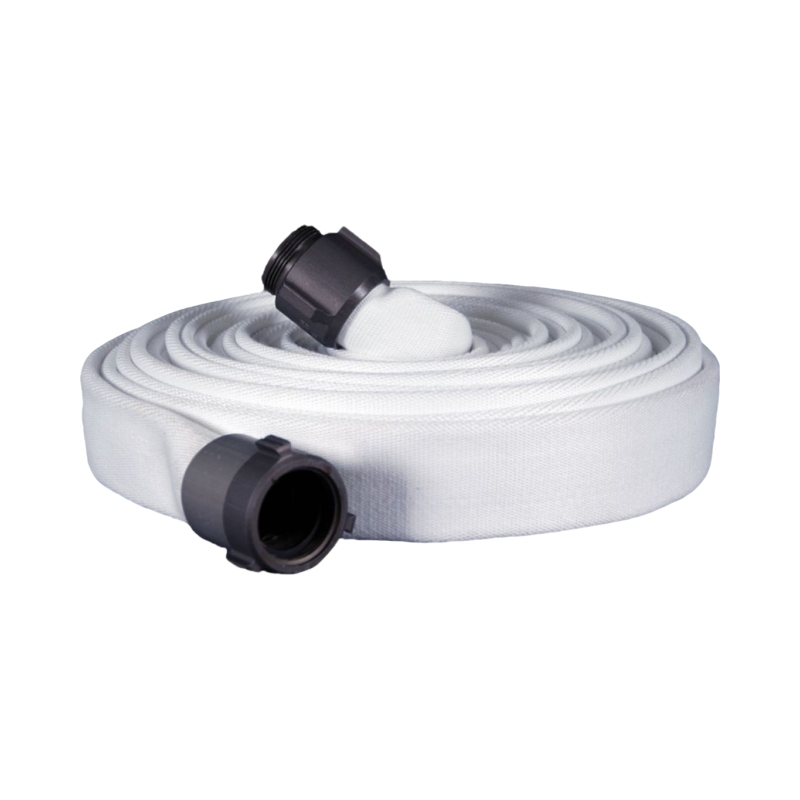
Lightweight Single-Jacket Fire Hose for Cabinets, Racks & Standpipes
CA-FIRE single-jacket fire hose is the industry-standard occupant-use hose for fire cabinets, rack systems, Class II and Class III standpipe stations, light industrial fire protection and economy fire-brigade service. One layer of high-tenacity polyester filament jacket bonded to a synthetic rubber or thermoplastic lining gives you a lightweight, low-cost hose that meets NFPA 14, UL and EN 14540 listing requirements.
Available in 1¼", 1½", 1¾", 2", 2½", 3", 4" and 6", with your choice of EPDM, TPU, TPR or Nitrile lining. The most popular configuration is 1½" × 30 m (100 ft) pre-folded for cabinet installation — fully listed and ready to drop into NFPA 14 Class II or Class III hose stations.
What Is Single-Jacket Fire Hose?
A single-jacket fire hose is a woven-jacket fire hose with one layer of polyester reinforcement bonded to an internal rubber or thermoplastic lining. The single-layer construction makes it lighter, more flexible and more affordable than double-jacket hose, at the cost of lower abrasion resistance and lower maximum service pressure. The result is the ideal hose for low-deployment, controlled-environment applications: cabinet and rack stations, standpipe occupant-use lines, economy industrial service and many international fire-brigade applications.
CA-FIRE single-jacket hose meets NFPA 14 requirements for listed 1½" occupant-use hose at Class II and Class III standpipe stations, EN 14540 for European fire service, and UL 19 / UL 219 for U.S. interior standpipe service. Each hose is service-pressure tested before shipment and stamped with the test pressure, manufacture date and unique serial number — exactly what NFPA 1962 requires for the in-service hose record.
Other industry names for this product: cabinet hose, rack hose, occupant-use hose, standpipe hose, single jacket hose, single-layer fire hose. All describe the same product — a woven single-jacket lined fire hose.
Full Specifications — Single-Jacket Fire Hose
Pressure ratings vary with lining material. EPDM and Nitrile linings carry the higher ratings; TPR and TPU economy variants are rated to lower pressures for cabinet and standpipe service. The table below shows the available service-pressure options for each size.
| Nominal ID | ID (mm) | Service Pressure (psi / bar) | Proof / Test Pressure (psi / bar) | Burst Pressure (psi / bar) | Standard Length |
|---|---|---|---|---|---|
| 1¼" | 32 | 150 / 10, 200 / 14, 220 / 15, 250 / 17, 300 / 21 | 300 / 21 to 600 / 42 | 450 / 30 to 900 / 63 | 15 / 20 / 25 / 30 m |
| 1½" | 38–40 | 150 / 10, 200 / 14, 220 / 15, 250 / 17, 300 / 21 | 300 / 21 to 600 / 42 | 450 / 30 to 900 / 63 | 15 / 20 / 25 / 30 m |
| 1¾" | 45 | 150 / 10, 200 / 14, 220 / 15, 250 / 17, 300 / 21 | 300 / 21 to 600 / 42 | 450 / 30 to 900 / 63 | 15 / 20 / 25 / 30 m |
| 2" | 50 | 150 / 10, 200 / 14, 220 / 15, 250 / 17, 300 / 21 | 300 / 21 to 600 / 42 | 450 / 30 to 900 / 63 | 15 / 20 / 25 / 30 m |
| 2½" | 65 | 150 / 10, 200 / 14, 220 / 15, 250 / 17, 300 / 21 | 300 / 21 to 600 / 42 | 450 / 30 to 900 / 63 | 15 / 20 / 25 / 30 m |
| 3" | 75 | 150 / 10, 200 / 14, 220 / 15, 250 / 17 | 300 / 21 to 500 / 35 | 450 / 30 to 750 / 51 | 15 / 20 / 30 m |
| 4" | 102 | 150 / 10, 200 / 14, 220 / 15, 250 / 17 | 300 / 21 to 500 / 35 | 450 / 30 to 750 / 51 | 15 / 20 / 30 m |
| 6" | 152 | 150 / 10, 200 / 14, 220 / 15, 250 / 17 | 300 / 21 to 500 / 35 | 450 / 30 to 750 / 51 | 15 / 20 / 30 m |
Hoses are stamped with the actual service test pressure per NFPA 1962. Custom lengths up to 100 m available. Specify desired service pressure when ordering to ensure the right lining and jacket weave configuration.
Construction
Single-jacket fire hose uses a streamlined two-layer construction. The lining is extruded as a continuous tube, then the polyester jacket is woven directly over it on a circular loom. Heat bonding fuses the two into a single integrated structure — true through-the-weave construction without delamination.
Inner Lining
Extruded synthetic tube — EPDM rubber, TPU polyurethane, TPR or nitrile rubber. Low-friction smooth bore for maximum flow rate. Ozone, weather and bacterial resistant. Service temperatures from −30 °C to +100 °C depending on material.
Polyester Jacket
100% virgin high-tenacity polyester filament, woven on circular looms in twill or plain weave. Bonded directly to the lining via through-the-weave heat fusion. Resists mold, mildew, UV and most common chemicals.
Single-Jacket vs Double-Jacket — Which One Do You Need?
The single most common specification question is whether single-jacket or double-jacket hose is right for the application. Here is a side-by-side comparison to clarify the decision.
Single-Jacket
- Weight: ~30% lighter than double-jacket
- Cost: ~25–40% lower than double-jacket
- Service pressure: 150–300 psi
- Abrasion resistance: Moderate
- Best for: Cabinet hose, rack stations, occupant use, light industrial, economy applications
- Standards: NFPA 14 occupant-use, UL 219, EN 14540
Double-Jacket
- Weight: Heavier — extra jacket layer
- Cost: Higher
- Service pressure: 250–400 psi
- Abrasion resistance: High — surviving drag on pavement
- Best for: Brigade attack, municipal fire service, high-deployment use
- Standards: NFPA 1961 attack hose, UL 19, FM 2111
Lining Options — Four Materials
CA-FIRE single-jacket hose is available with four lining materials. The right choice depends on operating environment, expected service life, and target price point.
EPDM Rubber
Ozone and weather resistant. Good for hot water and steam. Service −30 °C to +100 °C. Default specification for cabinet and standpipe hose. Up to 300 psi.
TPU (Polyurethane)
30% lighter than EPDM at equivalent ID. Highest abrasion resistance among the four. Excellent for high-cycle cabinet hose. Up to 250 psi service.
Nitrile (NBR)
Petroleum, oil and fuel resistant. Choose this for refineries, airports, marine applications and any environment with hydrocarbon exposure. Up to 300 psi.
TPR
Lowest-cost lining. Good chemical resistance, lightweight. Recommended for cabinet hose and standpipe service where 220 psi is sufficient.
Common Use Cases
Fire Cabinet / Hose Reel Stations
1½" × 30 m pre-folded single-jacket hose in wall-mounted fire cabinets — the most common installation worldwide. Ready for occupant use with an attached nozzle.
NFPA 14 Class II Standpipe
1½" listed lined hose attached to each hose connection for use by trained building occupants. Pre-folded or on a rack, ready to deploy.
NFPA 14 Class III Standpipe
1½" occupant-use hose alongside 2½" fire-department connections. The hybrid system in larger commercial, hospital and high-rise buildings.
Rack & Reel Cabinet Hose
Lightweight 1½" hose pre-coiled on a swing-arm rack or reel inside a fire cabinet. The lightest option for occupant deployment.
Light Industrial Fire Protection
Factory floor fire stations, warehouse hose lines, light industrial wash-down. Lower cost than double-jacket where 150–220 psi is adequate.
International Brigade Service
Many European, Asian and African fire brigades use single-jacket EPDM hose as their standard attack line — particularly in markets where EN 14540 governs.
Color & OEM Branding
Standard jacket colors are listed below. Color choice is often code-related: white is the European cabinet-hose standard, red is the North American standpipe-hose default. Custom color combinations, color-coded stripes and full OEM branding (department name, logo, in-service date, serial number) are available with reasonable MOQs.
Why Source Single-Jacket Fire Hose from CA-FIRE
- Listed for occupant-use service. UL, ULC, FM, EN 14540 and DIN 14811 listed. Meets NFPA 14 requirements for Class II and Class III standpipe occupant-use hose.
- Four lining materials in stock. EPDM, TPU, TPR and Nitrile — pick the right material for the operating environment, no compromises.
- Pre-folded or pre-coiled for cabinet installation. Hose can be supplied pre-folded in accordion configuration or pre-coiled on a rack — drop straight into the cabinet, no further preparation needed.
- Pre-coupled to spec. Storz, NH, NST, NPSH, BS 336, Machino, GOST and Guillemin couplings — brass or aluminum body, installed and pressure-tested before shipment.
- NFPA 1962 stamped. Every hose is printed with the service test pressure, manufacture date, length and a unique serial number — ready to enter your in-service hose log.
- OEM-friendly. Print your facility, department or brand identification along the hose length. Custom jacket colors and identification stripes available at reasonable MOQs.
- Direct manufacturer. Produced in our own facility. Factory pricing direct to fire-protection distributors, contractors and end users — no middlemen, no markups.
- Export to 60+ countries. Full test certificates, mill certs, hydrostatic test reports and commercial documentation supplied with every shipment.
Related Fire Hose Products
Single-Jacket Fire Hose FAQ
What is single-jacket fire hose used for?
Single-jacket fire hose is the standard hose for fire cabinets, NFPA 14 Class II and Class III standpipe occupant-use stations, building rack and reel systems, light industrial fire protection, and many international fire-brigade applications. The single-layer polyester jacket makes it lighter and cheaper than double-jacket hose, with adequate strength (150–300 psi service pressure) for any application where the hose will not be subjected to repeated heavy abrasion.
The most common configuration is 1½" × 30 m (100 ft) pre-folded for installation in a wall-mounted fire cabinet, with a nozzle pre-attached and a quarter-turn valve at the hose station.
What is the difference between single-jacket and double-jacket fire hose?
Single-jacket hose has one polyester reinforcement jacket bonded to the lining. Lighter (about 30% less weight), lower cost, service pressure 150–300 psi. Standard choice for cabinets, racks, standpipe occupant-use and light industrial.
Double-jacket hose adds a second polyester jacket woven over the first. Substantially heavier abrasion resistance and higher service pressure (250–400 psi). The standard for fire-brigade attack hose and any application where the hose will be dragged across rough surfaces.
For most occupant-use, cabinet and standpipe installations, single-jacket is the correct specification. For fire-brigade attack lines, use double-jacket.
Is single-jacket hose UL listed?
Yes. CA-FIRE single-jacket fire hose is UL listed under UL 19 (Lined Fire Hose and Hose Assemblies) or UL 219 (Lined Fire Hose for Interior Standpipes), depending on the configuration. We also carry ULC, FM, EN 14540 (European), BS 6391 (UK), DIN 14811 (Germany) and CCS (China) approvals. Test certificates are provided with every shipment.
What size single-jacket hose is required for an NFPA 14 standpipe?
NFPA 14 requires listed, lined, 1½" (40 mm) fire hose not exceeding 100 ft (30 m) at each hose station of a Class II or Class III standpipe system. The hose must be listed and approved by the AHJ. Smaller 1" hose may be used only in light-hazard occupancies, and only when the AHJ approves it. Hoses larger than 1½" (typically 2½") are reserved for fire-department use on Class I or Class III systems and are not occupant-use.
Our single-jacket cabinet hose is supplied in 1½" × 30 m as the default configuration to match this code requirement exactly.
Can I order single-jacket hose pre-folded for cabinet installation?
Yes. We can ship the hose pre-folded in accordion configuration with the nozzle pre-installed on the male coupling end — ready to drop into a fire-cabinet hose station with no on-site assembly. We can also pre-coil on a swing-arm rack frame if you provide the rack dimensions. Specify the cabinet manufacturer and model when ordering to ensure perfect fit.
How often does single-jacket cabinet hose need to be tested?
NFPA 1962 (Standard for the Care, Use, Inspection, Service Testing, and Replacement of Fire Hose) requires annual service testing of occupant-use hose at the service test pressure printed on the hose. Cabinet hose also requires a visual inspection every quarter and a removal-from-rack inspection at least every 3 years (or 5 years for certain configurations). CA-FIRE single-jacket hose is stamped with its service test pressure, manufacture date, length and serial number — ready for the in-service log.
What lining material should I choose for single-jacket hose?
EPDM is the default choice for general cabinet, standpipe and brigade use — best all-round ozone and weather resistance.
TPU is the lightest option and has the highest abrasion resistance — best for high-cycle deployment or where weight matters.
Nitrile is the right choice when the hose may be exposed to oil, fuel or other petroleum products — refineries, airports, marine and chemical industries.
TPR is the economy lining for cabinet hose at 220 psi or below — lowest cost, lightweight, adequate for most occupant-use applications.
How do I get a quote on single-jacket fire hose?
Email sales@ca-fire.com or message WhatsApp at +86 181-5036-2095 with: hose ID size, length per section, total quantity, lining preference (EPDM/TPU/TPR/NBR), service pressure required, coupling type and material, jacket color, packaging (pre-folded / pre-coiled / bulk), and any certification required (UL / FM / EN / NFPA / CCS). We respond within one business day with pricing, lead time and freight options.