
Attack Fire Hose
UL / FM listed handline hose · 1½", 1¾", 2" & 2½" · NFPA 1961 compliant · 400 psi service
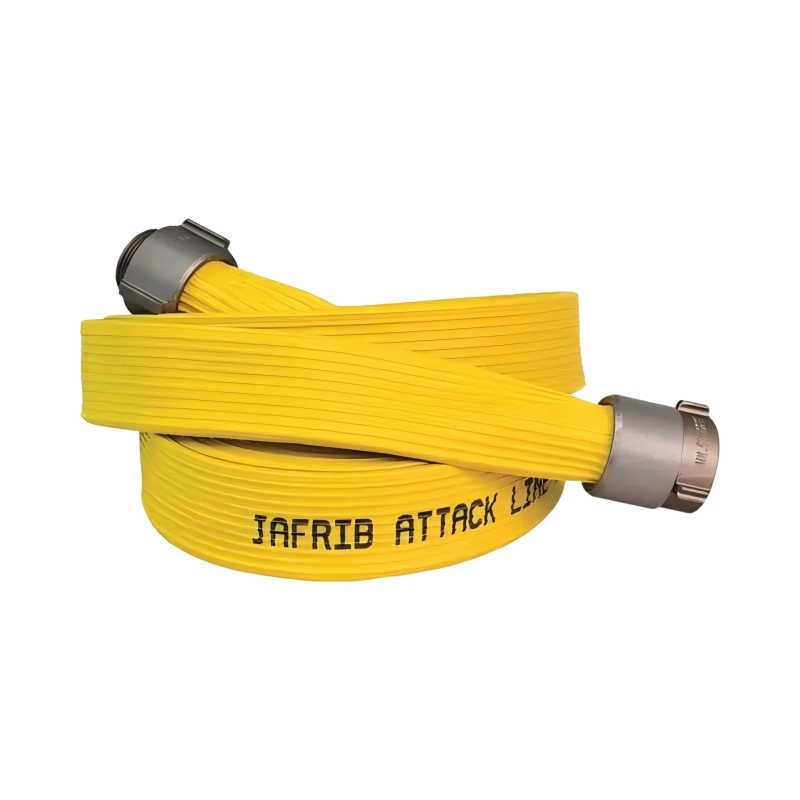
UL & FM Listed Attack Fire Hose for the Fireground
CA-FIRE attack fire hose is the handline that puts water on the fire. Designed and tested to NFPA 1961, our attack hoses combine a tightly woven polyester double-jacket with a low-friction synthetic rubber or thermoplastic lining — engineered to deliver maximum flow at 400 psi service pressure while withstanding the heat, drag and impact of structural firefighting.
Available in 1½", 1¾", 2" and 2½" — the four workhorse handline diameters of municipal fire service. Single-jacket variants are also available for cabinet, rack and standpipe occupant use where 300 psi service pressure is adequate.
What Is Attack Fire Hose?
An attack fire hose — also called an attack line, handline hose, or simply fire attack hose — is the high-pressure delivery hose firefighters use to put water directly onto a fire beyond its incipient stage. Unlike supply hose, which moves water from a hydrant to the pumper at residual pressure, attack hose carries water from the pumper engine to the nozzle at much higher boosted pressure so the firefighter can shape an effective fog or straight stream.
NFPA 1961 defines attack hose as fire hose designed to be used by trained firefighters to combat fires beyond the incipient stage, and requires it to withstand a minimum 300 psi service pressure. Most modern attack hoses are rated higher — 400 psi service pressure, 800 psi proof test, and 1,200 psi minimum burst. CA-FIRE attack hoses meet or exceed these thresholds in every size we manufacture.
Three things make attack hose different from cheaper occupant-use or industrial hose: (1) double-jacket construction for abrasion resistance when dragged across rough surfaces, (2) UL or FM third-party listing verifying performance under the kink test, alternating pressure test and burst test, and (3) service-printed test pressure on the jacket per NFPA 1962 — so the hose can be re-tested annually and remain in service for 10+ years.
Full Specifications — Attack Fire Hose
Two construction grades are offered: double-jacket at 400 psi service pressure (the brigade-service standard) and single-jacket at 300 psi service pressure (for cabinet, rack and occupant-use applications, and for departments seeking a lighter-weight hose).
Double-Jacket Attack Hose (Brigade Service)
| Nominal ID | ID (mm) | Service Pressure (psi / bar) | Proof / Test Pressure (psi / bar) | Burst Pressure (psi / bar) | Standard Length |
|---|---|---|---|---|---|
| 1½" | 38 | 400 / 28 | 800 / 55 | 1,200 / 84 | 15 / 20 / 25 / 30 m |
| 1¾" | 45 | 400 / 28 | 800 / 55 | 1,200 / 84 | 15 / 20 / 25 / 30 m |
| 2" | 50 | 400 / 28 | 800 / 55 | 1,200 / 84 | 15 / 20 / 25 / 30 m |
| 2½" | 65 | 400 / 28 | 800 / 55 | 1,200 / 84 | 15 / 20 / 25 / 30 m |
Single-Jacket Attack Hose (Cabinet / Rack / Occupant Use)
| Nominal ID | ID (mm) | Service Pressure (psi / bar) | Proof / Test Pressure (psi / bar) | Burst Pressure (psi / bar) | Standard Length |
|---|---|---|---|---|---|
| 1¼" | 32 | 300 / 21 | 600 / 42 | 900 / 63 | 15 / 20 / 25 / 30 m |
| 1½" | 38 | 300 / 21 | 600 / 42 | 900 / 63 | 15 / 20 / 25 / 30 m |
| 1¾" | 45 | 300 / 21 | 600 / 42 | 900 / 63 | 15 / 20 / 25 / 30 m |
| 2" | 50 | 300 / 21 | 600 / 42 | 900 / 63 | 15 / 20 / 25 / 30 m |
| 2½" | 65 | 300 / 21 | 600 / 42 | 900 / 63 | 15 / 20 / 25 / 30 m |
Pressure ratings vary with lining material. Hoses are stamped with the actual service test pressure per NFPA 1962. Custom pressure ratings and lengths available — contact CA-FIRE sales.
Construction
Attack hose uses a double-jacket woven construction — two layers of high-tenacity polyester filament jacket bonded to an extruded synthetic rubber or thermoplastic lining. The double-jacket is the standard for fire-brigade service because it more than doubles the abrasion resistance of single-jacket hose without significantly increasing weight.
Inner Lining
Extruded synthetic tube — EPDM rubber, TPU polyurethane, or nitrile rubber. Low friction loss, ozone resistant, bonded to the jacket for true through-the-weave construction.
Inner Jacket
100% virgin high-tenacity polyester filament, woven on circular looms in twill or plain weave. Spun warp + filament weft for the optimum balance of strength, weight and flexibility.
Outer Jacket
Second polyester jacket woven directly over the inner. Carries shared pressure load, dramatically increases abrasion resistance, and protects the lining from UV and physical damage.
Lining Options — Choose Your Material
The lining is the single most important specification choice for attack hose. Each material has different strengths: weight, abrasion resistance, chemical resistance, cold-weather flexibility and cost. CA-FIRE offers four lining materials so the hose can be matched to the specific service environment.
EPDM Rubber
The default brigade choice. Excellent ozone, weather and hot-water resistance. Reliable in repeated 400 psi service. Good cold flexibility down to −30 °C.
TPU (Polyurethane)
30% lighter than EPDM for the same ID. Superior abrasion resistance — preferred for high-deployment companies. Smooth bore, very low friction loss.
Nitrile (NBR)
Best for industrial, marine and airport fire protection — refineries, fuel-loading docks, hangars. Resists petroleum products that destroy EPDM and TPU.
TPR (Thermoplastic Rubber)
Lowest-cost lining for occupant-use, cabinet and rack hose. Good chemical resistance, lightweight. Recommended for non-brigade applications.
Choosing the Right Attack Hose Size
The four common attack-hose sizes serve distinctly different operational roles. Use this guide to specify the right diameter for your service.
1½" (38 mm)
The traditional handline diameter. Lightweight, easy to advance, flows up to ~150 GPM with a fog nozzle. Best for occupant-use, cabinet hose, mop-up and small structural fires.
1¾" (45 mm)
The modern attack-line of choice for most U.S. fire departments. Delivers ~185 GPM at 100 psi nozzle pressure with manageable weight and reaction force. Standard preconnect on most engines.
2" (50 mm)
High-flow alternative to 1¾". Reduces friction loss compared with 1¾" while remaining a one-person handline. Popular for industrial and high-challenge fires.
2½" (65 mm)
The big-line attack hose. Flows 250+ GPM with smooth-bore tips. Two-person handline for advanced exterior, commercial and master-stream work. Also fits 2½" standpipe outlets directly.
Color & Branding Options
Attack hose is supplied in eight standard jacket colors. Custom color combinations, color-coded reflective stripes and full OEM branding (department name, logo, certification mark, in-service date and serial number) can be printed along the hose length.
Why Source Attack Hose from CA-FIRE
- UL and FM listed. Tested independently to UL 19 and FM 2111 — including the kink test, alternating pressure test, and burst test required by NFPA 1961.
- Direct manufacturer. Produced in our own facility using through-the-weave extrusion. Factory pricing direct to fire departments, distributors and integrators — no middlemen.
- Four lining materials in stock. EPDM, TPU, Nitrile and TPR. Pick the right material for your service environment — no compromise.
- Pre-coupled to spec. Storz, NH, NST, NPSH, BS 336, Machino, GOST and Guillemin couplings — brass or aluminum body, installed and pressure-tested before shipment.
- NFPA 1962 stamped. Every hose is printed with the service test pressure, manufacture date, length and a unique serial number — exactly what NFPA 1962 requires for the in-service hose record.
- OEM-friendly. Print your department or brand logo, custom jacket colors, identification stripes and certification marks. Reasonable MOQs for fully custom orders.
- Global shipping. Exported to 60+ countries. Full test certificates, mill certs, hydrostatic test reports and commercial documentation supplied with every shipment.
Related Fire Hose Products
Attack Fire Hose FAQ
What is an attack fire hose used for?
Attack fire hose is the handline that delivers water directly onto a fire from a pumper engine, hydrant, or standpipe outlet. It is the hose held by firefighters at the fire scene. Per NFPA 1961, attack hose is designed to combat fires beyond the incipient stage, meaning it must sustain high pumping pressures — minimum 300 psi service pressure under the standard, typically 400 psi on modern brigade hose.
Common roles: structural interior attack, exterior attack, master-stream supply, standpipe operations, wildland engine line, and aircraft rescue fire fighting (ARFF).
What is the difference between an attack hose and a supply hose?
Attack hose works on the discharge side of the pumper at boosted pressure (typically 100–250 psi at the nozzle, with friction loss adding back to the engine pressure). It is sized 1½"–2½" and rated to 300–400 psi service pressure.
Supply hose (also called LDH / hydrant hose) works on the intake side, moving water from a hydrant or static source to the pumper at the hydrant's residual pressure (typically 50–125 psi). It is sized 2½"–6".
The two work together: supply hose feeds the pumper, the pumper boosts pressure, attack hose delivers water to the fire. See our Fire Hydrant Hose page for the supply-side companion product.
What size is best — 1½", 1¾", 2" or 2½" attack hose?
It depends on the operational role. 1¾" is the most popular attack size in modern U.S. fire service — it balances flow (~185 GPM), weight and reaction force for a one-person handline. 1½" is lighter and easier to advance but flows less; best for occupant-use, mop-up, and confined-space operations. 2" reduces friction loss versus 1¾" while remaining a one-person line — popular for industrial and high-challenge fires. 2½" is the big-line attack hose for two-person crews, master-stream supply and standpipe outlets — flows 250+ GPM with a smooth-bore tip.
How often does attack hose need to be tested?
NFPA 1962 (Standard for the Care, Use, Inspection, Service Testing, and Replacement of Fire Hose) requires annual service testing of attack hose to a minimum of 300 psi, or to the service test pressure printed on the hose — whichever is higher. CA-FIRE attack hose is printed with its full service test pressure (typically 400 psi) and the date of manufacture, so each hose record matches the NFPA 1962 in-service log requirement.
Beyond the annual hydrostatic test, NFPA 1962 also requires a visual inspection after every use and a more thorough physical inspection at least annually.
Is CA-FIRE attack hose NFPA 1961 compliant?
Yes. Our attack hose construction follows NFPA 1961 (Standard on Fire Hose) and is independently UL listed under UL 19 (Lined Fire Hose and Hose Assemblies) and FM approved under FM 2111. Test certificates are provided with every shipment, including kink test, alternating pressure test, hydrostatic test and burst test results.
We also produce attack hose certified to EN 14540 (European), BS 6391 Type 3 (UK), DIN 14811 (Germany), MSHA (mining), and CCS (China) for export markets that require local approvals.
How long does an attack hose last?
With proper care — annual testing, cleaning after every use, dry storage, no kinking in storage racks — a quality double-jacket attack hose lasts 10 to 20 years. NFPA 1962 does not mandate a retirement age, but does require retirement when the hose fails any annual service test, when the jacket shows abrasion damage exposing reinforcement, or when the lining bubbles or separates from the jacket. Hoses manufactured before July 1987 to pre-1979 NFPA 1961 standards must be removed from service.
What lining material should I choose?
For general municipal and brigade service, EPDM is the default — best all-round ozone, weather and aging resistance. For high-deployment operations where hose weight matters, TPU is the lightest option and has the highest abrasion resistance. For industrial, marine, refinery and airport fire protection, choose Nitrile for petroleum and fuel resistance. TPR is reserved for economy cabinet, rack and occupant-use applications where 400 psi performance is not required.
Can attack hose be ordered pre-coupled with my fire department's thread type?
Yes — every CA-FIRE attack hose ships pre-coupled with the thread you specify. Options include NH / NST (USA national), NPSH (USA pipe straight), Storz (Europe + U.S. LDH), BS 336 instantaneous (UK / Commonwealth), GOST (Russia / CIS), Machino (Japan / Asia), Guillemin (France) and Camlock (industrial). Brass or aluminum body. Couplings are installed, gasketed and pressure-tested at twice service pressure before shipment.
How do I get a quote on attack fire hose?
Email sales@ca-fire.com or message WhatsApp at +86 181-5036-2095 with: hose ID (1½"/1¾"/2"/2½"), construction (single or double jacket), lining preference (EPDM/TPU/NBR/TPR), length per section, total quantity, coupling type and material, jacket color, and any required certification (UL / FM / EN / BS / NFPA). We respond within one business day with pricing, lead time and freight options.