
Rubber-Covered Fire Hose
4-layer through-the-weave construction · LDH up to 12" · Nitrile + Hypalon · NFPA 1961 compliant
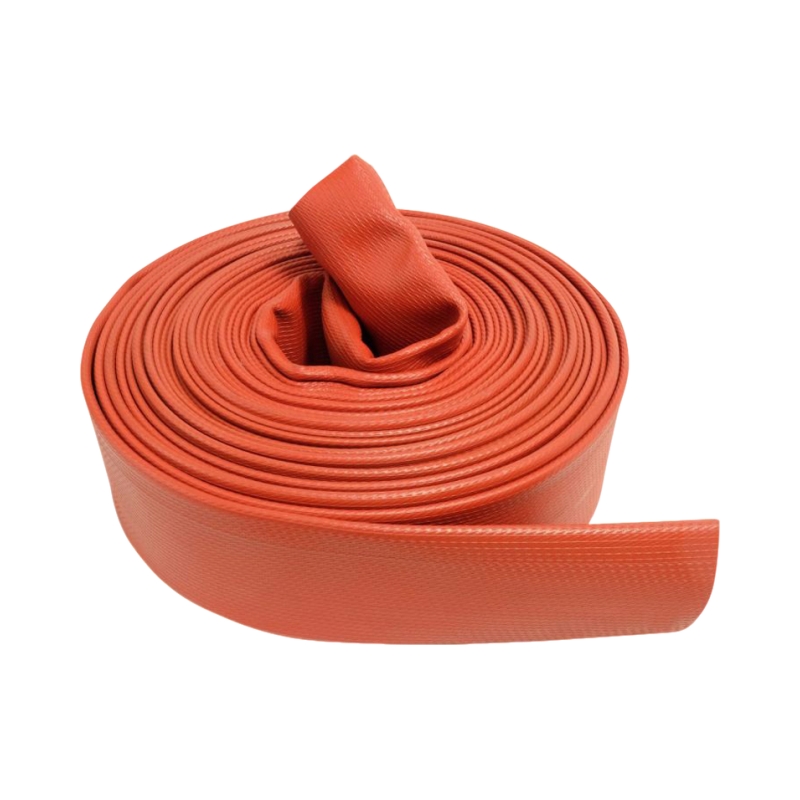
4-Layer Rubber-Covered Fire Hose for LDH Supply & Demanding Service
CA-FIRE rubber-covered fire hose uses a 4-layer through-the-weave construction: an inner nitrile rubber lining, a circumferentially woven high-tenacity polyester reinforcement, an inner bonding rubber layer, and an outer rubber cover formulated with Hypalon for UV, ozone and chemical resistance. The four layers are vulcanized into a unitized hose with 50 N adhesion strength — no glues, no adhesives, no delamination across a 10–20 year service life.
Manufactured in 1" to 12" internal diameter, with 4", 5" and 6" LDH (large diameter hose) being the most-requested sizes for municipal hydrant supply, relay pumping and industrial fire-protection installations. The hose is rated to 120–300 psi service pressure depending on diameter, and unlike woven-jacket hose, can be packed wet without rotting.
What Is Rubber-Covered Fire Hose?
A rubber-covered fire hose — also known as extruded fire hose, rubber lined fire hose, nitrile rubber fire hose, or Type 3 fire hose per the lay-flat hose classification — uses synthetic rubber for both the inside lining and the outside cover, completely encapsulating the polyester reinforcement jacket. This differs fundamentally from single-jacket or double-jacket woven-jacket hose, where the polyester filament is exposed on the outside surface of the hose.
The all-rubber exterior is the defining advantage. It eliminates abrasion failure modes that limit jacketed hose, resists UV, ozone, oil, fuel and most industrial chemicals, and allows the hose to be packed wet without mildew, rot or jacket damage. For LDH (large diameter hose) used in municipal supply at 4", 5" and 6" — where the hose stays deployed for hours, gets dragged repeatedly across pavement, and may sit on hot concrete in summer — rubber-covered construction is the industry standard.
CA-FIRE rubber-covered hose meets NFPA 1961 (the latest edition incorporates this hose type under the unified NFPA 1960 standard currently in approval). The construction passes the Taber abrasion test at 30,000+ cycles, holds 1,750 psi ultimate tensile strength and 500% minimum elongation, and resists ozone aging at 300 psi / 158 °F per the NFPA accelerated-aging test. It is built for the most demanding fire-service environments.
Full Specifications — Rubber-Covered Fire Hose
Service pressure ratings decrease with diameter — smaller sizes carry higher pressures for attack-side service, larger sizes are optimized for LDH supply-side use where flow volume matters more than pressure. Burst pressure is always 3× minimum service pressure per NFPA 1961.
| Nominal ID | ID (mm) | Service Pressure (psi / bar) | Test Pressure (psi / bar) | Burst Pressure (psi / bar) | Standard Length |
|---|---|---|---|---|---|
| 1" | 25 | 200 / 14, 220 / 15, 290 / 20 | 400 / 28 to 580 / 40 | 580–870 / 40–60 | 15 / 30 / 50 / 100 m |
| 1½" | 38 | 200 / 14, 220 / 15, 290 / 20 | 400 / 28 to 580 / 40 | 580–870 / 40–60 | 15 / 30 / 50 / 100 m |
| 1¾" | 45 | 200 / 14, 220 / 15, 290 / 20 | 400 / 28 to 580 / 40 | 580–870 / 40–60 | 15 / 30 / 50 / 100 m |
| 2" | 52 | 200 / 14, 220 / 15, 250 / 17, 300 / 21 | 400 / 28 to 600 / 42 | 600–900 / 42–63 | 15 / 30 / 50 / 100 m |
| 2½" | 65 | 200 / 14, 220 / 15, 250 / 17, 300 / 21 | 400 / 28 to 600 / 42 | 600–900 / 42–63 | 15 / 30 / 50 / 100 m |
| 3" | 75 | 150 / 10, 200 / 14, 220 / 15, 250 / 17 | 300 / 21 to 500 / 35 | 450–750 / 30–51 | 15 / 30 / 50 / 100 m |
| 4" | 102 | 150 / 10, 200 / 14, 220 / 15, 250 / 17 | 300 / 21 to 500 / 35 | 450–750 / 30–51 | 15 / 30 / 50 / 100 m |
| 5" | 127 | 120 / 8, 150 / 10, 200 / 14 | 240 / 17 to 400 / 28 | 360–600 / 24–42 | 15 / 30 / 100 m |
| 6" | 152 | 120 / 8, 150 / 10, 200 / 14 | 240 / 17 to 400 / 28 | 360–600 / 24–42 | 15 / 30 / 100 m |
| 8" | 204 | 120 / 8, 150 / 10 | 240 / 17 to 300 / 21 | 360–450 / 24–30 | 30 / 100 m |
| 10" | 254 | 120 / 8 | 240 / 17 | 360 / 24 | 30 / 100 m |
| 12" | 306 | 120 / 8 | 240 / 17 | 360 / 24 | 30 / 100 m |
Each hose is stamped with the actual service test pressure, manufacture date, length and serial number. Custom lengths up to 100 m available in single seamless extrusion.
4-Layer Through-the-Weave Construction
The through-the-weave manufacturing process is what makes rubber-covered hose different from a simple laminated rubber sleeve. The polyester reinforcement is woven first, then nitrile rubber is extruded directly through the weave — encapsulating every warp and weft yarn. This produces a unitized hose with no internal seams, no glue lines, and no adhesives that could fail with age, temperature cycling or chemical exposure.
Inner Tube
Smooth nitrile rubber lining — chemical-resistant, low friction loss, prevents waterway scaling. Ozone and oil-resistant. Service temperature −30 °C to +100 °C.
Reinforcement
High-tenacity polyester filament — and on LDH sizes, blended with nylon 6.6 — woven circumferentially. Carries the pressure load; polyester prevents snaking, nylon allows controlled dilation to reduce friction loss.
Bonding Layer
Inner nitrile rubber bonding layer extruded through the weave. Encapsulates the reinforcement, creates the 50 N adhesion bond, and protects the polyester from cover wear.
Outer Cover
Specially formulated rubber with Hypalon (chlorosulfonated polyethylene) for UV, ozone, heat, oil, fuel and chemical resistance. Ribbed surface increases abrasion resistance.
Why Choose Rubber-Covered Over Woven-Jacket Hose?
For specific applications — LDH supply, industrial fire protection, refinery service, harsh weather installations — rubber-covered hose has decisive advantages over woven-jacket constructions.
Packs Wet Without Damage
The all-rubber exterior is impervious to water absorption, mildew and rot. Pack the hose wet, store it on the apparatus, no need to dry before stowing. No more hanging hoses in towers.
Superior Abrasion Resistance
Hypalon-formulated rubber cover resists drag damage on pavement, steel grating, gravel and curb edges. Taber abrasion test exceeds 30,000 cycles — multiples of jacketed hose performance.
UV & Ozone Stable
Outdoor sun exposure, hot pavement and ozone aging degrade woven-polyester jackets. Hypalon-formulated cover is the same material used on military fuel tanks and roofing membranes — decades-long UV stability.
Chemical Resistant
Resists oil, fuel, hydraulic fluid, most acids and bases, and the de-icing salts encountered on roadways. Essential for refinery, port, airport and industrial fire-service applications.
Available in 4"–12"
The dominant choice for LDH supply lines. 5" LDH for hydrant-to-pumper service, 6" for industrial supply, up to 12" for the very largest municipal water-transfer applications.
Virtually Maintenance-Free
No annual jacket inspection for fraying or UV damage. No need to wash off salt water or chemicals to prevent rot. Just visual inspection and the annual NFPA 1962 service test.
Common Use Cases
5" LDH Hydrant-to-Pumper Supply
The dominant application worldwide. 5" rubber-covered LDH with Storz couplings on both ends, deployed from hydrant steamer port to pumper LDH inlet. Flows 1,250+ GPM at low friction loss.
4" LDH for Mid-Size Departments
4" rubber-covered LDH where 5" would be excessive for the typical fire ground. Lighter to handle, packs tighter on the apparatus, still delivers 800+ GPM.
6" – 12" Industrial Supply
Refineries, ports, chemical plants, power stations, ground-water remediation projects. Long lays of 6"–12" rubber-covered hose moving high water volumes to remote fire-monitor positions.
Relay Pumping Operations
Long-distance water transfer between yield hydrants and distant fire scenes, or pumper-to-pumper relay. Multiple 30 m sections of 4"–6" LDH, Storz-to-Storz, at low friction loss.
Industrial & Refinery Fire Protection
Built-in plant fire-protection systems where the hose must resist constant chemical and petroleum exposure. Nitrile rubber lining + Hypalon cover survive what jacketed hose cannot.
Soft Suction (Pony Length) Supply
Short 10"–20" sections of 4"–6" rubber-covered hose used to connect the hydrant directly to the pumper inlet. Flexible, won't collapse under hydrant pressure, fast to deploy.
Rubber-Covered vs Woven-Jacket — Which Construction Do You Need?
The most common question we get from fire chiefs evaluating LDH: should we buy rubber-covered or double-jacket supply hose? Here is a direct comparison.
Rubber-Covered
- Outer surface: Solid rubber with Hypalon
- Pack wet: Yes — no rot, no drying needed
- Abrasion resistance: Highest available
- Service pressure: 120–300 psi (size-dependent)
- Size range: 1" to 12" — including all LDH sizes
- Best for: LDH supply, industrial, refinery, marine, harsh-environment service
- Maintenance: Virtually none
Double-Jacket (Woven)
- Outer surface: Exposed polyester filament jacket
- Pack wet: No — must dry to prevent rot & mildew
- Abrasion resistance: High
- Service pressure: 250–400 psi
- Size range: 1¼" to 6"
- Best for: Brigade attack, master-stream, ARFF
- Maintenance: Annual jacket inspection & drying after every use
Color & OEM Branding
Rubber-covered hose is most commonly supplied in high-visibility colors per fire-service tradition — red and yellow are the most popular. Custom branding (department or company name, certification mark, in-service date and serial number) can be stamped along the hose length on the rubber cover.
Why Source Rubber-Covered Fire Hose from CA-FIRE
- True through-the-weave extrusion. Nitrile rubber is extruded directly through the polyester weave during vulcanization. No adhesives, no glue lines, no seams — a unitized hose that cannot delaminate.
- 50 N adhesion strength. Lining-to-cover adhesion exceeds the requirements of both NFPA 1961 and the FI-Firequip industry benchmark. The four layers behave as one material across the full 10–20 year service life.
- 30,000+ cycle Taber abrasion. The Hypalon-formulated outer cover passes the Taber H-22 wheel abrasion test at well above the 30,000-cycle benchmark — multiples of jacketed hose performance.
- 1" to 12" in stock. Full LDH size range plus smaller diameters for attack-side rubber service. One supplier for the entire supply-side schedule, including 8", 10" and 12" for industrial users.
- Pre-coupled to spec. Storz (the standard LDH coupling) in 4" and 5" per NFPA 1963, plus NH, NST, NPSH, BS 336, GOST and Machino. Forged or cast aluminum body, stainless steel hardware.
- Packs wet, packs tight. Available in seamless lengths up to 100 m for industrial users — fewer joints, less leak risk on critical supply lines.
- OEM branding. Stamp your department, company or distributor identification along the hose length. Custom colors available with reasonable MOQs.
- Export to 60+ countries. Full test certificates, mill certs, hydrostatic test reports, accelerated-aging test data and Taber abrasion data supplied with every shipment.
Related Fire Hose Products
Rubber-Covered Fire Hose FAQ
What is rubber-covered fire hose used for?
Rubber-covered fire hose is the standard construction for LDH (large diameter hose) supply lines — particularly 4", 5" and 6" — used to move large volumes of water from hydrants to pumper engines, and for relay pumping between distant water sources and fire scenes. It is also used for industrial fire-protection installations at refineries, ports, chemical plants and power stations, and for any application where the hose will be repeatedly dragged across pavement, exposed to UV and ozone, or contact with oil, fuel and chemicals.
The defining advantage is that rubber-covered hose can be packed wet without rot or mildew, eliminating the post-use drying requirement of woven-jacket hose.
What is the difference between rubber-covered and double-jacket fire hose?
Rubber-covered hose has a solid rubber outer cover (typically nitrile + Hypalon-formulated rubber) encapsulating the polyester reinforcement. The exterior is impervious to water, can be packed wet, resists UV, ozone, oil and fuels. Service pressure 120–300 psi depending on size. Available 1"–12". Virtually maintenance-free.
Double-jacket hose has exposed woven polyester filament on the outside, no rubber cover. Higher service pressure (250–400 psi) but must be dried after every use to prevent rot and mildew. Lighter and less expensive. Available 1¼"–6". Annual jacket inspection required.
For LDH supply, industrial and refinery service, rubber-covered is the right choice. For brigade attack lines where 400 psi is required, double-jacket is the right choice. See our Double-Jacket Fire Hose page for the woven-jacket product.
Is rubber-covered fire hose NFPA 1961 compliant?
Yes. CA-FIRE rubber-covered hose meets NFPA 1961 (Standard on Fire Hose) for both attack and supply hose constructions. The hose passes the required hydrostatic test (2× service pressure), alternating pressure test, kink test, burst test, and the accelerated-aging test (300 psi oxygen at 158 °F for 96 hours, retaining 60% original tensile and elongation). The recently approved NFPA 1960 unified standard incorporates rubber-covered hose as a recognized construction. Test certificates and mill data are supplied with every shipment.
What is the tensile strength of the rubber lining and cover?
CA-FIRE rubber-covered hose meets the industry benchmark of 1,750 psi minimum ultimate tensile strength for both the lining and cover, with a minimum 500% ultimate elongation. After accelerated-aging at 300 psi oxygen and 158 °F for 96 hours, the rubber retains at least 60% of its original tensile and elongation properties — the NFPA aging-resistance threshold.
Can rubber-covered hose be packed wet on the apparatus?
Yes — this is the single biggest operational advantage of rubber-covered hose over woven-jacket hose. The all-rubber exterior is impervious to water absorption and resists mildew and rot indefinitely. Many fire departments have eliminated their hose-drying towers entirely after switching their LDH from double-jacket to rubber-covered for this reason. Crews can simply rack the hose wet at the end of an incident and have it ready for the next call.
What coupling options are available?
For LDH sizes (4", 5" and 6"), Storz is the dominant choice — standardized by NFPA 1963 for 4" and 5". Forged aluminum is standard; cast or extruded aluminum and brass also available. Storz couplings with plastic tail pieces, sexless or self-locking versions can be supplied. For smaller diameters, we offer NH / NST, NPSH, BS 336 instantaneous, GOST, Machino and Guillemin threads. Couplings are pre-installed, gasketed and pressure-tested before shipment.
How long does rubber-covered fire hose last?
With proper care a quality rubber-covered fire hose lasts 10 to 20 years. NFPA 1962 requires annual service testing at the service test pressure printed on the hose, visual inspection after every use, and physical inspection at least annually. Unlike woven-jacket hose, rubber-covered hose does not need to be dried after use to prevent rot, but it should be visually inspected for cover damage (cuts, abrasion exposing the reinforcement) and retired when the reinforcement becomes visible through cover wear.
What size LDH is most popular — 4" or 5"?
5" LDH is now the dominant size in U.S. fire service for the steamer-port hydrant supply role. A 5" LDH flows roughly 2.5× the volume of 4" LDH at the same friction loss — about 1,250 GPM at 20 psi friction loss per 100 feet. NFPA 1963 standardizes both 4" and 5" Storz dimensions, and most new fire apparatus specify 5" Storz at the pump intake.
4" LDH remains common in smaller departments, areas with lower hydrant residual pressure, and where 5" would be too heavy or bulky for the typical fire-ground footprint. CA-FIRE supplies both.
How do I get a quote on rubber-covered fire hose?
Email sales@ca-fire.com or message WhatsApp at +86 181-5036-2095 with: hose ID (1" through 12"), service pressure required, length per section, total quantity, coupling type (Storz / NH / NST / etc.), coupling material (brass or aluminum), jacket color, and any certification required (NFPA 1961 / UL / FM / NSF / MSHA / CCS). We respond within one business day with pricing, lead time and freight options.