
Fire Hydrant Hose
Pre-coupled Storz, NH, NST & NPSH · 2½" to 6" · NFPA 1963 compliant · UL / FM listed
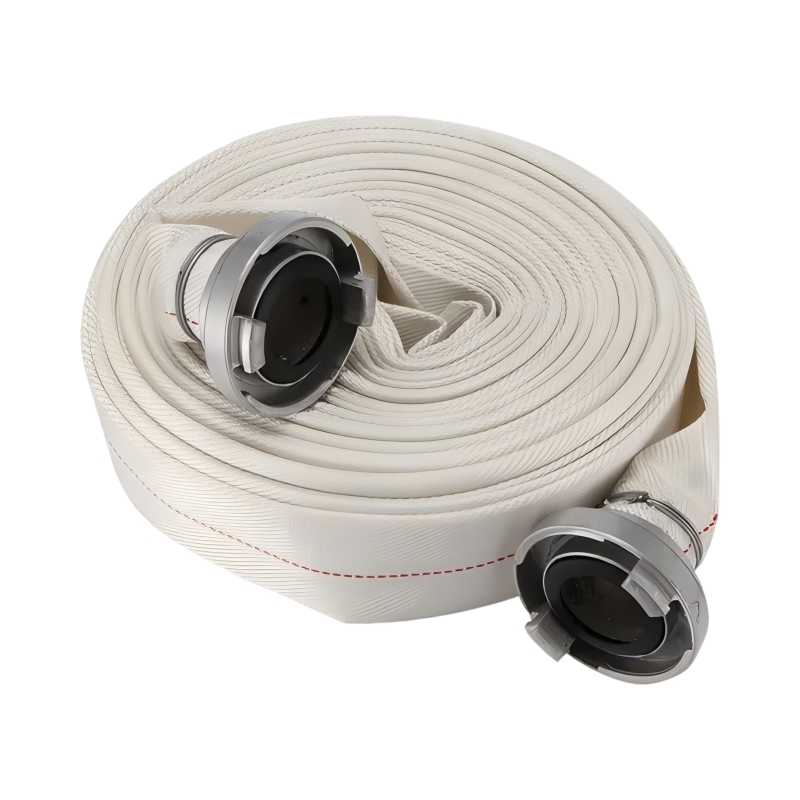
Heavy-Duty Fire Hydrant Hose — Pre-Coupled, Ready to Deploy
CA-FIRE fire hydrant hose is engineered for sustained pressurized water supply from municipal hydrants to fire engines and standpipe systems. Every hose ships fully pre-coupled with the thread of your choice — Storz quick-connect for LDH operations, NH / NST for traditional U.S. hydrant ports, NPSH for North American standpipes, or BS 336 instantaneous for UK and Commonwealth systems.
Available in 2½", 3", 4", 5" and 6" internal diameter. The most-requested size is 5" LDH (large diameter hose) for connecting a hydrant's 4½" steamer port to a pumper engine — flowing 1,250+ GPM at municipal water-main pressure.
What Is Fire Hydrant Hose?
A fire hydrant hose is the connecting hose used to draw pressurized water from a fire hydrant and deliver it to firefighting apparatus — most commonly a pumper engine, but also directly to standpipes, monitor nozzles, or aerial trucks. Unlike attack hose, which is used at the nozzle end of the line, hydrant hose works on the supply side: it moves large volumes of water at the hydrant's main pressure (typically 50–125 psi static, surging to 200+ psi during pumping).
This service profile demands a hose that combines three things: high burst rating to absorb pressure surges, an abrasion-resistant outer jacket to survive being dragged across pavement and curb edges, and pre-installed couplings that match the hydrant outlet. CA-FIRE produces hydrant hose in two construction grades — heavy-duty double-jacket for the bulk of the market, and 4-layer rubber-covered hose for LDH applications where the hose will remain deployed on rough ground for extended periods.
Outside the United States, "hydrant hose" is also called fire hydrant water hose, supply hose, hose for fire hydrant, or simply LDH when sized 4" or larger. We supply all configurations.
Full Specifications — Fire Hydrant Hose
Two construction grades cover every hydrant supply scenario. Double-jacket is the standard choice for 2½"–3" threaded supply lines; rubber-covered 4-layer hose is preferred for 4"–6" LDH where the hose stays deployed and is dragged across abrasive surfaces.
Double-Jacket Hydrant Hose
| Nominal ID | ID (mm) | Service Pressure (psi / bar) | Test Pressure (psi / bar) | Burst Pressure (psi / bar) | Standard Length |
|---|---|---|---|---|---|
| 2½" | 65 | 300 / 21 | 600 / 42 | 900 / 63 | 15 / 20 / 25 / 30 m |
| 3" | 75 | 300 / 21 | 600 / 42 | 900 / 63 | 15 / 20 / 25 / 30 m |
| 4" | 102 | 250 / 17 | 500 / 35 | 750 / 51 | 15 / 20 / 30 m |
| 5" | 127 | 250 / 17 | 500 / 35 | 750 / 51 | 15 / 20 / 30 m |
| 6" | 152 | 250 / 17 | 500 / 35 | 750 / 51 | 15 / 20 / 30 m |
Rubber-Covered LDH Hydrant Hose (4-Layer Construction)
| Nominal ID | ID (mm) | Service Pressure (psi / bar) | Test Pressure (psi / bar) | Burst Pressure (psi / bar) | Standard Length |
|---|---|---|---|---|---|
| 2½" | 65 | 200 / 14 | 400 / 28 | 600 / 42 | 15 / 30 / 100 m |
| 3" | 75 | 150 / 10 | 300 / 21 | 450 / 30 | 15 / 30 / 100 m |
| 4" | 102 | 150 / 10 | 300 / 21 | 450 / 30 | 15 / 30 / 100 m |
| 5" | 127 | 120 / 8 | 240 / 17 | 360 / 24 | 15 / 30 / 100 m |
| 6" | 152 | 120 / 8 | 240 / 17 | 360 / 24 | 15 / 30 / 100 m |
All specifications are typical values. Custom service pressure ratings up to 400 psi available on request — please confirm with CA-FIRE sales when placing an order.
Construction
The rubber-covered 4-layer construction is engineered for the demanding service profile of LDH hydrant supply — sustained pressurization, abrasion drag across pavement, UV exposure on long deployments, and resistance to chemicals encountered on industrial fire grounds.
Inner Tube
Smooth nitrile rubber lining — chemical-resistant, low friction loss, prevents waterway scaling over years of service.
Reinforcement
High-tenacity polyester filament woven circumferentially. Carries the pressure load with minimum stretch.
Bonding Layer
Inner nitrile rubber bond layer — protects the woven jacket and creates a true through-the-weave construction with 50 N adhesion.
Outer Cover
Specially formulated rubber with Hypalon for resistance to UV, ozone, oil, fuels and most industrial chemicals.
Coupling Options — Pre-Installed on Both Ends
Hydrant outlets use different threads in different countries — and even between fire departments within the same country. CA-FIRE pre-couples every hose with the thread you specify, machined to the correct standard and pressure-tested before shipment. Brass or aluminum bodies available.
Storz (NFPA 1963)
Sexless quarter-turn coupling. 4" and 5" sizes standardized by NFPA 1963. The preferred LDH connection for 4½" steamer-port hydrants.
NH / NST
National Hose / National Standard Thread — parallel-thread profile used on the majority of U.S. hydrant outlets. Standard 2½" and 4½".
NPSH
National Pipe Straight Hose — used on standpipes and some hydrant outlets. Available 1½" and 2½".
BS 336 Instantaneous
Push-and-twist instantaneous coupling. UK, Ireland, Australia, Singapore, Malaysia, Hong Kong. Sizes 1½", 2¼", 2¾".
Storz (DIN 14820)
European Storz sizing — 25/52/75/110/150 mm. Default coupling for most German, Dutch and Scandinavian fire services.
GOST
GOST-standard cam-lock hose half. Russia, Belarus, Kazakhstan and most CIS countries. Sizes 50, 65, 80, 90 mm.
Common Use Cases
Hydrant-to-Pumper Supply
5" LDH with Storz on both ends, deployed from a 4½" steamer port through a Storz adapter to a pumper's LDH inlet. The dominant U.S. configuration for residual-pressure supply.
2½" Direct Attack from Hydrant
2½" NH/NST hose taken directly off the hydrant's 2½" side outlet to feed a standpipe or a single high-flow handline — common for small commercial fires.
Standpipe Charging
2½" or 3" NPSH-threaded supply hose from FDC (fire department connection) to building standpipe systems. NFPA 14 service.
Industrial & Process Sites
4" or 6" Storz hose for industrial complexes — refineries, ports, chemical plants — where hydrant pressure must reach distant water-monitor positions.
Mutual-Aid & Relay Pumping
Long LDH lays of 30 m sections, Storz-to-Storz, for moving water from a yield hydrant to a distant fire scene at low friction loss.
Municipal Test & Flow Operations
Hydrant flow testing, system flushing, and water-main testing — hydrant hose with monitor nozzle or flow meter on the discharge end.
Why Source Fire Hydrant Hose from CA-FIRE
- Direct manufacturer. Hydrant hose is produced in our own facility using through-the-weave extrusion technology. No middleman — factory pricing direct to fire departments, integrators and distributors.
- Pre-coupled to your specification. We don't ship loose hose. Every order leaves the factory with couplings fitted, tightened to spec, gasketed, and pressure-tested at twice service pressure.
- Full coupling range stocked. Storz, NH, NST, NPSH, BS 336, GOST, Machino, Guillemin — pick the thread, we install it. Brass or aluminum body, sexless or self-locking on Storz.
- NFPA 1961 & 1963 compliant. Designs follow U.S. NFPA standards for attack hose construction and hydrant connection geometry. Equivalent EN 14540 documentation available for European markets.
- OEM branding. Print your department name, logo, certification mark and serial numbers along the hose length. Custom jacket colors and identification stripes available.
- Export experience to 60+ countries. Full submittal datasheets, mill certs, hydrostatic test reports and commercial documentation provided with every shipment.
Related Fire Hose Products
Fire Hydrant Hose FAQ
What size hose connects to a fire hydrant?
A standard U.S. fire hydrant has one large 4½" steamer port and two 2½" side outlets. The steamer port is typically connected to 4" or 5" LDH (large diameter hose) via a Storz adapter for pumper-engine supply. The 2½" side outlets accept 2½" NH/NST threaded hose for direct attack-line use. CA-FIRE supplies hydrant hose in all five common sizes — 2½", 3", 4", 5" and 6" — pre-coupled with your chosen thread.
Should I order Storz or threaded NH / NST hydrant hose?
This depends on which hydrants your hose will connect to:
Storz is the modern choice for 4" and 5" LDH. It connects in three seconds with a quarter-turn and requires no wrench. NFPA 1963 standardizes 4" and 5" Storz; the upcoming NFPA 1960 will add 6". Most new U.S. fire apparatus specify 5" Storz at the pump inlet. If the local hydrants still have NH/NST threaded steamer ports, a Storz-to-NH adapter is left fitted to the hydrant.
NH / NST is the traditional choice for 2½" supply lines and for any department whose hydrant network has not been converted to Storz. It is reliable and inexpensive but slower to connect under pressure.
Many departments order both: Storz for LDH supply, NH/NST for 2½" direct-attack lines.
What is the difference between hydrant hose and attack hose?
Hydrant hose is supply hose — it moves large volumes of water from the hydrant to the pumper engine, at the hydrant's main pressure (typically 50–125 psi residual). It is sized 2½"–6".
Attack hose is the handline used at the nozzle end of the fireground operation. It is sized 1½"–2½" and rated to 400 psi service pressure so firefighters can flow water with a fog or smooth-bore nozzle pattern.
The two work together: hydrant hose feeds the pumper, the pumper boosts pressure, attack hose delivers water to the fire. CA-FIRE manufactures both. See our Attack Fire Hose page for the matching attack-line product.
How much water can a 5-inch LDH hydrant hose flow?
A 5" LDH hydrant hose can flow approximately 1,250 GPM at 20 psi friction loss per 100 feet — and considerably more with adequate hydrant pressure. The exact flow depends on hydrant residual pressure, lay length, elevation and end-of-line back pressure. 5" LDH delivers roughly 2.5× the flow of 4" LDH at the same friction loss — which is why most U.S. departments have standardized on 5" for primary supply lines.
Is CA-FIRE hydrant hose NFPA 1963 compliant?
Yes. Our hydrant hose hose-body construction follows NFPA 1961 (Standard for Fire Hose), and our pre-installed couplings follow NFPA 1963 (Standard for Fire Hose Connections) — including the standardized 4" and 5" Storz dimensions. We also offer EN 14540 (European), BS 6391 (UK) and CCS (China) compliant variants. Test certificates and submittal datasheets are provided for every shipment.
What is the maximum length you can supply in a single hose?
Double-jacket hydrant hose is supplied in standard lengths of 15 m (50 ft), 20 m (66 ft), 25 m (82 ft) and 30 m (100 ft). Rubber-covered LDH hose can be produced in single lengths up to 100 m (330 ft) for industrial and mutual-aid relay applications, although 30 m is the most common length for fire-service use. Custom lengths can be cut to order — contact us with your requirement.
Can I order CA-FIRE hydrant hose with my own department branding?
Yes — OEM branding is standard. We can print your department or company name, logo, hose identification number, in-service date, and certification mark along the length of every hose. Custom jacket colors (red, yellow, white, orange, blue, green, tan, black) and color-coded identification stripes are available. Minimum order quantities apply for fully custom orders — please email sales@ca-fire.com with your specification.
How do I get a quote?
Email sales@ca-fire.com or message us on WhatsApp at +86 181-5036-2095 with the following details: hose ID size, length per section, total quantity, coupling type (Storz / NH / NST / NPSH / BS 336 / GOST / other), coupling material (brass or aluminum), lining preference (EPDM / TPU / Nitrile), and any required certification. We will respond with pricing, lead time and freight options within one business day.