
Marine Fire Hose
CCS / MED / SOLAS approved · 1½" – 3" · EPDM & TPR lined · For shipboard & offshore fire protection
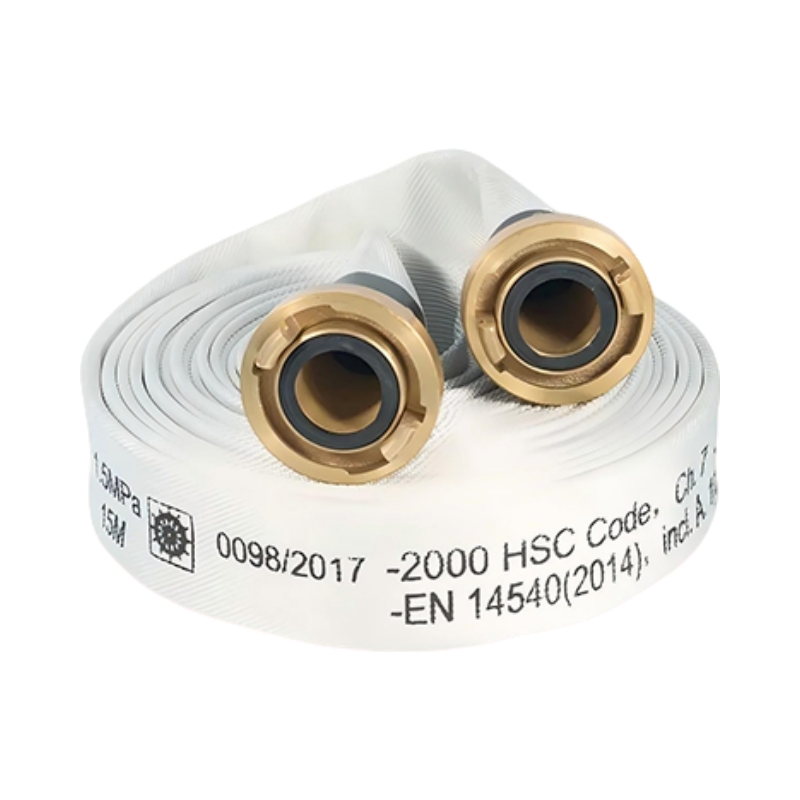
SOLAS-Compliant Marine Fire Hose for Shipboard & Offshore Service
CA-FIRE marine fire hose is engineered for the harsh realities of shipboard and offshore fire protection — constant saltwater exposure, UV and ozone aging on open decks, vibration, and the strict regulatory environment of international maritime classification societies. A 100% high-tenacity polyester single jacket bonded to a smooth EPDM rubber tube (or TPR variant) produces a hose that is ozone-stable, seawater-resistant, mildew-proof, and certified by CCS, MED and SOLAS for installation on every class of merchant vessel.
Available in 1½", 1¾", 2", 2½" and 3" — the regulatory-mandated sizes for shipboard fire-main outlets. Standard service pressure is 15 bar (220 psi) per SOLAS Chapter II-2 requirements, with 660 psi (45 bar) burst pressure. Pre-coupled with the threads specified by your flag state — Storz (most international), NH/NST (US-flagged vessels), GOST (Russian fleet), Machino (Japanese / SE Asian).
What Is Marine Fire Hose?
A marine fire hose — also called a shipboard fire hose, SOLAS fire hose, ship's fire hose, or marine hose — is a fire hose specifically constructed and certified for fire-fighting service aboard ships, offshore platforms and similar maritime applications. The hose differs from land-based fire hose in three regulatory and engineering ways: certification by marine classification societies (CCS, ABS, LR, BV, DNV-GL, RINA, NK, KR), compliance with SOLAS Chapter II-2 and the Marine Equipment Directive (MED), and material specifications engineered for sustained exposure to saltwater, ozone and UV.
Every flag-state vessel above a certain tonnage is required by international convention to maintain a fire-main system with hydrant outlets at regulated intervals along the ship's length. Each hydrant must have a fire hose, nozzle and spanner immediately available in a fire box or on a reel. The hoses must be non-perishable (which excludes most natural-rubber-lined cabinet hose), SOLAS-approved (which excludes uncertified industrial hose), and pre-fitted with the couplings specified by the ship's flag state.
CA-FIRE marine fire hose meets these requirements with two construction options. The premium EPDM-lined variant (Marineflo-D) uses ozone-resistant EPDM rubber for maximum service life in tropical and high-UV waters. The standard TPR-lined variant (Marineflo-P) uses thermoplastic rubber for lighter weight and faster water-up time. Both are CCS-approved and meet SOLAS Chapter II-2 service requirements.
Two Marine-Hose Variants — EPDM & TPR
The lining material is the single most important specification choice. Both variants are CCS-approved and meet SOLAS requirements — the choice between them depends on operating environment, service-life expectations and budget.
Marineflo-D · EPDM-Lined Marine Hose
Marineflo-P · TPR-Lined Marine Hose
Full Specifications — Marine Fire Hose
Both Marineflo-D (EPDM) and Marineflo-P (TPR) share the same dimensional specifications. The 15 bar service pressure rating meets SOLAS Chapter II-2 requirements for shipboard fire mains.
| Nominal ID | ID (mm) | Service Pressure (bar / psi) | Burst Pressure (bar / psi) | Standard Length |
|---|---|---|---|---|
| 1½" | 40 | 15 / 220 | 45 / 660 | 15 / 18 / 20 / 25 / 30 m |
| 1¾" | 45 | 15 / 220 | 45 / 660 | 15 / 18 / 20 / 25 / 30 m |
| 2" | 50 | 15 / 220 | 45 / 660 | 15 / 18 / 20 / 25 / 30 m |
| 2½" | 65 | 15 / 220 | 45 / 660 | 15 / 18 / 20 / 25 / 30 m |
| 2¾" | 70 | 15 / 220 | 45 / 660 | 15 / 18 / 20 / 25 / 30 m |
| 3" | 75 | 15 / 220 | 45 / 660 | 15 / 18 / 20 / 25 / 30 m |
Standard SOLAS hose length is 15 m, 18 m, 20 m, 25 m or 30 m — see FAQ below for SOLAS length limits per vessel size. Standard color is white; red, blue and yellow available. All hoses ship pre-coupled with the threads specified for your flag state.
Marine Certifications & Regulatory Compliance
Marine fire hose is one of the most regulated fire-protection products in the world. Every hose installed on a SOLAS-class vessel must carry approvals from the appropriate marine classification society and meet the construction requirements of the Marine Equipment Directive. CA-FIRE marine hose carries the certifications listed below.
CCS
China Classification Society — required for Chinese-flagged vessels and many Asian fleets.
MED
Marine Equipment Directive (Wheelmark) — the European Union maritime equipment standard.
SOLAS
Safety Of Life At Sea — the international convention governing all shipboard fire protection.
EN 14540
European standard for non-perishable fire hose — overlays well with marine requirements.
Additional Classification Society Approvals Available
On request, we can supply marine fire hose with type approval certificates from other major classification societies for vessels flagged in their respective jurisdictions:
- ABS — American Bureau of Shipping (US-flagged vessels)
- LR (Lloyd's Register) — UK-flagged and British Commonwealth vessels
- BV (Bureau Veritas) — French-flagged vessels and global certification
- DNV-GL — Scandinavian and German-flagged vessels
- RINA — Italian-flagged vessels
- NK (ClassNK) — Japanese-flagged vessels
- KR (Korean Register) — South Korean-flagged vessels
- RS — Russian Maritime Register of Shipping
Why Marine-Grade Hose, Not Standard Fire Hose
Standard land-based fire hose will physically work on a vessel — but it is not legal, not safe, and will not pass classification-society survey. Marine-grade construction differs from standard fire hose in five specific engineering ways.
Saltwater Resistance
EPDM tube and high-tenacity polyester jacket are intrinsically immune to seawater corrosion and hydrolysis. Standard rubber linings can swell or degrade under sustained saltwater exposure.
UV & Ozone Stable
Marine hose lives on open decks under direct equatorial sun and high atmospheric ozone. EPDM lining and polyester jacket are stable for the full service life — typically 10+ years.
Non-Perishable Materials
SOLAS Chapter II-2 requires shipboard fire hose to be made of non-perishable materials. Synthetic polyester + synthetic rubber linings meet this — flax canvas and natural-rubber hoses do not.
Classification Society Type Approval
Every CA-FIRE marine hose carries the type approval certificate of the appropriate classification society — your ship's safety officer can present this on survey.
Pre-Coupled to Flag-State Thread
Couplings match the thread specified by your flag state and ship's manufacturer — Storz, GOST, BS 336, Machino, NH/NST. No on-board coupling installation needed.
Low Friction Loss
Smooth EPDM bore minimizes friction loss along the long fire-main runs typical of cargo ships. Critical for delivering adequate nozzle pressure at the most remote hydrant outlet.
Common Marine Use Cases
Merchant Ship Fire Main
Cargo ships, tankers, container ships and bulk carriers. SOLAS-required fire hose at every hydrant outlet along the main deck and inside each fire box. 1½"–2½" with Storz or local-flag couplings.
Passenger Vessel & Cruise Ship
Higher density of hydrant outlets per SOLAS passenger-vessel requirements. White-colored EPDM hose is the conventional appearance for visible passenger-area installations.
Ferry & Coastal Vessel
Smaller domestic ferries and coastal vessels. TPR-lined Marineflo-P is the typical economical specification — lighter weight, faster water-up, sufficient ozone resistance for limited-range service.
Offshore Platform Fire Protection
Oil and gas platforms, FPSO units, drilling rigs. EPDM Marineflo-D for the demanding offshore environment — sustained UV, saltwater spray and tropical heat.
Port & Harbor Fire Service
Fire-protection hose at port terminals, container yards, ship-to-shore fueling positions. Marine-grade for compatibility with vessel-side firefighting in mixed land/sea environment.
Naval & Coast Guard Vessels
Custom specifications for naval and coast-guard vessels. Available with specific national-defense supply-chain documentation and country-of-origin certification on request.
Yacht & Superyacht
SOLAS-approved fire hose for commercial yachts and large private superyachts. Often supplied in coordinating colors (red, blue) to match the vessel's aesthetic interior fire-protection systems.
Marine Water Discharge
Deck wash-down, bilge transfer, and general marine water-discharge service. Marine-grade is the right choice over industrial mill hose because of the constant saltwater exposure.
Color Options
Standard color for marine fire hose is white (the SOLAS convention) or red (high-visibility marine variant). Yellow, blue and green are available for color-coded systems on offshore platforms and large passenger vessels.
Why Source Marine Fire Hose from CA-FIRE
- CCS, MED & SOLAS approved. Type approval certificates carried for the three core marine certification frameworks. Additional ABS, LR, BV, DNV-GL, RINA, NK, KR and RS certifications available on request.
- Two construction variants. Marineflo-D EPDM premium hose for ocean-going and offshore service; Marineflo-P TPR economy hose for inland and coastal vessels. Right hose, right price.
- Pre-coupled to flag-state spec. Storz (most international), NH/NST (US flag), BS 336 (UK / Commonwealth), Machino (Japan / SE Asia), GOST (Russian fleet), Guillemin (French flag). Brass or aluminum, installed and tested.
- SOLAS-standard 15 bar service. Working pressure 15 bar (220 psi) with 3× burst pressure margin per international convention. Custom higher pressures available on request.
- Multiple length options. 15, 18, 20, 25 and 30 m per SOLAS vessel-size requirements. Custom lengths available — we cut to your shipyard's specification.
- Full documentation package. Type approval certificate, test certificate, mill data and customs documentation supplied with every shipment. Ready for classification-society survey on vessel arrival.
- Direct manufacturer. Factory pricing from our own production facility — important for new-build shipyard contracts and large fleet replacements.
- Export to 60+ countries. Routine shipments to major shipbuilding hubs in China, Korea, Japan, Italy, Norway, Germany and Singapore.
Related Fire Hose Products
Marine Fire Hose FAQ
What is marine fire hose and how is it different from regular fire hose?
Marine fire hose is a fire hose specifically certified for installation aboard ships, offshore platforms and other maritime vessels covered by SOLAS Chapter II-2. It differs from regular land-based fire hose in three ways: (1) it carries type approval certificates from a marine classification society (CCS, ABS, LR, BV, etc.); (2) it is made of non-perishable materials — synthetic polyester jacket plus synthetic rubber lining — that resist saltwater, ozone and UV degradation; and (3) it is pre-coupled with the thread type specified by the ship's flag state.
Regular land-based fire hose (cabinet hose, attack hose) is not certified for shipboard installation and will not pass classification-society survey on a SOLAS-class vessel.
What is SOLAS and how does it affect marine fire hose?
SOLAS (International Convention for the Safety of Life at Sea) is the international maritime safety convention administered by the IMO. Chapter II-2 of SOLAS governs all fire-protection equipment aboard ships above a certain tonnage — including fire mains, fire pumps, fire hoses, hydrant outlets, nozzles and fire boxes.
SOLAS requires every fire hose aboard a SOLAS-class vessel to be: (1) made of non-perishable materials; (2) of a length compatible with the vessel's breadth; (3) supplied with a nozzle and necessary couplings; (4) stored in a clearly marked fire box or on a swing-out reel adjacent to its hydrant outlet.
CA-FIRE marine fire hose is type approved to meet all these requirements.
What is the difference between CCS, MED and SOLAS approval?
CCS (China Classification Society) — a national classification society. CCS type approval is required for Chinese-flagged vessels and recognized by many Asian fleets. CA-FIRE is based in China; CCS approval is our default certification.
MED (Marine Equipment Directive) — the European Union maritime equipment standard. MED-approved equipment carries the "Wheelmark" symbol and is accepted on EU-flagged vessels.
SOLAS — the underlying international convention. Both CCS and MED type approval demonstrate SOLAS compliance.
For vessels in other jurisdictions, we can supply marine hose with additional classification society approvals — ABS (US), LR (UK), BV (France), DNV-GL (Scandinavia / Germany), RINA (Italy), NK (Japan), KR (Korea), RS (Russia).
What length should I order? SOLAS length limits by vessel size?
SOLAS regulations limit marine fire hose length to ensure firefighters can reach any location aboard the vessel quickly. The general rule:
• Vessels with moulded breadth under 27 m: maximum hose length is 18 m for interior locations.
• Vessels with moulded breadth 27 m or more: hoses for exterior locations and cargo spaces may be up to 27 m.
• Many flag states also allow 15 m or 20 m hoses for specific application points.
CA-FIRE supplies marine fire hose in 15, 18, 20, 25 and 30 m standard lengths to cover the full SOLAS regulatory range.
Should I order EPDM or TPR marine hose?
EPDM (Marineflo-D) is the premium specification — best ozone, weather and aging resistance. The default choice for ocean-going merchant ships, offshore platforms and any vessel that will operate in tropical or high-UV waters. Service life typically 10+ years.
TPR (Marineflo-P) is the economy specification — lighter weight, faster water-up time, slightly lower cost. Adequate for inland ships, ferries, port vessels and other domestically-operating vessels with limited UV/ozone exposure.
For commercial deep-sea fleets, specify Marineflo-D. For inland or coastal service, Marineflo-P is the economical choice.
What coupling thread do I need for marine fire hose?
This depends on the ship's flag state and the shipbuilder's specification. The most common international marine thread is Storz. For US-flagged vessels, NH/NST threaded is the convention. UK-flagged and Commonwealth vessels typically use BS 336 instantaneous. Japanese and SE Asian vessels often use Machino. Russian fleet vessels use GOST. French-flagged vessels use Guillemin / DSP.
If you're unsure, consult your ship's as-built drawings or contact the shipbuilder. CA-FIRE can pre-couple with any of these threads. Brass is the conventional marine coupling material; aluminum is also available.
How long does marine fire hose last in shipboard service?
With proper care, a quality marine fire hose lasts 10–20 years aboard ship. EPDM-lined hose typically lasts longer than TPR-lined hose under sustained UV and tropical-heat exposure. Maintenance follows similar principles to land-based NFPA 1962: visual inspection during regular ship's rounds, annual hydrostatic test at the printed service test pressure, and retirement when the jacket shows abrasion damage exposing the reinforcement or the lining shows cracking or separation.
Classification-society survey will inspect all fire hoses periodically. Hoses that fail survey must be replaced before the vessel can sail.
Can I get classification society type approval certificates with my order?
Yes — this is standard with every marine fire hose shipment. Each order includes the type approval certificate from the relevant classification society (CCS / MED standard, or other societies on request), a test certificate showing the as-shipped service test pressure, mill data showing material composition, and customs documentation. These are exactly the documents your ship's safety officer needs for classification-society survey and flag-state inspection.
How do I get a quote on marine fire hose?
Email sales@ca-fire.com or message WhatsApp at +86 181-5036-2095 with: vessel flag state and class, hose ID (1½"–3"), variant (Marineflo-D EPDM or Marineflo-P TPR), length per section, total quantity, coupling thread, coupling material (brass or aluminum), jacket color, and which classification society certificates you need. We respond within one business day with pricing, lead time and freight options.