
Forestry & Wildland Fire Hose
Lightweight TPU-lined hose · 1" & 1½" · EN 694 certified · Type 1 / 2 / 3 + percolating
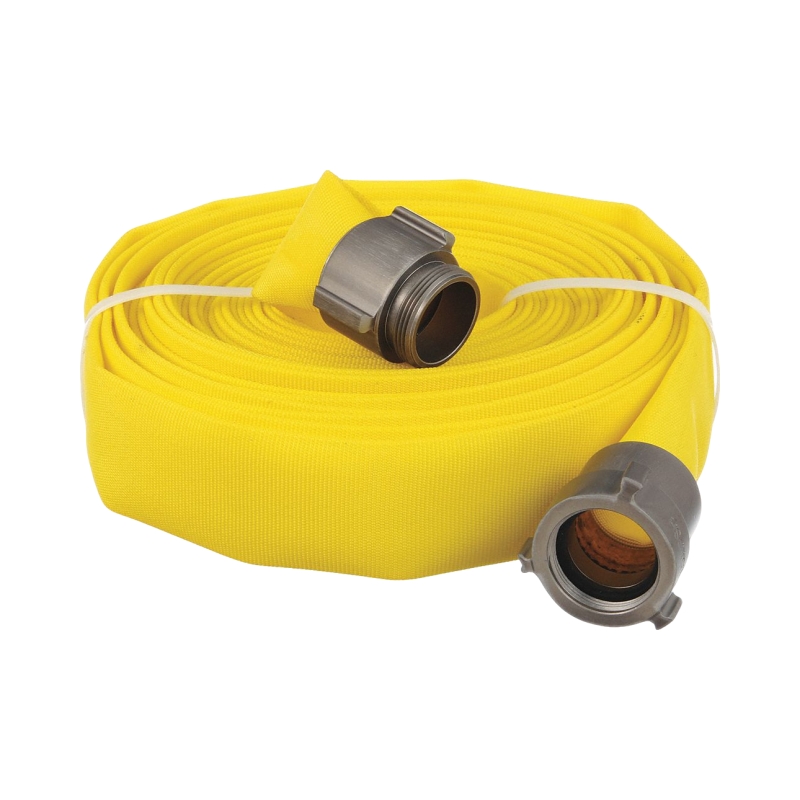
Lightweight Forestry & Wildland Fire Hose Built for the Backcountry
CA-FIRE forestry & wildland fire hose is engineered for the realities of fighting fire away from the road — long lays from a static water source, backpack deployment across rough terrain, helicopter drops, and operations in heat, dust and abrasion that destroy ordinary cabinet hose. A single jacket of 100% high-tenacity polyester filament wrapped around a smooth TPU (polyurethane) tube produces a hose that is ultralight, ultra-flexible, ozone-stable and EN 694 certified.
Available in 1" and 1½" as the workhorse wildland sizes, plus ½", ¾", 1¼" for booster, mop-up and small-diameter backup applications. Four product variants cover every operational role: standard Type 1 / Type 2 attack hose, semi-rigid backpack hose with helical reinforcement, self-protecting percolating (weeping) hose, and economy backup hose for grass and brush fires.
What Is Forestry & Wildland Fire Hose?
A forestry fire hose — also called a wildland fire hose, wildfire hose, brush hose or forest fire hose — is a lightweight, single-jacket fire hose specifically engineered for fighting fires in vegetation away from established hydrant systems. Compared to municipal cabinet or attack hose, forestry hose is designed around three priorities that don't matter on a structural fire ground: weight (firefighters pack 100+ feet up steep hillsides), flexibility (rapid deployment and repacking from a hose pack or self-laying bag), and UV / ozone aging resistance (the hose may sit in a sun-exposed engine bed for months between calls).
CA-FIRE forestry hose meets the major international wildland-hose standards: EN 694 (European wildland fire hose), USDA Forest Service Specification 5100-187 (the U.S. federal wildland hose specification), ULC (Canadian Underwriters Laboratories — required for helicopter-deployable hose) and BS 6391 (UK wildland classification). Every hose is supplied with a 100% TPU smooth-bore lining for the lowest friction loss available, and a tightly woven all-synthetic polyester jacket treated for abrasion resistance.
The USFS Type 1 / Type 2 / Type 3 classification system, established by Forest Service Spec 5100-187, is the U.S. industry shorthand. Type 1 is the most rugged general-purpose wildland hose; Type 2 is lighter for backpack operations; Type 3 is the lightest, for hose lays from helicopter or long backpack deployment. CA-FIRE produces hose in all three USFS Types plus a self-percolating variant for self-protection in the burn zone.
Four Forestry Hose Variants
Wildland firefighting is not a single use case — engine crews, hand crews, helitack, and backcountry incident-base crews all have different hose requirements. CA-FIRE offers four product variants on the forestry-hose platform.
Trailblazer 1871 / 1872
The standard wildland attack hose. Single-jacket polyester twill weave + smooth TPU tube. Yellow standard color. 1" and 1½" sizes.
- USFS Type: 1 / 2
- Standard: EN 694, BS 6391
- Service pressure: 300 psi
- Best for: Engine-crew attack, hand crew, general wildland
Reelite (Helical Reinforced)
Single-jacket TPU hose with internal nylon helical reinforcement — the hose maintains a round profile under vacuum, so it works as a booster line or low-pressure intake.
- USFS Type: 1 (semi-rigid)
- Standard: EN 694
- Service pressure: 300–600 psi
- Best for: Backpack hose, light air pressure hose, reel hose
Percolating (Weeping) Hose
TPU tube with weeping holes plus a wicking jacket — the hose intentionally seeps water through the jacket to keep itself wet and protect against burn-through in the flame zone.
- USFS Type: 1 percolating
- Standard: ULC approved
- Service pressure: 300 psi
- Best for: Lays through active burn zones, self-protection
Econo-Forestry
Single-jacket spun polyester + TPU tube. Backup hose for forestry workers, garden watering and small brush-fire response. Available in white and yellow.
- Sizes: ⅝" and ¾"
- Service pressure: 200 psi
- Burst pressure: 600 psi
- Best for: Backup line, small brush fire, garden / agricultural use
Lightweight Helitack Hose
The lightest hose we make. TPU lining + spun-polyester jacket optimized for helicopter deployment and remote crew operations. ULC approved.
- USFS Type: 3 (Type 5 in some classifications)
- Standard: ULC
- Weight: Lowest in the line
- Best for: Helicopter deployment, remote camps, where every pound matters
Mop-up & Supply Hose
Larger 1¼" and 1½" for engine-to-engine supply, mop-up operations and high-volume water transfer at the burn-out perimeter.
- Sizes: 1¼" and 1½"
- Standard: EN 694 / USFS 5100-187
- Service pressure: 300 psi
- Best for: Supply, mop-up, engine-to-engine relay
Full Specifications — Forestry & Wildland Fire Hose
The table below covers the standard Trailblazer (1871/1872), Reelite semi-rigid, percolating, and economy variants. All linings are smooth TPU bonded to the polyester jacket through the weave for zero delamination.
Standard Wildland Hose (Trailblazer 1871 / 1872) & Reelite Semi-Rigid
| Nominal ID | ID (mm) | Service Pressure (psi / bar) | Burst Pressure (psi / bar) | Variant | Standard Length |
|---|---|---|---|---|---|
| ½" | 13 | 300 / 21, 400 / 28, 600 / 42 | 900 / 63, 1,200 / 84, 1,800 / 126 | Reelite (semi-rigid) | 15 / 30 / 60 m |
| ¾" | 19 | 300 / 21, 400 / 28, 600 / 42 | 900 / 63, 1,200 / 84, 1,800 / 126 | Reelite (semi-rigid) | 15 / 30 / 60 m |
| 1" | 25 | 300 / 21, 400 / 28, 600 / 42 | 900 / 63, 1,200 / 84, 1,800 / 126 | Trailblazer / Reelite | 15 / 30 / 60 / 100 m |
| 1¼" | 33 | 300 / 21, 400 / 28, 600 / 42 | 900 / 63, 1,200 / 84, 1,800 / 126 | Trailblazer / Reelite | 15 / 30 / 100 m |
| 1½" | 40 | 300 / 21, 400 / 28 | 900 / 63, 1,200 / 84 | Trailblazer / Reelite | 15 / 30 / 100 m |
Percolating (Weeping) Wildland Hose
| Nominal ID | ID (mm) | Service Pressure (psi / bar) | Burst Pressure (psi / bar) | Standard Length |
|---|---|---|---|---|
| 1" | 25 | 300 / 21 | 900 / 63 | 15 / 30 m |
| 1½" | 38 | 300 / 21 | 900 / 63 | 15 / 30 m |
| 1¾" | 45 | 300 / 21 | 900 / 63 | 15 / 30 m |
Econo-Forestry Backup Hose
| Nominal ID | ID (mm) | Service Pressure (psi / bar) | Burst Pressure (psi / bar) | Standard Length |
|---|---|---|---|---|
| ⅝" | 16 | 200 / 14 | 600 / 42 | 15 / 30 m |
| ¾" | 19 | 200 / 14 | 600 / 42 | 15 / 30 m |
Hose is supplied with 1" NPSH or NH/NST forestry rocker-lug couplings as standard for U.S. orders; BS 336, Storz or Guillemin for export markets. Specify coupling type when ordering.
Why TPU Forestry Hose Beats Generic Single-Jacket Hose
The forestry-hose specification is fundamentally different from cabinet or attack hose. Every design choice is optimized for fire-line use.
Ultralight
Single-jacket TPU hose weighs roughly half of double-jacket EPDM cabinet hose of the same diameter. A 100 ft section of 1½" weighs under 15 lb empty — packable for backcountry crews.
Ozone & UV Stable
TPU is intrinsically ozone- and UV-resistant — critical for hose that sits in an open engine bed under direct sun for months between fires. Conventional rubber linings crack and harden under the same exposure.
Low Friction Loss
Smooth TPU bore = lowest friction loss available. Longer lays at lower pump pressure mean smaller portable pumps can deliver water further from the source — exactly what wildland operations need.
Wide Temperature Range
Operating range from −30 °C to +100 °C. Flexible in cold-weather wildland operations, stable in hot summer fire-ground conditions.
Easy to Pack & Repack
Flexible single-jacket construction works with self-laying hose bags, traditional cloverleaf packs, accordion folds and reels. Crews can repack quickly between deployments without specialized equipment.
Optional Self-Protecting Variant
The percolating (weeping) variant uses a wicking jacket and TPU tube with calibrated holes to keep itself wet — protecting the hose from burn-through when fire crosses the lay.
Common Use Cases
Engine Crew Wildland Attack
1" or 1½" preconnected lines off a Type 6 or Type 3 brush engine. NPSH or NH couplings, yellow color. The most common wildland-hose configuration in the U.S.
Hand Crew Progressive Hose Lay
100 ft sections of 1" or 1½" carried in hose packs, deployed progressively from the water source up the fire line. Forest Service crew standard.
Helitack Deployment
Lightest 1" TPU hose dropped by helicopter to remote crews. ULC approved for helicopter operations. Packed in self-laying bags for rapid deployment.
Mop-Up Operations
1¼" or 1½" supply line feeding multiple 1" mop-up branches. Used after the fire front has passed to extinguish residual smoldering material.
Wildland-Urban Interface (WUI)
Structure-protection lays around homes in the WUI zone. The percolating variant is preferred where the hose may be exposed to the active flame front.
Backcountry Cabin / Lodge Protection
Permanent hose lays installed around remote structures (forestry lookouts, mountain cabins, rural fire hydrant alternatives). Reelite semi-rigid version is ideal.
Color Options
Wildland hose is typically supplied in high-visibility colors. Yellow is the dominant convention for engine and hand-crew lines; white is used for percolating and helitack hose; red, orange, green, and black are available for color-coded systems (e.g. progressive hose lays with sized identification).
Why Source Forestry Hose from CA-FIRE
- EN 694, USFS 5100-187 & ULC certified. Hose construction meets the major international wildland-hose standards — European, U.S. Forest Service and Canadian Underwriters Laboratories.
- Six product variants in stock. Standard wildland hose, semi-rigid Reelite, percolating, helitack lightweight, mop-up supply and economy backup — one supplier for the full wildland-hose schedule.
- TPU smooth bore. Lowest friction loss available. Lower pump pressures, longer hose lays, smaller portable pumps — better wildland-firefighting economics.
- Pre-coupled with forestry-standard fittings. 1" NPSH rocker-lug for U.S. orders, BS 336 for UK / Australia, Storz / Guillemin for European markets, GOST for Russia. Forged or cast aluminum body for minimum weight.
- Helicopter-deployable variants. ULC-approved lightweight hose for remote crew and helitack operations — every pound matters when the hose is being airdropped to a hand crew.
- OEM branding. Print your agency or company identification along the hose. Custom jacket colors and identification stripes for progressive hose-lay systems.
- Direct manufacturer. Factory pricing from our own production facility. No middlemen, no markups, full traceability on every length.
Related Fire Hose Products
Forestry & Wildland Fire Hose FAQ
What is the difference between forestry hose and regular fire hose?
A forestry (or wildland) fire hose is fundamentally lighter, more flexible and more UV-stable than regular municipal fire hose. Regular cabinet hose is designed for use on a smooth surface inside a building — weight and flexibility don't matter much. Wildland hose is designed for use by crews who pack 100+ feet up steep hillsides and deploy progressively along a fire line — weight, flexibility and packability are everything.
Specific differences: single-jacket (vs double-jacket) for weight reduction; TPU lining (vs EPDM rubber) for ozone stability and low friction loss; high-tenacity polyester yarn treated for abrasion resistance; high-visibility yellow color (vs municipal white); 1" NPSH rocker-lug couplings (vs 2½" NH/NST); and certified to EN 694 / USFS 5100-187 (vs NFPA 1961 / UL).
What is the difference between USFS Type 1, Type 2 and Type 3 wildland hose?
USDA Forest Service Specification 5100-187 classifies wildland fire hose into types by weight and construction:
Type 1 — The most rugged general-purpose wildland hose. Tightly woven single-jacket with TPU lining, treated for abrasion. The default for engine-crew attack lines.
Type 2 — Lighter than Type 1, still single-jacket. For backpack hose and hand-crew progressive hose lays where weight matters more than abrasion resistance.
Type 3 — The lightest USFS classification. Designed for helicopter deployment and remote-crew use where every ounce counts. Often ULC-approved for helitack operations.
CA-FIRE supplies all three USFS Types. Specify Type 1, 2 or 3 when ordering, or describe the operational role and we will recommend the right construction.
What is percolating wildland fire hose?
Percolating fire hose (also called weeping hose or self-protecting hose) is designed to intentionally seep small amounts of water through the jacket while in use. The wet jacket protects the hose from burn-through if fire crosses the hose lay — critical when crews must run lines through active or just-extinguished burn zones.
CA-FIRE percolating hose uses TPU tube with calibrated weeping holes plus a high-wicking polyester jacket — water moves outward through the jacket at a controlled rate, keeping the hose wet without significant pressure loss. Service pressure is 300 psi, same as standard wildland hose. Available 1", 1½" and 1¾", in white or strobe-yellow.
Is CA-FIRE forestry hose USDA Forest Service compliant?
Yes. CA-FIRE forestry hose construction follows USDA Forest Service Specification 5100-187 (the federal wildland-hose spec). It also meets EN 694 (European wildland), BS 6391 Type 1 (UK), ULC (Canadian Underwriters Laboratories for helicopter operations), and the relevant NFPA 1961 attack-hose requirements. Test certificates and mill data are provided with every shipment.
Note: Direct procurement by U.S. federal agencies (USFS, BLM, NPS) typically requires the supplier to be on a federal contract vehicle. We supply through authorized U.S. distributors who carry those contracts.
What coupling fits forestry fire hose?
The U.S. wildland-hose standard is 1" NPSH (National Pipe Straight Hose) with rocker-lug couplings — a forged aluminum thread profile that resists damage when dragged. 1½" sizes typically use 1½" NH (National Hose) or NPSH. For helitack hose, lighter cast-aluminum versions are common.
For European markets we supply BS 336 instantaneous, Storz (Germany / Scandinavia), Guillemin (France) and Machino (Japan / SE Asia). For Russian / CIS markets, GOST. We pre-couple every hose with the thread you specify.
How long does forestry fire hose last?
With proper care a quality wildland hose lasts 8 to 15 years — typically shorter than municipal cabinet hose because of harsher service conditions (abrasion from rocks, branches, dragging across coarse ground; UV exposure on open engine beds). Inspection should follow NFPA 1962 principles: visual inspection after every use, annual service test at the printed service pressure, and retirement when the jacket shows abrasion exposing the lining or the lining bubbles or separates.
What size and length should I order for wildland operations?
For engine-crew attack lines: 1" × 100 ft is the U.S. standard preconnect length; 1½" × 100 ft for higher flow rate. NH or NPSH couplings.
For hand crew progressive hose lays: 1" × 100 ft, multiple sections carried in hose packs for progressive deployment up the line.
For helitack: 1" × 100 ft of the lightest Type 3 / helitack construction, packed in self-laying hose bags.
For mop-up and supply: 1¼" or 1½" × 100 ft, with 1" branches off a wye for mop-up operations.
How do I get a quote on forestry & wildland fire hose?
Email sales@ca-fire.com or message WhatsApp at +86 181-5036-2095 with: hose ID (1" or 1½"), variant (standard / semi-rigid / percolating / helitack / economy), USFS Type if known (1 / 2 / 3), service pressure required, length per section, total quantity, coupling type and material, jacket color, and any required certification (EN 694 / USFS 5100-187 / ULC / BS 6391). We respond within one business day with pricing, lead time and freight options.