
Double-Jacket Fire Hose
Municipal brigade attack & supply hose · 1¼"–6" · 400 psi service · Manufactured to NFPA 1961 / UL 19 / FM 2111 standards
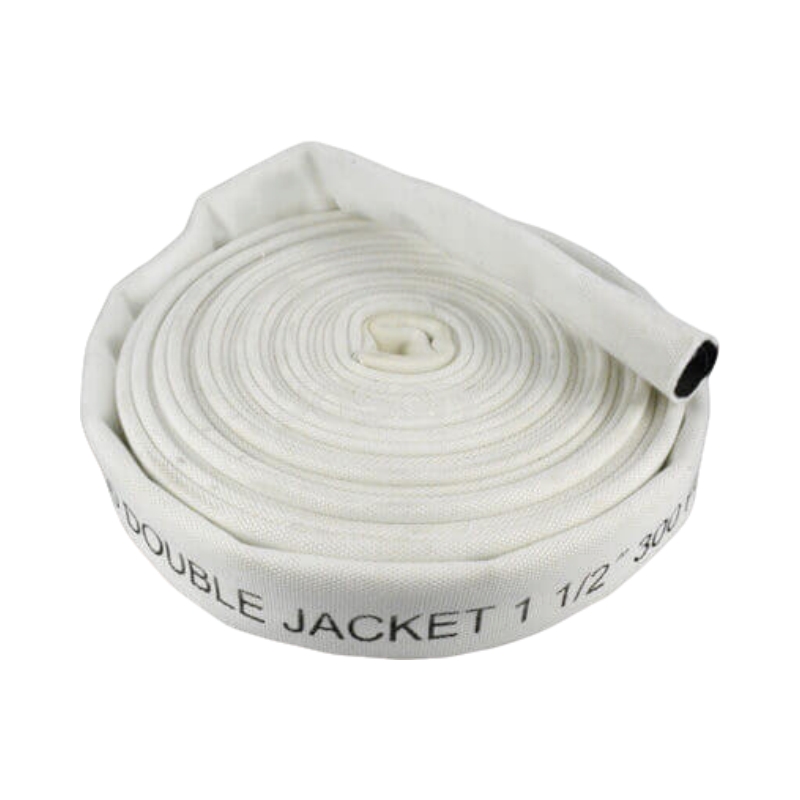
Heavy-Duty Double-Jacket Fire Hose — 400 PSI Brigade Service
CA-FIRE double-jacket fire hose is the workhorse of municipal fire service. Two layers of high-tenacity polyester filament jacket — one woven directly over the other — encapsulate a precision-extruded synthetic rubber or thermoplastic lining. The result is a hose rated to 400 psi service pressure, 800 psi proof pressure and 1,200 psi minimum burst, with substantially higher abrasion resistance than single-jacket hose. It is the recognized construction for NFPA 1961 attack hose, master-stream supply, industrial fire fighting, ARFF service and high-deployment hydrant supply.
Manufactured in all standard sizes from 1¼" to 6", with four lining material options (EPDM, TPU, Nitrile/TPR blend, SBR) and full coupling pre-installation. Construction, materials and testing follow UL 19 and FM 2111 requirements, and every hose is stamped with NFPA 1962 service test pressure and date — ready to enter your in-service hose log.
Note: CA-FIRE double-jacket hose is built to UL 19 and FM 2111 construction and performance standards. Third-party UL Listing and FM Approval are not yet issued for this product line — ask your CA-FIRE contact for current certification status or to discuss listing for your project.
What Is Double-Jacket Fire Hose?
A double-jacket fire hose — also called a double-wall fire hose, double-ply fire hose, or 2-ply jacket hose — has two woven polyester reinforcement jackets stacked over a single rubber or thermoplastic lining. The inner jacket reinforces the lining and shares pressure load; the outer jacket dramatically increases abrasion resistance and protects the hose from UV, heat, mechanical damage and contact with rough surfaces. The two jackets are bonded together through the weave with the lining, producing a single integrated construction that resists delamination.
This construction is the recognized industry standard for fire-brigade attack hose. NFPA 1961 requires attack hose to sustain at minimum 300 psi service pressure, but modern double-jacket hose typically exceeds this by a large margin — 400 psi service / 800 psi proof / 1,200 psi minimum burst is the most common factory specification. The extra jacket adds weight and cost compared with single-jacket hose, but pays for itself in service life: a quality double-jacket hose properly maintained will deliver 10–20 years of brigade service.
Beyond attack-line use, double-jacket construction is also used for 2½"–3" hydrant supply hose, ARFF (aircraft rescue fire fighting) handlines, master-stream appliance supply, industrial fire-protection installations, and any application where the hose will be repeatedly dragged across pavement, gravel, steel grating or other abrasive surfaces.
Full Specifications — Double-Jacket Fire Hose
Pressure ratings vary slightly with diameter. Sizes 1¼"–3" carry the highest 1,200 psi burst rating; sizes 4"–6" are rated to 900 psi minimum burst per NFPA 1961 large-diameter provisions. All sizes are available in 400 psi service rating; lower-pressure variants can be supplied where the application does not require the maximum rating.
| Nominal ID | ID (mm) | Service Pressure (psi / bar) | Proof / Test Pressure (psi / bar) | Burst Pressure (psi / bar) | Standard Length |
|---|---|---|---|---|---|
| 1¼" | 32 | 250 / 17, 300 / 21, 400 / 28 | 500 / 35 to 800 / 55 | 750 / 51, 900 / 63, 1,200 / 84 | 15 / 20 / 25 / 30 m |
| 1½" | 38 | 250 / 17, 300 / 21, 400 / 28 | 500 / 35 to 800 / 55 | 750 / 51, 900 / 63, 1,200 / 84 | 15 / 20 / 25 / 30 m |
| 1¾" | 45 | 250 / 17, 300 / 21, 400 / 28 | 500 / 35 to 800 / 55 | 750 / 51, 900 / 63, 1,200 / 84 | 15 / 20 / 25 / 30 m |
| 2" | 50 | 250 / 17, 300 / 21, 400 / 28 | 500 / 35 to 800 / 55 | 750 / 51, 900 / 63, 1,200 / 84 | 15 / 20 / 25 / 30 m |
| 2½" | 65 | 250 / 17, 300 / 21, 400 / 28 | 500 / 35 to 800 / 55 | 750 / 51, 900 / 63, 1,200 / 84 | 15 / 20 / 25 / 30 m |
| 2¾" | 70 | 250 / 17, 300 / 21, 400 / 28 | 500 / 35 to 800 / 55 | 750 / 51, 900 / 63, 1,200 / 84 | 15 / 20 / 25 / 30 m |
| 3" | 75 | 250 / 17, 300 / 21, 400 / 28 | 500 / 35 to 800 / 55 | 750 / 51, 900 / 63, 1,200 / 84 | 15 / 20 / 25 / 30 m |
| 4" | 102 | 250 / 17, 300 / 21, 400 / 28 | 500 / 35 to 800 / 55 | 750 / 51, 900 / 63 | 15 / 20 / 30 m |
| 5" | 127 | 250 / 17, 300 / 21, 400 / 28 | 500 / 35 to 800 / 55 | 750 / 51, 900 / 63 | 15 / 20 / 30 m |
| 6" | 152 | 250 / 17, 300 / 21, 400 / 28 | 500 / 35 to 800 / 55 | 750 / 51, 900 / 63 | 15 / 20 / 30 m |
Each hose is stamped with the actual service test pressure per NFPA 1962, manufacture date, length and unique serial number. Custom service pressures and lengths up to 100 m available — contact CA-FIRE sales.
Construction
Double-jacket fire hose uses a three-layer construction: an extruded synthetic lining is encapsulated between two woven polyester jackets. The two jackets are woven on circular looms with a tightly entangled filament filler yarn and ring-spun warp yarn for the optimum balance of tensile strength, flexibility, weight and abrasion resistance. The lining is bonded to the inner jacket through the weave during vulcanization — creating a true through-the-weave construction that resists delamination over a 10–20 year service life.
Inner Lining
Single-ply extruded synthetic tube — EPDM rubber, TPU, Nitrile/TPR or SBR. Smooth low-friction bore for maximum flow rate. Bonded to the inner jacket through the weave for true through-the-weave integration without delamination.
Inner Jacket
100% virgin high-tenacity polyester filament, woven on circular looms in twill or plain weave. Spun warp + filament filler yarns optimized for tensile strength, low elongation and bonding to the lining.
Outer Jacket
Second polyester jacket woven directly over the inner. Carries shared pressure load, dramatically increases abrasion resistance, and protects the hose from UV, heat, chemicals and physical damage on the fireground.
Testing & NFPA 1961 Compliance
Every CA-FIRE double-jacket fire hose is manufactured and tested to the requirements of UL 19 (Lined Fire Hose and Hose Assemblies) and FM 2111. Third-party UL Listing and FM Approval have not yet been issued for this product line, but the construction is verified in-house against the following tests required by NFPA 1961 before any hose ships:
Hydrostatic Test
Every length pressurized to twice the service test pressure with no leakage or coupling slippage.
Alternating Pressure
UL 19 cyclic pressure test simulating 10+ years of in-service pressure cycling without failure.
Kink Test
Hose kinked tightly and pressurized to 1.5× service pressure with no thread breakage in the reinforcement.
Burst Test
Sample sections burst-tested to confirm minimum burst pressure ≥3× service pressure (1,200 psi / 84 bar typical).
Single-Jacket vs Double-Jacket — Which One Do You Need?
The single most common question we receive from buyers is which jacket construction to specify. Here is a side-by-side comparison.
Single-Jacket
- Weight: ~30% lighter
- Cost: ~25–40% lower
- Service pressure: 150–300 psi
- Abrasion resistance: Moderate
- Best for: Cabinet hose, rack stations, occupant use, light industrial
- Standards: NFPA 14 occupant-use, UL 219, EN 14540
Double-Jacket
- Weight: Heavier — second jacket layer
- Cost: Higher
- Service pressure: 250–400 psi
- Abrasion resistance: High — survives drag on pavement, gravel and grating
- Best for: Brigade attack, supply, ARFF, master-stream, industrial fire fighting
- Standards: NFPA 1961 attack hose, UL 19, FM 2111
Lining Options — Four Materials
CA-FIRE double-jacket hose is offered with four lining materials. Each carries the full double-jacket reinforcement; choose the material based on operating environment, expected service life, and any specific chemical or temperature exposure.
EPDM Rubber
The default municipal-brigade choice. Excellent ozone, weather and hot-water resistance. Reliable in repeated 400 psi service. Good cold flexibility down to −30 °C. Service life 10–20 years.
TPU (Polyurethane)
30% lighter than EPDM for the same ID. Highest abrasion resistance. Smooth bore for very low friction loss. Preferred when departments need long lays or high-deployment operations.
Nitrile / TPR Blend
Best for industrial, refinery, airport and marine fire protection. Resists petroleum products, fuels and most industrial chemicals that destroy EPDM. MSHA approved.
SBR / Latex Rubber
Lower-cost lining for economy double-jacket service. Suitable for industrial wash-down, basic mill hose, and brigade installations where 400 psi is not required. MSHA approved variants available.
Common Use Cases
Municipal Brigade Attack
1¾" or 2" pre-connected on pumper engines as the primary attack line. Standard NH/NST couplings, EPDM lined for general service. The single largest application of double-jacket hose worldwide.
2½" Supply & Big-Line Attack
2½" double-jacket for high-flow handline operations, standpipe pack hose, and for supply lines between hydrants and pumpers at modest distances.
Master-Stream & Appliance Supply
2½", 3" or 4" double-jacket feeding deck guns, ladder pipes and portable monitor nozzles. Withstands the high working pressure required to deliver master-stream flow rates.
Industrial Fire-Protection Installations
Refinery, chemical plant, port facility and power plant fire hose stations where 400 psi service pressure and oil/fuel resistance are mandatory. Specify Nitrile/TPR lining.
ARFF — Aircraft Rescue Fire Fighting
Airport fire-service handlines, 1¾" or 2" with Nitrile/TPR lining for fuel resistance. Compatible with foam-eductor systems and aqueous film-forming foam (AFFF/AR-AFFF).
Hydrant-to-Pumper Supply (Smaller LDH)
2½" or 3" double-jacket as a supply line between hydrant and pumper engine in service areas where 4"–5" LDH is not practical. See our Hydrant Hose page for the dedicated supply-side product.
Color & OEM Branding
Standard color is white (the long-running North American brigade-hose convention), but eight jacket colors are available without surcharge. Custom color combinations, color-coded reflective stripes, department branding and full hose-length printing (name, logo, certification mark, in-service date, serial number) are available with reasonable MOQs.
Why Source Double-Jacket Hose from CA-FIRE
- Manufactured to UL 19 and FM 2111 standards. Full in-house test program — hydrostatic, alternating pressure, kink and burst tests required by NFPA 1961. Third-party UL/FM listing is not yet in place for this line; ask us about certification timelines for your project.
- Four lining materials in stock. EPDM, TPU, Nitrile/TPR blend and SBR — match the lining to the operating environment instead of accepting compromises.
- True 400 psi service hose. Every brigade-grade hose is rated for the full 400 psi service pressure with 1,200 psi minimum burst (sizes up to 3") — not 300 psi sold as "fire service."
- Pre-coupled to spec. Storz, NH, NST, NPSH, BS 336, Machino, GOST, Guillemin or Camlock — brass or aluminum, installed and pressure-tested before shipment.
- NFPA 1962 ready. Each hose printed with service test pressure, manufacture date, length and unique serial number. Drop straight into your in-service hose log.
- OEM-friendly. Print your department, brand or distributor identification along the hose. Custom jacket colors, stripes and certification marks available at reasonable MOQs.
- Direct manufacturer. Produced in our own facility using through-the-weave extrusion. Factory pricing, no middlemen, no markups.
- Export experience to 60+ countries. Full test certificates, mill certs, hydrostatic test reports and customs documentation supplied with every shipment.
Related Fire Hose Products
Double-Jacket Fire Hose FAQ
What is double-jacket fire hose used for?
Double-jacket fire hose is the recognized industry standard for municipal fire-brigade attack and supply lines, industrial fire fighting, ARFF (aircraft rescue fire fighting), master-stream appliance supply and any application that demands 400 psi service pressure with high abrasion resistance. The second polyester jacket — woven directly over the first — gives the hose substantially more resistance to drag damage on pavement, gravel and steel grating than single-jacket hose.
The most common configurations are 1¾" × 50 ft for preconnected attack lines, 2½" × 50 or 100 ft for big-line attack and supply, and 3" × 100 ft for master-stream and supply work.
What is the service pressure of double-jacket fire hose?
CA-FIRE double-jacket fire hose carries a standard 400 psi service pressure rating, 800 psi proof / hydrostatic test pressure, and 1,200 psi minimum burst pressure for sizes 1¼" through 3". Larger 4", 5" and 6" sizes are rated to 900 psi minimum burst per NFPA 1961 large-diameter provisions. Lower service pressure variants (250 or 300 psi) are also available where the application does not require the maximum 400 psi rating.
Each hose is stamped with its actual service test pressure per NFPA 1962, so the in-service hose log entry matches the hose marking exactly.
What is the difference between single-jacket and double-jacket fire hose?
Single-jacket hose has one woven polyester jacket bonded to the lining — lighter (~30% less weight), lower cost, service pressure 150–300 psi. Standard for cabinet, rack, standpipe occupant-use and light industrial applications.
Double-jacket hose adds a second polyester jacket woven over the first — substantially heavier abrasion resistance and higher service pressure (250–400 psi). The standard for fire-brigade attack hose and any application where the hose will be dragged across rough surfaces.
For brigade attack lines, supply hose, ARFF and industrial use, double-jacket is the correct specification. For cabinet, rack and occupant-use, single-jacket is the appropriate and more economical choice.
Is CA-FIRE double-jacket hose UL listed and NFPA 1961 compliant?
CA-FIRE double-jacket fire hose construction follows NFPA 1961 (Standard on Fire Hose) and is manufactured and tested to the requirements of UL 19 (Lined Fire Hose and Hose Assemblies) and FM 2111. Third-party UL Listing and FM Approval have not yet been issued for this product line — the hose is built to those standards, but does not currently carry the UL or FM mark. Each hose is tested in-house for hydrostatic strength, alternating pressure cycling, kink resistance and burst pressure before shipment, and factory test certificates and submittal datasheets are provided with every order. Contact us for the current status of UL/FM listing or to discuss certification for a specific project.
We also produce double-jacket hose manufactured to EN 14540 (European), BS 6391 Type 3 (UK), DIN 14811 (Germany), MSHA (mining), and CCS (China) specifications for export markets — confirm current certification status for any standard before specifying.
What lining material should I choose for double-jacket hose?
For general municipal and brigade service, EPDM is the default — best all-round ozone, weather and aging resistance. For high-deployment operations or wildland-urban interface use where weight matters, TPU is the lightest option and has the highest abrasion resistance. For industrial, refinery, airport and marine fire protection, choose Nitrile/TPR for petroleum and fuel resistance. SBR is the economy lining for industrial wash-down, mill hose and economy brigade applications where 400 psi performance is not required.
How often does double-jacket attack hose need to be tested?
NFPA 1962 requires annual service testing of attack hose to the service test pressure printed on the hose (typically 400 psi for our brigade-grade double-jacket hose). NFPA 1962 also requires a visual inspection after every use and a more thorough physical inspection at least annually. CA-FIRE double-jacket hose is stamped with the service test pressure, manufacture date, length and unique serial number — ready to enter your in-service hose log.
How long does double-jacket fire hose last?
With proper care — annual testing, cleaning after every use, dry storage, no kinking in storage racks — a quality double-jacket attack hose lasts 10 to 20 years. NFPA 1962 does not mandate a retirement age but does require retirement when the hose fails any annual service test, when the jacket shows abrasion damage exposing reinforcement, or when the lining bubbles or separates from the jacket. Hoses manufactured before July 1987 to pre-1979 NFPA 1961 standards must be removed from service.
Can double-jacket hose be ordered pre-coupled with my department's thread type?
Yes — every CA-FIRE double-jacket hose ships pre-coupled with the thread you specify. Options include NH / NST (USA national), NPSH (USA pipe straight), Storz (Europe and U.S. LDH), BS 336 instantaneous (UK / Commonwealth), GOST (Russia / CIS), Machino (Japan / Asia), Guillemin (France) and Camlock (industrial). Brass or aluminum body. Couplings are installed, gasketed and pressure-tested at twice service pressure before shipment.
How do I get a quote on double-jacket fire hose?
Email sales@ca-fire.com or message WhatsApp at +86 181-5036-2095 with: hose ID (1¼", 1½", 1¾", 2", 2½", 3", 4", 5" or 6"), service pressure required (250 / 300 / 400 psi), lining material (EPDM / TPU / NBR-TPR / SBR), length per section, total quantity, coupling type and material, jacket color, and any certification required (UL / FM / EN / NFPA / MSHA / CCS). We respond within one business day with pricing, lead time and freight options.