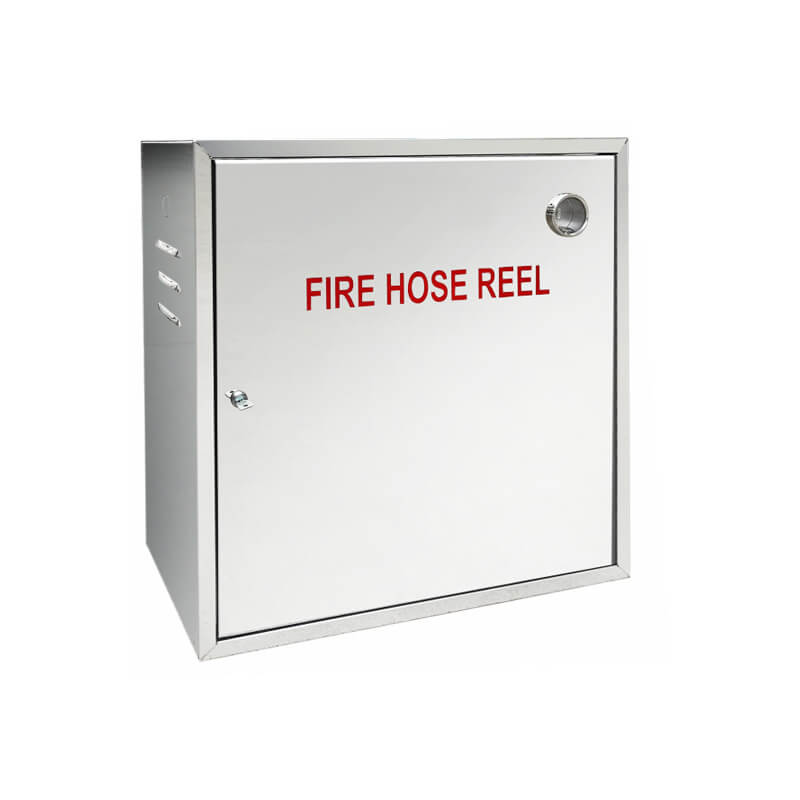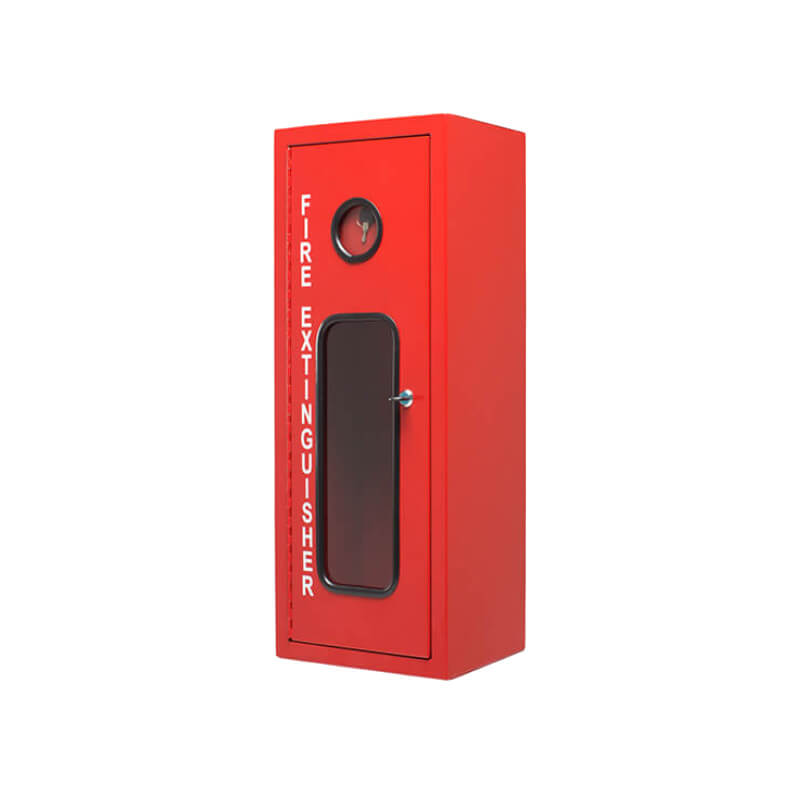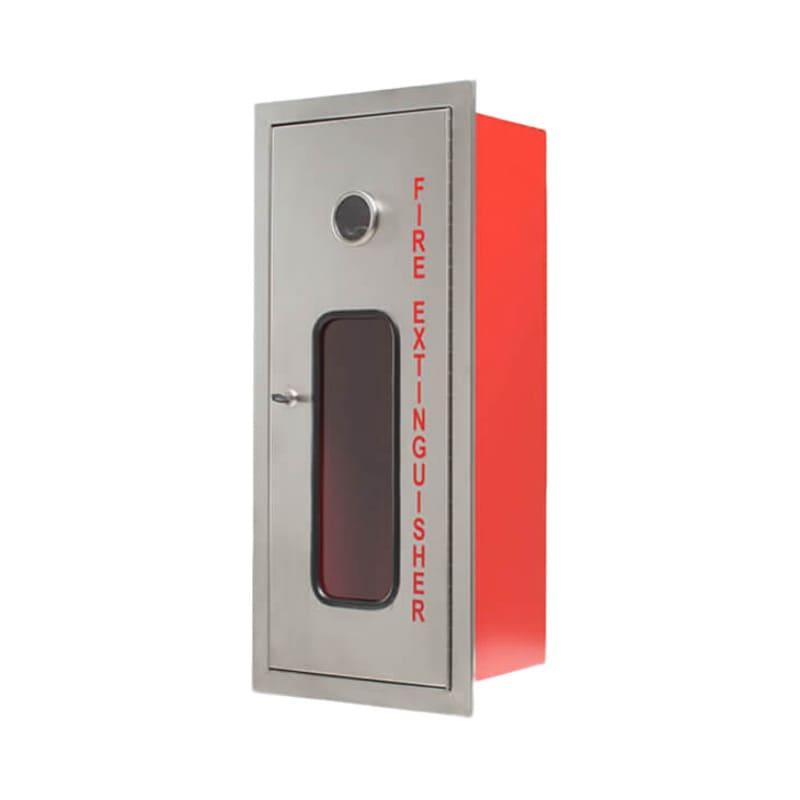
Stainless Steel Fire Extinguisher Cabinet
304 / 316 stainless · Wash-down grade · For food, pharma, marine & chemical environments
Wash-Down Grade Stainless Steel Fire Extinguisher Cabinet for Food, Pharma & Marine Sites
The CA-FIRE XMDDG stainless steel extinguisher cabinet exists for a narrow but critical category of environments — the places where even a weatherproof outdoor painted cabinet is not enough. Food processing plants with daily caustic wash-down. Pharmaceutical GMP zones where any flake of paint is a contamination event. Marine decks and offshore platforms where salt spray dissolves powder coat from the inside out. Chemical plants where acid vapour attacks painted steel. These are environments where the material itself has to be corrosion-proof, not just coated.
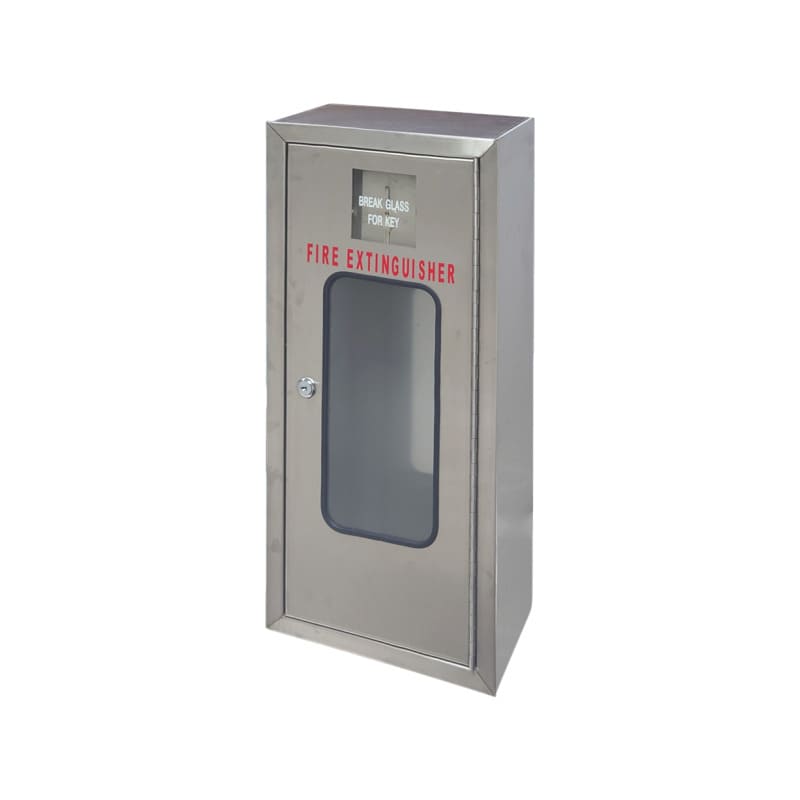
This cabinet is fabricated from 304 or 316 grade stainless steel — the same material used in commercial kitchens, pharmaceutical clean rooms and chemical process equipment. Brushed #4 finish as standard (also called satin finish); mirror-polished or bead-blasted available on request. Welded corners are seam-ground smooth so there are no crevices for bacteria or residue to accumulate. Internal hardware is stainless or galvanised so there is no rust bleed even after years of wash-down duty. The cabinet is a straight equivalent to our painted indoor and outdoor extinguisher cabinets — same layout, same sizes, same fittings — but built from a material that the environment cannot destroy.
If your environment is a standard indoor corridor, the painted recessed extinguisher cabinet is the right choice at a much lower cost. If it is an ordinary outdoor location — gas station, parking deck, construction site — the weatherproof outdoor variant is the right answer. Stainless steel is reserved for the environments where paint fails. The decision matrix further down this page helps pick which product fits your site.
Built for Regulated Environments
Stainless steel is the default fire-safety material in four regulated industries. Each has a specific compliance framework that rules out painted cabinets — not as a matter of preference, but as a matter of audit failure.
Key Features & Benefits
Six engineering choices that distinguish a genuine wash-down-grade stainless cabinet from a painted cabinet with a stainless door panel.
304 or 316? Pick by Chemistry, Not Price
Both 304 and 316 stainless are food-grade and fire-rated. The difference is corrosion resistance in specific chemical environments — choose by what your environment contains, not by price. Getting this wrong means rust in 2 years instead of 20.
Grade 304 Stainless
The industry baseline. 18% chromium, 8% nickel. Resists rust in indoor wash-down, food processing, pharmaceutical manufacturing and non-marine outdoor use. Most projects use 304 and are happy with it.
- Food processing (meat, dairy, bakery)
- Pharmaceutical manufacturing zones
- Commercial kitchens and breweries
- Clean rooms and lab facilities
- Inland industrial wash-down areas
Grade 316 Stainless
Adds 2–3% molybdenum to the 304 recipe, which dramatically improves resistance to chloride pitting — the specific failure mode caused by salt, bleach and certain acids. Specify 316 anywhere salt or strong sanitiser is present.
- Marine decks and offshore platforms
- Coastal sites with salt spray exposure
- Seafood processing (salt + chlorinated wash)
- Swimming pools and aquatic centres
- Chemical and petrochemical plants
Rule of thumb: If the site has salt, chlorine, bromine, or strong acids — specify 316. For everything else, 304 is the right answer and will outlast the building. Same rule applies to our stainless fire hose cabinet where we explain the grade selection in more depth for larger stations.
Technical Specifications
XMDDG stainless extinguisher cabinet model numbers and dimensions. Sizes match the painted XMDDG range so an existing site can swap in stainless versions at specific critical locations without changing the rest of the fleet.
| Model | Dimensions (mm) | Extinguisher Capacity | Grade Options | Typical Use |
|---|---|---|---|---|
| XMDDG22-SS | 680 × 240 × 180 | 4.5 kg / 10 lb ABC | 304 or 316 | Food plants, pharma corridors, lab zones |
| XMDDG32-SS | 800 × 280 × 200 | 9 kg / 20 lb ABC | 304 or 316 | Process plants, breweries, marine decks |
| XMDDG42-SS | 800 × 300 × 220 | 9 kg / 20 lb + accessories | 304 or 316 | Offshore platforms, heavy chemical zones |
Material & Construction
| Body Material | 1.0–1.2 mm 304 stainless (standard) or 316 stainless (marine / chemical upgrade) |
| Finish | #4 brushed (standard); mirror polish, bead blast, electropolish on request |
| Door | Solid stainless / tempered glass insert / clear acrylic break-front |
| Welds | Seam-ground smooth at all exterior corners — HACCP / GMP audit compliant |
| Hinge | 304 / 316 stainless piano hinge or concealed pivot |
| Fasteners | All fasteners stainless — no mild steel anywhere on the cabinet |
| Signage | Laser-etched directly into stainless; ISO 7010 / NFPA 170 pictogram |
| Lock Options | No lock / stainless roller latch / key cylinder / break-glass front |
| Wash-Down Rating | Suitable for daily food-grade wash-down, high-pressure rinse, steam cleaning |
| Certifications Reference | NFPA 10, GB 4351; HACCP / GMP / FDA surface compatibility |
Stainless vs Painted Outdoor — Which Do I Actually Need?
Stainless steel is 2–3× the cost of painted outdoor. In most projects that premium is not justified — a UV-stable painted outdoor cabinet will last the life of the facility. But in four specific environments, stainless is the only material that will not fail, and the painted version becomes a liability. Use this decision matrix to pick the right product for each cabinet location on your site.
Typical Applications
The eight industries that specify stainless steel as their default fire-cabinet material. These are not preference choices — in each of these, painted cabinets fail audits or fail structurally within the first year of service.
Frequently Asked Questions
Do I need 304 or 316 stainless steel for my project?
The simple decision rule is: if your environment contains salt, chlorine, bromine or strong acids, specify 316; for everything else, 304 is the right answer and will outlast the building. Specifically, choose 316 for marine decks, offshore platforms, coastal sites, seafood processing (salt plus chlorinated wash), swimming pool plant rooms, and chemical or petrochemical process zones. Choose 304 for food processing plants (meat, dairy, bakery), pharmaceutical GMP corridors, commercial kitchens, breweries and wineries, clean rooms, and general wash-down areas without chloride exposure. The difference between 304 and 316 is roughly 20–30% in unit cost, and the performance difference only shows up in chloride environments — so specifying 316 for a dairy plant is wasted money, and specifying 304 for a marine deck will rust within 2 years.
Why not just use a painted outdoor cabinet for a food plant?
Two reasons, both serious. First, HACCP audit compliance: any flake of paint that comes off the cabinet is a physical contamination hazard in food production, and cleaning crews doing daily caustic wash-down will accelerate paint degradation regardless of coating quality. A painted cabinet that passes an audit this year will fail it next year. Second, chemical attack: food-grade sanitisers (quaternary ammonium, chlorinated alkaline cleaners, peracetic acid) attack polyester powder coat at the molecular level. The cabinet starts chalking within months, bleeds rust from every weld seam within a year, and becomes an audit finding. Stainless is not an upgrade in food plants — it is the baseline material. Painted cabinets exist only because stainless was historically expensive.
What does "seam-ground welds" mean and why does it matter?
When stainless sheets are welded at corners, the weld bead is initially raised and rough. Seam-grinding means that bead is ground flush and polished to the same surface finish as the adjacent sheet, eliminating crevices where bacteria, cleaning residue, condensation or particulates could collect. In HACCP and GMP audits, inspectors specifically check corner welds on stainless equipment — a raised or porous weld is an audit finding because it is a potential contamination point. Our XMDDG-SS cabinets are seam-ground as standard on all exterior corners for exactly this reason. Interior welds (where the extinguisher sits) are also seam-ground on request for higher-grade clean-room applications.
Can I get a glass door on the stainless cabinet?
Yes. Three door options are available on any XMDDG-SS model: solid stainless (default for wash-down environments), tempered safety glass insert (for visual inspection in less aggressive environments), and clear acrylic break-front (for emergency access without keys). In food and pharma wash-down environments we usually recommend solid stainless because glass gaskets and sealing compounds can be attacked by sanitiser cycles. In lab and clean-room environments where the cabinet is not wash-down serviced, tempered glass works well and gives the inspection-without-opening benefit of our standard glass-front cabinets. Specify at quotation time — mixing door types within a single order is supported.
How is the stainless cabinet signage made? Will it survive wash-down?
Signage is laser-etched directly into the stainless face — not printed, not stickered, not powder-coated. Laser etching creates a permanent low-relief mark in the metal itself that survives every wash-down cycle, every chemical sanitiser and every abrasive cleaning pad for the life of the cabinet. Adhesive stickers curl and peel under wash-down within weeks; screen-printed ink fades and flakes within months; powder-coated lettering chalks under sanitisers. Only laser etching is legible after 5+ years in a wash-down environment. Standard signage is "Fire Extinguisher" plus the ISO 7010 pictogram; custom wording, bilingual signage and OEM logos are all etched at manufacture.
Is the cost premium over painted cabinets really worth it?
It depends entirely on the environment. In a standard indoor corridor or a normal outdoor location, stainless is pure waste — the painted cabinet lasts 15–20 years and the premium is never recovered. Do not specify stainless for office corridors or gas station forecourts. In food, pharma, marine and chemical environments the economics flip completely: a painted cabinet fails within 1–2 years (or fails an audit sooner), has to be replaced, and the total cost over 10 years is higher than stainless specified upfront. The real cost of a failed painted cabinet is not the cabinet replacement — it is the audit finding, the production hold, the contamination investigation, or the IMO non-compliance citation. Stainless is the cheaper option in these environments when measured across the facility lifetime.
Can stainless cabinets be used outdoors without an outdoor-rated coating?
Yes — stainless does not need a protective coating to survive outdoors, which is one of its core advantages. Painted outdoor cabinets rely on a UV-stable powder coat to protect the carbon steel underneath; strip or degrade that coating and the substrate rusts. Stainless steel is the corrosion-resistant layer itself, so there is nothing to protect and nothing to peel. 304 stainless is fine for most outdoor environments including rain, snow and sun. 316 stainless is required for marine outdoor environments where chloride from salt spray would pit 304 over time. The one situation where stainless outdoor is problematic is heavy industrial air with reducing atmospheres (certain chemical plants) where even stainless can tea-stain — in those cases we recommend 316 plus regular rinse-down to remove surface contaminants.
How do I request a quote for the XMDDG stainless series?
Email sales@ca-fire.com with: the model number (XMDDG22-SS, 32-SS or 42-SS), stainless grade (304 or 316 — the decision guide above helps), finish type (brushed / mirror / bead blast), door option (solid / glass / acrylic), quantity, destination country, industry type (food / pharma / marine / chemical) and project timeline. The industry type is the critical detail because it confirms the grade decision and may affect welding specification (interior seam-grinding for clean-room use). We respond within one business day with pricing, lead time, material certificates and a full submittal package. CAD blocks and Revit families are available from our CAD & BIM download centre.