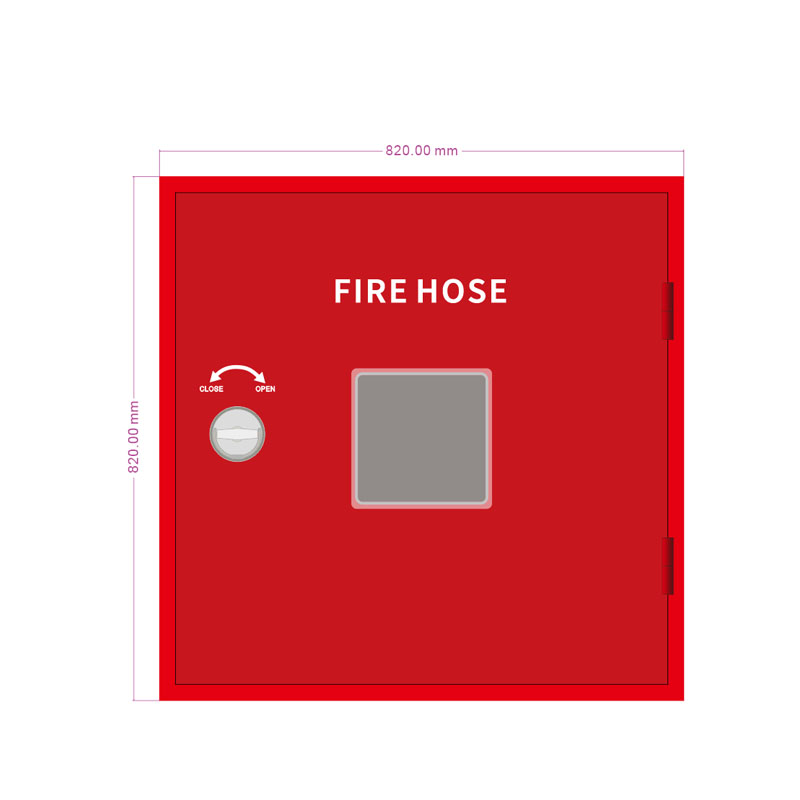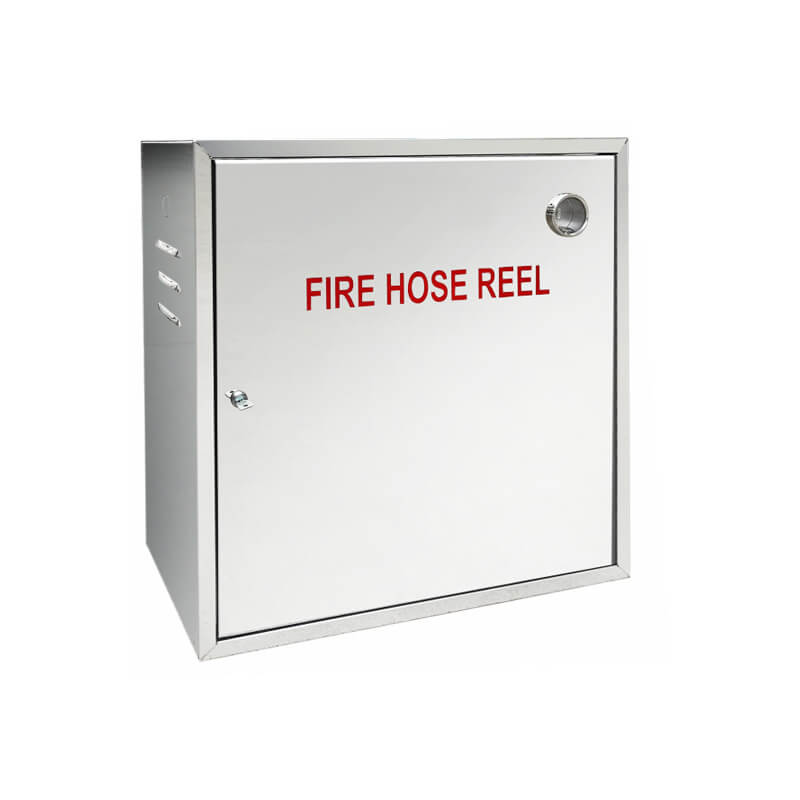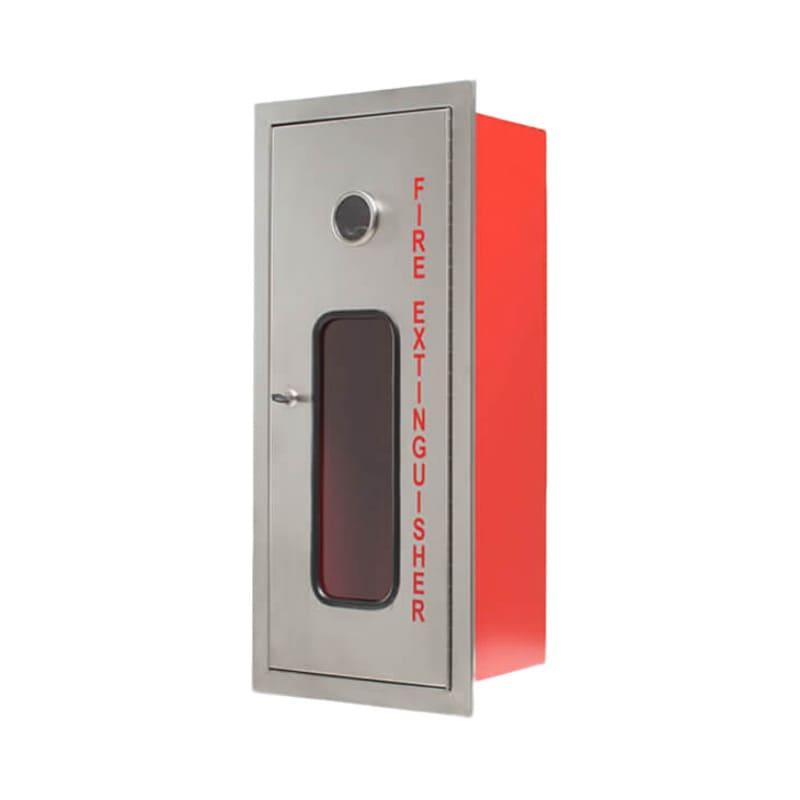
Recessed Fire Hose Cabinet
Flush wall-mounted · Clean architectural finish · Trim ring · ADA-friendly projection · 1000–2000 mm
Flush-Mount Recessed Fire Hose Cabinet for Architectural Interiors
The CA-FIRE SG24 recessed fire hose cabinet sits entirely inside the wall cavity, with only the door and a slim trim ring visible on the finished surface. This is the fire hose cabinet you specify when the corridor cannot afford a 240 mm box hanging off the wall — because the walkway is narrow, because the architect rejected the look of a utilitarian red box on the wall, or because the project has to meet ADA accessible-route rules that limit wall-mounted object projection to a maximum of 4 inches (100 mm).
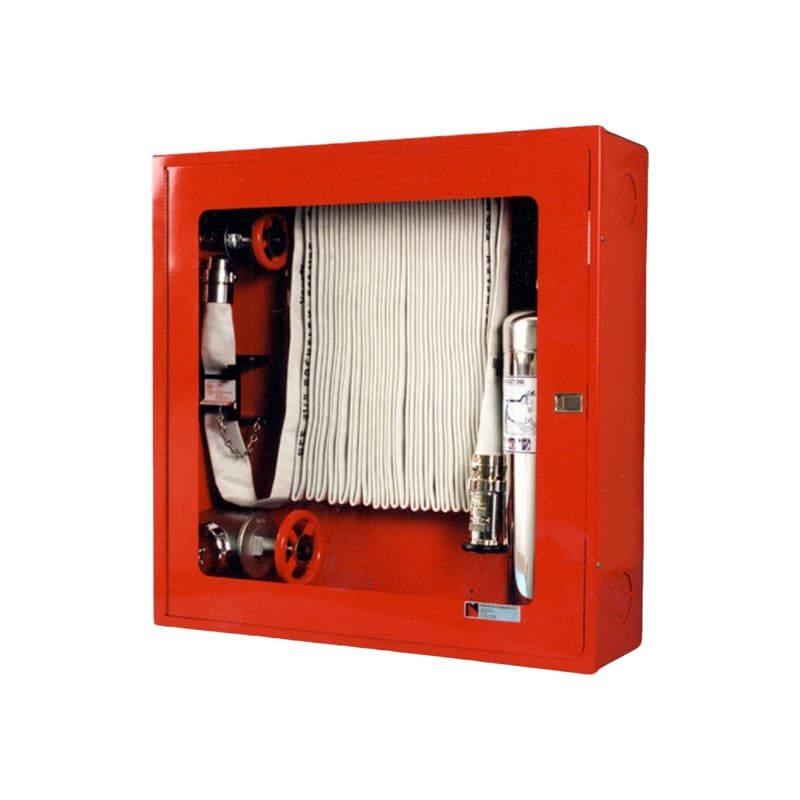
Every recessed cabinet ships with a factory-fitted trim ring that covers the rough opening in the finished wall, so site carpenters do not need to cut a picture-frame edge with millimetre precision. The body is 1.0–1.2 mm cold-rolled carbon steel with red polyester powder coat, and the cabinet is engineered to integrate with both drywall (stud framing + gypsum board) and masonry construction (CMU block, poured concrete, brick). Full hose station equipment fits inside — angle valve, 1.5″ or 2.5″ hose, nozzle, rack and optional extinguisher — in the same NFPA 14 layout as our surface-mount cabinets.
The SG24 recessed series is offered in four sizes from 1000 × 700 × 240 mm to 2000 × 750 × 240 mm, covering Class I, II and III standpipe hose stations. Surface and semi-recessed variants of the same cabinet are available on the main fire hose cabinet page, and the recessed-vs-surface selection decision is explained in depth in our mounting type comparison guide.
Key Features & Benefits
Six features that matter to architects, interior designers and fit-out contractors choosing flush-mount over surface-mount for hotel, hospital, office and mall projects.
Technical Specifications & Rough Opening
SG24 recessed standard sizes with rough-opening dimensions for framing coordination. The rough opening is slightly larger than the cabinet body to allow shim room during install; the trim ring covers the gap.
| Model | Cabinet Body (W×H×D mm) | Rough Opening (W×H mm) | Min. Wall Depth | Class / Application |
|---|---|---|---|---|
| SG24B65Z-R | 1000 × 700 × 240 | 1020 × 720 | 260 mm | Class II — offices, hotel corridors |
| SG24D65-R | 1600 × 700 × 240 | 1620 × 720 | 260 mm | Class I / III — malls, office towers |
| SG24E65Z-R | 1800 × 700 × 240 | 1820 × 720 | 260 mm | Class I / III — high-rise, public venues |
| SG24F65Z-R | 2000 × 750 × 240 | 2020 × 770 | 260 mm | Combined stations — large industrial |
Note: The 800 mm cabinet in the surface-mount SG24 range is not offered as a recessed model. Openings smaller than 1000 mm rarely justify the wall cut and framing labour — for these sizes we recommend the surface-mount tempered glass or stainless steel variants.
Material & Construction
| Body Material | 1.0–1.2 mm cold-rolled carbon steel (Q235 / SPCC) |
| Finish | Red polyester powder coat RAL 3000 / 3020 or custom |
| Trim Ring | Factory-fitted steel architrave, 20–25 mm overlap on all four sides |
| Door Options | Solid steel, tempered glass front, or louvred ventilated |
| Hinge | Stainless steel piano hinge or concealed pivot |
| Lock Options | Break-glass, key cylinder, padlock hasp, or no lock |
| Signage | Screen-printed or adhesive vinyl — "Fire Hydrant / Fire Hose" |
| Fixing Method | Pre-drilled body tabs, fastened to stud framing or masonry anchors |
| Total Projection | ≤ 4 inches (≤ 100 mm) from finished wall surface |
| Standards Reference | NFPA 14, GB 16280, EN 671 principles; ISO 9001 manufacturing |
Recessed vs Semi-Recessed vs Surface Mount
The SG24 cabinet body is offered in three mounting configurations to match project constraints. Fully recessed is the default specification for architectural interiors; the other two are available when wall construction or budget rules out full recess.
Surface Mount
Cabinet sits on the finished wall, bolted through the back plate. Fastest install, no wall cutting, works on any wall type including poured concrete.
- No wall cut required
- Fastest on-site installation
- Works on any wall
- Not ADA-compliant in accessible routes
Semi-Recessed
Cabinet body sits partly inside the wall cavity, typically half the depth. Good compromise for walls that can take a 120–150 mm recess but not full cabinet depth.
- Reduced projection
- Shallower wall cut than full recess
- Still exceeds 4″ ADA limit
- Suitable for stud walls
Fully Recessed ★
Full cabinet body inside the wall cavity; only the door and trim ring project. The flagship architectural specification and the only variant that meets ADA accessible-route rules.
- ADA-compliant projection
- Cleanest architectural finish
- Requires design-stage framing
- Minimum 260 mm wall depth
Wall Type Compatibility
Not every wall can host a fully recessed cabinet. The table below summarises compatibility with the wall types most commonly encountered on commercial fit-out projects. When recessed is not practical, we recommend surface mount on a tempered glass or stainless variant.
| Wall Construction | Fully Recessed? | Semi-Recessed? | Notes |
|---|---|---|---|
| Metal stud + drywall (150 mm stud) | Marginal | Yes | 260 mm body won't fit; semi-recessed works with 120 mm stud depth |
| Metal stud + drywall (200 mm stud) | Yes — coordinate framing | Yes | Add jamb studs at both sides of cabinet opening |
| Wood stud + drywall (standard 2×6) | Tight | Yes | 2×6 gives ~140 mm depth; requires furred-out wall for full recess |
| CMU block (200 mm / 8″) | Yes | Yes | Coordinate with block coursing during design |
| CMU block (300 mm / 12″) | Yes — ideal | Yes | Most forgiving wall type for recessed hose cabinets |
| Solid poured concrete wall | No (after-the-fact) | Only with formed recess | Must be formed at pour; coring after the fact is not economical |
| Structural shear wall / column | No | No | Structural element — cannot be cut; use surface mount instead |
| Partition wall < 120 mm deep | No | No | Insufficient depth; use surface mount |
Installation Sequence (6 Steps)
Recessed cabinet installation is a design-stage decision, not an afterthought — the rough opening must be coordinated with structural framing before drywall goes up. The sequence below is the standard install flow used on most commercial projects.
Coordinate in Design
Mark cabinet location on architectural drawings with rough opening dimensions from the spec table. Confirm wall depth, standpipe riser location and minimum 260 mm cavity depth before framing.
Frame the Opening
Add jamb studs to both sides of the cabinet opening and a header stud above, to create a load-bearing frame independent of the surrounding wall framing. Leave the rough opening slightly oversize per the spec table.
Connect the Standpipe
Route the standpipe outlet and angle valve connection to the rear of the cabinet cavity before the cabinet body goes in. Leave enough slack for shim adjustment during cabinet seating.
Seat the Cabinet Body
Slide the cabinet body into the rough opening. Shim square and plumb, then fasten the pre-drilled body tabs to the jamb studs or masonry anchors. Check that the door swings freely before the trim ring goes on.
Install Trim Ring
Attach the trim ring over the finished wall — drywall, paint or stone cladding. The ring covers any minor overcut and creates a clean picture-frame edge. Caulk around the ring for a finished look.
Fit Equipment & Sign Off
Install hose, nozzle, extinguisher and signage. Verify door swing, label position and tamper seal. Hand over to the fire-protection contractor for commissioning and AHJ inspection.
A complete step-by-step install guide with photos and common errors is published in our How to Install a Fire Hose Cabinet blog post.
Why Recessed Mounting Matters for ADA Compliance
The ADA Standards for Accessible Design limit wall-mounted objects between 27″ and 80″ above the finished floor to a maximum projection of 4 inches into accessible routes. A surface-mount fire hose cabinet projects 240 mm (roughly 9.5 inches) — more than double the ADA limit — and therefore cannot be placed in a required accessible corridor without a protective barrier.
A fully recessed cabinet solves this at the source: with only the door and trim ring visible, total projection stays under 100 mm (≤ 4 inches) and the cabinet is fully compliant in any accessible route. This is why the recessed variant is the default specification for hospitals, schools, public buildings and any project where ADA (or the equivalent local accessibility code) applies.
For the full rule breakdown and how it interacts with NFPA 10 mounting height, see our ADA & NFPA mounting height guide.
Typical Applications
Recessed fire hose cabinets are specified wherever corridor width, architectural finish or accessibility compliance matter. Eight common project types:
Frequently Asked Questions
What is the minimum wall depth needed for a recessed fire hose cabinet?
The SG24 recessed cabinet body is 240 mm deep, and we recommend a minimum wall cavity depth of 260 mm to allow shim room during installation. This typically rules out 150 mm metal stud walls and standard 2×6 wood stud walls in the fully recessed configuration — those walls will accept a semi-recessed cabinet (body sits partly in the cavity, partly proud) but not full recess. 200 mm stud walls, 200 mm CMU block and 300 mm CMU block are all suitable for full recess, and CMU is the most forgiving wall type because coursing can be adjusted to suit the opening exactly.
What are the rough opening dimensions for framing?
Rough opening dimensions are slightly larger than the cabinet body — typically 20 mm wider and 20 mm taller — to give install crews shim room and to tolerate framing variation. For the four standard sizes: SG24B65Z-R needs a 1020 × 720 mm rough opening; SG24D65-R needs 1620 × 720 mm; SG24E65Z-R needs 1820 × 720 mm; SG24F65Z-R needs 2020 × 770 mm. The trim ring has approximately 20–25 mm of overlap on all four sides so it will hide any overcut within that tolerance. Framing contractors should add jamb studs at both sides of the opening and a header stud above, creating an independent frame around the cabinet cavity.
Can I install a recessed cabinet in a poured concrete wall after the pour?
Not economically. Coring a 1000+ mm wide opening in an existing poured-concrete wall requires wall-saw cutting, and this is expensive, slow and generates large amounts of dust and debris. More importantly it may affect structural integrity if the wall is a shear wall or load-bearing element — and most concrete walls in commercial buildings are structural. The recessed option for concrete walls must be planned at the pour, with a formed recess built into the shuttering. If the decision to go recessed comes after construction, the practical answer is to use a surface-mount cabinet on the concrete wall and accept the 240 mm projection.
Does the recessed cabinet meet ADA accessible-route requirements?
Yes — that is one of the main reasons to specify the recessed variant. The ADA Standards for Accessible Design limit wall-mounted objects between 27″ and 80″ above the finished floor to a maximum 4-inch (100 mm) projection into accessible routes. A surface-mount SG24 cabinet projects 240 mm, which is 9.5 inches — more than double the ADA limit. A recessed SG24 cabinet keeps total projection under 4 inches (door + trim ring), making it fully compliant. For a detailed walkthrough of ADA, NFPA and OSHA mounting rules together, see our mounting height guide.
Is the trim ring included or a separate accessory?
The trim ring (architrave) ships with every recessed cabinet at no extra charge. It is a factory-fitted steel ring that attaches to the front of the cabinet body and overlaps the finished wall surface by 20–25 mm on all four sides. This overlap hides any minor overcut or framing misalignment around the rough opening, saving site carpenters from having to cut a picture-frame edge with millimetre precision. The ring is powder-coated to match the cabinet body (red RAL 3000 standard) but can be custom colour-matched to the wall for architectural projects where the cabinet is meant to disappear into the finish.
Can I get a glass-front door on the recessed cabinet?
Yes. A 5 mm tempered safety glass front door is available as a door option on any SG24 recessed model. This combines the visual-inspection benefit of our tempered glass series with the architectural flush-mount finish of the recessed body — a popular specification for hotels, malls and public buildings where both inspection efficiency and corridor appearance matter. Specify "recessed with tempered glass insert" at quotation time and confirm whether you need the full-width glass or a smaller vision panel.
Why is the 800 mm size not offered as a recessed cabinet?
Two reasons. First, the labour and carpentry cost of cutting a rough opening and framing jamb studs is the same regardless of cabinet size, so on very small cabinets the fit-out cost becomes disproportionate to the product cost. Second, the 800 mm cabinet exists mostly for Class II occupant-use stations in small offices and retail, where surface-mount on a masonry wall is already the practical choice. If you need an 800 mm recessed cabinet for an unusual application, we can build to order — contact sales with your project details.
How do I request a quote for the SG24 recessed series?
Email [email protected] with the model number (or required cabinet dimensions), wall construction type (drywall / CMU / concrete), wall depth, door option (solid / tempered glass / louvred), lock option, quantity and project timeline. Wall construction is the most important detail because it determines whether full recess, semi-recessed or surface mount is the right specification. We respond within one business day with pricing, lead time, rough-opening dimensions and a submittal package. CAD blocks and Revit families are free from our CAD & BIM download centre.