
Diaphragm Deluge Valve — ZSFM Series, Cast Iron Flanged (DN50–DN350)
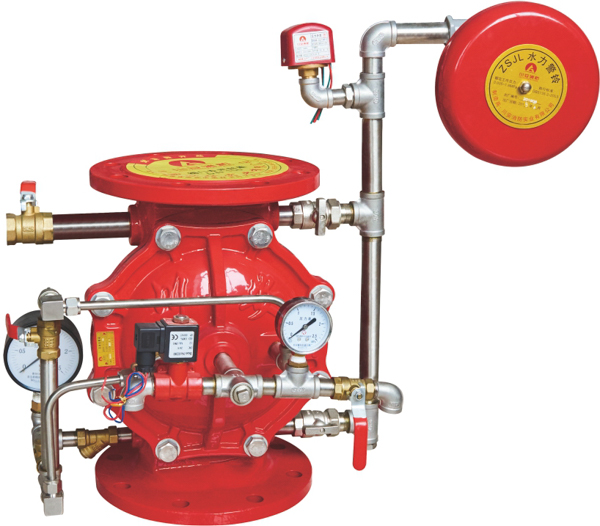
A diaphragm deluge valve is a normally-closed fire suppression control valve that uses a flexible rubber diaphragm as its primary sealing element. In standby, control-chamber water pressure holds the diaphragm firmly against its seat — keeping the downstream open-nozzle pipework completely dry. When a fire signal is received, control-chamber pressure is vented to drain, and supply pressure immediately lifts the diaphragm open. Water floods the entire open nozzle network simultaneously.
The diaphragm mechanism gives this valve type two practical advantages over older clapper-type deluge valves: a full-bore waterway with no hinge or disc obstruction (hydraulic resistance below 0.08 MPa), and a positive drip-free seal maintained by water pressure alone, with no mechanical latching components that can corrode or seize.
CA-FIRE’s ZSFM Series is the standard cast iron flanged diaphragm deluge valve — available in 10 sizes from DN50 to DN350, rated 1.6 MPa, with electric solenoid, pneumatic pilot, or manual actuation. It is the baseline deluge valve specification for commercial buildings, warehouses, power stations, and general industrial facilities where the installation environment does not require stainless steel or explosion-proof rated components.
For corrosive or marine environments, see the stainless steel deluge valve. For Zone 1/2 hazardous area installations, see the explosion-proof deluge valve skid.
Technical Specifications
Model: ZSFM 50–350-1.6
| Parameter | Value |
|---|---|
| Nominal Size | DN50 – DN350 (10 sizes) |
| Working Pressure | 1.6 MPa |
| Seal Test Pressure | 3.2 MPa |
| Strength Test Pressure | 6.4 MPa |
| Hydraulic Resistance | < 0.08 MPa |
| Leakage Rate | ≤ 0.1 L/min at working pressure |
| Body Material | High-quality grey cast iron |
| Diaphragm Material | EPDM rubber with fabric reinforcement |
| Connection Type | Flanged — GB/T 9113 (ANSI B16.1 on request) |
| Activation Method | Electric solenoid (DC24V / AC220V) · Pneumatic wet/dry pilot · Manual |
| Alarm Response Time | ≤ 3 seconds |
| Operating Temperature | 4°C to 70°C |
| Operating Medium | Water · Foam-water mixture (up to 6% concentrate) |
| Service Life | ≥ 10 years |
| Standard | GB 5135.7-2019 |
| Certification | National fire product type approval · PICC product liability insurance |
Dimensional Data
| DN (mm) | Height (mm) | Flange Bolt Circle (mm) | No. of Bolts | Weight (kg) |
|---|---|---|---|---|
| 50 | 270 | 160 | 8 | 38 |
| 65 | 270 | 180 | 8 | 45 |
| 80 | 330 | 200 | 8 | 62 |
| 100 | 340 | 220 | 8 | 85 |
| 125 | 415 | 250 | 8 | 110 |
| 150 | 435 | 280 | 8 | 145 |
| 200 | 555 | 340 | 12 | 210 |
| 250 | 665 | 400 | 12 | 295 |
| 300 | 800 | 460 | 16 | 420 |
| 350 | 850 | 520 | 16 | 580 |
Dimensional drawings and CAD files are available on request — contact sales@ca-fire.com.
Key Features
EPDM Diaphragm — Full-Bore Flow, Reliable Seal
The EPDM rubber diaphragm with fabric reinforcement is the defining feature of this valve. It provides a positive, leak-free seal against the valve seat across the full 1.6 MPa working pressure range (leakage rate ≤ 0.1 L/min), with no mechanical latch or spring-loaded component that could corrode or seize over time.
When the valve opens, the diaphragm retracts fully into the bonnet cavity — exposing the complete bore and delivering hydraulic resistance below 0.08 MPa. This is consistently lower than clapper-type deluge valves (typically 0.08–0.12 MPa), reducing the system hydraulic calculation margin required and allowing slightly smaller pipe sizing in flow-critical designs.
The EPDM compound resists chlorinated water, foam-water mixture at up to 6% concentrate, and moderate chemical contamination from impure water supplies. Routine replacement of the diaphragm (typically every 5 years or at first signs of cracking or hardening) can be completed without removing the valve body from the pipeline — the bonnet unbolts directly.
Three Activation Modes — Electric, Pneumatic, Manual
Electric solenoid (most common): A solenoid valve on the trim line receives a DC24V or AC220V signal from the fire alarm control panel, vents the control chamber in under one second, and the diaphragm opens within ≤ 3 seconds of signal receipt. Standard for all modern automatic deluge systems with a detection panel.
Pneumatic pilot (wet or dry): A pressurised pilot line connects to a closed detection sprinkler or pneumatic actuator. Heat or pressure loss from the pilot sprinkler releases control-chamber pressure and opens the main valve. Wet pilot is used in standard environments; dry pilot (pressurised air or nitrogen) is used where pilot line freezing is a risk. Suitable where electrical power supply to the valve station is unreliable or restricted.
Manual: An emergency manual release at the valve station trips the valve directly — a backup that operates regardless of detection system or power status.
All three modes can be combined in a dual-trigger or triple-redundancy configuration for critical or high-consequence applications.
Cast Iron Body — Certified Performance at Competitive Cost
The valve body, bonnet, and end connections are cast from high-quality grey cast iron, machined on CNC centres for consistent flange face geometry and sealing surface finish. Grey cast iron provides the structural integrity required for a 1.6 MPa working pressure valve — strength-tested to 6.4 MPa — at a significantly lower material cost than ductile iron or stainless steel.
For corrosive or marine environments where grey cast iron is not appropriate, the same diaphragm mechanism and hydraulic performance are available in the stainless steel deluge valve (SS304/SS316 body).
Diaphragm — Component Detail and Replacement
The deluge valve diaphragm is a replaceable wear component. CA-FIRE supplies replacement diaphragms for the ZSFM series in all sizes — stocked and available for immediate despatch. Diaphragm replacement procedure:
- Isolate and depressurise the valve (close upstream isolation valve, open drain)
- Remove bonnet bolts — typically 8–16 bolts depending on DN
- Lift bonnet clear — diaphragm remains seated on the valve body
- Inspect diaphragm face and fabric backing; replace if cracked, hardened, or deformed
- Position new diaphragm, refit bonnet, torque bolts to specification
- Re-pressurise control chamber, check for leaks, restore to standby
Total procedure time: 45–90 minutes depending on valve size. No special tools required beyond standard flange bolt toolkit. Replacement diaphragms are available in DN50 through DN350 — contact sales@ca-fire.com with model number and DN size.
How the Diaphragm Deluge Valve Works
Standby: Control-chamber water pressure (connected via a small pilot port to the supply side) holds the EPDM diaphragm firmly against its seat. Downstream open-nozzle pipework is completely dry and at atmospheric pressure. The valve is closed with zero leakage.
Fire detected: Detector sends signal to fire alarm control panel → panel energises solenoid valve on trim → solenoid opens → control chamber pressure vents to drain.
Valve opens: With restraining pressure removed, supply pressure acting on the underside of the diaphragm lifts it fully into the bonnet cavity. Full bore opens — water flows at maximum design rate into the downstream distribution pipework.
Simultaneous discharge: All open spray nozzles or open sprinkler heads across the entire protected zone discharge simultaneously — total-zone suppression with no sequencing delay.
Alarm activates: Water flowing through the alarm port drives the water-motor alarm gong and trips the alarm pressure switch → electrical signal sent to fire alarm panel and connected monitoring system.
Reset after suppression: De-energise solenoid → reconnect control chamber pressure supply → diaphragm reseats under control-chamber pressure → drain downstream piping via drain valve → system returned to standby. No tools required for reset.
Deluge Valve Assembly Drawing
A full dimensional drawing for the ZSFM series diaphragm deluge valve — including the complete deluge valve trim assembly (solenoid valve, manual release, pressure gauges, alarm port, drain connections, and isolation valve positions) — is available as a PDF and AutoCAD DWG file. Contact sales@ca-fire.com to request the assembly drawing for your specified DN size. Drawings are provided free of charge with all project enquiries.
Diaphragm Deluge Valve vs Other Deluge Valve Types
| Feature | Diaphragm (This Product) | Clapper Type | Stainless Steel | Explosion-Proof |
|---|---|---|---|---|
| Sealing element | EPDM diaphragm | Rubber-faced clapper | EPDM diaphragm | EPDM diaphragm |
| Body material | Cast iron | Ductile iron | SS304 / SS316 | Carbon steel |
| Hydraulic resistance | < 0.08 MPa | 0.08–0.12 MPa | < 0.08 MPa | < 0.08 MPa |
| Corrosion resistance | Standard | Standard | ✓ High (marine/chemical) | Standard + coating |
| Explosion-proof rating | No | No | Optional | ✓ Ex db IIC T6 Gb |
| Working pressure | 1.6 MPa | 1.6 MPa | 1.6 MPa | 1.6 / 2.5 MPa |
| Diaphragm replacement | ✓ In-line — bonnet removal only | N/A — seat lapping required | ✓ In-line | ✓ In-line |
| Relative cost | ✓ Most competitive | Moderate | Higher | Higher |
| Best for | Standard commercial / industrial | Retrofit / legacy systems | Corrosive / marine / offshore | Hazardous area Zone 1 / 2 |
Applications
Power transformers and substations: The diaphragm deluge valve is widely specified for transformer bay deluge protection — foam-water mixture compatibility makes it directly suitable for transformer oil fire suppression without modification. The clean full-bore waterway ensures design discharge density is reached immediately at valve opening.
Warehouses and logistics centres: High-rack storage of paper, textiles, rubber, plastics, and other combustible commodities. Deluge systems provide rapid total-zone suppression to prevent fire spread across adjacent rack rows before fire brigade arrival.
Chemical and process plants (non-classified areas): Manufacturing facilities and chemical storage where fast-spreading flammable liquid hazards are present but the installation area is not Zone 1 or Zone 2 classified. For classified areas, see the explosion-proof deluge valve skid.
Airports, metro stations, and large public buildings: High-occupancy venues where fast response and reliable alarm signalling are required. The ≤ 3 second alarm response time and integrated water-motor alarm meet GB 50084 and equivalent international requirements.
Cable tunnels and power station cable areas: Simultaneous suppression across the full tunnel cross-section from a single valve activation — the fundamental advantage of deluge over zone-by-zone wet-pipe systems in linear tunnel geometries.
Hospitals, schools, and public sector buildings: Budget-sensitive projects requiring national fire certification and reliable performance. The cast iron diaphragm deluge valve offers the lowest cost point in CA-FIRE’s range without compromising on certified performance specifications.
Deluge Valve Price
The cast iron ZSFM diaphragm deluge valve is CA-FIRE’s most competitively priced deluge valve configuration. Pricing depends on DN size, quantity, export destination, and trim specification (solenoid only, solenoid + manual, or full trim assembly). DN100 (100mm) is the most commonly ordered size for mid-scale industrial systems.
To receive a formal quotation with itemised pricing, lead time, and freight options, contact sales@ca-fire.com with:
- Required DN size(s)
- Quantity per size
- Activation mode (solenoid / pneumatic / manual or combined)
- Flange standard (GB or ANSI)
- Destination port
Response within 24 hours on all quotation requests. Volume pricing available for project orders.
Frequently Asked Questions
What is the difference between a diaphragm deluge valve and a clapper deluge valve? A diaphragm deluge valve seals using a flexible rubber diaphragm held by water pressure — no hinge, no latch, no disc that can corrode or seize. A clapper deluge valve uses a hinged disc pressed against a seat. The diaphragm design provides lower hydraulic resistance (< 0.08 MPa vs 0.08–0.12 MPa for clappers), a clean full-bore waterway, and simpler field maintenance (diaphragm replacement vs seat lapping).
Can this valve be used with foam suppression systems? Yes. The EPDM diaphragm and cast iron body are compatible with foam-water mixture at concentrate ratios up to 6% — covering AFFF, FFFP, AR-AFFF, and protein foam concentrates used in industrial fire protection.
Is this valve compatible with NFPA 13 / NFPA 15 designs? The ZSFM series is designed and tested to GB 5135.7-2019. For NFPA 13/15 projects, CA-FIRE provides Cv values and hydraulic performance data for inclusion in the hydraulic calculation. ANSI flange connections are available on request.
What maintenance does this valve require? Semi-annual visual inspection of body, trim, and gauge readings. Annual functional test of solenoid activation and alarm pressure switch. Biennial diaphragm inspection — replace if cracking, hardening, or deformation is observed. Diaphragm replacement does not require removing the valve from the pipeline.
Are assembly drawings available? Yes — dimensional drawings and deluge valve assembly drawings in PDF and DWG format are available free of charge. Contact sales@ca-fire.com with your required DN size.
Related Products
- Deluge Valve — Full Range & Selection Guide
- Stainless Steel Deluge Valve — SS304/SS316 for corrosive/marine environments
- Explosion-Proof Deluge Valve Skid — Zone 1/2 hazardous area installations
- Explosion-Proof Deluge Valve 2.5MPa — high-pressure petrochemical applications
- Deluge Valve Assembly — factory-assembled complete station
- Alarm Check Valve Series — for closed-head wet-pipe sprinkler systems
Email: sales@ca-fire.com · Mobile: +86 13400715622 · WhatsApp: +86 18150362095 · WeChat: 404863577 · www.ca-fire.com
General Specifications
| Specification | Details |
|---|---|
| Product Name | Cast Iron Flanged Deluge Alarm Valve (Fire Sprinkler System Valves) |
| Model | ZSFM 50~350-1.6 |
| Core Function | Rapid water release, fire suppression, alarm triggering |
| Working Pressure | 1.6MPa |
| Sealing Test Pressure | 3.2MPa |
| Strength Test Pressure | 6.4MPa |
| Hydraulic Resistance | <0.08MPa |
| Material | High-quality cast iron |
| Connection Type | Flanged connection |
| Application Temperature | 4-70°C |
| Operating Medium | Clean water, foam mixture |
| Service Life | ≥10 years (under normal operating conditions) |
| Certification | National fire product certification, PICC liability insurance |
Dimension Specifications
| DN (mm) | Height (mm) | Flange Bolt Circle Diameter (mm) | Number of Bolts | Weight (kg) |
|---|---|---|---|---|
| 50 | 270 | 160 | 8 | 38 |
| 65 | 270 | 180 | 8 | 45 |
| 80 | 330 | 200 | 8 | 62 |
| 100 | 340 | 220 | 8 | 85 |
| 125 | 415 | 250 | 8 | 110 |
| 150 | 435 | 280 | 8 | 145 |
| 200 | 555 | 340 | 12 | 210 |
| 250 | 665 | 400 | 12 | 295 |
| 300 | 800 | 460 | 16 | 420 |
| 350 | 850 | 520 | 16 | 580 |