
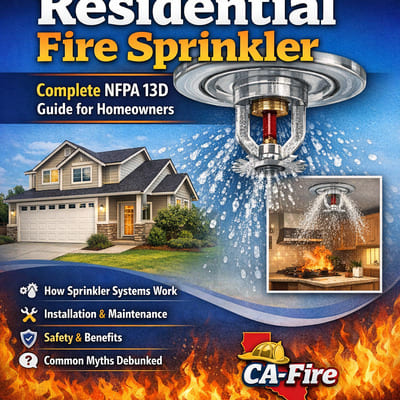
NFPA 13D Homeowner Guide
NFPA 13D Guide: Home Sprinkler Systems
for Homeowners & Builders
A home sprinkler system reduces the risk of dying in a residential fire by approximately 80%. It costs $1–$2 per square foot in new construction. And yet most homeowners know almost nothing about how it works, what the code requires, or what decisions they need to make. This guide covers all of it.
🕒 10 min read
🏠 NFPA 13D 2022 Edition
80%
Reduction in risk of dying in a home fire
$1–$2
Per sq ft in new construction
83%
Of home fires originate in rooms that require sprinklers
1–2
Heads typically operate per incident — not the whole house
Most fire deaths in the United States happen in homes. Commercial buildings — offices, warehouses, hotels — have become dramatically safer over the past half century because nearly all of them are required to have sprinkler systems. Homes, by contrast, are the last major building category where sprinklers are not yet universally mandated, and where the fire death rate remains stubbornly high.
NFPA 13D is the standard that governs residential sprinkler systems in one- and two-family dwellings. It is deliberately simpler and less expensive than the commercial standard (NFPA 13), designed to maximize uptake in homes by reducing the cost and complexity of compliance. Understanding what it requires — and what it allows you to skip — is the starting point for every homeowner or builder considering a home sprinkler system. For full product specifications, K-factor tables, and ordering information for flush, concealed, and sidewall head options, see our residential fire sprinkler head product page.
In This Guide
- What Is NFPA 13D and Who Does It Apply To?
- Where Sprinklers Are Required — and Where They’re Exempt
- Which Sprinkler Heads Are Used in Homes?
- Water Supply: Municipal, Well & Multipurpose Systems
- Pipe Material & Installation Requirements
- Design Flow: How Much Water Does NFPA 13D Actually Need?
- How Much Does a Home Sprinkler System Cost?
- Is a Sprinkler System Mandatory for My Home?
- 5 Myths About Home Sprinklers — Debunked
- Frequently Asked Questions
1. What Is NFPA 13D and Who Does It Apply To?
NFPA 13D, Standard for the Installation of Sprinkler Systems in One- and Two-Family Dwellings and Manufactured Homes, is published by the National Fire Protection Association and establishes the minimum requirements for designing, installing, and maintaining fire sprinkler systems in residential properties. The 2022 edition expanded the standard’s scope to include townhouses.
NFPA 13D Applies To
- Single-family detached homes
- Two-family dwellings (duplexes)
- Townhouses (added in 2022 edition)
- Manufactured homes
- No size restriction — applies to any size home
Use NFPA 13R or 13 Instead For
- Apartment buildings and condos (up to 4 stories → 13R)
- Multi-family buildings over 4 stories (→ NFPA 13)
- Hotels and short-term rental complexes (→ 13R or 13)
- Any commercial use within a dwelling (→ NFPA 13)
The Life-Safety-First Philosophy
NFPA 13D was deliberately designed with a narrower goal than its commercial counterpart. NFPA 13D was developed to provide an economical option to install life-safety systems in homes. When installing a residential sprinkler system in accordance with NFPA 13D, the purpose is limited to detecting and controlling residential fires so that the room of origin does not flashover and occupants have time to escape. Property protection is secondary to life safety in the 13D design philosophy.
This means 13D systems are simpler, smaller in flow demand, and permit more room exemptions than NFPA 13. If you want maximum property protection as well as life safety — for example, in a high-value custom home — your contractor can install a system to the more stringent NFPA 13 standard instead. Many homeowners in custom or luxury homes choose this voluntarily.
2. Where Sprinklers Are Required — and Where They’re Exempt
One of the most practical questions for any homeowner is: which rooms in my house actually need a sprinkler head? NFPA 13D focuses protection on the spaces where people live and where fires most often start. It permits omission of heads in spaces where the risk is low or access is impractical.
✓ Rooms That Require Sprinklers
- Bedrooms — the primary location of fire deaths
- Living rooms and family rooms
- Kitchens and dining rooms
- Hallways and corridors
- Laundry rooms
- Bathrooms larger than 55 sq ft (5.1 m²)
- Closets larger than 24 sq ft (2.2 m²) or with a dimension exceeding 3 ft (0.9 m)
- Attached garages — required by many jurisdictions (California mandates this even though NFPA 13D permits omission)
⚠ Areas Exempt Under NFPA 13D (§8.3)
- Attics, crawl spaces & concealed spaces not used as living areas
- Small bathrooms ≤ 55 sq ft (5.1 m²)
- Small closets ≤ 24 sq ft (2.2 m²) with no dimension exceeding 3 ft
- Attached garages — per NFPA 13D base standard
- Open porches, balconies & carports
- Pantries meeting specific size criteria
Important: Local AHJ amendments frequently require sprinklers in areas that 13D exempts. California, for example, requires attached garages. Always verify local requirements.
Why These Exemptions Are Acceptable
This coverage provides fire protection from 83% of all areas where fires originate — living rooms account for 41% of home fire origins, bedrooms 27%, and kitchens 15%. By protecting these three room types, the system covers the overwhelming majority of residential fire scenarios.
3. Which Sprinkler Heads Are Used in Homes?
NFPA 13D permits three types of sprinkler heads: listed residential sprinklers, quick response sprinklers, and standard response sprinklers. In practice, the vast majority of home installations use one of the first two types.
Listed Residential Sprinkler — Most Common
A specially listed head designed and tested specifically for residential occupancies. Has a very fast RTI (≤ 50 (m·s)½ — same as quick response) but with a spray pattern optimized for typical room geometry — lower ceiling heights and smaller floor areas than commercial spaces. Available as pendent, concealed, or sidewall.
Key advantage: Listed residential heads have the highest coverage area per head under 13D (up to 20.9 m²), reducing the total head count and simplifying the pipe layout.
Quick Response (QR) Sprinkler
Standard quick response commercial heads (RTI ≤ 50 (m·s)½, 3 mm glass bulb) are permitted by NFPA 13D as an alternative to listed residential heads. They cost less per unit and are more readily available, but may result in more heads per room because their listed coverage area is smaller than residential heads.
When to use: In garages, utility rooms, or attached spaces where a commercial QR head is more practical than a residential head.
Concealed Residential Head
A residential listed head with a flat cover plate that sits flush with the ceiling. Invisible until activation — when heat from a fire melts the solder attaching the cover plate, it drops away and the head activates normally. The most popular choice for high-finish bedrooms and living rooms where aesthetics matter.
Limitation: The cover plate can be painted (flat face only) but the head body and the solder point around the rim must never be painted.
Temperature Rating — Always 68°C for Living Spaces
For all standard living areas in a home (bedrooms, living rooms, kitchens, hallways), the standard 68°C (155°F) red bulb head is correct — ambient temperature in these rooms never approaches the 38°C maximum ambient limit for this rating. Two exceptions require higher temperature ratings:
- Garages and spaces subject to temperatures over 38°C: Intermediate temperature rating (79°C or 93°C) is required. NFPA 13D specifies that spaces subject to temperatures in excess of 100°F (38°C) must use intermediate temperature rated heads.
- Attic spaces where sprinklers are specified: Attic temperatures routinely exceed 66°C in summer in hot climates. A 93°C or 121°C head prevents nuisance activations from summer heat buildup.
4. Water Supply: Municipal, Well & Multipurpose Systems
The water supply is the first design consideration — before pipe sizing, before head placement. NFPA 13D recognizes three supply configurations, each with different cost and complexity implications.
Option 1: Municipal Water Supply (Most Common)
The sprinkler system taps directly from the house’s domestic water connection — typically a dedicated service line or a tap from the domestic meter. The design must verify that the municipal supply can deliver the required flow (for most 13D systems, 13–18 gal/min at the most demanding two heads) at minimum residual pressure. In most suburban locations on city water, this is straightforward. A water flow test or utility pressure/flow data confirms adequacy.
Option 2: Multipurpose Piping System (Cost Saver)
NFPA 13D uniquely permits a multipurpose piping system where the sprinkler heads are connected to the same plumbing supply that serves the domestic fixtures (sinks, toilets, showers). This eliminates the need for a separate dedicated sprinkler piping network — the sprinkler heads are simply branches off the domestic plumbing. The result is significant cost savings, particularly in new construction. The trade-off is that the domestic plumbing must be sized to simultaneously supply both the sprinklers and normal domestic use, and the system must always remain under pressure (it cannot be shut off without also cutting the domestic water supply).
Option 3: Well or Tank Supply (Rural Homes)
For homes on private wells or with tank water supplies, NFPA 13D requires verification that the well pump can deliver the required sprinkler flow (typically 26–52 L/min for 1–2 heads) at adequate pressure simultaneously with domestic use. Well systems with pressure tanks add cost but are frequently adequate without modification. Homes with marginal well capacity may require a dedicated pressure tank for the sprinkler system or a pump upgrade.
5. Pipe Material & Installation Requirements
NFPA 13D permits a wider range of pipe materials than the commercial standard, reflecting the lower pressure requirements and simpler system configurations typical in residential installations:
| Material | Common? | Notes |
|---|---|---|
| CPVC | ★★★★★ | Most common in US residential construction. Lightweight, no threading, lower cost than steel or copper. Typically “Blazemaster” brand or equivalent. Must not be used in garages (UV and chemical exposure) or where ambient exceeds 66°C. |
| Copper | ★★★ | Used in garages and exposed locations where CPVC is not permitted. Higher material cost; requires brazed or press-fit joints. Corrosion-resistant. |
| Steel | ★★ | Black or galvanized steel is permitted but rarely used in residential due to higher installation cost (threading required). More common when system is installed to NFPA 13 rather than 13D. |
| CPVC Underground | ✗ | CPVC is not rated for underground use. Underground service line to the house from the meter must be copper or approved polyethylene. |
Chemical compatibility warning: CPVC pipe is incompatible with many petroleum-based lubricants, PVC cement, certain pipe insulation foams, and some spray paints. Any incompatible material applied to or adjacent to CPVC can cause stress cracking that leads to failure. Always verify compatibility of all materials that will contact CPVC with the pipe manufacturer’s data sheet before specifying.
6. Design Flow: How Much Water Does NFPA 13D Actually Need?
One of the biggest misconceptions about home sprinkler systems is that they will flood the entire house when activated. In reality, the system design is based on a very modest water demand — and in most fires, only one or two heads activate at all.
NFPA 13D Hydraulic Design Basis
1 or 2
Heads in the design area
13–18
Gallons per minute per head
0.05
gpm/sq ft design density
10 min
Minimum water supply duration
To put this in perspective: a typical kitchen tap flows at around 2 gallons per minute. A single activated sprinkler head in a home system discharges 13–18 gal/min — about the same as running 7–9 kitchen taps simultaneously. This is a meaningful amount of water but far less than the 200–500 gal/min that a fire hose delivers. And critically, only the heads directly above the fire’s thermal plume will activate — neighboring heads remain closed.
The 10-minute supply duration is the NFPA 13D minimum — enough time for the fire department to arrive in an urban or suburban location. In rural areas with longer response times, the AHJ may require a longer supply duration, which affects sizing of any dedicated storage tank.
7. How Much Does a Home Sprinkler System Cost?
New Build — CPVC
$1–$2 /sq ft
~$2,000–$4,000 for a 2,000 sq ft home
Retrofit — Finished Home
$2–$7 /sq ft
~$4,000–$14,000 for same home
Annual Maintenance
$150–$300
Annual inspection per NFPA 25
The new construction cost is the most compelling argument for including sprinklers at the design stage. On a $400,000 home, a $3,000 sprinkler system represents 0.75% of the home’s value — and that cost can often be financed as part of the mortgage, adding a few dollars per month to the payment. The system also typically qualifies for a 5–10% discount on homeowner’s insurance premiums, which can recover the financing cost within a few years.
Multipurpose system cost savings: Homebuilders who use the multipurpose piping option (integrating sprinklers with the domestic plumbing) typically see installation costs 30–40% lower than standalone dedicated sprinkler systems in new construction. If your contractor offers both options, ask for both quotes before deciding.
8. Is a Sprinkler System Mandatory for My Home?
This depends entirely on your local jurisdiction. The International Residential Code (IRC) has required sprinklers in new one- and two-family homes since the 2009 edition, but individual states and counties adopt the IRC on their own schedule — and many have amended or repealed the sprinkler requirement.
| Jurisdiction Status | What It Means for Your Build |
|---|---|
| Mandatory (e.g., California, Maryland) | All new one- and two-family homes must have sprinklers. No exceptions for voluntary adoption — it is a building permit requirement. California further requires coverage of attached garages beyond NFPA 13D base requirements. |
| Voluntary (most US states) | No state mandate for new homes, but local municipalities may have adopted their own requirement. Homeowners can install voluntarily and may qualify for insurance discounts. Some HOAs in wildfire-prone areas incentivize or require sprinklers. |
| State preemption (some states) | Some states have passed laws specifically prohibiting local governments from mandating residential sprinklers. In these states, sprinklers are voluntary regardless of local desire to require them. |
Always check your local building department — requirements change frequently. Even where not mandated, many homeowners in fire-risk areas (wildland-urban interface, remote locations with long fire department response times, or large homes) choose to install sprinklers voluntarily for the life-safety benefits and insurance savings.
9. Five Myths About Home Sprinklers — Debunked
Myth 1: “If one sprinkler activates, they all go off”
Reality: Each sprinkler head operates independently. Only the heads whose glass bulb is heated to the activation temperature by the fire will open. Only one or two sprinklers are normally required to extinguish a fire — a single sprinkler being activated will not set off the rest of the system, as they are all heat sensitive. “All-off” systems exist only in deluge systems used for special industrial applications — never in homes.
Myth 2: “A smoke alarm will set off the sprinklers”
Reality: Sprinkler heads respond only to heat at the deflector — not smoke, not alarm sounds, not steam, and not cooking odors. The glass bulb must reach the activation temperature (68°C for standard heads) before anything happens. A smoke alarm and a sprinkler are completely independent systems.
Myth 3: “The water damage from sprinklers will destroy my home”
Reality: A single sprinkler head releases 20–40 gallons per minute, while fire hoses use approximately 8.5 times more water per minute. NFPA data show that sprinklers average 341 gallons per incident, compared to 2,935 gallons for firefighter suppression. Sprinklers cause dramatically less water damage than firefighting hoses — and the fire itself causes far more damage than either.
Myth 4: “Sprinklers go off randomly — there’s a 1-in-a-million chance of accidental discharge”
Reality: The chances of a properly maintained sprinkler head misfiring are 1 in 16 million. Manufacturing defects, physical damage (a struck head), or improper installation account for essentially all accidental discharges. A properly installed and maintained system has a vanishingly small accidental activation rate.
Myth 5: “Sprinklers are only for big commercial buildings”
Reality: Most fire deaths in the US occur in homes. Automatic sprinklers can help reduce the risk of dying in a home fire by about 80 percent. The NFPA 13D standard was specifically designed to make residential systems cost-effective and practical for individual homeowners. At $1–$2 per square foot in new construction, a home system is among the most cost-effective life-safety investments available.
10. Frequently Asked Questions
Sourcing Residential Sprinkler Heads?
We supply UL-listed quick response and residential-listed sprinkler heads in pendent, concealed, and sidewall configurations for NFPA 13D systems. Factory-direct supply for contractors and distributors.
Related Products & Resources
Authoritative Sources & Standards
- NFPA 13D: Standard for the Installation of Sprinkler Systems in One- and Two-Family Dwellings and Manufactured Homes — 2022 Edition — National Fire Protection Association
- NFPA 25: Inspection, Testing and Maintenance of Water-Based Fire Protection Systems — National Fire Protection Association
- NFPA Fire Loss in the United States — Residential Fire Statistics — National Fire Protection Association
- UL Fire Safety Certification Resources — Underwriters Laboratories
- FM Approvals: Fire Protection Product Certification — FM Global