Horizontal Deluge Valve Assembly — Explosion-Proof Skid-Mounted System (DN50–DN350
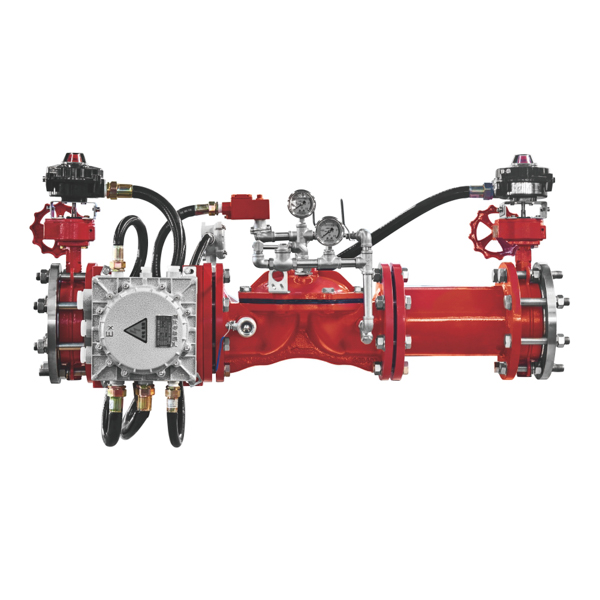
A deluge valve assembly is a factory-integrated fire suppression station combining the deluge alarm valve, explosion-proof control trim, instrumentation, pipework, and local control panel on a single structural skid frame — supplied complete and pressure-tested, ready for site pipe and cable connections only.
CA-FIRE’s horizontal explosion-proof deluge valve assembly (Model ZSFM 50–350-1.6-Ex, horizontal) is the low-profile format within the CA-FIRE skid range. All components are arranged along a horizontal frame — maximum installed height 600–1,250mm depending on valve size — making it the correct specification for three specific installation conditions that a vertical skid cannot serve:
Low headroom: Ceiling height restricted by overhead pipework, structural beams, or HVAC — the horizontal assembly fits where a vertical skid (2,200–5,000mm tall) cannot.
Multiple zones, one skid: The horizontal frame extends naturally to house two, three, or four independent deluge valves in parallel on a single skid — each serving its own suppression zone with independent activation and control. This multi-valve capability is the primary reason engineers specify horizontal over vertical.
Ground-level outdoor installation: Outdoor bunded areas and tank farm compounds where low centre of gravity, weather exposure, and bund wall height constraints all favour the horizontal format.
For installations where floor space is limited but headroom is available, see the vertical deluge valve skid. For individual valve supply without skid frame, see the diaphragm deluge valve.
Technical Specifications
Model: ZSFM 50–350-1.6-Ex (Horizontal Skid-Mounted)
| Parameter | Value |
|---|---|
| Nominal Size | DN50 – DN350 |
| Working Pressure | 1.6 MPa |
| Seal Test Pressure | 3.2 MPa |
| Strength Test Pressure | 6.4 MPa |
| Hydraulic Resistance | < 0.08 MPa |
| Valve Body Material | Carbon steel (standard) · SS304/316 (optional) |
| Skid Frame Material | Carbon steel with anti-corrosion coating · SS option |
| Explosion-Proof Rating | Ex db IIC T6 Gb / Ex tb IIIC T80°C Db |
| Protection Level | IP65 |
| Valves per Skid | 1–4 (multi-valve configuration to order) |
| Activation Modes | Automatic · Remote linkage · Manual |
| Response Time | ≤ 2 s (auto/remote) · ≤ 1 s (manual) |
| Control Voltage | DC24V, ≤ 1.6A |
| Power Consumption | 55W (panel) · 12W (solenoid) |
| Operating Temperature | −20°C to +70°C |
| Operating Medium | Water · Foam-water mixture (up to 6%) |
| Connection Type | Flanged — GB standard (ANSI on request) |
| Service Life | ≥ 15 years |
| Standards | GB 5135.7-2019 · IEC 60079 · NFPA 13 (on request) |
| Certifications | National fire product certification · PICC liability insurance · Ex certification |
Skid Dimensional Data — Single-Valve Configuration
| DN (mm) | Length (mm) | Width (mm) | Height (mm) | Weight (kg) |
|---|---|---|---|---|
| 50 | 1,800 | 800 | 600 | 280 |
| 80 | 2,200 | 900 | 700 | 420 |
| 100 | 2,500 | 1,000 | 750 | 580 |
| 150 | 3,000 | 1,100 | 850 | 850 |
| 200 | 3,500 | 1,200 | 950 | 1,200 |
| 250 | 4,000 | 1,300 | 1,050 | 1,600 |
| 300 | 4,500 | 1,400 | 1,150 | 2,100 |
| 350 | 5,000 | 1,500 | 1,250 | 2,800 |
Multi-valve skid dimensions on request — specify number of valves, DN size, and zone configuration.
Dimensional drawings and deluge valve assembly drawing in PDF/DWG format available free on request — sales@ca-fire.com
Horizontal vs. Vertical — Which Format to Specify
| Factor | Horizontal Assembly (This Product) | Vertical Skid |
|---|---|---|
| Max installed height | 600–1,250mm | 2,200–5,000mm |
| Floor area | Larger footprint | ✓ Compact |
| Multi-valve single skid | ✓ Natural lateral extension | More complex |
| Low-headroom suitability | ✓ Yes | No |
| Outdoor / bunded area | ✓ Low centre of gravity | Requires anchoring |
| Structural deck loading | Distributed — lower point load | Concentrated tall load |
| Maintenance access | Front + top along full length | Front face only |
| Best for | Low-bay buildings, multi-zone, outdoor bunds | Compact indoor stations, platforms |
Key Features
Multi-Valve Configuration — Multiple Zones, One Skid
The defining operational advantage of the horizontal deluge valve assembly is its ability to house multiple independent deluge valves on a single extended frame. Where a facility requires two, three, or four deluge valve stations serving adjacent suppression zones, a single multi-valve horizontal skid provides:
- One water supply connection point for all zones on the skid
- One cable entry and termination point for all zone signals
- One factory acceptance test covering all valves simultaneously
- One skid foundation instead of multiple individual valve station bases
- Simplified commissioning and handover documentation
Each valve on the skid operates independently — zone-selective activation, independent control chamber, independent solenoid and alarm circuit. Activation of one zone does not affect adjacent zones on the same skid.
Single-valve horizontal configurations are also available for facilities requiring horizontal installation of a single zone.
Low-Profile Design — Fits Where Vertical Cannot
Maximum skid height ranges from 600mm (DN50) to 1,250mm (DN350) — well within the clearance available in low-bay industrial buildings, below conveyor and overhead pipework systems, and inside bund wall height constraints in outdoor tank farm applications.
The horizontal frame distributes total assembly weight across a longer footprint, reducing point loads on elevated structural decks and making crane placement more straightforward compared to lifting a tall vertical skid into position.
Explosion-Proof Certification — Zone 1/2 and Zone 21/22
Every electrical component carries independent explosion-proof certification: Ex db IIC T6 Gb / Ex tb IIIC T80°C Db · IP65
| Hazardous Zone | Atmosphere | Certified |
|---|---|---|
| Zone 1 | Explosive gas — present under normal operation | ✓ |
| Zone 2 | Explosive gas — present under abnormal conditions | ✓ |
| Zone 21 | Explosive dust — present under normal operation | ✓ |
| Zone 22 | Explosive dust — present under abnormal conditions | ✓ |
IIC gas group covers hydrogen and acetylene — the most ignition-sensitive gases in industrial use — making this assembly suitable for virtually all hazardous area classifications in petrochemical, oil and gas, mining, and chemical industries. Per IEC 60079-1, all explosion-proof housings prevent spark propagation to surrounding flammable atmospheres.
Factory Pre-Assembled — Complete FAT Before Dispatch
Every horizontal deluge valve assembly is fully assembled, pre-wired, pre-piped, and factory-tested before leaving CA-FIRE’s facility:
- Hydrostatic strength test at 6.4 MPa on assembled skid
- Seal integrity test at 3.2 MPa
- Functional activation test — automatic, remote, and manual modes
- Explosion-proof component inspection against certification drawings
- All electrical connections pre-wired; all trim connections pre-piped
A factory acceptance test (FAT) report ships with every assembly. On site, the installation team connects the water supply flange(s), discharge header(s), detection signal cable, and power supply — the system is ready for commissioning without further assembly work.
Three Independent Activation Modes
Automatic: Detection sensor → integrated control panel → explosion-proof solenoid → valve open in ≤ 2 seconds. Primary mode for automatic systems.
Remote linkage: Central FACS or DCS → control panel → zone-selective activation from remote control room. Essential for multi-zone petrochemical complexes managing several deluge areas simultaneously.
Manual: Explosion-proof pushbutton on skid panel → direct activation in ≤ 1 second, independent of automatic and remote systems.
All three modes independently functional — no single failure renders the system inoperable.
Deluge Valve Assembly Components — What’s Included
Suppression control:
- Deluge alarm valve(s) — diaphragm type ZSFM series, flanged DN50–DN350
- Supply-side isolation valve (OS&Y gate or butterfly)
- Downstream test and drain valve per zone
Trim and instrumentation:
- Explosion-proof solenoid valve (DC24V) per zone
- Supply-side strainer
- Supply and system pressure gauges per zone
- Explosion-proof alarm pressure switch per zone
- Water-motor alarm gong
- Manual emergency release (explosion-proof) per zone
Control and monitoring:
- Integrated explosion-proof local control panel (IP65, DC24V)
- Pre-wired signal cables between all electrical components
- Terminal block for field connection to fire alarm system / DCS
- Optional: 4–20mA pressure transmitters, Modbus RTU module for SCADA integration
Structure:
- Horizontal carbon steel skid frame with anti-corrosion coating
- Lifting lugs for crane installation
- All interconnecting trim pipework pre-installed in stainless steel
Deluge Valve Assembly Drawing
Full dimensional drawings and P&ID diagrams for the horizontal deluge valve assembly — covering single-valve and multi-valve configurations — are available in PDF and AutoCAD DWG format. Drawings include all trim connection details, instrument locations, and field connection point positions. Available free with all project enquiries.
Contact sales@ca-fire.com with required DN size(s), number of valves per skid, and flange standard (GB or ANSI).
How the Horizontal Deluge Valve Assembly Works
Standby: Each valve on the skid is held closed by control-chamber water pressure. All downstream zone pipework and open nozzles are dry. The explosion-proof control panel monitors supply pressure and all zone detector statuses continuously.
Fire detected: Explosion-proof detector in the affected zone sends signal to the integrated control panel.
Zone-selective activation: Control panel identifies the activated zone → energises that zone’s solenoid valve → control-chamber pressure for that valve vents to drain → diaphragm opens in ≤ 2 seconds. On multi-valve skids, only the valve serving the fire zone activates — all other zones remain in standby.
Simultaneous zone discharge: Water or foam-water mixture fills the activated zone’s distribution pipework → discharges simultaneously through all open nozzles in that zone — immediate total-area suppression.
Alarm output: Flow through the alarm port drives the water-motor gong and trips the alarm pressure switch → signal to local control panel and all connected monitoring systems.
Adjacent zones unaffected: In multi-valve assemblies, other zone valves on the skid remain closed throughout the active suppression and reset sequence.
Reset: De-energise solenoid → re-pressurise control chamber → diaphragm reseats → drain activated zone via drain valve → return to standby. Other zones on the skid are unaffected.
Applications
Petrochemical and refinery process units: Large refinery areas — distillation columns, heat exchanger farms, pump halls — with low-bay structural steel buildings where overhead process pipework or steel framing limits vertical installation. Multi-valve horizontal assemblies serve adjacent process zones from a single water supply point, per NFPA 30 flammable liquid protection requirements.
Oil and gas storage tank bunds: Outdoor bunded tank farm areas where horizontal skids are installed at grade within or adjacent to the bund wall. Low-profile configuration fits within bund wall height limits; low centre of gravity provides structural stability without tall anchor frame requirements.
Multi-zone industrial parks and chemical complexes: Large-scale facilities requiring simultaneous protection of multiple adjacent zones — where a single multi-valve horizontal skid reduces total installation cost versus equivalent numbers of individual valve stations.
Low-bay warehouses and distribution centres: High-rack storage with low roof structures and overhead racking or conveyor systems preventing vertical skid installation. Horizontal assembly height of 600–950mm (DN50–DN200) fits within typical low-bay ceiling clearances.
Power plant cable tunnels and basement areas: Underground cable tunnels, basement switchgear rooms, and sub-floor plant areas — where height is restricted by the tunnel or basement ceiling and horizontal orientation is the only viable skid format.
Offshore platform main deck installations: Platform main decks with restricted topsides height and structural beam spacing — horizontal skids distribute load across deck structure more effectively than tall vertical configurations.
Standards and Certifications
| Standard | Scope |
|---|---|
| GB 5135.7-2019 | Chinese national standard — deluge alarm valves |
| IEC 60079-0 / IEC 60079-1 | Explosion-proof equipment — general and flameproof enclosure |
| GB 50151 | Foam fire extinguishing system design standard |
| NFPA 13 | Sprinkler system installation |
| NFPA 30 | Flammable and combustible liquids |
| NFPA 15 | Water spray fixed systems for fire protection |
Frequently Asked Questions
What is the main difference between a horizontal and vertical deluge valve assembly? The orientation and resulting installation envelope. The horizontal deluge valve assembly has a maximum height of 600–1,250mm — suitable for low-headroom environments and multi-valve parallel configurations. The vertical skid is 2,200–5,000mm tall — suited to compact floor-space installations where headroom is available. Both provide identical fire suppression performance and explosion-proof certification. The choice is determined by available installation dimensions and whether multiple zones need to share one skid.
Can the horizontal skid house multiple deluge valves? Yes — this is the primary advantage of the horizontal format. The skid frame extends laterally to house 2–4 independent deluge valves, each serving its own suppression zone with independent activation, control, and alarm circuit. Multi-valve configurations are designed to order. Contact sales@ca-fire.com with zone count, valve sizes, and activation logic for a multi-valve assembly proposal.
Is a deluge valve assembly drawing available? Yes. Dimensional drawings and P&ID diagrams for single-valve and multi-valve configurations are available in PDF and DWG format, free with all project enquiries. Contact sales@ca-fire.com with DN size(s) and configuration.
Is this assembly suitable for foam-water suppression? Yes. Valve bodies handle foam-water mixture at up to 6% concentrate — AFFF, AR-AFFF, FFFP, and protein foam types. The skid includes a foam inlet connection point for direct integration with a balanced-pressure proportioner or bladder tank system. Foam proportioning equipment available as part of the complete package.
What is the lead time? DN50–DN200 single-valve standard configurations: typically 4–6 weeks from order. DN250–DN350 and multi-valve assemblies: 8–14 weeks depending on complexity. Confirmed schedule provided with each quotation.
What customisation is available? Valve body material (carbon steel or SS304/316), number of valves per skid (1–4), DN size (DN50–DN350), flange standard (GB or ANSI), solenoid voltage (DC24V or AC220V), additional pressure transmitters for DCS, remote position indicators, stainless steel skid frame. Submit specifications to sales@ca-fire.com.
Related Products
- Deluge Valve — Full Range & Selection Guide
- Vertical Deluge Valve Skid — compact footprint where headroom is available
- Explosion-Proof Deluge Valve 2.5MPa — high-pressure piston type
- Stainless Steel Deluge Valve — corrosive/marine environments
- Diaphragm Deluge Valve — individual valve, DN50–DN350
- Foam Bladder Tank System — foam proportioning for foam-water deluge
Email: sales@ca-fire.com · Mobile: +86 13400715622 · WhatsApp: +86 18150362095 · WeChat: 404863577 · www.ca-fire.com
General Specifications
| Specification | Details |
|---|---|
| Product Name | Horizontal Skid-Mounted Explosion-Proof Deluge Valve (Fire Sprinkler Valve) |
| Model | ZSFM 50~350-1.6 (Ex) |
| Core Function | Explosion-proof fire suppression, rapid water/foam release, remote control |
| Working Pressure | 1.6MPa |
| Sealing Test Pressure | 3.2MPa |
| Strength Test Pressure | 6.4MPa |
| Hydraulic Resistance | <0.08MPa |
| Material | Carbon steel (standard), Stainless steel (optional) |
| Installation Type | Horizontal skid-mounted |
| Explosion-Proof Rating | Ex db IIC T6 Gb/Ex tb IIIC T80°C Db |
| Protection Level | IP65 |
| Application Temperature | -20°C to +70°C |
| Operating Medium | Clean water, foam mixture |
| Service Life | ≥15 years (under normal operating conditions) |
| Certification | National fire product certification, PICC liability insurance, Explosion-proof certification |
Dimension Specifications
| DN (mm) | Skid Length (mm) | Skid Width (mm) | Skid Height (mm) | Weight (kg) | Number of Valves per Skid |
|---|---|---|---|---|---|
| 50 | 1800 | 800 | 600 | 280 | 1 |
| 80 | 2200 | 900 | 700 | 420 | 1 |
| 100 | 2500 | 1000 | 750 | 580 | 1 |
| 150 | 3000 | 1100 | 850 | 850 | 1 |
| 200 | 3500 | 1200 | 950 | 1200 | 1 |
| 250 | 4000 | 1300 | 1050 | 1600 | 1 |
| 300 | 4500 | 1400 | 1150 | 2100 | 1 |
| 350 | 5000 | 1500 | 1250 | 2800 | 1 |