
Pre-Action Deluge Valve
Double-Interlock · Supervised Air/N₂ Charge · DN80–DN250 · Data Centres & Archives
⚠️ The Defining Feature — Why Pre-Action Exists
Double-Interlock — Two Independent Conditions Required for Discharge
A standard deluge valve discharges water on a single fire signal. A pre-action deluge valve requires two independent confirmations before water can enter the downstream pipework — protecting against the catastrophic cost of an accidental discharge in water-sensitive facilities like data centres, server halls, archives, museums, and cold-storage warehouses.
Detection System Activates
An independent fire detector (smoke, heat, or flame detector) must trigger. The detection panel energises the solenoid trip valve.
Sprinkler Head Operates
A closed sprinkler head must thermally activate, releasing the supervised air/nitrogen charge from the downstream pipework.
A detector alarm without a sprinkler operating cannot release water. A mechanical sprinkler operation without a detector alarm cannot release water. Single-point failures, accidental impacts, and false alarms are all eliminated as discharge causes.
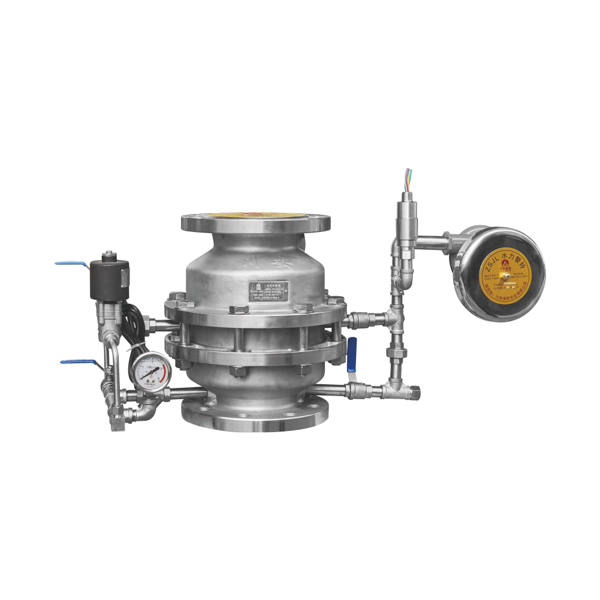
Double-interlock — both detector activation AND sprinkler operation must occur before any water enters downstream pipework.
Single-point failures, accidental impacts, and detection-system glitches cannot release water — protected dry-pipe network.
Continuous downstream pipe-integrity monitoring — any leak or break is detected before a fire event, not during one.
Cast iron standard, stainless steel for corrosive zones, grooved for fast-track install. Common control trim across all.
How Pre-Action Differs From Standard Deluge & Wet-Pipe Sprinkler Systems
All three system types use water as the suppression agent, but the way water is held back from the protected area differs fundamentally — which determines what happens during a fault, an accident, or a false alarm.
Wet-Pipe System
Pipework is permanently filled with water under pressure. Closed sprinkler heads release water individually when their fusible elements melt.
If a head is damaged: water discharges immediately at that point. Not suitable for water-sensitive areas.
Pipework: WATER · Trigger: 1 sprinkler head
Standard Deluge
Pipework is dry (atmospheric) with permanently open spray nozzles. Water held back only by the closed deluge valve.
If detection signal received: ALL nozzles in the zone discharge simultaneously. Single-condition trigger.
Pipework: AIR (atmospheric) · Trigger: 1 detection signal
Pre-Action (This Product)
Pipework is dry under supervised air/N₂ charge. Closed sprinkler heads as in wet-pipe. Water held back by closed deluge valve.
For water to discharge: BOTH a detector AND a sprinkler head must operate. Double-interlock.
Pipework: AIR (supervised) · Trigger: 2 conditions (AND gate)
How the Double-Interlock Pre-Action Sequence Works
Standby — Both Conditions Inactive
Detection system armed. Downstream pipework dry under supervised air/N₂ at 0.14–0.21 MPa. Pre-action valve held closed by control chamber pressure. Closed sprinkler heads intact.
Condition #1: Detection
Smoke, heat, or flame detector activates. Control panel signals — but does NOT energise the trip valve yet. Pre-alarm to facility staff. Water still cannot enter pipework.
Condition #2: Sprinkler Operates
A sprinkler head's fusible element melts in the heat. The supervised air/N₂ charge vents through the open head. Supervisory pressure switch confirms loss-of-charge.
Both AND'd → Discharge
With BOTH conditions confirmed, the control panel energises the solenoid trip valve. Pre-action valve opens. Water flows to all open sprinkler heads in the affected zone — controlled response, no false discharge.
For a complete decision framework comparing pre-action vs standard deluge vs wet-pipe alarm valves, with selection scenarios for 5 hazard types, see: Deluge Valve vs Pre-Action vs Wet Alarm Valve — Which to Specify?
Complete Technical Specifications
Pressure Ratings & Body — Cast Iron Standard (ZSFY 80~250-1.6A)
| Parameter | Value | Standard / Test |
|---|---|---|
| Nominal pressure | 1.6 MPa (PN16) | GB 5135.2 |
| Seal test pressure | 3.2 MPa | Hydrostatic, 10 min, zero leakage |
| Strength test pressure | 6.4 MPa | Hydrostatic, no deformation |
| Supervised pipework charge | 0.14 – 0.21 MPa | Air or nitrogen, low-pressure |
| Supervisory pressure switch setpoint | 0.10 MPa (low alarm) | Adjustable per project requirements |
| Body material — standard | Cast iron (grey) | Epoxy anti-corrosion coating |
| Sealing element | EPDM diaphragm (fabric-reinforced) | Sprinkler & clean-water service |
| Trim & piping | Brass / stainless steel | Corrosion-resistant standard |
| Connection | Flanged PN16 (GB / ANSI Class 150) | Drilling per order |
| Medium temperature | 4°C – 70°C | Indoor service typical |
| Suitable medium | Clean water (drinking-water grade preferred) | — |
Dimensions by Nominal Size — Cast Iron Standard
| Nominal Size | DN80 | DN100 | DN125 | DN150 | DN200 | DN250 |
|---|---|---|---|---|---|---|
| Valve assembly height (mm) | 560 | 600 | 690 | 740 | 930 | 1135 |
| Flange PCD (mm) | 160 | 180 | 210 | 240 | 295 | 355 |
| Bolt count × diameter | 8-Φ18 | 8-Φ18 | 8-Φ18 | 8-Φ22 | 12-Φ22 | 12-Φ26 |
| Working pressure | 1.6 MPa (all sizes) | |||||
Body Variants — Choose by Environment & Installation Method
| Variant | Model Code | Sizes Available | Best For |
|---|---|---|---|
| Cast iron — standard | ZSFY 80~250-1.6A | DN80 – DN250 | Standard data centres, indoor archives, most commercial installations |
| Stainless steel SS body — Ex-rated | ZSFY 100/150/200-1.6P-Ex | DN100, DN150, DN200 | Corrosive environments, hazardous areas, marine/coastal data centres |
| Grooved coupling — fast-install | ZSFY 100/150/200-1.6(G) | DN100, DN150, DN200 | Victaulic-piping systems, retrofit projects, fast-track schedules |
Triple Activation Modes
| Mode | Trigger | Use Case |
|---|---|---|
| Electric signal start (电信号启动) | Detection panel + sprinkler operation (double-interlock) | Standard primary mode for data centres and modern facilities |
| Wet or dry pilot pipe start (湿式或干式引导管启动) | Pilot sprinkler line + zone sprinkler operation | Sites without reliable detection panel or where hydraulic-only is required |
| Emergency manual (应急手动) | Manual trip ball valve on valve trim | Maintenance, commissioning, emergency local trip — always available |
Why Specify the ZSFY Pre-Action Deluge Valve
🔒 Genuine Double-Interlock — Two AND'd Conditions
Some "pre-action" valves on the market are single-interlock — they require either a detector OR a sprinkler activation, not both. This is faster-acting but offers far less false-discharge protection. The CA-FIRE ZSFY is configured for genuine double-interlock as standard: both the electrical detection signal AND the loss of supervised air pressure on the downstream side must be confirmed before the trip solenoid energises. This is the configuration explicitly required by Tier III/IV data centre design standards (Uptime Institute) and recommended by NFPA 13 for water-sensitive protected zones.
📡 Continuous Pipe-Integrity Monitoring
The supervised downstream air/N₂ charge isn't just a discharge interlock — it's also continuous leak detection on the entire downstream pipework. A pinhole leak, a damaged sprinkler head, a loose fitting, or a corrosion failure anywhere in the dry-pipe network will cause the supervisory pressure to drop below 0.10 MPa, triggering a supervisory alarm at the FACP before a fire event occurs. This is a major advantage over standard deluge systems, where pipework integrity is invisible until the system fires and a leak is discovered the hard way.
❄️ Freeze-Protected Dry-Pipe Network
Because the downstream pipework is filled with air or nitrogen rather than water during standby, the pre-action system is inherently freeze-protected — making it the correct choice not only for data centres but also for cold-storage warehouses, freezer rooms, refrigerated archives, and unheated parking structures in northern climates. The valve body itself remains in a heated mechanical room; only the protected-area pipework is exposed to freezing temperatures, and that pipework contains no water during standby.
🔧 Reset After Trip — No Component Replacement
After the system has tripped and the fire is controlled, the ZSFY can be reset to standby in a single maintenance visit without replacing any component. The reset sequence: (1) close upstream supply, (2) close zone sprinklers, (3) drain downstream pipework, (4) replace any operated sprinkler heads, (5) re-pressurise downstream with air/N₂ to 0.14 MPa, (6) re-prime control chamber, (7) restore supply. Total reset time: 60–90 minutes by a single trained technician. No diaphragm or piston replacement required after a routine trip.
Applications — Where Pre-Action Is the Correct Specification
Data Centres & Server Halls
Tier III and Tier IV data centres mandate pre-action protection per Uptime Institute guidelines. A single accidental water discharge in a server hall can cause millions in equipment damage and recovery downtime — the double-interlock is essentially insurance against that scenario.
Telecommunications Switching Halls
Mobile carrier core network equipment, switch rooms, and submarine cable landing stations. Same water-damage profile as data centres — accidental discharge risks national-scale telecoms outage.
Archives, Museums & Library Stacks
National archives, university special collections, art museums, and rare-book libraries hold irreplaceable materials. Pre-action ensures water discharge only when fire is genuinely confirmed by both detection and sprinkler operation — not from a damaged pipe or false alarm.
Cold-Chain & Freezer Warehouses
Pharmaceutical cold storage, frozen-food distribution centres, and refrigerated logistics warehouses operate at sub-zero temperatures where standard wet-pipe systems would freeze. Pre-action's dry pipework is freeze-immune during standby.
Pharmaceutical Clean Rooms & Labs
GMP pharmaceutical manufacturing clean rooms, biocontainment laboratories, and process areas where accidental water release would contaminate batches or violate biocontainment integrity.
Unheated Parking Structures & Loading Bays
Freeze-prone covered car parks, loading docks, and outdoor-exposed warehouse aisles in cold climates. Pre-action provides freeze-protection during winter standby with no anti-freeze chemistry required.
Pre-Action Deluge Valve Brands — Neutral Specification Reference
Engineers specifying pre-action systems often see Tyco DV-5A, Viking E-1, and Reliable DDX in international project documents. Below is a neutral specification reference comparing the CA-FIRE ZSFY against these widely-specified equivalents — to help engineers map their existing project specs to a CA-FIRE deliverable.
| Specification Point | CA-FIRE ZSFY | Tyco DV-5A (ref.) | Viking E-1 (ref.) | Reliable DDX (ref.) |
|---|---|---|---|---|
| Mechanism type | Diaphragm | Diaphragm | Diaphragm | Diaphragm |
| Working pressure | 1.6 MPa (PN16) | 1.2 MPa (175 psi) | 1.2 MPa (175 psi) | 1.2 MPa (175 psi) |
| Double-interlock available | ✓ Standard | ✓ Standard | ✓ Standard | ✓ Standard |
| Listing | GB 5135.2 (UL/FM optional) | UL / FM | UL / FM | UL / FM |
| SS body variant | ✓ Standard option | Special order | Special order | Special order |
| Grooved variant | ✓ Standard option | Available | Available | Available |
| Lead time (typical) | 6–8 weeks (ex-China) | 16–20 weeks | 16–20 weeks | 16–20 weeks |
Comparison provided for engineering reference only. CA-FIRE makes no claim regarding the proprietary engineering of the listed competitor products. UL/FM-listed CA-FIRE variants are available on specification — contact sales@ca-fire.com to confirm certification scope and lead time for your project.
Frequently Asked Questions
What's the difference between a pre-action deluge valve and a standard deluge valve?
The fundamental difference is in the downstream pipework state and the number of conditions required to discharge water.
A standard deluge valve serves an open-nozzle network: the downstream pipework is dry at atmospheric pressure, the nozzles are permanently open. When a single fire signal is received, the valve opens and ALL nozzles discharge simultaneously. Single-condition trigger.
A pre-action deluge valve serves a closed-sprinkler-head network with the downstream pipework under a supervised air or nitrogen charge. Two conditions must be met independently for water to discharge: (1) the detection system must activate AND (2) a sprinkler head must thermally operate, releasing the supervised charge. This double-interlock makes accidental discharge essentially impossible — the cost-justifying feature for water-sensitive facilities like data centres.
For a complete decision framework, see Deluge Valve vs Pre-Action vs Wet Alarm Valve — Which to Specify?
Why is pre-action specifically required for data centres — can't we just use a wet-pipe sprinkler?
Data centres concentrate enormous economic value into very small physical spaces — a single rack can hold $500K+ of equipment, and a server hall can contain hundreds of racks. Accidental water discharge causes damage that frequently exceeds the cost of the original fire that triggered it. A wet-pipe sprinkler system has water permanently in the pipework above the equipment — any pinhole leak, corrosion failure, or accidental impact discharges water onto the equipment.
Pre-action eliminates this risk in two ways: (1) the downstream pipework contains no water during standby, so a leak or impact cannot release water; (2) the double-interlock means even an accidental detector activation cannot release water without a sprinkler also operating thermally. The Uptime Institute Tier III and Tier IV standards explicitly require pre-action protection in data hall areas. NFPA 13 also recommends pre-action for any zone where water damage potential is comparable to or greater than fire damage potential.
What does "supervised air charge" mean and what pressure is used?
The downstream pipework of a pre-action system is filled with low-pressure air or nitrogen (typically 0.14–0.21 MPa) instead of water. This gas charge serves three functions:
(1) It acts as the second interlock condition. When a sprinkler head thermally activates, the supervisory air/N₂ charge vents through the open head — loss of supervisory pressure is the second confirming signal that combines with the detection signal to trigger water discharge.
(2) It provides continuous pipe-integrity monitoring. Any leak in the downstream pipework — pinhole, corrosion, damaged sprinkler, loose fitting — causes the supervisory pressure to drop. A supervisory pressure switch set typically at 0.10 MPa triggers a maintenance alarm at the FACP, allowing the leak to be repaired before a fire event occurs.
(3) It keeps the pipework dry and freeze-protected. No water means no freezing risk, even when the protected zone is unheated or refrigerated.
Nitrogen is preferred over air for two reasons: it doesn't promote internal pipe corrosion (no oxygen), and it doesn't introduce moisture into the pipework. For data centres and long-life installations, N₂ from a small bottle bank is the standard specification.
Can the pre-action deluge valve be used in cold-storage or freezer warehouses?
Yes — pre-action is one of the standard solutions for cold-storage fire protection precisely because the dry-pipe network is freeze-immune during standby. The valve body itself is installed in a heated mechanical room (above 4°C), but the protected-zone pipework can run through freezer rooms at -20°C or colder without any antifreeze additives or heat-tracing required.
Two design considerations for cold-storage installations: (1) Use nitrogen rather than air as the supervisory charge — it eliminates moisture condensation that could form ice particles in the pipework; (2) specify dry-type sprinkler heads rated for the cold-store temperature range. CA-FIRE's pre-action valve is fully compatible with both — the supervisory pressure setpoint and trim are specified during the order phase to match the cold-store design temperature.
How fast does a pre-action system actually respond compared to standard deluge?
Pre-action is inherently slower than standard deluge because it requires the second condition — a sprinkler head thermally activating — before water can flow. Realistic response times:
Standard deluge: <3 seconds from detection signal to full discharge from all nozzles. The detector fires the system instantly.
Pre-action: Detection alarm is instant (milliseconds), but water discharge waits for the sprinkler head to reach its activation temperature. For a 68°C-rated sprinkler in a typical data hall, this is approximately 30–90 seconds depending on fire size, ceiling height, and air movement. Once the sprinkler operates, water reaches it in 1–2 seconds.
This deliberate delay is the trade-off: data centre operators accept a 1-minute delay before discharge in exchange for essentially zero risk of accidental discharge. The pre-alarm to the facility staff (instant detector alarm, before water flow) gives them a window to investigate and abort if the alarm is false. By the time a sprinkler thermally activates, a real fire is genuinely present and water is the correct response.
What information do you need to prepare a quotation for a pre-action deluge valve?
To prepare an accurate quotation, please provide: (1) nominal size (DN80–DN250) and number of valves; (2) body variant preference — cast iron standard, stainless steel for corrosive zones, or grooved for fast-track install; (3) installation environment — data centre / cold-store / archive / clean-room — to confirm appropriate trim specification; (4) certification scope required — GB 5135.2 (standard), UL-listed (US/Middle East projects), FM-approved (insurance-driven specs); (5) connection standard (GB PN16 flange or ANSI Class 150); (6) supervised charge medium preference — air or nitrogen; (7) any existing project specification that references competitor models like Tyco DV-5A or Viking E-1 (we can map the equivalent CA-FIRE specification).
Contact sales@ca-fire.com or WhatsApp +86 18150362095. Standard GB-certified quotations: 1–2 business days. UL/FM-listed scope: 3–7 business days for engineering confirmation.
Related Deluge Valve Products
Further Reading — Pre-Action System Resources
Complete decision framework for system type selection — when each is the right choice, with five real-world hazard scenarios and side-by-side spec comparison. Read the comparison guide →
Neutral comparison of the major deluge and pre-action valve manufacturers — pricing tier, certifications, lead times, and matching CA-FIRE equivalents to existing project specs. Read the manufacturer guide →
Step-by-step explanation of standby, trip, discharge and reset for all deluge valve types including the pre-action double-interlock sequence. Read the operation guide →
Complete classification framework for matching deluge valve type to project requirements. Read the types guide →
Get a Quote — Pre-Action Deluge Valve (ZSFY Series)
DN80–DN250 · 1.6 MPa · Double-Interlock · Cast Iron / Stainless Steel / Grooved · UL/FM Optional
Data Centres · Archives · Cold Storage · Clean Rooms · Worldwide Export with English Documentation