
Deluge Valve Assembly
Horizontal Layout · DN50–DN350 · 1.6 / 2.5 MPa · Walk-Around Maintenance · Low-Ceiling Fit
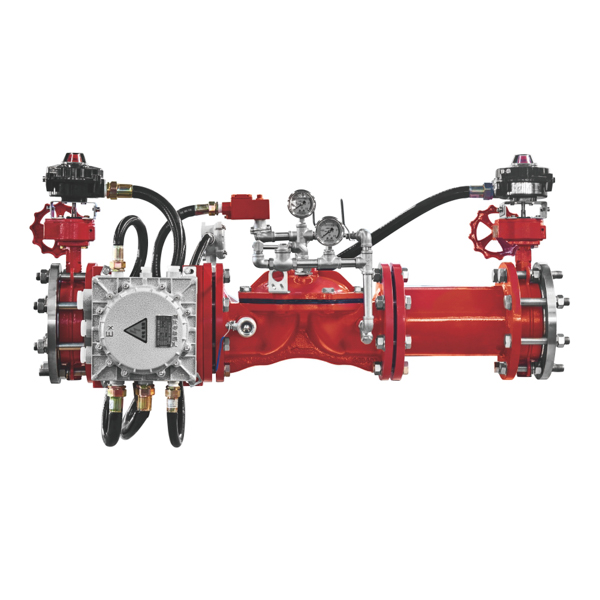
Fits standard 2.4m ceiling industrial mezzanines and ground-floor plant rooms — vertical skid needs ~2m clearance above frame.
All serviceable components at technician working height — no ladder, no scaffolding, no vertical reach for routine maintenance.
Inlet flange, outlet flange, electrical entry — same 3-connection install as vertical skid. No site pipework or wiring.
Every assembly hydrostatically tested at 1.5× working pressure before shipment — same factory acceptance protocol as vertical.
Horizontal Layout — Component Positioning & Walk-Around Access
The horizontal pry-mounted layout places the deluge alarm valve as the central spine of the assembly with all control trim, isolation valves, instrumentation, and the Ex-rated local control panel arranged at technician working height. The result is a station that can be commissioned, tested, and maintained without the operator ever needing to use a ladder or work at height.
Complete Technical Specifications
Assembly System Specifications
| Parameter | Value | Notes |
|---|---|---|
| Format | Horizontal pry-mounted assembly | 水平撬装式 — single-frame integration |
| Nominal pipe sizes | DN50 – DN350 | Sized to project hydraulics |
| Working pressure | 1.6 MPa (standard) · 2.5 MPa (Ex high-pressure) | Specified at order |
| Seal test pressure | 3.2 MPa (1.6 MPa) · 5.0 MPa (2.5 MPa) | Hydrostatic, factory |
| Strength test pressure | 6.4 MPa (1.6 MPa) · 8.0 MPa (2.5 MPa) | Hydrostatic, factory |
| Hydraulic resistance | < 0.08 MPa (1.6 MPa) · < 0.12 MPa (2.5 MPa) | End-to-end across the assembly |
| Frame material | Carbon steel painted RAL 3000 (red) | SS304 frame optional |
| Internal pipework | Carbon steel std · SS304/SS316 optional | Galvanised internal coating standard |
| Mode of operation | Remote auto / Site manual / Manual override | 3 modes always available |
| Ambient temperature | 4°C – 70°C standard | Heated cabinet variant available on request |
| Min ceiling required | ~1.0 m above the assembly frame | Fits standard 2.4m ceiling industrial spaces |
| Standards | GB 5135.2 · NFPA 13 · NFPA 15 · IEC 60079 | Full English documentation |
Ex-Rated Component Certifications
| Component | Ex Marking | IP Rating | Voltage |
|---|---|---|---|
| Local control panel (LCP) | Ex db IIC T6 Gb · Ex tb IIIC T80°C Db | IP66 / IP68 | 220 VAC / 5A · 24 VDC / 1.5A |
| Ex junction box (HY-8A-Ex) | Ex db IIB T6 Gb · Ex tb IIIC T80°C Db | IP66 | — |
| Solenoid trip valve (CT4) | Ex mb IIC T4 Gb · Ex mb IIIC T130°C Db | IP65 | 24 VDC / 220 VAC · 4–12 W |
| Solenoid trip valve (CT5) | Ex db IIC T5 Gb · Ex tb IIIC T95°C Db | IP65 | 24 VDC / 220 VAC · 5.5–12 W |
| Solenoid trip valve (CT6) | Ex db IIC T6 Gb · Ex tb IIIC T80°C Db | IP66 / IP68 | 24 VDC / 220 VAC |
| Pressure switch (CT6) | Ex db IIC T5 Gb · Ex tb IIIC T95°C Db | IP65 | — |
| Cable glands | Ex db IIC | IP66 minimum | — |
Why Specify the Horizontal Deluge Valve Assembly
📏 Low-Ceiling Fit — ~1m Clearance Sufficient
The horizontal layout requires only about 1 metre of clearance above the assembly frame for cable entry, lifting access, and routine maintenance reach. By comparison, the vertical skid requires roughly 2 metres of clearance for the upright valve column. For installations in standard 2.4m ceiling industrial mezzanines, ground-floor plant rooms, and most retrofit projects where a higher ceiling is not available, the horizontal assembly is the only viable factory-built option. The vertical skid simply doesn't physically fit in many real-world installation envelopes.
🚶 Walk-Around Access — Lower Total Maintenance Cost
Every routine maintenance task on a horizontal assembly is performed at technician working height — no ladder, no scaffold, no fall-arrest harness. Trip-testing the alarm pressure switch, draining the system, replacing a pressure gauge, manually exercising the deluge valve — all done from a standing position at the assembly side. Over a 20-year facility life with quarterly maintenance visits, the elimination of work-at-height typically saves 15–25 hours of labour per year per assembly, plus the cost of fall-protection equipment and permits. For facility owners running their own maintenance programs, this is a meaningful lifecycle cost factor.
🏭 Same Factory-Build Quality as Vertical Skid
The horizontal assembly is not a cost-reduced or compromised alternative to the vertical skid — it uses the same Ex-rated electrical components, the same valve mechanisms (ZSFM 1.6 MPa or ZSFM-Ex 2.5 MPa), the same factory hydrostatic test protocol at 1.5× working pressure, and the same certification scope (Chinese CNEx standard, ATEX/IECEx and UL/FM available on specification). The choice between horizontal and vertical is a physical-envelope and access-preference decision, not a quality or capability decision. Both formats deliver identical operational performance.
📋 Drawings & Documentation Provided Up Front
For project specification work, CA-FIRE provides a complete documentation package per assembly: certified GA drawing (general arrangement) in PDF and editable AutoCAD; P&ID schematic showing the mechanical and electrical interconnections; itemised bill of materials with manufacturer part numbers and Ex certification references; Ex certification certificates for every electrical component; hydrostatic test report on the assembled unit; and installation & commissioning manual in English. The drawing package is provided within 1–2 business days of inquiry — useful for tender submissions and design coordination work where drawing turnaround drives the project schedule.
Applications — Where the Horizontal Assembly Is the Right Choice
Commercial Ground-Floor Plant Rooms
Standard commercial industrial buildings with 2.4–3.0 m ceiling height in the mechanical rooms. Insufficient overhead clearance for vertical skid; horizontal assembly fits comfortably with normal cable entry routing.
Retrofit & Renovation Projects
Adding deluge protection to an existing facility where the available installation space was not designed for fire suppression equipment. Horizontal layout adapts to lower-ceiling mechanical spaces that vertical formats can't fit.
Industrial Warehouses & Logistics
Large-area warehousing with foam-water deluge protection, conveyor zones, or flammable-liquid storage. Plant rooms typically along the warehouse perimeter with standard floor-to-ceiling heights — horizontal assembly is the natural fit.
Power Plant Mechanical Mezzanines
Power station auxiliary mechanical mezzanines for transformer deluge, turbine hall protection — typically with 2.5–3.0m ceiling and walk-around platform layout. The horizontal format aligns with the existing platform circulation pattern.
Aircraft Hangar Plant Rooms
Foam-water deluge supply to NFPA 409 hangars, with the deluge valve station typically located in the hangar plant room or annex. Walk-around maintenance access aligns with hangar maintenance team workflow.
Owner-Operator Facilities — Lifecycle Cost Focus
Facilities where the building owner runs the maintenance program and lifecycle cost matters more than initial install. Walk-around access reduces 20-year maintenance cost meaningfully — see installation & commissioning guide for routine task time estimates.
Horizontal Assembly vs Vertical Skid — Which Do You Need?
CA-FIRE manufactures both formats and the choice is primarily about physical installation envelope and maintenance access preference. Both formats use identical Ex-rated electrical components, identical factory testing protocols, and identical certification scope.
Specify horizontal assembly when ceiling height is constrained, walk-around maintenance access is preferred, or the project specification favours the traditional horizontal layout. Specify vertical skid when floor space is constrained — typical of petrochemical plant rooms, offshore topsides, and retrofit installations where horizontal floor area is at a premium.
View Vertical Skid →Frequently Asked Questions
Can I get a deluge valve assembly drawing for my project specification?
Yes — CA-FIRE provides complete drawing packages for every horizontal deluge valve assembly. The standard package includes:
(1) Certified general arrangement (GA) drawing in PDF and editable AutoCAD format, with overall dimensions, flange face-to-face distances, lifting lug positions, frame mounting hole pattern, and electrical entry locations; (2) P&ID schematic showing all mechanical and electrical interconnections, supervised pressure points, alarm circuit map, and field termination points; (3) Bill of materials with manufacturer part numbers, Ex certification references, and IP ratings for every component; (4) Foundation plan with anchor bolt pattern and load reactions; (5) Cable schedule showing field wiring requirements between the assembly LCP and the FACP.
To request the drawing package for your project, email sales@ca-fire.com with: nominal valve size, working pressure (1.6 or 2.5 MPa), preferred actuation mode, certification scope, and any project-specific dimensional constraints. Standard turnaround for the drawing package is 1–2 business days.
What's the difference between "deluge valve assembly" and "deluge valve skid"?
Both terms refer to a complete pre-engineered, factory-built deluge valve station — the difference is in the physical orientation of the components on the steel frame:
The horizontal assembly arranges the deluge valve and all control trim along a horizontal axis, with components mounted at technician working height for walk-around maintenance access. Lower ceiling height needed, larger floor footprint, easier to maintain.
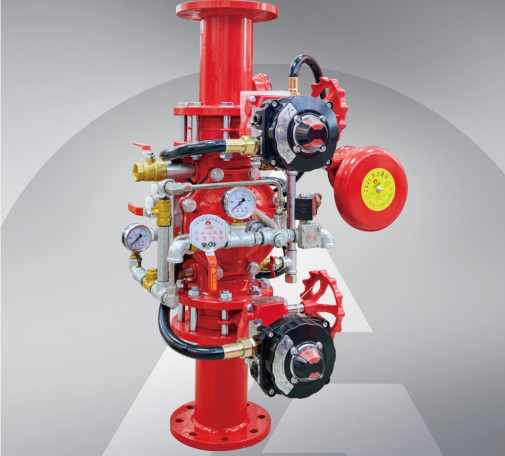
The vertical skid stacks components along a vertical axis, with the deluge valve body upright and trim arranged around it on a compact vertical frame. Smaller floor footprint, larger ceiling height needed, more compact for shipping and offshore installation.
Both terms are used interchangeably in some markets — particularly in BRI export contexts where local engineering vocabulary varies. When CA-FIRE quotes for a "deluge valve assembly", we default to the horizontal format unless the project specification explicitly calls for vertical (or unless the floor footprint is constrained, in which case we'll proactively recommend vertical). Both are available at every nominal size from DN50 to DN350.
Why specify the horizontal version rather than the vertical skid?
Three primary reasons to specify the horizontal assembly:
(1) Ceiling height constraint. The vertical skid needs approximately 2 metres of clearance above the frame for the upright valve column plus cable entry. Many real-world installations — standard 2.4m ceiling industrial spaces, retrofit installations in existing buildings, mechanical mezzanines — simply don't have this clearance available. The horizontal assembly fits comfortably in 1 metre of overhead clearance, which is available almost everywhere.
(2) Walk-around maintenance preference. Some facility owners and maintenance organisations require all routine maintenance to be performed without work-at-height risk. Pressure switches, gauges, drain valves, and the manual trip ball valve all positioned at technician working height eliminates the need for ladders, scaffold, or fall-arrest equipment for routine tasks. Over a 20-year facility lifecycle this is a meaningful labour-cost saving.
(3) Project specification or local norms. Some project specifications and some local engineering norms favour the traditional horizontal valve station layout. When the specification is fixed by the design engineer or the AHJ, supplying a vertical skid would be non-compliant regardless of any technical advantages.
How does the lifting and shipping work for a horizontal assembly compared to vertical?
Shipping crate dimensions differ significantly between the two formats. For DN150 size as an example:
Vertical skid: approximately 0.9m × 0.9m × 2.0m (footprint × height) — fits in a smaller crate, more compact shipping volume, easier to handle on offshore platforms where lifting capacity is finite. Lower shipping cost per unit volume but the upright orientation can make truck transport awkward in some markets.
Horizontal assembly: approximately 2.0m × 1.2m × 1.0m (length × width × height) — larger footprint crate but lower height. Easier to handle by forklift in standard warehouses. Better fit for sea container shipping (no height constraint issues at port handling). Generally more economical for inland projects with road-only transport.
Lifting on site: the horizontal format ships on its own structural frame and can be moved into position with standard forklift or pallet-jack handling. The vertical format typically requires overhead crane or gantry for upright positioning. Both formats are supplied with certified lifting lugs.
Can the horizontal assembly be supplied with the 2.5 MPa Ex-proof valve for petrochemical use?
Yes — the horizontal format is available with either the standard 1.6 MPa diaphragm valve (ZSFM) or the 2.5 MPa piston-type explosion-proof valve (ZSFM-Ex). Specify the working pressure at order; the assembly frame, pipework grade, and pressure-test scope all change accordingly.
The full BOM, factory testing protocol, and Ex certification scope are identical between horizontal and vertical at any given pressure rating — the choice is purely physical orientation. For details on when 2.5 MPa is required vs 1.6 MPa, see the explosion-proof deluge valve product page.
What information do you need to prepare a quotation for a deluge valve assembly?
To prepare an accurate quotation, please provide: (1) nominal valve size (DN50–DN350) and quantity of assemblies; (2) working pressure — 1.6 MPa diaphragm or 2.5 MPa piston-type Ex; (3) actuation mode preference — electric solenoid (standard), wet pilot, dry pilot, or all three; (4) installation environment — indoor / outdoor / sheltered; (5) hazardous area classification from the project Ex zone drawing; (6) certification scope — Chinese CNEx (standard), ATEX/IECEx, or UL/FM; (7) connection standards (GB PN16/PN25 flanges or ANSI Class 150/300); (8) any dimensional constraints on the installation envelope — particularly maximum length and ceiling height available.
Whether you need drawings up front for tender or design coordination, mention this in the inquiry — we can provide GA drawing and P&ID alongside the quotation, typically 1–2 business days for the standard CNEx scope or 3–7 business days for ATEX/UL/FM scope. Contact sales@ca-fire.com or WhatsApp +86 18150362095.
Related Deluge Valve Products
Further Reading — Assembly Installation & Documentation
Step-by-step install procedure for assembly-mounted deluge valves, NFPA 13 acceptance test walkthrough, Ex-cable-entry best practices, and downloadable commissioning checklist. Read the installation guide →
Annotated breakdown of every component on a complete deluge valve assembly — what each part does, how it interconnects, and the standard part numbers for replacement. Read the components guide →
Detailed coverage of the local control panel function on factory-built assemblies: wiring schedule, input/output signal map, manual override, BMS integration. Read the LCP guide →
Complete classification of all 7 deluge valve types with a project-to-product decision framework — including when to specify an assembly vs a skid vs a standalone valve. Read the types guide →
Get a Quote — Deluge Valve Assembly (Horizontal Pry-Mounted)
DN50–DN350 · 1.6 / 2.5 MPa · Ex db IIC T6 Gb · Walk-Around Access · GA Drawing & P&ID Provided
Commercial · Industrial · Warehouse · Power · Aircraft Hangar · BRI Export with Full English Documentation