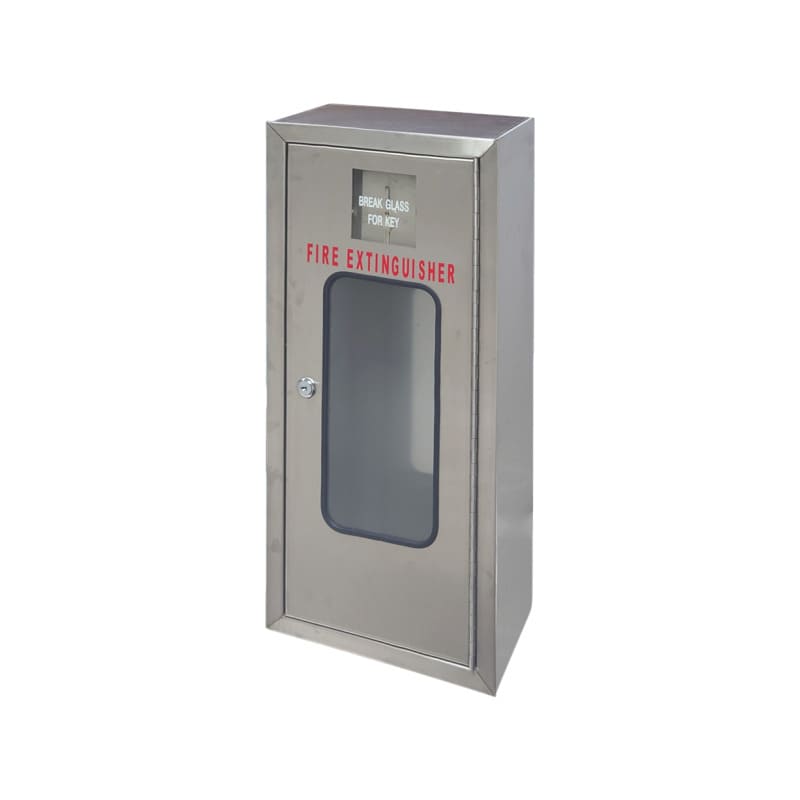
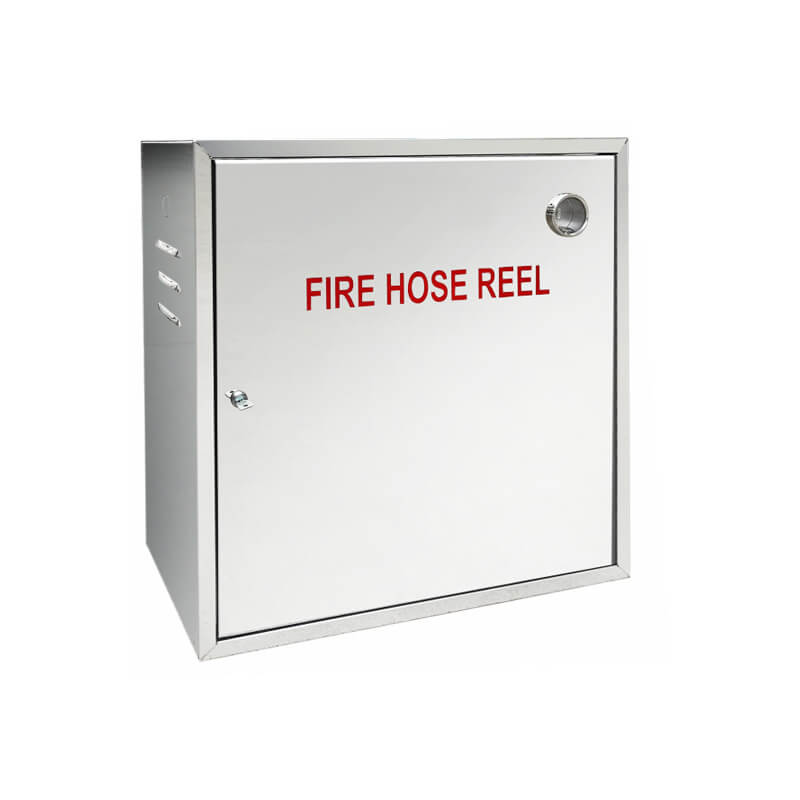
Stainless Steel Fire Hose Cabinet
304 / 316 stainless steel · Marine, chemical & food-grade · Corrosion-proof · 800–2000 mm
Corrosion-Proof Stainless Steel Fire Hose Cabinet
The CA-FIRE SG24 SS stainless steel fire hose cabinet exists for one reason: ordinary powder-coated steel cabinets do not survive in corrosive environments. Within 6 to 18 months of installation in a coastal building, a ship, a chemical plant or a food-processing facility, standard carbon-steel cabinets begin to show rust bleed-through, paint lift, hinge seizure and fastener corrosion. Five years in, many are beyond economical repair and need full replacement — taking down the hose station every time and creating a recurring maintenance budget line.
The SG24 SS series eliminates that cycle. Built from 304 stainless steel as standard and 316 stainless steel as an upgrade, the entire cabinet — body, door, hinges, fasteners, shelf brackets — resists salt spray, humidity, chlorides, acids, alkalis and most industrial chemicals. In a typical marine or coastal installation, a 304 SS cabinet will still be in service after 20 years with no repaint, no body replacement and no corrosion-driven tamper-seal failures.
The series covers four standard sizes from 800 × 650 × 240 mm to 2000 × 750 × 240 mm — notably including a 2000 mm model not available in the carbon-steel SG24 range, specifically for large Class I and III hose stations in high-rise and industrial projects. See the complete fire hose cabinet range for comparison, or the fire hose cabinet dimensions guide for size selection by standpipe class.
Key Features & Benefits
Six engineering features that make the SG24 SS the right choice for coastal, marine, chemical, food-processing and pharmaceutical facilities where ordinary powder-coated steel cabinets fail within months.
Technical Specifications
SG24 SS stainless steel fire hose cabinet model numbers and dimensions. Four standard sizes including the extended 2000 mm variant not available in the carbon-steel range. Custom sizes and OEM variants available on request.
| Model | Dimensions (mm) | Intended Hose Station Class | Typical Application | Material |
|---|---|---|---|---|
| SG24A65-J | 800 × 650 × 240 | Class II (1.5″ occupant hose) | Marine cabins, food-grade kitchens | 304 SS (316 option) |
| SG24B65Z-J | 1000 × 700 × 240 | Class II (1.5″ occupant hose) | Coastal hotels, food-processing | 304 SS (316 option) |
| SG24E65-J | 1800 × 700 × 240 | Class I / III (2.5″ FD hose) | Chemical plants, offshore structures | 304 SS (316 option) |
| SG24F65Z-JS | 2000 × 750 × 240 | Class I / III (combined station) | High-rise marine, LNG, large industrial | 304 SS (316 option) |
Material & Construction
| Body Material | 1.0–1.2 mm 304 stainless steel sheet (316 optional) |
| Composition (304) | Cr 18%, Ni 8%, Fe balance, C < 0.08% |
| Composition (316) | Cr 16–18%, Ni 10–14%, Mo 2–3% (pitting resistance) |
| Surface Finish | No. 4 brushed (default), mirror polish or bead-blast optional |
| Hinge | Stainless steel piano hinge (304 or 316 matched to body) |
| Fasteners | Stainless steel screws and rivets — no galvanic mismatch |
| Shelf Brackets | Stainless steel, welded or bolt-in |
| Door Options | Solid stainless, stainless frame with tempered glass insert, or ventilated louvred |
| Lock Options | Break-glass, key cylinder, padlock hasp |
| Signage | Laser-etched, engraved, or adhesive vinyl — permanent identification |
| Salt-Spray Test | ASTM B117, 1000+ hours pass (304), 2000+ hours pass (316) |
| Mounting | Surface-mount (default); recessed and semi-recessed available |
| Standards Reference | NFPA 14, GB 16280, EN 671 principles; ISO 9001 manufacturing |
304 vs 316 — Which Grade Do You Need?
Both 304 and 316 stainless steel are excellent fire cabinet materials, but they are not interchangeable. Picking the right grade is a function of your environment — specifically, how much chloride the cabinet will see. Here is the practical difference:
304 Stainless Steel — Default
- Composition 18% Cr / 8% Ni
- Best for Indoor, sheltered outdoor, general coastal, humid climates
- Resists Rain, humidity, most acids & alkalis, food, dairy, pharma
- Avoid in Direct salt spray, pool halls, chlorinated wash-down, offshore
- Salt-spray 1000+ hours ASTM B117
- Cost Baseline stainless price
- Typical use Coastal hotels, food plants, hospitals, general industrial
316 Stainless Steel — Upgrade
- Composition 16–18% Cr / 10–14% Ni / 2–3% Mo
- Best for Marine, offshore, chemical, chloride exposure
- Resists Everything 304 resists plus pitting and crevice corrosion in chlorides
- Avoid in Nothing practical for fire cabinet use
- Salt-spray 2000+ hours ASTM B117
- Cost Approximately 20–30% premium over 304
- Typical use Ships, offshore platforms, LNG terminals, swimming complexes, chlorine plants
What's Inside the Cabinet
SG24 SS cabinets ship empty by default so buyers can fit equipment matched to local spec, or fully equipped with a Class II hose station kit assembled at our Fujian factory. Typical contents for a fully-equipped marine-grade cabinet:
1.5″ or 2.5″ brass, bronze or stainless steel ball valve. For chloride environments, specify stainless or DZR brass to avoid dezincification.
65 mm × 25 m or 20 m polyester-jacketed rubber-lined hose. Resistant to mildew and chemical exposure common in industrial installations.
Stainless steel hose rack or enclosed reel, matched to the cabinet body material. Critical — a zinc-plated rack in a stainless cabinet corrodes first and stains the cabinet.
Fog / straight-stream nozzle, bronze or stainless construction for corrosion resistance. ABS is not recommended for extended outdoor or chemical exposure.
One or two 4/5 kg ABC dry powder or CO₂ extinguishers on a stainless steel bracket for combined-station cabinets.
Stainless spanner, hose strap, tamper seal, laser-etched instructions. All metal accessories in matched stainless grade.
For a complete component breakdown with NFPA citations, read What's Inside a Fire Hose Cabinet?.
Typical Applications
The SG24 SS series is specified wherever carbon steel cabinets fail prematurely. Eight environments where stainless steel is not a preference but a requirement:
Environment Suitability — Which Grade Fits Your Site?
Not every site needs stainless steel, and not every stainless site needs 316. Use the table below to match environment to grade. For sites where even carbon steel is adequate, our tempered glass series or standard powder-coated recessed cabinets are lower-cost alternatives.
| Environment | Carbon Steel (PC) | 304 Stainless | 316 Stainless |
|---|---|---|---|
| Indoor office / hotel corridor | ✓ Adequate | Over-spec | Over-spec |
| Humid tropical indoor | Marginal | ✓ Recommended | Over-spec |
| Sheltered outdoor (covered walkway) | Marginal | ✓ Recommended | Acceptable |
| Coastal building (1–10 km from sea) | ✗ Fails in 2–5 yr | ✓ Recommended | Acceptable |
| Direct sea-spray / beachfront | ✗ Fails in 1 yr | Acceptable | ✓ Recommended |
| Marine vessel / ship | ✗ Not suitable | Acceptable for interior | ✓ Required for exterior |
| Offshore platform / LNG terminal | ✗ Not permitted | ✗ Not sufficient | ✓ Required |
| Food processing wash-down area | ✗ Not hygienic | ✓ Recommended | Over-spec unless chlorinated |
| Pharmaceutical clean-room | ✗ Not permitted | ✓ Recommended | Acceptable |
| Swimming pool hall (chlorinated) | ✗ Fails in 6–18 mo | ✗ Pitting corrosion | ✓ Required |
| Chemical plant (acids / alkalis) | ✗ Not suitable | Check chemical list | ✓ Recommended |
Frequently Asked Questions
Why pay more for a stainless steel fire hose cabinet?
Because in a corrosive environment, a powder-coated carbon steel cabinet is not a fire hose cabinet — it is a future replacement project. Coastal buildings, marine vessels, chemical plants, food processing facilities and pool halls all expose cabinets to chlorides, humidity or aggressive chemicals that attack painted steel within months. Paint lifts, rust bleeds through, hinges seize, fasteners corrode, tamper seals fail, and within 3 to 5 years the whole cabinet needs replacement. A 304 stainless cabinet installed once stays in service for 20+ years with no repaint and no body replacement. The upfront premium is typically 40 to 70% over painted carbon steel; the total cost of ownership is usually lower before the seventh year.
What is the difference between 304 and 316 stainless steel?
Both are austenitic chromium-nickel stainless steels and both are excellent fire cabinet materials. The key difference is molybdenum: 316 stainless contains 2 to 3% molybdenum that 304 does not, and this molybdenum dramatically improves resistance to pitting and crevice corrosion in chloride environments. In plain English: 304 is the default stainless grade and handles everything from humid indoor air to general coastal exposure. 316 is the upgrade you specify when the cabinet will see direct salt spray, chlorinated pool atmospheres, marine exterior locations, chemical plant chloride streams, or offshore platforms. 316 costs roughly 20 to 30% more than 304 but is not necessary for most projects.
Is the whole cabinet stainless, or just the exterior?
The whole cabinet is stainless. Body, door, hinges, shelves, brackets and fasteners are all stainless steel in the grade you specify. This matters because the weak point of many cheap "stainless" cabinets is that the body is stainless but the hinges and fasteners are zinc-plated carbon steel, and those corrode first — sometimes leaking rust onto the stainless body and spoiling the finish. Using matched stainless grade throughout avoids galvanic mismatch and eliminates sacrificial rust points. Always ask suppliers to confirm what grade the hardware is, not just the body.
What standard sizes are available in the SG24 SS series?
Four standard sizes: SG24A65-J at 800×650×240 mm for Class II occupant-use stations; SG24B65Z-J at 1000×700×240 mm for general coastal commercial; SG24E65-J at 1800×700×240 mm for Class I and III fire-department stations; and SG24F65Z-JS at 2000×750×240 mm for high-rise marine, LNG terminals and large industrial combined stations. The 2000 mm model is specific to the stainless series — it is not offered in the carbon-steel range because the demand exists almost exclusively in industrial and marine projects that specify stainless anyway. Custom sizes outside this range are available with minimum order quantity. See the dimensions guide for class-based size selection.
Does the cabinet finish affect hygiene compliance?
Yes — this is why stainless is mandatory in food-processing, pharmaceutical and clean-room applications. Painted surfaces can chip and flake, creating particulate contamination and bacterial harbour sites that fail GMP, HACCP and FDA audits. Stainless steel has a smooth non-porous surface that can be pressure-washed, steam-cleaned or chemically sanitised without damage, and it does not support bacterial growth the way scratched paint does. For wash-down environments, specify the No. 4 brushed finish as standard — bead-blast and mirror polish are available but brushed is the industry default for hygiene applications.
How does it perform in salt-spray testing?
304 stainless steel routinely passes ASTM B117 salt-spray testing for 1000+ hours of continuous salt-fog exposure with no significant corrosion. 316 stainless doubles that to 2000+ hours under the same test. For comparison, powder-coated carbon steel typically shows scribe-line rust within 200 to 500 hours — meaning 304 SS offers 2 to 5 times the corrosion life of a painted cabinet, and 316 SS offers 4 to 10 times. Test certificates for the base material can be provided on request at quotation stage for projects that require documentation in the submittal package.
Can I get a glass-front variant in stainless steel?
Yes. A stainless steel frame with a 5 mm tempered safety glass insert is available as a door option on any SG24 SS model. This gives you the visual-inspection benefit of our tempered glass series combined with the corrosion resistance of stainless steel — ideal for coastal hotels, food-processing offices and marine passenger areas where both hygiene and walk-by inspection matter. Specify "stainless with tempered glass insert" at quotation time.
How do I request a quote for the SG24 SS series?
Email [email protected] with the model number (or required internal dimensions), stainless grade (304 or 316), surface finish (brushed / mirror / bead-blast), door option, lock option, quantity, destination country and project environment. The environment description is important — "for a coastal hotel 2 km from the sea" tells us 304 is appropriate; "for an offshore platform" tells us 316 is required. We respond within one business day with pricing, lead time and a project submittal package. CAD blocks, Revit families and CSI sections available at the CAD & BIM download centre.