

Fire Sprinkler Technical Guide
Quick Response vs Standard Response
Fire Sprinkler: What Really Differs?
The difference is not just speed — it is a fundamental change in glass bulb physics, NFPA 13 occupancy rules, and life-safety strategy. Specify the wrong type and your system may fail compliance review or deliver slower suppression than the hazard demands.
🕒 9 min read
🏭 NFPA 13 / 13R / 13D Compliant
Ask most contractors which sprinkler head they routinely install and the answer is “quick response.” But ask them exactly why — or when standard response is actually the correct choice — and the conversation gets complicated fast. The two types look nearly identical on a shelf. They thread into the same fittings, share the same K-factors, and come in the same temperature ratings. Yet their activation physics are measurably different, their NFPA 13 requirements are distinct, and mixing them incorrectly within a hydraulic design area is a code violation.
This guide explains the science of Response Time Index (RTI), how glass bulb diameter translates to real-world activation speed, where each type is mandated or prohibited under NFPA 13, and how to confidently specify the right head for any occupancy type.
In This Article
- What Is RTI? The Science Behind Response Speed
- How Quick and Standard Response Heads Physically Differ
- Side-by-Side Specification Comparison
- Quick Response Sprinkler — Deep Dive
- Standard Response Sprinkler — Deep Dive
- NFPA 13 Occupancy & Mixing Rules
- Decision Table: Which Type for Which Occupancy?
- Common Specification Mistakes
- Frequently Asked Questions
1. What Is RTI? The Science Behind Response Speed
RTI stands for Response Time Index. It is the single number that defines how quickly a sprinkler’s heat-sensitive element responds to a rising temperature environment — and it is the official metric used in NFPA 13 to classify a head as quick response or standard response.
RTI is calculated from plunge test data using the following relationship:
Response Time Index Formula
RTI = ti × √ui
ti = thermal lag time (seconds) measured in plunge test | ui = air velocity during test (m/s)
Units: (m·s)½
In plain English: a lower RTI value means the head responds faster. The smaller the glass bulb and the thinner the bulb wall, the less thermal mass the heat must overcome — and the faster the internal liquid expands to shatter the bulb and release the valve.
Quick Response
≤ 50
(m·s)½
Special Response
51–80
(m·s)½
Standard Response
> 80
(m·s)½
2. How Quick and Standard Response Heads Physically Differ
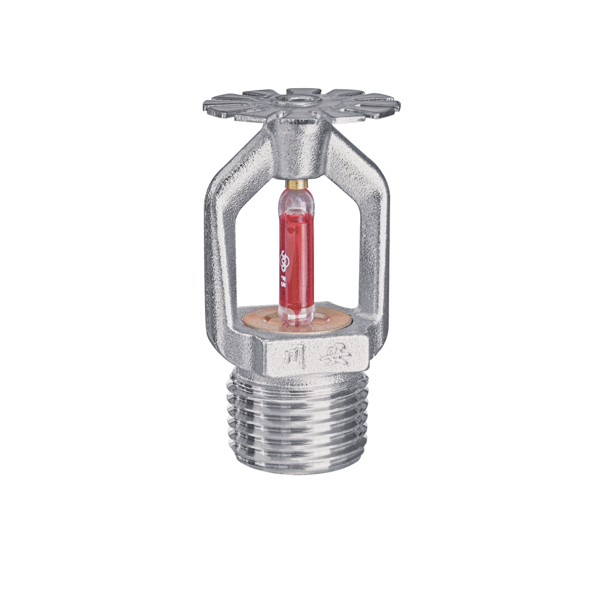
From across a room, a quick response head and a standard response head of the same type are visually indistinguishable. The difference is in the glass bulb — specifically its diameter and wall thickness — and in the C-factor (conductivity index) of the head’s frame arms that conduct heat toward the bulb.

3. Side-by-Side Specification Comparison
| Specification | Quick Response (QR) | Standard Response (SR) |
|---|---|---|
| RTI classification | ≤ 50 (m·s)½ | > 80 (m·s)½ |
| Glass bulb diameter | 3 mm (Q3) | 5 mm (Q5) |
| Relative activation speed | ~2× faster than SR under same conditions | Baseline reference speed |
| K-factor (metric) | K=80 / K=115 | K=80 / K=115 |
| Activation temperatures | 57 / 68 / 79 / 93 / 141 °C | 57 / 68 / 79 / 93 / 141 °C |
| Minimum ambient temperature | 4 °C | 4 °C |
| Thread connection | R½ (K=80) / R¾ (K=115) | R½ (K=80) / R¾ (K=115) |
| Installation orientations | Pendent / Upright / Sidewall | Pendent / Upright / Sidewall |
| Required for light hazard occupancies (NFPA 13)? | ✓ Yes — mandatory per NFPA 13 §8.3.2 | ✗ Not permitted in light hazard wet pipe |
| Used in ordinary hazard Group 1 & 2? | ✓ Permitted | ✓ Permitted |
| Used in extra hazard / high-piled storage? | ✓ Permitted with correct K-factor | ✓ Standard choice for many storage scenarios |
| Can be mixed with the other type in same area? | ✗ No — NFPA 13 prohibits mixing QR and SR in the same compartment | |
| Typical hydraulic design area benefit | Reduced design area allowed in light hazard | Full standard design area required |
| Relative unit cost | Slightly higher (precision bulb manufacturing) | Lower |
4. Quick Response Sprinkler — Deep Dive
The quick response fire sprinkler was developed in the 1980s as a result of fire research demonstrating that early activation — before a fire reaches flashover — dramatically improves life safety outcomes and reduces property damage. The key innovation was reducing the glass bulb diameter from 5 mm to 3 mm, cutting the thermal mass that the heat must overcome to trigger activation.
Why Faster Activation Saves Lives
In a compartment fire, temperature rises exponentially once a fire establishes itself. The critical threshold is flashover — typically occurring at ceiling-level temperatures above 600 °C — after which the entire room contents ignite simultaneously and survival for anyone inside becomes statistically improbable. A quick response sprinkler activating even 30–60 seconds earlier than a standard response head can suppress a fire before it reaches flashover conditions, particularly in light hazard occupancies with lower fuel loads.
Research published by the NFPA Research Foundation and the UL Fire Safety Research Institute consistently shows that quick response sprinklers operating in light hazard occupancies produce smaller water-damaged areas, lower temperatures at occupant head height, and fewer activated heads per fire event — all of which contribute to better outcomes.
📌 NFPA 13 Mandate
NFPA 13 Section 8.3.2 requires quick response sprinklers in all light hazard wet pipe systems — which includes most offices, hotels, schools, healthcare facilities, and residential occupancies. Standard response heads are not permitted as a substitute in these applications unless the AHJ grants an exception.
Hydraulic Design Area Reduction
One significant practical benefit of quick response heads in light hazard occupancies is that NFPA 13 permits a reduced hydraulic design area compared to standard response heads. The assumption is that because QR heads activate faster and suppress fire earlier, fewer heads will open simultaneously — reducing the peak flow demand on the system. This can allow designers to use smaller pipe sizes and pumps, with real cost savings on larger projects.
Best Applications for Quick Response Heads
- Offices, corporate campuses, and co-working spaces
- Hotels — guestrooms, corridors, and lobbies
- Schools, universities, and libraries
- Hospitals, clinics, and healthcare facilities
- Residential occupancies under NFPA 13R
- Retail stores and shopping centres (light hazard areas)
- Restaurants and hospitality venues
- Any wet pipe light hazard system under NFPA 13
5. Standard Response Sprinkler — Deep Dive
The standard response fire sprinkler is not an outdated or inferior product — it is a deliberately engineered choice for specific occupancy types and system designs. The 5 mm bulb’s greater thermal mass is advantageous in high-challenge fire scenarios, where a fire needs to be well-established before suppression begins, and in situations where early activation could open too many heads simultaneously, overwhelming the water supply.
Why Slower Can Be Better in Certain Occupancies
In ordinary and extra hazard occupancies — manufacturing plants, warehouses, paint shops, chemical storage, high-piled retail — fires can grow very rapidly and produce high heat release rates. In these environments, the hydraulic design intent is to suppress the fire with a large volume of water delivered simultaneously to the design area. If quick response heads were used, the lower RTI would cause heads at the perimeter of the fire to activate too early, before the fire has been fully identified by the hydraulic calculations, potentially skewing water distribution away from the seat of the fire.
Standard response heads — with their higher RTI — activate more selectively, concentrating water discharge on the heads directly above the fire rather than those on the thermal plume’s edge. This is exactly the behavior that ordinary and extra hazard hydraulic calculations are designed around.
⚠ Important: Dry Pipe and Pre-Action Systems
NFPA 13 does not require quick response heads in dry pipe or pre-action systems, even in light hazard occupancies. The rationale is that the water delivery delay inherent to dry systems negates the RTI advantage — by the time water reaches an activated QR head, the time benefit has been consumed by the transit delay. Standard response heads are fully acceptable in dry and pre-action systems across all hazard classifications.
Best Applications for Standard Response Heads
- Dry pipe and pre-action systems (all occupancies)
- Ordinary hazard Group 1 — light manufacturing, auto showrooms, bakeries
- Ordinary hazard Group 2 — machine shops, wood working, mercantile
- Extra hazard — flammable liquid handling, open foam processing
- High-piled storage and warehouse applications (with appropriate K-factor)
- ESFR sprinkler systems — which use their own special listing requirements
- Retrofit projects where existing system design was calculated for standard response
6. NFPA 13 Occupancy & Mixing Rules
The 2022 edition of NFPA 13 contains the following critical provisions for response type selection:
§ 8.3.2 — Light Hazard Wet Pipe Mandate
All sprinklers in light hazard wet pipe systems shall be quick response — unless the system is in a building without a finished ceiling, or the AHJ approves an alternative. This applies to new construction and major alterations.
§ 6.2.4 — No Mixing Within a Compartment
Quick response and standard response sprinklers shall not be used in the same compartment — defined as a space bounded by walls and a ceiling. Mixing types within the same room or area is prohibited because the hydraulic design calculations assume uniform RTI behavior across all heads in the design area.
§ 8.3.4 — Dry and Pre-Action Systems Exemption
Quick response sprinklers are not required in dry pipe or pre-action systems. Standard response heads are acceptable in these systems regardless of occupancy hazard classification, because the transit delay in dry systems makes the RTI advantage negligible.
§ 8.5 — Residential Sprinklers (NFPA 13D / 13R)
Residential sprinklers governed by NFPA 13D and 13R are listed under a separate UL standard (UL 1626) and have their own RTI requirements. They are always quick response by design but are listed separately from commercial QR heads. Do not substitute one for the other.
⚠ Retrofit Warning: Replacing SR Heads with QR
When retrofitting an existing building originally designed with standard response heads, you cannot simply swap in quick response heads without re-running the hydraulic calculations. The reduced design area assumptions for QR heads may allow pipe downsizing — but they could also create pressure imbalances if the existing pipe network was not sized for QR flow patterns. Always have a licensed fire protection engineer review the system before changing response types.
7. Decision Table: Which Type for Which Occupancy?
| Occupancy / Scenario | Recommended | Reason / NFPA 13 Basis |
|---|---|---|
| Office building — wet pipe | Quick Response | Light hazard — §8.3.2 mandatory requirement |
| Hotel guestrooms — wet pipe | Quick Response | Light hazard — mandatory; NFPA 13R also applies |
| School / university — wet pipe | Quick Response | Light hazard — §8.3.2 mandatory; life-safety priority |
| Hospital / healthcare — wet pipe | Quick Response | Light hazard — mandatory; non-ambulatory occupants require fastest suppression |
| Warehouse / high-piled storage — wet pipe | Standard Response | Ordinary/Extra hazard — hydraulic design based on SR behavior |
| Manufacturing plant — wet pipe | Standard Response | Ordinary/Extra hazard — SR preferred for controlled area suppression |
| Any occupancy — dry pipe system | Standard Response | §8.3.4 exempts dry systems; transit delay negates QR RTI advantage |
| Data center — pre-action system | Standard Response | Pre-action system — QR not required; SR selected for controlled activation |
| Residential home — NFPA 13D | Residential QR | Listed residential sprinklers — separate UL 1626 listing, not interchangeable with commercial QR |
| Retrofit — existing SR system, light hazard | Engineer Review | Cannot substitute QR for SR without re-calculating hydraulics — consult licensed FPE |
8. Common Specification Mistakes
Using standard response heads in a light hazard wet pipe system
This violates NFPA 13 §8.3.2. On inspection, the AHJ can require full head replacement — an expensive remediation on a large project. Always verify response type before ordering heads for light hazard applications.
Mixing QR and SR heads in the same room or compartment
This is explicitly prohibited by NFPA 13 §6.2.4. The hydraulic calculations assume uniform RTI behavior. A mixed compartment will have heads opening at different times, invalidating the flow distribution model the system was designed around.
Substituting residential sprinklers for commercial quick response heads
Residential sprinklers (UL 1626) are listed under different flow and coverage criteria than commercial QR heads (UL 199). They are not interchangeable even though both are quick response. Commercial systems must use commercially listed QR heads.
Replacing activated QR heads with SR heads on a light hazard system
After a fire event, replacement heads must match the original listing — same response type, K-factor, and temperature rating. Using SR heads to replace QR heads after activation turns a compliant system non-compliant and may not be discovered until the next inspection.
Identifying response type by visual inspection alone
QR and SR heads of the same model line look nearly identical. The only reliable way to confirm response type is by reading the model code stamped on the frame (Q3 = quick response, Q5 = standard response) or checking the manufacturer’s data sheet for the RTI value. Never assume based on appearance.
9. Frequently Asked Questions
Need to Specify Quick or Standard Response Heads?
Browse our full range of UL-listed quick response and standard response sprinkler heads. Technical data sheets, RTI certificates, K-factor tables, and OEM supply for contractors and distributors worldwide.
Related Products & Resources
Authoritative Sources & Standards
- NFPA 13: Standard for the Installation of Sprinkler Systems — National Fire Protection Association
- NFPA 13R: Sprinkler Systems in Low-Rise Residential Occupancies — National Fire Protection Association
- NFPA 13D: Sprinkler Systems in One- and Two-Family Dwellings — National Fire Protection Association
- NFPA Research Foundation — Fire Suppression Studies — National Fire Protection Association
- UL Fire Safety Certification Resources — Underwriters Laboratories
- FM Approvals: Fire Protection Product Testing — FM Global