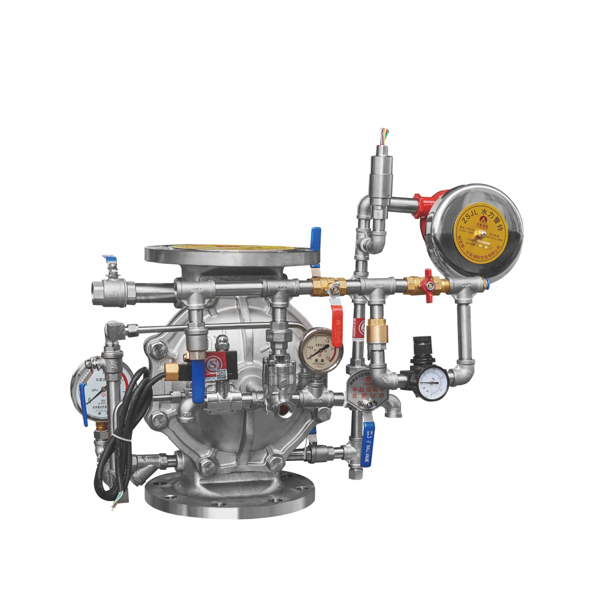
Stainless Steel Deluge Valve — SS304/SS316, Explosion-Proof & Air-Controlled (DN50–DN350)
A stainless steel deluge valve is specified in place of a standard carbon steel or ductile iron deluge valve when the installation environment would corrode a coated metal valve body within its design service life — coastal salt-air, offshore seawater spray, chemical plant atmospheres, high-humidity tropical climates, and food or pharmaceutical processing environments where hygiene regulations require stainless steel contact surfaces.
Corrosion resistance is the primary reason to specify this valve. The explosion-proof certification (Ex db IIC T6 Gb) and air-controlled dry pilot activation are additional capabilities that frequently apply in the same environments — offshore platforms, petrochemical refineries, and cold-climate industrial installations — making this a combined three-function product for the most demanding deluge system applications.
CA-FIRE’s ZSFM 50–350-1.6P-Ex stainless steel deluge valve is available in SS304 or SS316, DN50 through DN350, with electric solenoid, air-controlled dry pilot, or manual actuation. It delivers the same simultaneous total-zone discharge as a standard diaphragm deluge valve, in a body engineered for 15+ year service life where carbon steel would fail in 3–5 years.
For standard indoor or non-corrosive installations, the cast iron diaphragm deluge valve provides equivalent hydraulic performance at lower cost. For 2.5 MPa high-pressure applications in hazardous areas, see the explosion-proof deluge valve.
Technical Specifications
Model: ZSFM 50–350-1.6P-Ex
| Parameter | Value |
|---|---|
| Nominal Size | DN50 – DN350 (10 sizes) |
| Working Pressure | 1.6 MPa |
| Seal Test Pressure | 3.2 MPa |
| Strength Test Pressure | 6.4 MPa |
| Hydraulic Resistance | < 0.08 MPa |
| Body Material | SS304 (standard) · SS316 (marine/chloride environments) |
| Diaphragm Material | EPDM rubber · PTFE (chemical service option) |
| Explosion-Proof Rating | Ex db IIC T6 Gb / Ex tb IIIC T80°C Db |
| Protection Level | IP65 |
| Activation Method | Air-controlled dry pilot (0.1–0.3 MPa) · Electric solenoid (DC24V/AC220V) · Manual |
| Response Time | ≤ 2 s (auto/air) · ≤ 1 s (manual) |
| Operating Temperature | −20°C to +70°C |
| Operating Medium | Water · Foam-water mixture (up to 6%) |
| Connection Type | Flanged — GB standard (ANSI on request) |
| Service Life | ≥ 15 years |
| Standards | GB 5135.7-2019 · IEC 60079 · NFPA 13 (on request) |
| Certifications | National fire product certification · PICC liability insurance · Ex certification |
Dimensional Data
| DN (mm) | Height (mm) | Flange Bolt Circle (mm) | No. of Bolts | Weight (kg) |
|---|---|---|---|---|
| 50 | 270 | 160 | 8 | 42 |
| 65 | 270 | 180 | 8 | 55 |
| 80 | 330 | 200 | 8 | 78 |
| 100 | 340 | 220 | 8 | 95 |
| 125 | 415 | 250 | 8 | 130 |
| 150 | 435 | 280 | 8 | 165 |
| 200 | 555 | 340 | 12 | 240 |
| 250 | 655 | 400 | 12 | 320 |
| 300 | 800 | 460 | 16 | 450 |
| 350 | 850 | 520 | 16 | 610 |
Dimensional drawings and CAD files available on request — sales@ca-fire.com
SS304 vs SS316 — Which Grade to Specify
This is the first selection decision for any stainless steel deluge valve order. The two grades have identical mechanical properties and hydraulic performance — the difference is entirely in corrosion resistance to specific chemical agents.
SS304 is the standard grade. It provides excellent resistance to oxidising acids, most industrial chemical atmospheres, and general corrosive environments where chloride ion concentration is low. Correct specification for inland chemical plants, wastewater treatment, food and beverage processing, and general high-humidity industrial environments.
SS316 contains approximately 2% molybdenum, which provides dramatically superior resistance to chloride-induced pitting and crevice corrosion. SS316 is the mandatory specification for any installation within approximately 5 km of the coast, in direct contact with seawater or salt spray, on offshore platforms, in marine vessels, or in chemical plants processing chlorine compounds or chloride-containing acids. The cost premium over SS304 is modest; the performance difference in chloride environments is the difference between 15-year service life and 3–5 year failure.
When in doubt, specify SS316. The cost difference is small relative to the labour and downtime cost of premature valve replacement in a corrosive environment.
| Environment | Correct Grade |
|---|---|
| Inland chemical plant, wastewater, food processing | SS304 |
| Coastal (within 5 km of sea) | SS316 |
| Offshore platform, marine vessel | SS316 |
| Seawater contact or chloride compounds | SS316 |
| General high-humidity, non-chloride | SS304 |
| Pharmaceutical, cleanroom | SS304 or SS316 (project-specific) |
Key Features
Stainless Steel Body — Corrosion Resistance Without Coating Dependence
The fundamental advantage of a stainless steel deluge valve over a coated carbon steel or ductile iron equivalent is that corrosion resistance is inherent in the material, not dependent on a coating that can chip, crack, or undercut.
Epoxy and paint coatings on carbon steel valves are vulnerable to mechanical damage during installation, differential thermal expansion between coating and substrate, and chemical vapour penetration through microscopic defects. Once the coating is compromised, rapid under-film corrosion develops — often invisibly — until the next inspection reveals structural degradation or blocked alarm ports. In coastal and offshore environments, coating failure can occur within 2–3 years of installation.
A stainless steel deluge valve body corrodes at an extremely slow, predictable rate across its full specification envelope regardless of surface damage. The valve removed after 15 years of service in a coastal environment looks functionally identical to the one installed — no pitting, no underfilm rust, no alarm port blockage from corrosion debris.
Deluge Valve Diaphragm — EPDM or PTFE
The deluge valve diaphragm in the stainless steel model is available in two materials to match the process environment:
EPDM rubber (standard): Compatible with clean water, foam-water mixture up to 6% concentrate, and most general industrial water supplies. Suitable for the majority of installations. Service life ≥ 5 years under normal operating conditions before inspection and replacement assessment.
PTFE (chemical service option): Specified when the water supply or environment involves hydrocarbon contamination, strong acids or alkalis, solvents, or other aggressive chemicals incompatible with EPDM. PTFE provides near-universal chemical resistance at the cost of slightly reduced flexibility — suitable for petrochemical and chemical process applications where EPDM would degrade. Specify PTFE diaphragm at time of order.
Both diaphragm materials can be replaced in-line without removing the valve body from the pipeline — bonnet removal only, no pipe cutting required.
Air-Controlled Dry Pilot — Freeze-Proof Activation
The air-controlled activation system replaces the water-filled wet pilot line used in standard deluge valves with a pressurised dry air or nitrogen line (0.1–0.3 MPa). This has two practical consequences:
Freeze prevention: No standing water in the pilot line means no freezing risk in sub-zero environments — cold storage facilities, outdoor installations in northern climates, and cryogenic plant areas. The air-controlled stainless steel deluge valve is the standard specification for freezing-environment deluge systems where a wet pilot would be impractical.
Pre-action capability: The dry pilot can be configured in a double-interlock arrangement requiring both a fire detection signal AND pilot line activation before the valve opens — preventing accidental water discharge in sensitive environments. This makes the valve suitable for pre-action system configurations protecting data halls, archives, and cold-chain facilities where accidental discharge would cause damage comparable to a moderate fire.
Electric solenoid (DC24V or AC220V) and manual activation are available as primary or backup modes alongside air-controlled operation.
Explosion-Proof Certification — Zone 1/2 Hazardous Areas
All electrical components carry independent explosion-proof certification: Ex db IIC T6 Gb / Ex tb IIIC T80°C Db · IP65
| Hazardous Zone | Atmosphere | Certified |
|---|---|---|
| Zone 1 | Explosive gas — present under normal operation | ✓ |
| Zone 2 | Explosive gas — present under abnormal conditions | ✓ |
| Zone 21 | Explosive dust — present under normal operation | ✓ |
| Zone 22 | Explosive dust — present under abnormal conditions | ✓ |
IIC gas group covers hydrogen and acetylene — the most ignition-sensitive gases — making this valve compliant for virtually all hazardous area classifications encountered in petrochemical and offshore applications. Per IEC 60079-1, all Ex housings prevent internal sparks from reaching surrounding flammable atmospheres.
Note the distinction from the 2.5 MPa explosion-proof deluge valve: that valve is specified for high-pressure petrochemical systems (up to 2.5 MPa) where the elevated pressure rating is the primary requirement. This stainless steel model is specified when corrosion resistance is the primary requirement and explosion-proof certification is an additional necessity of the same environment.
Stainless Steel vs Carbon Steel Deluge Valve — Selection Guide
| Factor | Stainless Steel Deluge Valve | Carbon Steel / Cast Iron Deluge Valve |
|---|---|---|
| Body corrosion resistance | ✓ Inherent — material property | Depends on coating integrity |
| Coastal/marine environment | ✓ SS316 specified | Not recommended |
| Chemical plant atmosphere | ✓ SS304/SS316 suitable | Limited — coating vulnerable |
| Offshore platform | ✓ SS316 mandatory | Not suitable |
| Indoor climate-controlled | Suitable (higher cost) | ✓ Standard, cost-effective |
| Explosion-proof requirement | ✓ Ex variant available | Available (separate model) |
| Sub-zero / freeze-risk | ✓ Air-controlled pilot | Wet pilot freezes |
| Food/pharma hygiene | ✓ SS required | Not suitable |
| Diaphragm options | ✓ EPDM or PTFE | EPDM only |
| 15-year lifecycle cost (corrosive) | ✓ Lower | Higher — replacement cycles |
| Initial cost | Higher | ✓ Lower |
Applications
Offshore oil and gas platforms: Engine rooms, pump rooms, wellhead areas, and process deck deluge systems — SS316 body with air-controlled dry pilot for freeze protection and Ex-rated accessories for Zone 1 compliance. CA-FIRE stainless steel deluge valves have been installed on South China Sea offshore infrastructure for Sinopec and CNOOC subsidiaries.
Coastal power plants and desalination facilities: Transformer deluge systems, cable tunnel suppression, and cooling water pump room protection within 5 km of the coast — salt-air atmosphere makes SS316 the correct long-term specification versus carbon steel valves requiring re-coating every 2–3 years.
Petrochemical refineries (corrosive process areas): Chemical reactor buildings, solvent storage, acid plant protection, and loading terminal deluge systems — SS304 for general chemical atmospheres, SS316 where chloride compounds are present. PTFE diaphragm option for hydrocarbon or strong acid contact.
Cold storage and freeze-risk installations: Refrigerated warehouses, cold-chain distribution, and outdoor pipeline systems in northern climates — air-controlled dry pilot eliminates water-in-pilot-line freezing that would prevent standard deluge valve activation in sub-zero conditions.
LNG terminals and gas processing: Zone 1 methane atmospheres with temperature extremes and coastal or offshore exposure — the combination of SS316 corrosion resistance, IIC Ex certification, and air-controlled operation addresses all three environmental requirements simultaneously. Per NFPA 59A LNG facility standards.
Food and pharmaceutical processing: Stainless steel body required by food safety regulations and HACCP compliance. The SS304 valve eliminates corrosion contamination risk from iron-bodied valves in regular wash-down environments.
Frequently Asked Questions
When should I specify SS316 instead of SS304? Specify SS316 for any installation within approximately 5 km of the coast, on offshore platforms, in direct contact with seawater or salt spray, or in chemical environments where chlorides are present in the atmosphere or process fluids. For all other corrosive environments without significant chloride risk, SS304 provides adequate protection at lower cost. If in doubt, specify SS316 — the cost difference is modest and the performance margin in chloride environments is substantial.
What is the difference between this valve and the explosion-proof deluge valve? The explosion-proof deluge valve is a 2.5 MPa piston-type valve specified primarily for high-pressure petrochemical systems. This stainless steel model is 1.6 MPa and specified primarily for corrosive environments — the explosion-proof certification is an additional feature for hazardous-area installations that also have corrosion exposure. If you need 2.5 MPa in a non-corrosive hazardous area, specify the explosion-proof model. If you need corrosion resistance with hazardous-area certification at 1.6 MPa, specify this model.
Can this valve be used in a pre-action system? Yes. The air-controlled dry pilot is specifically designed for double-interlock pre-action configurations — requiring both a fire detection signal and pilot line activation before the valve opens. Suitable for data centres, archives, cold-chain facilities, and other sensitive environments where accidental discharge must be prevented.
What diaphragm material should I specify for a petrochemical application? Specify PTFE diaphragm for applications involving hydrocarbon contact, strong acids or alkalis, or solvent atmospheres. Specify standard EPDM for water and foam-water service — EPDM is suitable for the majority of petrochemical deluge applications where the medium is water or foam-water mixture rather than process fluid.
Is this valve compatible with foam suppression systems? Yes. EPDM and PTFE diaphragm materials are both compatible with foam-water mixture at up to 6% concentrate — AFFF, AR-AFFF, FFFP, and protein foam types. No modification to the valve body required.
What maintenance does a stainless steel deluge valve require? Quarterly visual inspection of body, trim, and gauges. Annual functional test of solenoid and pressure switches. Biennial diaphragm inspection — replace if cracking, hardening, or deformation detected. The stainless steel body requires no re-coating, rust treatment, or anti-corrosion touch-up — reducing annual maintenance time and consumable costs significantly compared to carbon steel equivalents in corrosive environments.
Related Products
- Deluge Valve — Full Range & Selection Guide
- Diaphragm Deluge Valve — Cast Iron Flanged — standard indoor/non-corrosive installations
- Explosion-Proof Deluge Valve 2.5MPa — high-pressure piston type for petrochemical
- Deluge Valve Skid — Vertical Explosion-Proof — complete factory-assembled hazardous-area station
- Stainless Steel Alarm Valve — SS304/SS316 for wet-pipe sprinkler systems in corrosive environments
- Foam Bladder Tank System — foam proportioning for foam-water deluge
Email: sales@ca-fire.com · Mobile: +86 13400715622 · WhatsApp: +86 18150362095 · WeChat: 404863577 · www.ca-fire.com
| Specification | Details |
|---|---|
| Product Name | Stainless Steel Explosion-Proof/Air-Controlled Deluge Valve |
| Model | ZSFM 50~350-1.6P(Ex) |
| Core Function | Explosion-proof fire suppression, air-controlled activation, corrosion resistance |
| Working Pressure | 1.6MPa |
| Sealing Test Pressure | 3.2MPa |
| Strength Test Pressure | 6.4MPa |
| Hydraulic Resistance | <0.08MPa |
| Material | 304/316 stainless steel (optional) |
| Explosion-Proof Rating | Ex db IIC T6 Gb/Ex tb IIIC T80°C Db |
| Activation Method | Air-controlled (dry pilot) + electric/manual backup |
| Protection Level | IP65 |
| Application Temperature | -20°C to +70°C |
| Operating Medium | Clean water, foam mixture |
| Service Life | ≥15 years (under normal operating conditions) |
| Certification | National fire product certification, PICC liability insurance, Explosion-proof certification |
Dimension Specifications
| DN (mm) | Height (mm) | Flange Bolt Circle Diameter (mm) | Number of Bolts | Weight (kg) |
|---|---|---|---|---|
| 50 | 270 | 160 | 8 | 42 |
| 65 | 270 | 180 | 8 | 55 |
| 80 | 330 | 200 | 8 | 78 |
| 100 | 340 | 220 | 8 | 95 |
| 125 | 415 | 250 | 8 | 130 |
| 150 | 435 | 280 | 8 | 165 |
| 200 | 555 | 340 | 12 | 240 |
| 250 | 655 | 400 | 12 | 320 |
| 300 | 800 | 460 | 16 | 450 |
| 350 | 850 | 520 | 16 | 610 |
H3: Performance Parameters
- Response Time: ≤2 seconds (air-controlled/electric activation); ≤1 second (manual activation)
- Maximum Flow Rate: Up to 360L/s (depending on DN size)
- Air-Controlled Pressure Range: 0.1-0.3MPa
- Control Voltage: DC24V, ≤1.6A
- Power Consumption: 55W (control panel); 12W (solenoid valve)
- Compatibility: Works with pre-action systems, foam suppression systems, and fire detection systems
- Connection Type: Flange connection (DN50~350)