Deluge Valve Skid — Vertical Explosion-Proof Skid-Mounted Assembly (DN50–DN350)
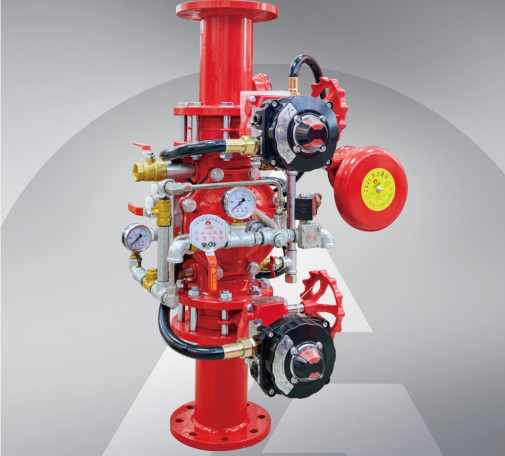
A deluge valve skid is a factory pre-assembled fire suppression station that integrates the deluge alarm valve, control trim, pipework, instrumentation, and local control panel onto a single structural skid frame — delivered to site as a complete, pressure-tested unit ready for connection to the water supply and detection system.
The skid format eliminates field assembly errors, compresses installation to a single mechanical and electrical connection sequence, and provides a documented factory test record before any component leaves the manufacturing facility.
CA-FIRE’s vertical explosion-proof deluge valve skid (Model ZSFM 50–350-1.6-Ex) is engineered for hazardous industrial environments where three requirements apply simultaneously: explosion-proof certification for Zone 1/2 classified areas (Ex db IIC T6 Gb / Ex tb IIIC T80°C Db), a compact vertical footprint where floor space is constrained, and complete system integration with a factory-tested local control panel included.
For standard non-hazardous-area installations requiring a pre-assembled station, see the horizontal deluge valve assembly. For individual valve supply without skid frame, see the diaphragm deluge valve.
Technical Specifications
Model: ZSFM 50–350-1.6-Ex (Vertical Skid-Mounted)
| Parameter | Value |
|---|---|
| Nominal Size | DN50 – DN350 |
| Working Pressure | 1.6 MPa |
| Seal Test Pressure | 3.2 MPa |
| Strength Test Pressure | 6.4 MPa |
| Hydraulic Resistance | < 0.08 MPa |
| Valve Body Material | Carbon steel (standard) · Stainless steel (optional) |
| Skid Frame Material | Carbon steel with anti-corrosion coating · SS option |
| Explosion-Proof Rating | Ex db IIC T6 Gb / Ex tb IIIC T80°C Db |
| Protection Level | IP65 |
| Activation Modes | Automatic · Remote linkage · Manual |
| Response Time | ≤ 2 s (auto/remote) · ≤ 1 s (manual) |
| Control Voltage | DC24V, ≤ 1.6A |
| Power Consumption | 55W (panel) · 12W (solenoid) |
| Operating Temperature | −20°C to +70°C |
| Operating Medium | Water · Foam-water mixture |
| Connection Type | Flanged (GB standard · ANSI on request) |
| Service Life | ≥ 15 years |
| Standards | GB 5135.7-2019 · IEC 60079 · NFPA 13 (on request) |
| Certifications | National fire product certification · PICC liability insurance · Ex certification |
Skid Dimensional Data
| DN (mm) | Height (mm) | Width (mm) | Depth (mm) | Weight (kg) |
|---|---|---|---|---|
| 50 | 2,200 | 800 | 600 | 320 |
| 80 | 2,500 | 900 | 650 | 480 |
| 100 | 2,800 | 1,000 | 700 | 650 |
| 150 | 3,200 | 1,100 | 750 | 920 |
| 200 | 3,600 | 1,200 | 800 | 1,300 |
| 250 | 4,000 | 1,300 | 850 | 1,750 |
| 300 | 4,500 | 1,400 | 900 | 2,300 |
| 350 | 5,000 | 1,500 | 950 | 3,100 |
Skid dimensional drawings and P&ID diagrams available on request — sales@ca-fire.com
Key Features
Vertical Skid Design — Up to 40% Smaller Floor Footprint
All components — main valve, isolation valves, strainer, pressure gauges, solenoid trim, alarm connections, and control panel — are arranged vertically on the structural steel skid frame rather than spread horizontally. For a DN200 valve station, the vertical skid occupies under 2 m² versus 3–4 m² for an equivalent horizontal assembly.
The vertical frame also provides inherent structural rigidity against the vibration loads common in pumping stations, compressor rooms, and industrial processing areas — relevant both structurally and for long-term instrument reliability.
Explosion-Proof Certification — Zone 1/2 and Zone 21/22
Every electrical component carries independent explosion-proof certification:
Ex db IIC T6 Gb / Ex tb IIIC T80°C Db · IP65
| Hazardous Zone | Environment | Certified |
|---|---|---|
| Zone 1 | Explosive gas — present under normal operation | ✓ |
| Zone 2 | Explosive gas — present under abnormal conditions | ✓ |
| Zone 21 | Explosive dust — present under normal operation | ✓ |
| Zone 22 | Explosive dust — present under abnormal conditions | ✓ |
The IIC gas group certification covers hydrogen and acetylene — the most ignitable industrial gases — making this skid compliant for virtually every hazardous area classification encountered in petrochemical, oil and gas, mining, and chemical plant applications.
Per IEC 60079-0 and the ATEX framework, all explosion-proof housings on the skid contain any internal ignition source, preventing spark propagation to surrounding flammable atmospheres.
Deluge Valve Control Panel — Integrated Local Station
The deluge valve control panel integrated into every skid is the local command and monitoring interface for the complete station. It provides:
- Real-time supply pressure and system pressure display
- Valve open/closed position indicator
- Solenoid activation and fault status
- Alarm pressure switch status
- Manual activation button (explosion-proof, IP65) — the deluge valve local control panel emergency release operates in ≤ 1 second regardless of automatic system status
- Standard dry-contact signal outputs for connection to the facility FACS, DCS, or SCADA system
- Optional 4–20mA pressure transmitter outputs and Modbus RTU module for distributed control integration
The deluge valve panel operates at DC24V (55W) and interfaces directly with all major fire alarm control panel brands — no proprietary gateway required. For DCS integration, specify the Modbus RTU option at time of order.
Factory Pre-Assembled and Pressure Tested
Every deluge valve skid assembly leaves CA-FIRE’s facility after completing:
- Hydrostatic strength test at 6.4 MPa on the fully assembled skid
- Seal integrity test at 3.2 MPa
- Functional activation test across all three modes — automatic, remote, and manual
- Explosion-proof component inspection against certification drawings
- Pre-wiring of all electrical connections between control panel, solenoids, and pressure switches
- Pre-piping of all trim connections — alarm port, drain, test lines, and strainer
A factory acceptance test (FAT) report documenting all results ships with every skid. On site, the installation team connects the water supply flange, discharge header, detection signal cable, and power supply — and the system is ready for commissioning.
Three Independent Activation Modes — Full Redundancy
Automatic: Fire detector sends signal to the integrated control panel → panel energises explosion-proof solenoid → deluge valve opens in ≤ 2 seconds.
Remote linkage: Facility FACS or DCS sends activation signal to the control panel → zone-by-zone activation from a central control room without local intervention.
Manual: Explosion-proof manual release button on the local control panel → direct operator activation in ≤ 1 second, independent of automatic and remote systems.
All three modes are independently functional — no single-point failure can render the system inoperable.
What’s Included in the Deluge Valve Skid Assembly
Main valve and isolation:
- Deluge alarm valve (diaphragm type, ZSFM series), flanged DN50–DN350
- Supply-side OS&Y gate valve or butterfly isolation valve
- Downstream test and drain valve
Trim and instrumentation:
- Explosion-proof solenoid valve (DC24V)
- Strainer on supply and trim lines
- Supply pressure gauge and system pressure gauge
- Explosion-proof alarm pressure switch (IP65)
- Water-motor alarm gong
- Manual emergency release (explosion-proof)
Control and monitoring:
- Integrated explosion-proof local control panel (IP65, DC24V)
- Pre-wired signal cables between all electrical components
- Terminal block for field connection to fire alarm / DCS system
Structure:
- Vertical carbon steel skid frame with anti-corrosion coating
- Stainless steel frame option for corrosive environments
- All interconnecting trim pipework in stainless steel
How the Deluge Valve Skid Works
Standby: Deluge alarm valve held closed by control-chamber water pressure. Downstream open-nozzle pipework is dry. The local control panel monitors system pressure and detector status continuously.
Fire detected: Explosion-proof detector identifies fire condition → signal to integrated control panel within seconds.
Solenoid activates: Control panel energises explosion-proof solenoid on trim → control-chamber pressure vents to drain → supply pressure lifts internal diaphragm → main valve opens fully in ≤ 2 seconds.
Simultaneous discharge: Water or foam-water mixture fills the downstream distribution header and discharges instantly through all open nozzles across the protected zone — total-area coverage with no inter-zone delay.
Alarm output: Flow through the alarm port drives the water-motor gong and triggers the explosion-proof alarm pressure switch → signal to local control panel and all connected monitoring systems simultaneously.
Manual override: Operator presses explosion-proof manual release button on local control panel → valve opens in ≤ 1 second regardless of automatic system status.
Reset: Solenoid de-energised → control chamber re-pressurised → diaphragm reseats → downstream piping drained via skid drain valve → system returns to standby.
Skid vs. Site-Built Installation — Key Differences
| Factor | Deluge Valve Skid | Site-Built Assembly |
|---|---|---|
| Assembly location | Factory — controlled conditions | Site — variable conditions |
| Pressure testing | ✓ Full system FAT before dispatch | Individual component tests only |
| Ex component connections | ✓ Factory-made, certified | Field-made — certification risk |
| Installation time on site | Pipe + electrical connections only | Full valve, trim, and panel assembly |
| Error risk | Minimal — factory QC | Higher — site conditions |
| Documentation | ✓ FAT report included | Field test records only |
| Single supplier responsibility | ✓ Yes | Multiple vendors |
| Lead time | 4–12 weeks (size/config dependent) | Component lead times vary |
Applications
Petrochemical refineries and chemical plants: Process units, reactor buildings, solvent storage, and loading bays — Zone 1/2 classified environments where Ex certification is a legal requirement and floor space between process equipment is minimal.
Offshore oil and gas platforms: Every square metre carries structural and operational cost. The vertical skid minimises deck penetration and structural loading while delivering a complete certified deluge station for wellhead areas, compressor modules, and pump rooms.
LNG and gas processing facilities: Zone 1 methane atmospheres — covered by IIC gas group certification. The pre-assembled, pre-tested skid simplifies commissioning in remote or time-critical LNG project environments. Compliant with NFPA 59A LNG facility requirements.
Coal handling plants and mines: Transfer stations, crusher buildings, and underground roadways where combustible coal dust creates Zone 21 classified atmospheres — directly covered by the Ex tb IIIC T80°C Db dust certification.
Power generation facilities: Turbine halls, transformer enclosures, cable tunnels, and fuel oil storage — high-value assets where reliable suppression and explosion-proof electrical safety are simultaneously required.
Compact urban industrial facilities: Chemical processing or paint manufacturing plants in urban or port areas where building footprint constraints make the vertical skid the only viable full-station configuration.
Standards and Certifications
| Standard | Scope |
|---|---|
| GB 5135.7-2019 | Chinese national standard — deluge alarm valves |
| IEC 60079-0 / IEC 60079-1 | International explosion-proof equipment — general and flameproof enclosure |
| GB 50151 | Design standard for foam fire extinguishing systems |
| NFPA 13 | Sprinkler system installation — available on request |
| NFPA 15 | Water spray fixed systems for fire protection |
| ATEX Directive 2014/34/EU | EU explosion-proof equipment — reference standard |
PICC product liability insurance and national fire product certification are included with every skid. Third-party Ex certification documentation is provided as part of the FAT package.
Frequently Asked Questions
What is the difference between a deluge valve skid and a standard deluge valve assembly? A deluge valve skid is factory pre-assembled — all components mounted, interconnected, pre-wired, and pressure-tested as a complete system before delivery. A site-built assembly installs individual components on site. The skid eliminates field assembly errors, provides a documented FAT record, and — critically for hazardous-area installations — ensures all Ex component interconnections are made under factory quality conditions rather than on site.
What is the lead time? DN50–DN200 standard models: typically 4–6 weeks from order confirmation. DN250–DN350 and custom configurations (stainless body, non-standard flange, foam integration, additional instrumentation): 8–12 weeks. A confirmed delivery schedule is provided with every quotation.
Can the deluge valve skid be installed outdoors? Yes. IP65 covers outdoor installation against dust and water jets. For coastal or high-humidity environments, CA-FIRE recommends the stainless steel body and frame option. Contact sales@ca-fire.com with site conditions for a specific recommendation.
Can the skid integrate with our existing FACS / DCS / SCADA? Yes. Standard dry-contact signal outputs for activation, alarm, and fault status are compatible with all major fire alarm panel brands. 4–20mA pressure transmitter outputs and Modbus RTU communication modules are available as options for DCS/SCADA integration. Specify your interface requirements when requesting a quotation.
Is the skid suitable for foam-water suppression? Yes. The deluge alarm valve handles foam-water mixture at up to 6% concentrate without modification. The skid includes a foam inlet connection point for integration with a balanced-pressure foam proportioner or bladder tank system. CA-FIRE can supply complete foam proportioning equipment as part of the skid package.
Can CA-FIRE customise the skid? Yes. Standard customisation options: nominal size (DN50–DN350), body material (carbon steel or SS304/316), skid frame finish, solenoid voltage (DC24V or AC220V), flange standard (GB or ANSI), foam system integration, additional pressure transmitters, and remote position indicators. Submit project specifications to sales@ca-fire.com for a tailored proposal.
Related Products
- Deluge Valve — Full Range & Selection Guide
- Horizontal Deluge Valve Assembly — horizontal skid for non-hazardous-area installations
- Explosion-Proof Deluge Valve 2.5MPa — high-pressure piston type for petrochemical systems
- Stainless Steel Deluge Valve — SS304/SS316 for corrosive environments
- Diaphragm Deluge Valve — individual valve supply, DN50–DN350
- Foam Bladder Tank System — foam proportioning for foam-water deluge systems
Email: sales@ca-fire.com · Mobile: +86 13400715622 · WhatsApp: +86 18150362095 · WeChat: 404863577 · www.ca-fire.com
General Specifications
| Specification | Details |
|---|---|
| Product Name | Vertical Skid-Mounted Explosion-Proof Deluge Valve |
| Model | ZSFM 50~350-1.6 (Ex) |
| Core Function | Explosion-proof fire suppression, rapid fluid release, backflow prevention, alarm triggering |
| Working Pressure | 1.6MPa |
| Sealing Test Pressure | 3.2MPa |
| Strength Test Pressure | 6.4MPa |
| Hydraulic Resistance | <0.08MPa |
| Material | Carbon steel (standard), Stainless steel (optional) |
| Installation Type | Vertical skid-mounted |
| Explosion-Proof Rating | Ex db IIC T6 Gb/Ex tb IIIC T80°C Db |
| Protection Level | IP65 |
| Application Temperature | -20°C to +70°C |
| Operating Medium | Clean water, foam mixture |
| Service Life | ≥15 years (under normal operating conditions) |
| Certification | National fire product certification, PICC liability insurance, Explosion-proof certification |
Dimension Specifications
| DN (mm) | Skid Height (mm) | Skid Width (mm) | Skid Depth (mm) | Weight (kg) | Number of Valves per Skid |
|---|---|---|---|---|---|
| 50 | 2200 | 800 | 600 | 320 | 1 |
| 80 | 2500 | 900 | 650 | 480 | 1 |
| 100 | 2800 | 1000 | 700 | 650 | 1 |
| 150 | 3200 | 1100 | 750 | 920 | 1 |
| 200 | 3600 | 1200 | 800 | 1300 | 1 |
| 250 | 4000 | 1300 | 850 | 1750 | 1 |
| 300 | 4500 | 1400 | 900 | 2300 | 1 |
| 350 | 5000 | 1500 | 950 | 3100 | 1 |