
Marine Fire Nozzle — Brass for Continuous Saltwater Duty
The CA-FIRE marine fire nozzle is the brass version of our standard QLD adjustable nozzle — same hydraulic performance, completely different construction. Solid brass body with electroplated galvanised surface treatment instead of anodised aluminium. Engineered for continuous service on ships, fire boats, port facilities and offshore platforms where saltwater corrosion would destroy a land-based nozzle within a few seasons. 115–475 LPM adjustable flow, 34-metre reach, SOLAS Chapter II-2 compatible.
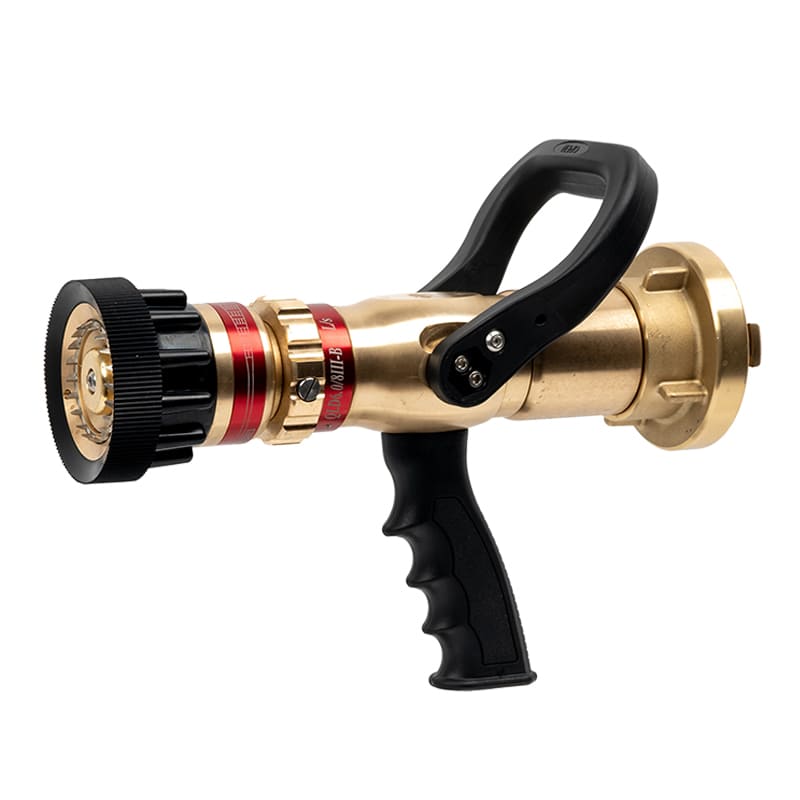
The Brass Nozzle Built for Decades of Saltwater Service
Aluminium fire nozzles do not survive saltwater. Even hard-anodised aluminium develops pitting at threaded sections, internal seal surfaces and flow control mechanisms within a few seasons of continuous shipboard service. The pitting starts on a single fitting and propagates rapidly — and once the flow control or valve seat fails, the whole nozzle has to be replaced, often as part of a fleet-wide certification audit at significant cost.
The CA-FIRE marine fire nozzle QLD6.0/8III-B is the brass version built specifically to avoid that failure mode. The body is solid brass — naturally corrosion-resistant in saltwater, with two centuries of service history in marine equipment. Over the brass body we add an electroplated galvanised surface treatment that provides a second protective layer specifically against the harsh combination of salt spray, hot engine room conditions, and the chemical contaminants common in port and refinery environments.
Hydraulic performance is identical to our standard land-based QLD adjustable nozzle: 115/230/360/475 LPM in four operator-selectable detents, 34 metres reach at 7 bar working pressure, with the same flow control and jet/fog pattern switching. The only differences are construction material (brass vs aluminium), total mass (3.8 kg vs 1.8 kg) and intended environment (continuous marine vs land-based).
Why Brass for Marine
- Solid brass body — naturally corrosion-resistant in saltwater
- Electroplated galvanised surface treatment — second protective layer
- Identical hydraulic performance to land-based QLD6.0/8III-B
- 115/230/360/475 LPM at 7 bar — adjustable detent flow control
- 34-metre reach with switchable jet ↔ fog pattern
- 1.5″ / 2.5″ Storz / Machino / NH / NPSH couplings
- Brass-on-brass coupling avoids galvanic corrosion at the connection
- SOLAS Chapter II-2 compatible specification
- Class society approval available (LR / DNV / ABS / BV / CCS / RINA)
- Custom thread specifications (BS, GOST, AS, JIS) on OEM orders
- 100% pressure tested before shipment
Brass Marine vs Standard Aluminium
The QLD6.0/8III-B comes in two distinct versions for two distinct environments. Same model number, same hydraulic performance — completely different material engineering. Pick the version that matches your operating environment.
QLD6.0/8III-B (Brass)
- Body MaterialSolid Brass
- Surface TreatmentElectroplated Galvanised
- Total Weight3.8 kg
- Flow Rate115–475 LPM (identical)
- Working Pressure7 bar (identical)
- Reach34 m (identical)
- Coupling1.5″ / 2.5″ (identical)
- Service LifeDecades in saltwater
QLD6.0/8III-B (Aluminium)
- Body MaterialAnodised Aluminium
- Surface TreatmentHard Anodising
- Total Weight1.8 kg
- Flow Rate115–475 LPM (identical)
- Working Pressure7 bar (identical)
- Reach34 m (identical)
- Coupling1.5″ / 2.5″ (identical)
- Service LifeDecades on land
Three Material Decisions That Define a Marine Nozzle
A marine nozzle is not just "the land nozzle painted differently". Three specific material engineering decisions separate equipment that survives decades at sea from equipment that fails in three seasons.
Solid Brass Construction
Body machined from solid brass billet — not brass-plated aluminium. The complete body, including internal channels and threaded sections, is brass throughout. Brass forms a protective patina layer in saltwater that prevents further oxidation, and is dimensionally stable across the temperature range of shipboard engine rooms and deck installations.
Electroplated Galvanisation
Galvanised electroplating is applied over the brass body as a second corrosion barrier — specifically against the combination of salt spray, refinery atmosphere, port industrial pollution and shipboard chemical exposure that destroy bare brass over time. The two-layer protection (brass + galvanisation) is the standard for naval and merchant marine equipment.
Brass-on-Brass Connection
The coupling is forged brass — not steel or aluminium. Pairing brass coupling with brass body avoids bimetallic galvanic corrosion at the connection point, which is the most common failure mode of mixed-metal marine equipment. Standard 1.5″ / 2.5″ Storz / Machino / NH / NPSH; BS, GOST, AS and JIS custom threads on OEM request for naval and flag-state specific projects.
QLD6.0/8III-B Marine — Technical Data
| Model | QLD6.0/8III-B (Brass Marine Variant) |
| Body Material | Solid Brass |
| Surface Treatment | Electroplated Galvanised — additional anti-corrosion layer |
| Working Pressure | 7 BAR (≈100 PSI) |
| Flow Rate | 115 / 230 / 360 / 475 L/M — 4 operator-selectable detents |
| Reach | 34 m |
| Spray Pattern | Switchable: straight jet ↔ wide fog |
| Total Weight | 3.8 kg (vs 1.8 kg for aluminium version) |
| Coupling Sizes | 1.5″ / 2.5″ |
| Coupling Types | Storz / Machino / NH / NPSH (BS / GOST / AS / JIS on OEM request) |
| Coupling Material | Forged brass (brass-on-brass to avoid bimetallic corrosion) |
| Primary Applications | Cargo ships, container vessels, bulk carriers, tankers, tugs, fire boats, port facilities, offshore platforms, naval auxiliaries, shipyards, port fire stations |
| Standards | GB 8181 · NFPA 1964 compatible · SOLAS Chapter II-2 compatible · ISO 9001 manufacturing |
| Class Society Approval | Available on project order: LR · DNV · ABS · BV · CCS · RINA |
| MED Wheel-Mark | Available on project order — contact sales with flag state |
| Pressure Testing | 100% pressure tested before shipment |
| Insurance | PICC product liability coverage on all shipments |
Where Marine Fire Equipment Has to Survive
Cargo Ships & Container Vessels
Container ships, bulk carriers and tankers carry permanent fire main installations with deck hydrants, engine room hose stations and cabin firefighting equipment. The QLD6.0/8III-B is permanently mounted at hose stations across the vessel and survives the full operating life of the ship — engine room heat, salt spray on deck, port pollution and crew firefighting drills.
Fire Boats & Tugs
Harbour fire boats and tugs equipped for firefighting duty operate the nozzles in continuous contact with seawater — including direct seawater pumping through the nozzle for fire main supply. The brass body and galvanised surface treatment are specifically engineered for this duty cycle. The 34-metre reach and 475 LPM peak flow handle ship-to-ship and ship-to-shore fire response.
Ports, Harbours & Dockyards
Port and harbour fire stations equip shore fire teams with nozzles that must work in saltwater-saturated atmosphere. The brass marine variant is the standard equipment for port fire crews, dockyard fire installations and shipyard facilities — paired with our deck hydrant range for complete supply-side and discharge-side marine compatibility.
Offshore Drilling & Production Platforms
Offshore platforms face the harshest marine corrosion environment in the industry — continuous salt spray, hydrocarbon exposure, hot equipment, and remote location making field replacement difficult and expensive. The QLD6.0/8III-B brass marine nozzle is specified for fire stations on drilling rigs, production platforms, FPSO units and floating storage facilities.
Naval Auxiliary & Supply Vessels
Naval auxiliary vessels, supply ships and coast guard vessels with onboard firefighting capability operate to military specifications that often require brass marine equipment with documented corrosion resistance. The brass marine nozzle with optional flag-state custom threads (BS, GOST, AS) and class society certification is suitable for naval and government fleet procurement.
Shipyards & Marine Refineries
Shipyards, ship repair facilities and shore-based marine refineries face a combination of saltwater atmosphere AND industrial chemical pollution that destroys ordinary nozzles fastest. The two-layer corrosion protection on the marine variant (solid brass + galvanised treatment) handles both saltwater and industrial exposure in one product.
Frequently Asked Questions — Marine Fire Nozzle
What is a marine fire nozzle?
What is the difference between the marine QLD6.0/8III-B and the standard QLD6.0/8III-B?
Why brass instead of aluminium for marine fire nozzles?
What ships and platforms is the QLD6.0/8III-B designed for?
Is the QLD6.0/8III-B marine nozzle SOLAS-compliant?
What does the marine QLD6.0/8III-B weigh?
Can the standard aluminium QLD nozzle be used at sea occasionally?
What couplings are available on the marine fire nozzle?
What is the lead time for the marine fire nozzle?
Request a Quote on the Marine Fire Nozzle
24-hour quote turnaround. Free CAD drawings, test certificates and class society documentation for confirmed projects. SOLAS Chapter II-2 compatibility, MED wheel-mark certification, LR / DNV / ABS / BV / CCS / RINA class approval available on project orders for marine and naval customers.