

Fire Sprinkler Technical Guide
When Do You Need a Sidewall Sprinkler?
Types, Applications & NFPA 13 Rules
Most spaces use pendent sprinklers — but corridors, guestrooms, and spaces where overhead piping is impossible demand a different approach. Sidewall heads solve problems that no other orientation can.
🕒 9 min read
🏭 NFPA 13 / 13R Compliant
A hotel corridor. A historic building with ornate plaster ceilings that cannot be penetrated. A narrow retail space where a central branch line would block signage. A guestroom where the architect insists the ceiling remains completely clean. In every one of these situations, the same solution appears in the fire protection engineer’s drawing set: a sidewall sprinkler head.
The sidewall head is one of the most misunderstood — and most underspecified — tools in fire protection design. Engineers who only work with commercial pendent systems sometimes treat it as an edge case. In reality, sidewall heads cover a distinct and surprisingly broad set of applications, and choosing the wrong type — horizontal versus vertical, standard versus extended coverage — has significant consequences for code compliance, hydraulic performance, and installation cost. This guide covers all of it. For full technical specifications, K-factor tables, model codes, and ordering information, see our sidewall fire sprinkler head product page.
In This Article
- How a Sidewall Sprinkler Works
- The Three Types: Standard, Extended Coverage & Vertical
- Specification Comparison Table
- Standard Horizontal Sidewall — Deep Dive
- Extended Coverage Sidewall — Deep Dive
- Vertical Sidewall — Deep Dive
- NFPA 13 Installation Rules
- When to Use Sidewall: Application Decision Table
- Common Installation Mistakes
- Frequently Asked Questions
1. How a Sidewall Sprinkler Works
Every sprinkler head — pendent, upright, or sidewall — shares the same activation mechanism: a liquid-filled glass bulb holds the valve cap in place until rising temperature shatters it, releasing pressurized water onto a deflector plate. The deflector’s geometry is what makes each type unique.
A sidewall sprinkler is mounted on a wall or the side of a beam, with its orifice facing horizontally into the room. When activated, water hits an asymmetric deflector that redirects the flow into a characteristic quarter-spherical spray pattern — projecting water outward across the room and downward toward the floor, while directing very little water back toward the wall on which the head is mounted.
This geometry is the key insight: the sidewall head converts a horizontal water jet into a room-filling distribution pattern without needing a pipe anywhere near the center of the ceiling. One head on one wall — fed by a single branch line running along the wall — can cover the entire floor area of a narrow room or corridor.
Sidewall Spray Pattern vs Pendent — The Key Difference
Pendent Head
Full hemispherical pattern downward from ceiling center. Requires branch pipe crossing the room overhead.
Sidewall Head
Quarter-spherical pattern outward & downward from wall. Branch pipe runs along the wall — ceiling stays clear.
2. The Three Types: Standard, Extended Coverage & Vertical
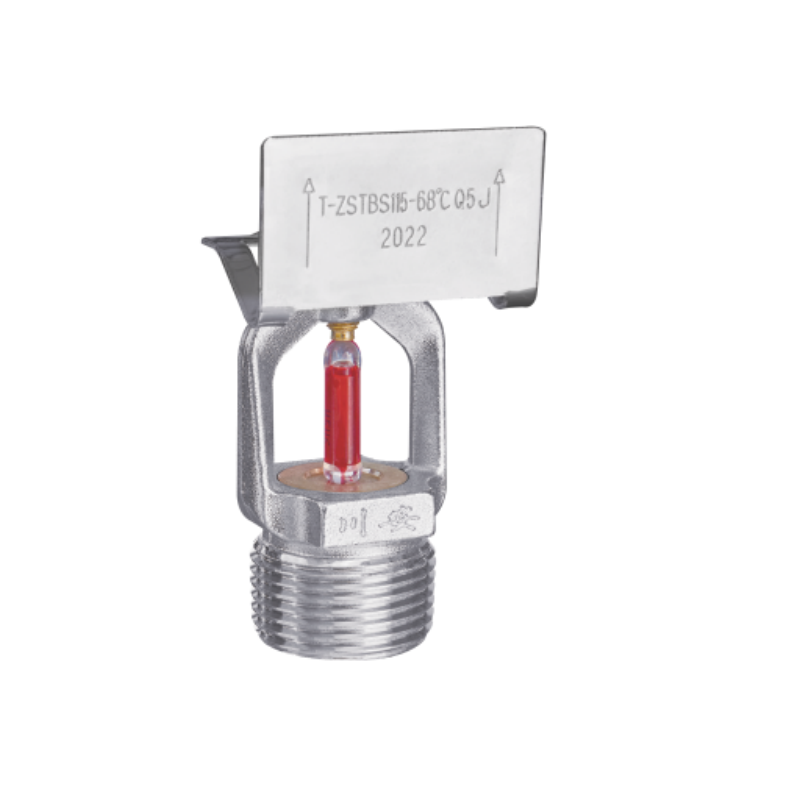
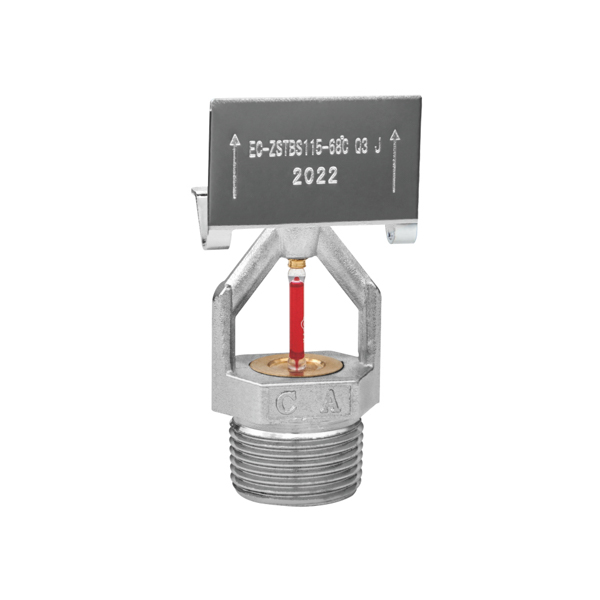
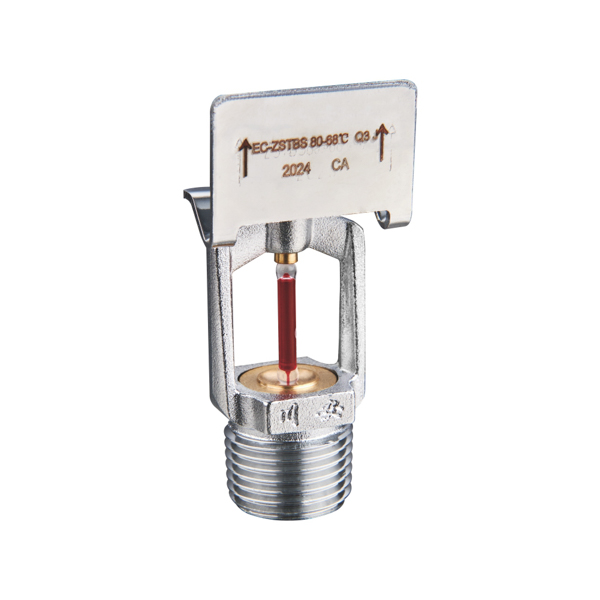
Sidewall sprinklers come in three distinct variants. Understanding which type applies to your project requires knowing the room width, ceiling height, and required coverage area. The three product images below show each type from our range:
3. Specification Comparison Table
| Specification | Standard SW T-ZSTBS-115 |
EC Sidewall K=115 EC-ZSTBS-115 |
EC Sidewall K=80 EC-ZSTBS-80 |
Vertical Sidewall T-ZSTBZ |
|---|---|---|---|---|
| Orientation | Horizontal | Horizontal | Horizontal | Vertical (upright) |
| K-factor (metric) | K = 115 | K = 115 | K = 80 | K = 80 |
| Response type | Standard (Q5) | Quick (Q3) | Quick (Q3) | Standard (Q5) |
| Glass bulb activation (std) | 68°C | 68°C | 68°C | 68°C |
| Thread connection | R:3/4 | R:3/4 | R:½ | R:½ (K=80) |
| Min. working pressure | 0.1 MPa | 0.1 MPa | 0.1 MPa | 0.1 MPa |
| Spray pattern | Quarter-sphere outward & down | Extended quarter-sphere | Extended quarter-sphere | Full hemisphere upward & outward |
| Typical max room width coverage | Up to 4.3 m from wall | Up to 5.5 m from wall | Up to 4.9 m from wall | Per listed area (all directions) |
| Compatible with dry pipe systems? | ✗ Wet pipe only | ✗ Wet pipe only | ✗ Wet pipe only | ✓ Yes — self-draining |
| Key applications | Corridors, standard hotel rooms | Wide guestrooms, open retail, offices | Narrow corridors, low-pressure systems | Exposed pipe near walls, cold climates |
| NFPA 13 required for light hazard? | ⚠ SR — check AHJ | ✓ QR — compliant | ✓ QR — compliant | ⚠ SR — check AHJ |
4. Standard Horizontal Sidewall — Deep Dive
The standard horizontal sidewall fire sprinkler is the workhorse of the family. It mounts on the wall near the ceiling — typically with its deflector 100–150 mm below the ceiling — and projects water in a quarter-spherical arc that sweeps the room floor from the near wall to the far wall.
The Corridor Application: Why Sidewall Dominates
Hotel corridors are the single most common application for horizontal sidewall heads — and for good reason. A typical corridor is 1.5–2.5 m wide and can run 50–100 m in length. Installing a central overhead branch pipe through this space would require penetrating the ceiling at regular intervals along the entire run, adding dozens of fittings and requiring coordination with mechanical, electrical, and ceiling finishes.
With sidewall heads, a single 25 mm branch pipe runs along one side of the corridor wall just below the ceiling line. One head every 3.0–4.6 m covers the full corridor width on both sides of the pipe. The result is a cleaner ceiling, faster installation, and significantly fewer pipe fittings — translating directly to lower labor cost per linear meter of corridor protected.
📌 Key Design Rule: The Far-Wall Distance
Standard horizontal sidewall heads are listed for specific maximum distances from the wall on which they are mounted to the far wall of the room. Exceeding the listed distance — even by a small amount — takes the head outside its tested coverage area and voids the listing. Always verify the far-wall distance from the manufacturer’s data sheet before finalizing room assignments.
Response Type Consideration
The standard sidewall head (T-ZSTBS-115) uses a 5 mm standard response glass bulb (Q5). For light hazard wet pipe systems — which includes hotel corridors and guestrooms under NFPA 13 — quick response heads are mandatory per Section 8.3.2. If the design calls for a light hazard wet pipe system, specify the quick response EC variants (EC-ZSTBS-80 or EC-ZSTBS-115, both Q3) rather than the standard response head. The standard response sidewall is appropriate for dry pipe systems and ordinary hazard occupancies.
Best Applications
- Hotel, dormitory, and apartment corridors
- Hotel guestrooms up to standard width (≤ 4.3 m from head wall to far wall)
- Retail store aisles and linear display spaces
- Narrow office spaces where overhead pipe is impractical
- Historic buildings where ceiling penetrations are restricted or aesthetically unacceptable
- Retrofit projects where new branch pipe routing overhead is cost-prohibitive
5. Extended Coverage Sidewall — Deep Dive
Extended coverage (EC) sidewall heads address the standard sidewall’s primary limitation: room width. A standard sidewall head covers approximately 4.3 m to the far wall — adequate for corridors and smaller guestrooms, but insufficient for the wide-bay hotel rooms (4.5–5.5 m) common in modern four- and five-star developments, or for open-plan office spaces with 5+ m bays.
The EC sidewall head uses a redesigned deflector with a wider spray angle that distributes water across a larger horizontal arc. This allows one head to protect a room up to 5.5 m wide (EC-ZSTBS-115) from a single wall-mounted position, eliminating the need for a second head on the opposite wall or an overhead branch pipe crossing the middle of the room.
📌 Cost Benefit: Fewer Heads, Less Pipe
On a 150-room hotel project where standard sidewall heads would require two heads per room (one each side), switching to EC sidewall heads can eliminate 150 heads, 150 branch fittings, and the associated piping. At scale, this easily represents a five-figure reduction in materials and labor cost — which explains why EC sidewall heads have become the default choice for new hotel construction in most markets.
K=80 vs K=115: Which EC Head to Use
Both EC-ZSTBS-80 (K=80, R:½) and EC-ZSTBS-115 (K=115, R:3/4) are quick response extended coverage heads. The choice between them comes down to system pressure and room width:
- EC-ZSTBS-80: Lower flow rate at a given pressure. Choose when system pressure is limited or when room widths are up to 4.9 m and a smaller orifice is hydraulically sufficient.
- EC-ZSTBS-115: Higher flow rate — delivers more water per head at the same pressure. Required when rooms are wider (up to 5.5 m) or when the hydraulic calculation demands higher minimum flow to meet density requirements.
Both heads use R:½ and R:3/4 threads respectively, so they are not interchangeable on the same branch pipe without a reducer fitting. Confirm the correct thread before ordering.
Best Applications for EC Sidewall
- Hotel and apartment guestrooms 4.5–5.5 m wide (single-wall coverage)
- Open-plan offices and meeting rooms with clean ceiling requirements
- Retail spaces with wide floor plates and architectural ceiling features
- Conference centers and banquet halls with decorative ceilings
- Any light hazard wet pipe system where quick response and wide coverage are required simultaneously
6. Vertical Sidewall — Deep Dive
The vertical sidewall head (also called the upright sidewall) is a fundamentally different product from the horizontal variants. Its body mounts on a wall with the orifice facing upward — the same orientation as an upright pendent head — but positioned on the side of the beam or wall rather than on a ceiling branch pipe. The deflector produces a full hemispherical spray that covers the space around and below the head.
The Key Advantage: Dry System Compatible
Unlike horizontal sidewall heads, the vertical sidewall head’s upright orientation makes it self-draining. Water in the branch pipe above the head drains away naturally — there is no residual water trapped in the head body that could freeze. This makes vertical sidewall heads the correct choice for dry pipe and pre-action systems in locations where wall-mounting is required, such as unheated loading docks, open parking structures, and cold storage entryways.
⚠ Do Not Confuse Vertical and Horizontal Sidewall Deflectors
The deflector geometry of a vertical sidewall head is designed for upward water flow, just like an upright head. A horizontal sidewall deflector is designed for side-directed water flow. The two are not interchangeable: installing a horizontal sidewall head in a vertical (upright) position — or vice versa — produces an unlisted, untested spray pattern that will fail hydraulic calculations and inspection.
Best Applications for Vertical Sidewall
- Unheated loading docks on dry pipe systems
- Covered parking structures with exposed pipe
- Cold storage entryways and freezer vestibules
- Industrial buildings with exposed structural steel where wall-mounting is the only practical option
- Outdoor covered walkways and canopies in cold climates
7. NFPA 13 Installation Rules
NFPA 13 Chapter 10 and the individual head listings establish the following requirements for sidewall installation:
Deflector-to-Ceiling Distance
The deflector of a horizontal sidewall head must be positioned 100–150 mm below the ceiling (unless the listing specifies a different range). This clearance is critical: too close to the ceiling and the thermal skipping phenomenon delays activation; too far and water distribution is disrupted before it reaches the floor.
Distance from the Mounting Wall
The deflector must be positioned 100–150 mm from the mounting wall (measured from the wall face to the centerline of the deflector). Mounting too close concentrates water near the wall; too far reduces reach to the far end of the room and can displace coverage outside the listed area.
Far Wall Distance — The Most Critical Limit
Each sidewall head listing specifies a maximum distance from the mounting wall to the far wall of the protected room. Exceeding this distance — even by 100 mm — puts the far end of the room outside the tested coverage zone. This is non-negotiable; oversized rooms require either a second head on the opposite wall or a different head type.
Head Spacing Along the Wall
Maximum spacing between heads along the wall is specified in the listing — typically 3.0–4.6 m for standard sidewall heads. Minimum spacing (to prevent one activated head from wetting the bulb of the next head before it activates) is 1.8 m. Both limits must be respected.
Obstructions Between Head and Far Wall
Column-type obstructions, tall wardrobes, or structural elements projecting from walls within the spray path require additional heads or redesign. NFPA 13 Section 10.2.7 provides specific rules for obstructions in relation to sidewall heads. A wardrobe unit taller than 300 mm above the deflector height and within 600 mm of the head’s spray path is typically considered an obstruction requiring an additional head in the affected zone.
8. When to Use Sidewall: Application Decision Table
| Space / Scenario | Recommended Type | Key Reason |
|---|---|---|
| Hotel corridor (≤ 2.4 m wide) — wet pipe | EC-ZSTBS-80 (QR) | Corridor width within K=80 EC coverage; QR meets §8.3.2; no overhead pipe needed |
| Hotel guestroom (≤ 4.3 m wide) — wet pipe | EC-ZSTBS-80 (QR) | Single head covers full room width; QR mandatory; clean ceiling preserved |
| Hotel guestroom (4.3–5.5 m wide) — wet pipe | EC-ZSTBS-115 (QR) | Wider EC coverage up to 5.5 m; avoids second head or overhead pipe in wide rooms |
| Historic building — ceiling penetration prohibited | EC-ZSTBS (QR) | Wall-only pipe run; ceiling entirely untouched; preserves historic fabric |
| Unheated loading dock — dry pipe | Vertical Sidewall | Dry system — self-draining upright; horizontal SW not permitted on dry systems |
| Open parking structure — dry or wet pipe | Vertical Sidewall | Exposed pipe environment; self-draining; mounts on structural beams or columns |
| Open-plan office (bay ≤ 5.5 m) — wet pipe | EC-ZSTBS-115 (QR) | Eliminates overhead pipe crossing; design-forward clean ceiling appearance |
| Room wider than 5.5 m — wet pipe | Pendent or 2× SW | Beyond EC sidewall listing limit — use pendent or one SW head each wall |
| Ordinary hazard warehouse aisle — wet or dry | Upright or Pendent | Sidewall not suitable for high rack storage — use upright or in-rack per NFPA 13 Ch.17 |
9. Common Installation Mistakes
Installing horizontal sidewall heads on a dry pipe system
Standard horizontal sidewall heads are only listed for wet pipe systems. Their internal geometry traps water — a residual pocket that will freeze in sub-zero conditions, blocking discharge. On dry or pre-action systems, use vertical sidewall (upright) heads or dry-type pendent heads instead.
Exceeding the listed far-wall distance
This is the most frequently cited deficiency in sidewall installations. A standard sidewall head mounted in a room that is 50 mm wider than its listed maximum is outside its tested coverage area — the installation is non-compliant regardless of the head’s other properties. Always measure the room before ordering heads, not after.
Incorrect deflector-to-ceiling clearance
Mounting the deflector flush with the ceiling or more than 150 mm below it both result in non-listed performance. The 100–150 mm range is tight — always use a template or measurement jig during rough-in, not estimation by eye.
Using standard response sidewall in a light hazard wet pipe system
NFPA 13 §8.3.2 requires quick response heads in all light hazard wet pipe systems. The standard response T-ZSTBS-115 (Q5) does not comply for these applications. If your project is a hotel, apartment, or office on a wet pipe system, specify the EC-ZSTBS-80 or EC-ZSTBS-115 (Q3) variants.
Orienting the head the wrong way — deflector facing the wrong wall
The deflector of a horizontal sidewall head has a distinct top and bottom — it is asymmetric by design. Rotating the head 180° reverses the spray pattern: water is thrown toward the ceiling instead of toward the floor. This mistake occasionally occurs when installers unfamiliar with sidewall heads install them without checking the orientation marking. Always verify deflector orientation before tightening the fitting.
10. Frequently Asked Questions
Need Sidewall Sprinkler Heads for Your Project?
Browse our full range of UL-listed standard and extended coverage sidewall sprinkler heads. Technical data sheets, K-factor tables, and OEM supply for contractors and distributors worldwide.
Related Products & Resources
Authoritative Sources & Standards
- NFPA 13: Standard for the Installation of Sprinkler Systems — National Fire Protection Association
- NFPA 13R: Sprinkler Systems in Low-Rise Residential Occupancies — National Fire Protection Association
- NFPA 25: Inspection, Testing and Maintenance of Water-Based Fire Protection Systems — National Fire Protection Association
- UL Fire Safety Certification Resources — Underwriters Laboratories
- FM Approvals: Fire Protection Product Testing — FM Global