

Fire Sprinkler Technical Guide
Concealed vs Recessed Fire Sprinkler Head:
Which Is Right for Your Project?
Both heads hide below the ceiling line — but they work very differently. Specifying the wrong type means rework, failed inspections, or a ceiling that looks nothing like the architect intended.
🕒 9 min read
🏭 NFPA 13 Compliant
When a hotel lobby, hospital ward, or upscale office demands a clean ceiling, standard pendent sprinkler heads — with their visible brass bodies and red glass bulbs — are simply not acceptable to architects or interior designers. That is where concealed and recessed sprinkler heads step in. Both are designed to minimize visual intrusion, but the similarity ends there.
Confusing the two types is one of the most common specification errors in commercial fit-out projects. A recessed head sits partially inside the ceiling with an escutcheon plate hiding the gap; a concealed head sits entirely above the ceiling plane, covered by a flat snap-on cap that drops away at activation. The structural, hydraulic, and aesthetic implications of that distinction are significant — and this guide covers all of them.
In This Article
1. How Each Head Works
Both concealed and recessed heads are variations of the standard pendent sprinkler — water flows down from a pipe in the ceiling plenum, through the head body, and is distributed by a deflector plate. The difference lies entirely in how much of the head sits below the finished ceiling plane, and how the aesthetic cover is designed to interact with the activation mechanism.
2. Side-by-Side Specification Comparison
Every meaningful technical and practical specification compared in one table:
| Specification | Recessed Head | Concealed Head |
|---|---|---|
| Head position relative to ceiling | Partially recessed — body inside ceiling, deflector below | Fully concealed — entire body above ceiling plane |
| Ceiling appearance | Escutcheon plate visible, slight protrusion | Flat cover plate, fully flush — nearly invisible |
| Cover plate / escutcheon function | Cosmetic only — no role in activation | Functional — drops at cover plate activation temp |
| Dual-temperature activation | ✗ No — single bulb temperature | ✓ Yes — cover plate drops first (~57 °C), then bulb activates (~68 °C) |
| K-factor (metric) | K=80 / K=115 | K=80 / K=115 |
| Glass bulb activation temp (standard) | 57 / 68 / 79 / 93 / 141 °C | 68 / 79 / 93 °C (cover plate: ~57 °C) |
| RTI (Response Time Index) | ≤50 (m·s)½ | ≤50 (m·s)½ |
| Thread connection | R½ (K=80) / R¾ (K=115) | R½ (K=80) / R¾ (K=115) |
| Cover plate paintable? | ⚠ Escutcheon available in standard finishes | ✓ Yes — field-paintable to match any ceiling color |
| Adjustable for ceiling thickness variation | ✓ Yes — two-piece adjustable escutcheon | ✓ Yes — cup and cover allow ±6 mm adjustment |
| Minimum working pressure | 0.1 MPa | 0.1 MPa |
| Coverage area (NFPA 13 Light Hazard) | Up to 20.9 m² | Up to 20.9 m² |
| Compatible with dry pipe systems? | ✗ No — wet pipe only | ✗ No — wet pipe only |
| Relative unit cost | Moderate | Higher (dual-element mechanism) |
| Best for | Offices, healthcare, schools — clean look without premium cost | Hotels, luxury retail, high-end residential — completely invisible |
3. Recessed Fire Sprinkler Head — Deep Dive
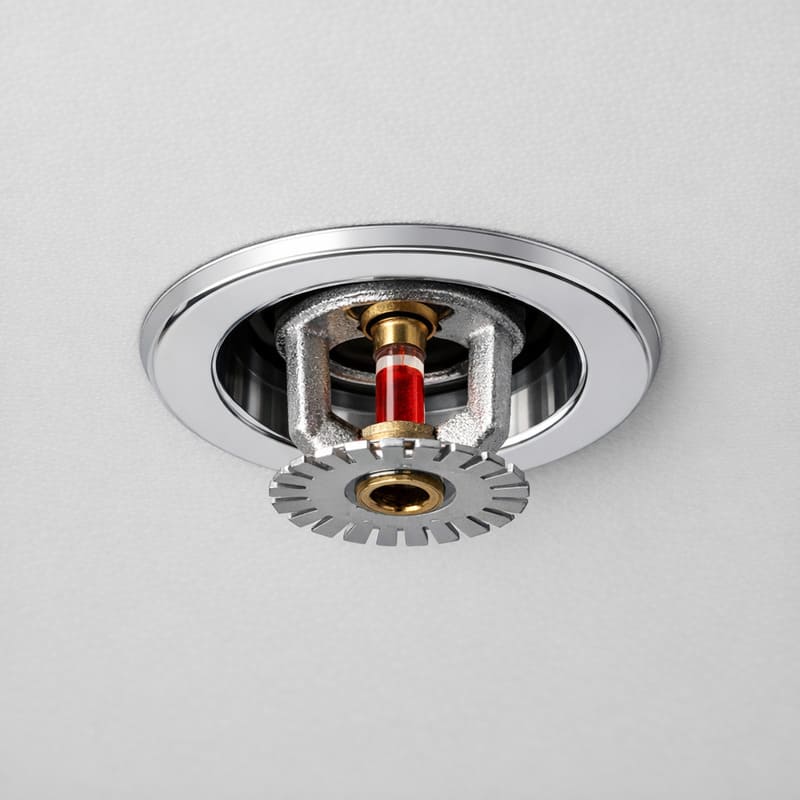
The recessed fire sprinkler head (also called semi-recessed) is essentially a standard pendent head combined with a two-piece adjustable escutcheon. The inner piece of the escutcheon threads or clips onto the sprinkler body; the outer decorative ring rests against the ceiling surface. Together they cover the hole cut in the ceiling tile or drywall, making the installation look finished and intentional.
The Adjustable Escutcheon: Why It Matters
One of the most practical advantages of the recessed head is the two-piece escutcheon’s adjustability. In construction, drop ceiling heights are rarely perfectly consistent. The adjustable escutcheon — typically offering 12–20 mm of vertical travel — accommodates variations in ceiling height without requiring the piping to be repositioned. This saves significant labor cost during installation and greatly simplifies coordination between fire protection and ceiling contractors.
📌 Key Advantage
Because the escutcheon plays no role in heat detection or water distribution, the recessed head behaves identically to a standard pendent head from a hydraulic and fire suppression standpoint. There is no performance penalty for the improved aesthetics.
Deflector Position and NFPA 13 Compliance
The deflector of a recessed head still projects below the finished ceiling surface — unlike a concealed head where the entire mechanism is hidden. NFPA 13 requires the deflector to be positioned 25–355 mm below the ceiling. For recessed heads, the degree of recess affects this measurement: the deeper the head is set into the ceiling, the lower the deflector sits relative to the structural deck above. Always verify that the listed deflector position is maintained after escutcheon adjustment.
Best Applications for Recessed Heads
- General office buildings and corporate campuses
- Healthcare facilities — clinics, hospitals, care homes
- Schools, universities, and public administration buildings
- Retail stores and commercial showrooms
- Conference centers and meeting rooms
- Any wet pipe system where aesthetics matter but budget limits the use of concealed heads throughout
4. Concealed Fire Sprinkler Head — Deep Dive
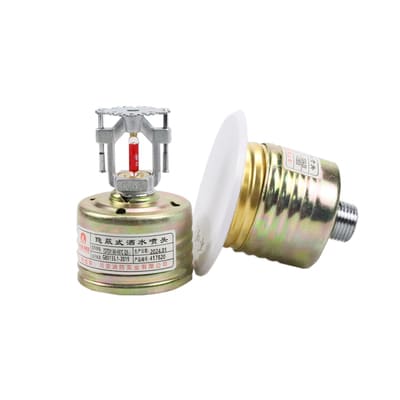
The concealed fire sprinkler head takes ceiling integration one step further. When correctly installed, nothing is visible from below except a smooth flat disc — typically 70–80 mm in diameter — that can be painted to match the ceiling exactly. For architects designing high-end hospitality, luxury residential, or premium retail spaces, this near-invisibility is the only acceptable solution.
The Dual-Temperature Activation Mechanism — Explained
Because the sprinkler body is fully above the ceiling, the glass bulb cannot be reached by the convective heat plume of a fire in the room below — at least not quickly. To solve this, the concealed head uses a two-stage activation system:
Cover Plate Drops (~57 °C)
As room temperature rises, the low-temperature solder holding the cover plate to its cup softens. At approximately 57 °C, the cover plate detaches and falls away, fully exposing the sprinkler head below the ceiling.
Glass Bulb Activates (~68 °C)
With the cover plate gone, the exposed glass bulb is now subject to the rising convective heat column. At its rated temperature (typically 68 °C), the bulb shatters, the valve opens, and water flows through the deflector in the normal pendent spray pattern.
⚠ Critical: Never Paint Over the Cover Plate Solder Joint
Paint applied to the edge of the cover plate can bond it to the mounting cup and prevent it from dropping at the correct temperature. Only the flat face of the cover plate should be painted — never the rim or the joint. NFPA 13 and most manufacturer listings prohibit applying paint that interferes with the release mechanism.
The Cover Plate Adjustment Range
The concealed head mounts via a retaining cup that is threaded onto the sprinkler body and sits against the ceiling from above. The flat cover plate snaps into this cup from below. Most listed concealed heads allow ±6 mm of cover plate travel to accommodate minor ceiling variation — but this range is smaller than the recessed head’s escutcheon, making accurate pipe placement during rough-in more critical.
Best Applications for Concealed Heads
- Five-star hotels and luxury hospitality venues
- High-end residential apartments and private homes
- Premium retail flagships and boutique stores
- Museum galleries, art installations, and exhibition spaces
- Executive boardrooms and VIP areas
- Any wet pipe system where the sprinkler head must be architecturally invisible
5. NFPA 13 Installation Requirements
NFPA 13 addresses both head types in its listing and installation provisions. Key requirements include:
Listed as an Assembly
Both concealed and recessed heads must be installed as a complete listed assembly. The cover plate or escutcheon is part of the listing — substituting components from different manufacturers, or mixing cover plates from one brand with heads from another, is a code violation.
Deflector Distance from Ceiling
For concealed heads, the deflector must be positioned per the listing — typically 25–150 mm above the finished ceiling (since the body is above the ceiling). The cover plate drop exposes the deflector into the room. Verify the specific listing data sheet for each model.
Wet Pipe Systems Only
Neither concealed nor standard recessed heads are listed for dry pipe or pre-action systems. If your project requires dry pipe protection with a finished ceiling aesthetic, you must specify a dry-type sprinkler head or install upright heads in the wet section above the ceiling.
⚠ Paint Restrictions Under NFPA 13
Section 6.2.9 of NFPA 13 prohibits painting, coating, or otherwise altering any sprinkler component in a way that affects its operation. For concealed heads, this means only the outer face of the cover plate may be painted — and only with the paint specified in the manufacturer’s listing. Over-painting the glass bulb area, frame arms, or solder joint is strictly prohibited and will require head replacement on inspection.
6. Decision Table: Which Head for Which Project?
Use this quick-reference table during design development or when reviewing specifications with clients:
| Project Scenario | Recommended | Reason |
|---|---|---|
| Five-star hotel guestrooms & lobbies | Concealed | Fully flush, paintable — meets luxury brand standards |
| Standard office building (open plan) | Recessed | Clean appearance at lower cost; easy ceiling coordination |
| Hospital ward with infection-control ceilings | Concealed | Flush cover eliminates dust-collection ledges; easier to clean |
| School classrooms | Recessed | Cost-effective; vandal-resistance less critical above ceiling |
| Museum gallery / art exhibition space | Concealed | Invisible from below; paintable to match white gallery ceiling |
| Luxury residential apartment (wet pipe) | Concealed | Homeowner expectation of zero visible fire protection hardware |
| Budget retail / grocery store | Recessed | Budget-efficient; full concealment not required by tenant |
| Data center (dry / pre-action system) | Neither | Neither type listed for dry/pre-action — use upright or dry-type pendent |
7. Installation & Coordination Tips
Both head types require tighter coordination between trades than a standard exposed pendent head. Here are the critical items to lock down before rough-in begins:
Confirm finished ceiling height before pipe rough-in
For concealed heads, the sprinkler body must be positioned within the cup’s ±6 mm adjustment range of the finished ceiling. Get the confirmed ceiling height from the architect before laying pipe — not after.
Coordinate head centerline with tile grid or plasterboard layout
Concealed and recessed heads look terrible if they straddle a tile joint or land off-center in a ceiling tile. Always cross-reference the hydraulic layout with the reflected ceiling plan (RCP) from the architect.
Install cover plates only after painting is complete
Painting should be done with only the mounting cup in place. The cover plate should be installed as a final finishing step — after all painting and ceiling work is complete — to avoid contaminating the solder joint or bulb area.
Use only a sprinkler wrench — never pliers on the body
All sprinkler heads — including concealed types — must be installed using the manufacturer-specified sprinkler wrench engaged on the wrench flat. Using pliers on the frame arms or cover cup can crack the glass bulb, damage the solder, or deform the seating surface.
Keep spare cover plates on site
Cover plates are consumable items — they drop during activation and must be replaced after any head operation. Per NFPA 25, a stock of spare heads (and cover plates) equal to 6 heads or 1% of installed heads (whichever is greater) must be kept on site for each type and temperature rating in the system.
8. Frequently Asked Questions
Ready to Specify the Right Head for Your Ceiling?
Browse our full range of UL-listed concealed and recessed sprinkler heads. Technical data sheets, K-factor tables, and OEM supply available for contractors and distributors worldwide.
Related Products & Resources
Authoritative Sources & Standards
- NFPA 13: Standard for the Installation of Sprinkler Systems — National Fire Protection Association
- NFPA 25: Inspection, Testing and Maintenance of Water-Based Fire Protection Systems — National Fire Protection Association
- NFPA 13D: Sprinkler Systems in One- and Two-Family Dwellings — National Fire Protection Association
- UL Fire Safety Certification Resources — Underwriters Laboratories
- FM Approvals: Fire Protection Product Testing — FM Global