

Fire Sprinkler Technical Guide
Pendent vs Upright Fire Sprinkler Heads:
Which One Do You Actually Need?
Choosing the wrong sprinkler orientation can compromise coverage, void compliance with NFPA 13, and create costly rework. This guide breaks down every technical difference so you can specify with confidence.
🕒 8 min read
🏭 NFPA 13 Compliant
Walk into any fire protection supply catalog and you will see pendent and upright sprinkler heads listed side by side, often sharing identical K-factors and temperature ratings. Yet swapping one for the other on a real project can result in flooded ceilings, failed inspections, or — in the worst case — a system that does not suppress a fire correctly. The difference is not cosmetic. It is hydraulic, structural, and code-driven.
This guide covers everything a fire protection engineer, contractor, or facility manager needs: how each head works, where each is required, how they compare on every meaningful specification, and a clear decision framework you can apply to your next project.
In This Article
1. How Each Sprinkler Head Works
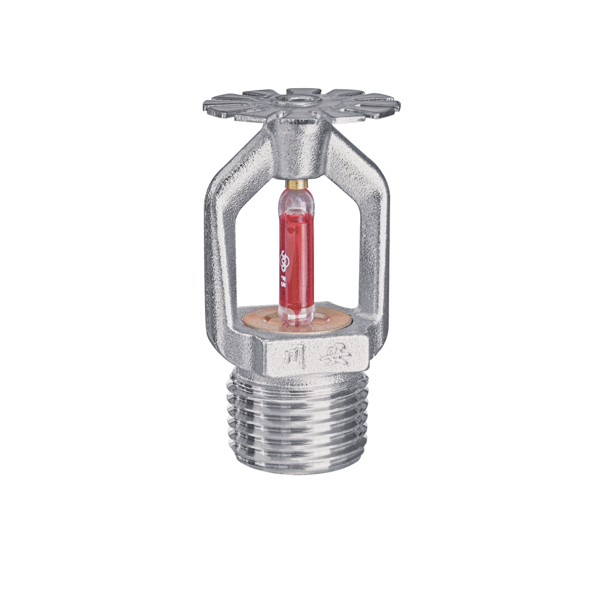
Both pendent and upright sprinklers share the same activation principle. A liquid-filled glass bulb (or a fusible alloy link) holds the valve cap in place. When ambient temperature reaches the rated threshold — typically 68 °C for standard installations — the bulb shatters or the link melts, the cap releases, and pressurized water flows through the orifice onto a deflector plate.
The deflector is where the two designs diverge fundamentally. Its geometry determines whether water sprays downward in a hemispherical pattern (pendent) or upward and outward in an umbrella pattern (upright). This single difference drives every installation rule, hydraulic calculation, and application recommendation that follows.

2. Key Technical Differences at a Glance
The table below summarizes every specification that matters for design and installation. Scroll right on mobile if needed.
| Specification | Pendent Head | Upright Head |
|---|---|---|
| Deflector orientation | Faces downward | Faces upward |
| Water distribution pattern | Hemispherical spray downward | Inverted umbrella downward |
| Pipe position relative to head | Head hangs below pipe | Head sits above pipe |
| Typical K-factor (metric) | K=80 / K=115 | K=80 / K=115 |
| Standard activation temperatures | 57 / 68 / 79 / 93 / 141 °C | 57 / 68 / 79 / 93 / 141 °C |
| Glass bulb color (68 °C) | Red | Red |
| Thread connection | R½ (K=80) / R¾ (K=115) | R½ (K=80) / R¾ (K=115) |
| Suitable for concealed ceiling spaces? | ✓ Yes (with cover plate option) | ✗ Not typically |
| Suitable for exposed pipe systems? | ✓ Yes | ✓ Yes (preferred) |
| Compatible with dry pipe systems? | ⚠ Only with listed dry-pendent type | ✓ Yes — preferred orientation |
| Coverage area per head (NFPA 13 Light Hazard) | Up to 20.9 m² | Up to 20.9 m² |
| Minimum working pressure | 0.1 MPa | 0.1 MPa |
| RTI (Response Time Index) | ≤50 (m·s)½ (quick response) | ≤50 (m·s)½ (quick response) |
3. Pendent Fire Sprinkler Head — Deep Dive
The pendent fire sprinkler head is the most widely installed sprinkler orientation worldwide. You will find it in virtually every modern office building, hotel, shopping center, hospital, and residential complex where the pipe runs above a finished ceiling.
Why Pendent Is the Default for Finished Spaces
When a building has a suspended or finished ceiling, the piping runs in the plenum above. A pendent head threads into a drop nipple that passes through a small hole in the ceiling tile or drywall, leaving only the head and its escutcheon plate visible below. This keeps the mechanical infrastructure hidden while maintaining full fire suppression coverage.
The hemispherical spray pattern is optimized for exactly this scenario. Water fans outward and downward, reaching floor-level combustibles efficiently from a low-profile ceiling mount.
📌 Key Advantage
Pendent heads are the only orientation compatible with concealed (recessed) cover plates, which allow the head to sit flush with the ceiling surface — essential for high-end architectural spaces.
Pendent Heads in Dry Pipe Systems: A Critical Warning
Standard pendent heads must never be installed in the pendent position on a dry pipe or pre-action system unless they are specifically listed for dry service. The reason: in a dry system, the pipe above the ceiling is filled with pressurized air or nitrogen. When activated, water flows into the pipe and rushes toward the open head. A standard pendent head has a small residual air pocket that can trap water — and in cold environments that trapped water can freeze, block the orifice, and prevent discharge.
For dry systems serving pendent positions, engineers must specify dry-type pendent heads or use upright heads instead (see Section 4).
Best Applications for Pendent Heads
- Office buildings with suspended ceilings
- Hotels, retail spaces, and hospitality venues
- Hospitals and healthcare facilities
- Residential buildings (wet pipe systems)
- Schools, universities, and public buildings
- Any space requiring an architecturally clean ceiling
4. Upright Fire Sprinkler Head — Deep Dive
The upright fire sprinkler head is engineered for environments where exposed piping is practical, required, or unavoidable. Industrial facilities, warehouses, parking garages, mechanical rooms, and storage areas all favor upright orientation — not only for functional reasons but because NFPA 13 often specifies it.
Why Upright Excels in Exposed Pipe Systems
In a system with exposed overhead piping — common in warehouses or industrial plants — the branch pipe runs horizontally at ceiling level and the upright head sits above it. The inverted umbrella spray pattern casts water outward in all directions as it exits the deflector, then the water arcs downward due to gravity. This results in excellent floor-level coverage despite the water initially being directed upward.
Critically, the upright orientation is inherently self-draining. Because the head faces upward and the orifice is at the top of the pipe tee, water will not pool inside the head body when pressure is removed. This makes upright heads the natural choice for dry pipe and pre-action systems where drainage after actuation (or testing) must be complete and reliable.
⚠ Important Rule
Never install an upright head in the pendent position. The deflector geometry is optimized for upward water flow; inverting an upright head produces an uneven, non-UL-listed spray pattern that fails hydraulic design calculations.
Best Applications for Upright Heads
- Warehouses, logistics centers, and distribution facilities
- Manufacturing plants and industrial buildings
- Dry pipe and pre-action systems (any climate)
- Parking structures
- Mechanical and electrical equipment rooms
- Spaces where exposed piping is acceptable or preferred
5. NFPA 13 Installation Requirements
NFPA 13, Standard for the Installation of Sprinkler Systems, establishes the minimum requirements for both orientations. Key provisions include:
Deflector Positioning
Pendent deflectors must be positioned 25–355 mm (1–14 in) below the ceiling. Upright deflectors must be 25–355 mm below the deck or ceiling above the pipe. Deviations require engineering justification.
Obstruction Rules
Structural beams, ducts, or other obstructions within 450 mm (18 in) of a pendent head may require additional heads. Upright heads in rack storage must also comply with Chapter 17 in-rack sprinkler requirements.
Temperature Ratings
Both orientations must use temperature ratings appropriate to the maximum expected ambient temperature. NFPA 13 Table 6.2.3.1 specifies that heads near heat sources (skylights, boilers) must be rated at least 38 °C above the expected maximum.
For residential applications, residential fire sprinklers governed by NFPA 13D (one- and two-family dwellings) or NFPA 13R (residential occupancies up to four stories) have modified coverage area and spacing rules that differ from commercial NFPA 13 requirements.
6. Decision Table: Which Head for Which Scenario?
Use this reference when specifying or reviewing fire protection drawings:
| Scenario | Recommended | Reason |
|---|---|---|
| Office building with suspended ceiling (wet system) | Pendent | Conceals piping; clean ceiling aesthetics |
| Hotel guestrooms (wet system) | Pendent | Recessed option available for aesthetics |
| Warehouse with exposed pipe (wet or dry system) | Upright | Exposed pipe environment; self-draining |
| Dry pipe system in cold climate | Upright | Self-draining; no freeze risk in head body |
| Pre-action system (data center, archive) | Upright | Preferred for dry pipe portion; pendent only with dry-listed head |
| Residential home (NFPA 13D) | Pendent | Wet system; ceiling mount; concealed option |
| Parking garage (open or closed) | Upright | Exposed structure; open-air environments often use dry systems |
| Manufacturing / industrial plant | Upright | Exposed pipe; heavy contamination environment |
| Museum, art gallery (high aesthetics) | Pendent | Concealed cover option; minimal visual footprint |
7. Common Mistakes to Avoid
Installing a standard pendent head on a dry pipe system
This violates NFPA 13 and creates freeze risk. Only UL-listed dry-type pendent heads or upright heads are permitted in dry systems.
Flipping an upright head to install it in the pendent position
This changes the listed water distribution characteristics and invalidates the hydraulic calculations. Each head is factory-tested in a specific orientation.
Incorrect deflector-to-ceiling distance
NFPA 13 requires deflectors to be within 25–355 mm of the ceiling. Mounting too close to the ceiling causes a cold-water delay effect (thermal skipping); too far reduces coverage efficiency.
Mixing quick-response and standard-response heads in the same hydraulic area
NFPA 13 prohibits mixing response types in the same compartment unless all heads in that area are of the same RTI classification. Check your quick-response sprinkler listings carefully.
Using a wrench on the body instead of the wrench flat
Applying torque to the glass bulb frame or deflector can damage the heat-sensitive element and cause premature activation or failure to activate. Always use a sprinkler head wrench on the designated flat.
8. Frequently Asked Questions
Ready to Specify the Right Sprinkler Head?
Browse our full range of UL-listed fire sprinkler heads. Technical datasheets, K-factor tables, and OEM supply available for contractors and distributors worldwide.
Related Products & Resources
Authoritative Sources & Standards
- NFPA 13: Standard for the Installation of Sprinkler Systems — National Fire Protection Association
- NFPA 25: Inspection, Testing and Maintenance of Water-Based Fire Protection Systems — National Fire Protection Association
- NFPA 13D: Sprinkler Systems in One- and Two-Family Dwellings — National Fire Protection Association
- UL Fire Safety Certification Resources — Underwriters Laboratories
- FM Approvals: Fire Protection Product Testing — FM Global