Synthetic Foam Concentrate S-Type 3% 6% | CAFS | CA-FIRE
CA-FIRE Protection · Foam Concentrate

Synthetic Foam Concentrate
S-Type

Class A & B coverage · 3% & 6% mixing ratio · CAFS compatible · Long shelf life · Fixed & portable systems

Synthetic Foam Concentrate

Synthetic Foam Concentrate S-Type
Versatile General-Purpose Fire Protection

CA-FIRE synthetic foam concentrate S-type is a hydrocarbon-surfactant-based foam agent formulated from high-grade surface active agents, foam stabilisers, preservatives and corrosion inhibitors. It is the most versatile foam concentrate in the CA-FIRE range — providing effective suppression across both Class B flammable liquid fires (petroleum products, oils, non-polar solvents) and Class A solid fuel fires (wood, paper, rubber, general combustibles) from a single product stock.

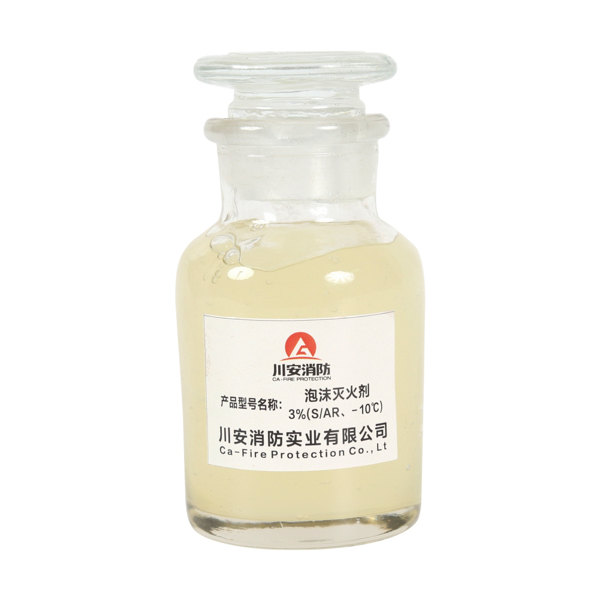
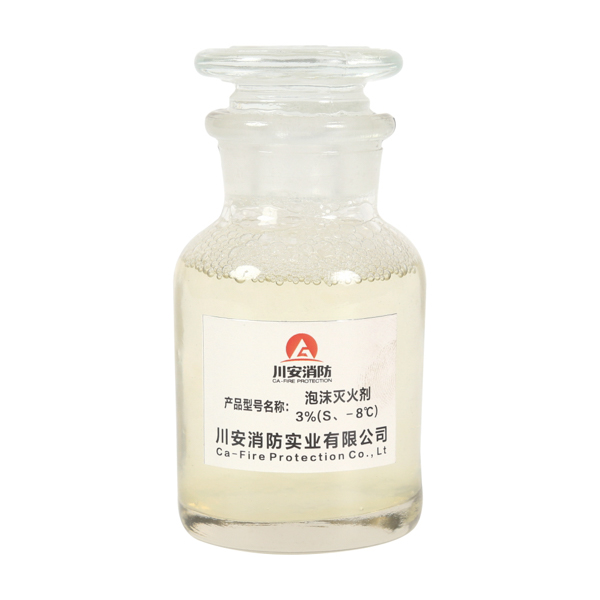
Available in 3%S-8°C (3% mixing ratio, freeze point −8°C) and 6%S-20°C (6% mixing ratio, freeze point −20°C) — the 6% model's lower freeze point makes it the preferred choice for cold-climate installations, outdoor tank systems and cold-storage facility protection. Both models are compatible with fixed deluge systems, inline proportioners, bladder tank systems, CAFS rigs and all portable foam equipment.

Compared to protein-based foams, synthetic S-type offers a significantly longer shelf life, no odour or biological degradation issues, lower viscosity for reliable cold-temperature flow through proportioners, and broad compatibility with all standard fire protection system types. Manufactured at our Fujian facility and tested to GB 15308.
Class A & B Fires 3% & 6% Mixing Ratio CAFS Compatible Long Shelf Life Freeze Point −20 °C Fixed & Portable No Protein Degradation GB 15308 Tested
Synthetic Foam Concentrate S-Type 3%S-8°C 6%S-20°C CAFS — CA-FIRE Protection In Stock · 2 Models
3 / 6%
Mixing Ratio
−20 °C
Min Freeze Point
45 °C
Max Use Temp
A & B
Fire Classes
6.5
pH Value
10+ yr
Shelf Life
Key Advantages

Why Choose Synthetic Foam Concentrate

🔄
Class A & B — One Stock
A single product covers both solid fuel (Class A) and flammable liquid (Class B) fires. Simplifies procurement, storage and system operation — particularly valuable for general industrial sites, warehouses and mixed-hazard facilities where maintaining two separate foam stocks adds cost and complexity.
Longest Shelf Life
Synthetic foam concentrates have a significantly longer shelf life than protein-based foams (FFFP, fluoroprotein). No biological degradation, no protein rancidity or odour issues. Storage in stable conditions well beyond 10 years is achievable — reducing replacement cost and foam waste over a system's life.
❄️
Superior Cold-Climate Performance
The 6%S-20°C model has a freeze point of −20°C and remains pumpable to −15°C — suitable for cold-climate outdoor tank systems, offshore platforms and cold-storage facilities. Lower viscosity at cold temperatures compared to protein foams also reduces proportioner blockage risk in winter conditions.
🔌
Universal System Compatibility
Compatible with every standard proportioning system: inline proportioners, bladder tanks, balanced pressure pump skids, CAFS rigs, portable induction branchpipes and around-the-pump proportioners. Works reliably with fresh water supplies. The go-to choice for new installations where system flexibility is a priority.
Full Range Comparison

How Synthetic S-Type Fits in the
CA-FIRE Foam Concentrate Range

Property AFFF AR-AFFF FFFP Synthetic S-Type ✦ Class A MJABP High Expansion
Class B hydrocarbons ✓ Excellent ✓ Excellent ✓ Excellent ✓ Good ✗ No ◎ Enclosed only
Class B polar solvents ✗ No ✓ Yes ✗ No ✗ No ✗ No ◎ Enclosed only
Class A solid fuels ✗ No ✗ No ✗ No ✓ Yes ✓ Excellent ◎ Enclosed only
CAFS compatible ◎ Limited ◎ Limited ✗ Not recommended ✓ Yes ✓ Primary use ✗ N/A
Burnback resistance ◎ Moderate ◎ Moderate ✓ Excellent ◎ Moderate ✗ N/A ✗ N/A
Shelf life ◎ 10 yr ◎ 10 yr ✗ Shorter (protein) ✓ 10+ yr ✓ 10+ yr ✓ 10 yr
Cold-climate freeze point ◎ −10 °C ✓ −36 °C (SW grade) ◎ −10 °C ✓ −20 °C (6% model) ◎ −18 °C ✓ −20 °C
Fluorochemicals (PFAS) Contains fluorosurfactants Contains fluorosurfactants Contains fluorosurfactants ✓ None — hydrocarbon only ✓ None — PFAS-free ✓ None
Best for Petroleum tanks, airports Chemical plants, polar solvents Large oil tanks, subsurface General industrial, CAFS, mixed hazards Wildland, structural, CAFS Engine rooms, hangars, mines
Suppression Mechanism

How Synthetic Foam Extinguishes Fire

01
Proportioning
S-type concentrate is inducted at 3% or 6% into the water supply via an inline proportioner, bladder tank, balanced pressure system or CAFS direct injection — producing a homogeneous foam solution ready for aeration.
02
Foam Generation
The foam solution is passed through an aspirating branch pipe or CAFS nozzle, entraining air to produce a low-expansion foam blanket at 6–9× expansion ratio. The surfactants stabilise the foam bubble walls against drainage and collapse.
03
Surface Sealing
The foam blanket spreads across the fuel surface and seals it from contact with atmospheric oxygen. On Class B fuels, the blanket suppresses vapour generation from the fuel surface. On Class A fuels, reduced surface tension enables the foam's water content to penetrate and cool deep into the solid fuel.
04
Cooling & Extinction
Water draining from the foam blanket continuously cools the fuel below ignition temperature. Maintained application sustains the blanket until the fire is completely extinguished and the fuel has cooled to below re-ignition temperature throughout its depth.
Technical Specifications

Synthetic Foam Concentrate S-Type — Technical Data

Model Fire Class Mixing Ratio Freeze Point pH Value Expansion Ratio Min Use Temp Max Use Temp CAFS
3%S-8°C Class A & B 3% −8 °C 6.5 6.0–9.0 (Low) −3 °C 45 °C Yes
6%S-20°C Class A & B 6% −20 °C 6.5 6.0–9.0 (Low) −15 °C 45 °C Yes

All specifications per GB 15308 at 20°C. Neither model is suitable for polar solvent (Class B miscible liquid) fires — specify AR-AFFF for alcohol, ketone or ester fire hazards. Contact CA-FIRE for third-party test certificates or project-specific technical data.

Model Selection Guide

CriterionChoose 3%S-8°CChoose 6%S-20°C
Proportioner calibrationSystem designed for 3%System designed for 6%
Minimum ambient temperatureAbove −3 °C (temperate climates)Down to −15 °C (cold climates)
Cold storage / outdoor tanksNot recommended below −3 °CPreferred — survives −20 °C storage
Concentrate economyUses less concentrate per litre of solutionHigher concentrate per litre of solution
Offshore / cold-region installationsMarginalRecommended

Packaging Options

Pack SizeContainer TypePallet QtySuitable For
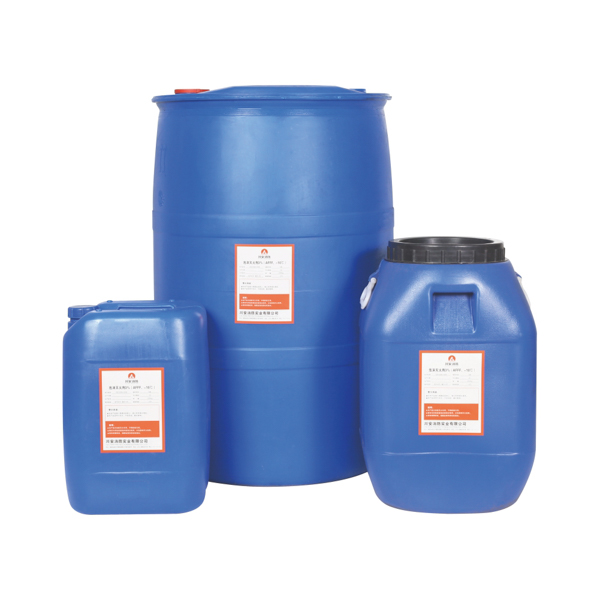
20 LHDPE Jerrican40 jerricans / palletPortable systems, CAFS tenders, testing
200 LSteel or HDPE Drum4 drums / palletFixed systems, medium industrial installations
1000 LIBC Tote (HDPE / SS cage)1 IBC / palletLarge industrial sites, bulk project supply, OEM
Typical Applications

Where Synthetic Foam Concentrate Is Used

🏭
General Industrial Fire Protection
Mixed-hazard industrial sites — manufacturing plants, warehouses, logistics centres — where both solid combustibles and flammable liquids are present. A single S-type stock replaces the need for separate Class A and Class B foam systems, simplifying maintenance and re-stocking.
🛢️
Oil & Fuel Storage — General Purpose
Small to medium petroleum storage facilities, fuel oil bunds, diesel day-tank systems, generator fuel storage and light industrial fuel handling where the moderate burnback resistance of S-type is acceptable and system simplicity is preferred over specialist foam agents.
🚒
CAFS Fire Engines — Urban & Industrial
CAFS-equipped structural and industrial fire engines where both Class A (structural) and Class B (fuel spill) fire scenarios may be encountered. S-type allows one foam product on the vehicle to cover all hazards, avoiding mid-incident system changes.
Marine — General Vessel Protection
Fixed foam fire systems on workboats, ro-ro ferries, supply vessels and general cargo ships where a general-purpose Class A and B agent is specified for cargo decks, vehicle decks and machinery spaces without the requirements for specialised protein foam.
🏗️
Construction Sites & Temporary Facilities
Temporary portable foam systems on construction sites, event facilities and temporary fuel storage areas where a versatile, easy-to-store agent is needed for short-duration project protection. Long shelf life minimises wastage at end of project.
🌡️
Cold-Climate & Outdoor Installations
The 6%S-20°C model is specified for outdoor tank bund systems, cold-climate industrial sites and high-altitude installations where ambient temperatures regularly fall below −5°C. The −20°C freeze point prevents concentrate crystallisation in unheated storage tanks and bladder tanks.

Application Guide

Follow these guidelines to ensure correct proportioning and effective foam application with synthetic S-type concentrate.

1
Match Model to System Design
Confirm whether your system is calibrated for 3% or 6%. Check proportioner, bladder tank pickup tube and any in-line devices are rated for the correct percentage. Do not substitute one ratio for the other without recalibrating.
2
Cold-Climate: Use 6%S-20°C
For any installation where ambient or storage temperature may fall below −3°C, specify 6%S-20°C. Ensure storage tanks and proportioner pipework are assessed for minimum temperature — concentrate that has frozen and thawed may need requalification testing.
3
Class A Application
For Class A fires (structural, solid fuel), apply foam directly onto the burning material or deflect onto an overhead surface. Allow the foam's water content to drain into the fuel for deep penetration. CAFS delivery significantly improves penetration depth on solid fuel fires.
4
Class B Application
For Class B fires (flammable liquid), deflect foam off a wall or apply as a bank shot onto the fuel surface — never apply directly into the burning liquid. Maintain application to build and sustain a complete foam blanket before reducing flow.
5
Annual Inspection
Sample and test annually per NFPA 11 Annex C. Check expansion ratio, 25% drainage time and pH. Synthetic foam typically passes annual testing for many years beyond the 10-year minimum shelf life when stored correctly.

System & Fuel Compatibility

System / Fuel TypeCompatible
Gasoline / diesel / kerosene ✓ Yes — Class B
Fuel oil / crude oil ✓ Yes — Class B
Wood / timber / paper / rubber ✓ Yes — Class A
General mixed solid combustibles ✓ Yes — Class A
Ethanol / methanol / IPA (polar solvents) ✗ No — use AR-AFFF
Acetone / ketones ✗ No — use AR-AFFF
Inline / Venturi proportioner ✓ Yes
Bladder tank system ✓ Yes
Balanced pressure pump skid ✓ Yes
CAFS (compressed air foam) ✓ Yes
Portable induction branch pipe ✓ Yes
Fresh water supply ✓ Yes
Subsurface injection ⚠ Limited — FFFP preferred
FAQ

Frequently Asked Questions about Synthetic Foam Concentrate

Synthetic foam concentrate S-type is a hydrocarbon-surfactant-based foam agent that suppresses both Class B flammable liquid fires (petroleum products, oils, non-polar solvents) and Class A solid fuel fires (wood, paper, rubber, general combustibles). When proportioned at 3% or 6% and aspirated through a foam branch or CAFS nozzle, it produces a stable low-expansion foam blanket that seals the fuel surface from oxygen, suppresses vapour on liquid fuels, and delivers cooling water deep into solid fuels. It is the most versatile general-purpose foam concentrate in the CA-FIRE range and the preferred choice for mixed-hazard industrial sites where a single foam product must cover multiple fire classes.
Both models produce equivalent foam performance when correctly proportioned. 3%S-8°C uses a 3% mixing ratio and has a freeze point of −8°C (minimum operating temperature −3°C). 6%S-20°C uses 6% and has a significantly lower freeze point of −20°C (minimum operating temperature −15°C), making it the correct choice for cold-climate installations, outdoor tank bund systems and any situation where storage or ambient temperature may fall below −3°C. The choice is primarily determined by (1) your proportioner calibration, and (2) the minimum installation temperature. Never substitute one percentage for the other without recalibrating the proportioner or bladder tank.
No. Both are synthetic (non-protein) foams, but they differ significantly. AFFF contains fluorosurfactants that form a thin aqueous film on hydrocarbon fuel surfaces — providing very rapid vapour suppression and knockdown on Class B fires, but at the cost of fluorochemical content (PFAS) and no Class A coverage. Synthetic S-type uses only hydrocarbon surfactants (no fluorosurfactants) — it suppresses fires purely through foam blanket smothering and cooling, without film formation. S-type offers dual Class A and B coverage, longer shelf life, no PFAS, and lower cost. However, for large petroleum tank fires, petrochemical plants and airport applications where maximum Class B knockdown speed is critical, AFFF or FFFP remains the superior technical choice. For general industrial and mixed-hazard applications, S-type is typically the more practical and economical option.
No. Standard synthetic foam concentrate S-type is not effective on polar solvent fires (alcohols, ketones, esters, water-miscible flammable liquids). Like standard AFFF, the foam breaks down rapidly when it contacts a polar solvent — the solvent dissolves the foam bubble walls before a protective blanket can form. For polar solvent hazards, you must specify AR-AFFF (Alcohol Resistant Foam Concentrate) — CA-FIRE's AFFF/AR or S/AR types. If your site has both petroleum and polar solvent hazards, AR-AFFF covers both from a single stock.
CA-FIRE synthetic foam concentrate has a minimum guaranteed shelf life of 10 years when stored correctly in sealed containers at 0°C to 45°C. In practice, synthetic concentrates frequently remain within specification well beyond 10 years when stored at stable, moderate temperatures — significantly outlasting protein-based foams (FFFP, fluoroprotein) which are susceptible to biological degradation, rancidity and odour development, particularly if storage temperatures fluctuate. This longer effective lifespan reduces the lifecycle cost of foam inventory, particularly for installations with long re-inspection cycles or remote systems where concentrate replacement is logistically challenging. Annual testing per NFPA 11 Annex C is still recommended to formally verify continued performance.
Yes. CA-FIRE S-type synthetic foam concentrate is fully compatible with CAFS apparatus. When compressed air is injected, it produces a stable foam texture suitable for both wet and dry CAFS modes at the standard 3% or 6% mixing ratio. S-type is widely used on CAFS-equipped structural and industrial fire engines where both Class A and Class B hazards may be encountered. Note that for pure Class A applications (wildland, structural only) at very low ratios (0.1–0.5%), the dedicated Class A Foam Concentrate MJABP is more concentrate-efficient — S-type at 3–6% uses significantly more concentrate per litre of foam solution than Class A foam at 0.1–1%.
CA-FIRE synthetic foam concentrate is available in 20 L HDPE jerricans, 200 L steel or HDPE drums and 1000 L IBC totes. OEM private-label packaging is available for distributors and fire equipment manufacturers. Standard in-stock items ship within 3–7 business days ex-factory from Fujian. Bulk project orders are produced to schedule — contact sales@ca-fire.com with required model (3%S-8°C or 6%S-20°C), quantity and delivery destination for pricing and lead times. 20 L DHL Express samples are available for pre-purchase testing within approximately 5 business days.
Request a Quote for Synthetic Foam Concentrate S-Type
Contact CA-FIRE for project pricing on 3%S-8°C or 6%S-20°C, bulk OEM supply, SDS documents or 20 L sample orders. Please specify model and required quantity when enquiring.
📧 Get a Quote Now
Scroll to Top