
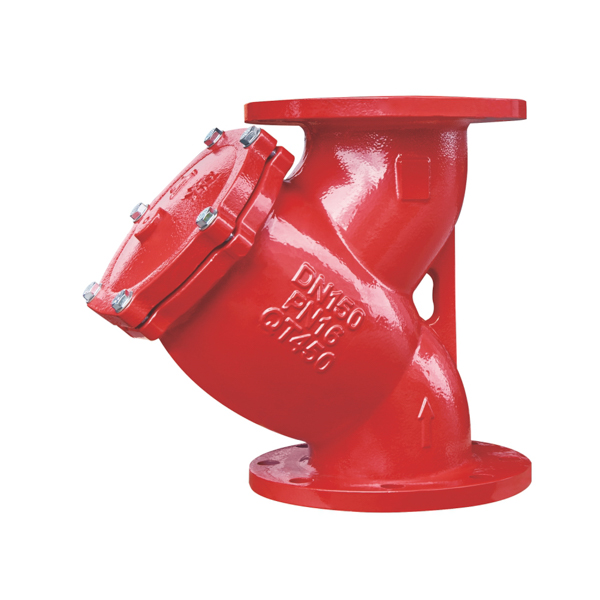
Y Type Strainer — Flanged End Pipeline Filter, DN50–DN400
The CA-FIRE flanged Y type strainer is an in-line pipeline debris filter for fire sprinkler, standpipe and fire pump supply systems with flanged pipework. A stainless steel 304 mesh screen inside the Y-shaped ductile iron body captures weld spatter, pipe scale, rust particles and construction debris before they reach sprinkler heads, deluge valves, alarm valves, check valves and fire pump impellers — protecting critical fire system components from blockage and mechanical damage. Available in DN50–DN400 (2"–16") with ANSI B16.1 Class 125 or DIN 2501 PN16 flanged ends, with a threaded blow-down plug for in-line cleaning without pipe removal.
What Is a Y Type Strainer and Where Does It Sit in the Pipeline?
A Y type strainer — also written as Y-type strainer or Y strainer — takes its name from the Y-shape of the valve body: the main flow runs straight through the horizontal arms of the Y, while the angled leg houses the cylindrical stainless steel screen basket. Water passes through the mesh, leaving debris trapped inside the basket. The clean water continues to the downstream components. The angled leg design gives the Y type strainer a smaller body profile and lower pressure drop compared to basket-type pot strainers at equivalent mesh sizes.
In a fire protection system, the Y type strainer is positioned upstream of the first sensitive component in each section of the pipeline — typically immediately downstream of the isolation gate valve and upstream of the first check valve, alarm valve, deluge valve, or fire pump connection. The flanged ends bolt directly into the flanged pipework without adaptors.
Typical Pipeline Position — Fire Protection System
Alarm Valve
Pump
The Y type strainer is always installed downstream of the isolation gate valve so the strainer can be isolated for cleaning without depressurising the entire supply main.
Flange Standards — ANSI vs. DIN: Which to Specify?
The CA-FIRE flanged Y type strainer is available in two flange standards. Select the standard that matches your existing flanged pipework and the project specification.
Technical Specifications
| Parameter | Specification |
|---|---|
| Product Type | Y Type Strainer — Flanged End Pipeline Filter |
| Nominal Pressure | 1.6 MPa (PN16) |
| Nominal Diameter | DN50 – DN400 (2" – 16") |
| Hydrostatic Test Pressure | 3.2 MPa |
| Body Material | Ductile iron — fusion-bonded epoxy coated (inside & outside) |
| Screen Material | Stainless steel 304 |
| Standard Mesh Size | 16 mesh — approx. 1.2 mm opening |
| Optional Mesh Sizes | 8 mesh (2.4 mm), 30 mesh (0.6 mm) — on request |
| Screen Open Area | ≥ 3× pipe bore area |
| End Connection | Flanged — ANSI B16.1 Class 125 or DIN 2501 PN16 (specify) |
| Flange Face Finish | Raised face (RF) — standard for both ANSI and DIN |
| Clean-Out | Threaded blow-down plug — NPT or BSP (size by DN) |
| Applicable Medium | Water, foam fire suppression mixture |
| Medium Temperature | 0 – 80 °C |
| Installation | Horizontal (screen leg down) preferred; vertical acceptable |
| Certifications | ISO 9001, CE |
Size & Face-to-Face Dimensions
| DN | Inch | Face-to-Face (mm) | Flange OD (mm) ANSI / DIN | Bolt Holes |
|---|---|---|---|---|
| DN50 | 2" | 203 | 152 / 165 | 4 × ⌀19 |
| DN65 | 2½" | 216 | 178 / 185 | 4 × ⌀19 |
| DN80 | 3" | 241 | 191 / 200 | 4 × ⌀19 |
| DN100 | 4" | 267 | 229 / 220 | 8 × ⌀19 |
| DN125 | 5" | 292 | 254 / 250 | 8 × ⌀22 |
| DN150 | 6" | 318 | 279 / 285 | 8 × ⌀22 |
| DN200 | 8" | 368 | 343 / 340 | 8 × ⌀22 |
| DN250 | 10" | 419 | 406 / 395 | 12 × ⌀25 |
| DN300 | 12" | 470 | 483 / 445 | 12 × ⌀25 |
| DN350 | 14" | 521 | 533 / 505 | 16 × ⌀25 |
| DN400 | 16" | 572 | 597 / 565 | 16 × ⌀28 |
Cleaning Methods — Live System & Isolated
The flanged Y type strainer supports two cleaning approaches depending on whether the system can be isolated or must remain live. NFPA 25 requires annual inspection and cleaning of pipeline strainers as part of the fire protection system inspection program.
Key Features
Fire Protection Applications
Fire Pump Suction & Discharge — Large Bore Protection
Fire pump suction and discharge flanged mains in DN200–DN400 are a primary application for the flanged Y type strainer. Debris entering the pump through the suction line can damage impeller vanes and mechanical seals within seconds of pump start — the Y type strainer on the suction main is a critical protective component on any fire pump set. The flanged ends match the flanged connections on pump suction and discharge manifolds used in all major fire pump installations.
Alarm Valve & Check Valve Protection — Flanged Systems
Installed upstream of flanged alarm valves (wet-pipe) and preaction deluge valves, the Y type strainer removes scale and debris that could prevent valve clapper discs from seating correctly — causing slow water loss through a wet alarm system or a false alarm activation. In flanged fire protection systems, the strainer bolts directly to the flanged inlet of the alarm valve or check valve without additional fittings.
High-Rise Building System Risers — DN200–DN300
On high-rise residential, hotel and commercial buildings with flanged main system risers in DN200–DN300, the flanged Y type strainer is installed at each floor or zone branch connection to catch debris before it enters the zone. The flanged connections match the schedule 40 or schedule 80 flanged riser pipe used in high-rise fire protection throughout North America, the Middle East and SE Asia.
Industrial Fire Protection — DN300–DN400 Large Systems
Petrochemical facilities, power plants and industrial sites with large-bore flanged fire protection mains in DN300–DN400 specify flanged Y type strainers upstream of foam deluge valves, monitor nozzle supply valves and fire hydrant ring mains. Only the flanged product covers this size range — the DN400 flanged Y type strainer is unavailable in a grooved configuration.
Flanged Y Type Strainer vs. Grooved Y Strainer — Which to Choose?
| Criterion | Flanged Y Type Strainer (This product) |
Grooved Y Strainer |
|---|---|---|
| End connection | Flanged — ANSI B16.1 / DIN PN16 | Grooved — ANSI/AWWA C606 |
| Max size available | ✅ DN400 (16") | DN300 (12") |
| Installation | Bolt-up — flange gasket + bolts required | ✅ Fast — Victaulic coupling, no tools |
| Removal for cleaning | Unbolting required for body removal | ✅ Coupling removal — quicker |
| Blow-down cleaning | ✅ Both types: plug blow-down in-line | ✅ Both types: plug blow-down in-line |
| Piping system match | ✅ Flanged fire protection systems | ✅ Grooved / Victaulic fire protection systems |
| Best for | ✅ Flanged systems, pump mains, DN300–DN400 | Grooved systems, fast installation, DN50–DN300 |
Frequently Asked Questions — Y Type Strainer Flanged
-
Q1 What is a Y type strainer used for?A Y type strainer is an in-line pipeline filter that removes solid particulate — scale, weld spatter, rust and construction debris — from flowing water before it reaches sensitive downstream components. In fire protection systems, Y type strainers are installed upstream of sprinkler heads, deluge valves, alarm valves, check valves and fire pumps to prevent blockages and mechanical damage that could impair or disable the fire suppression system.
-
Q2 What is the difference between a Y type strainer and a Y strainer?Y type strainer and Y strainer refer to exactly the same product — a pipeline strainer with a Y-shaped body where the screen basket sits in the angled leg. The terms are fully interchangeable in specifications and datasheets. The distinction that matters for specification is always the end connection type: flanged (this product, for flanged pipework) or grooved (for Victaulic-style grooved pipework — see our grooved Y strainer).
-
Q3 What flange standard does the CA-FIRE Y type strainer use?The CA-FIRE flanged Y type strainer is available in two flange standards: ANSI B16.1 Class 125 (standard for North American and many international fire protection specifications under NFPA 13, FM and UL requirements) or DIN 2501 PN16 (standard for European and many international fire protection projects under EN 12845 and local national fire codes). Please specify the required flange standard when requesting a quote — both standards are stocked.
-
Q4 How do you clean a flanged Y type strainer?A flanged Y type strainer can be cleaned two ways. For a live-system partial clean: slowly open the threaded blow-down plug at the base of the screen leg while system pressure is maintained — water flow flushes loose debris out through the plug without system shutdown. For a full screen clean: close the upstream and downstream isolation gate valves, drain the strainer body via the blow-down plug, remove the plug and withdraw the stainless steel screen basket for manual cleaning or compressed-air blowing. NFPA 25 requires annual strainer inspection and cleaning.
-
Q5 What sizes does the CA-FIRE flanged Y type strainer come in?The CA-FIRE flanged Y type strainer is available in DN50–DN400 (2 inch to 16 inch) with ANSI B16.1 Class 125 or DIN 2501 PN16 flanged ends. The DN350 and DN400 sizes are only available in flanged configuration — the grooved Y strainer tops out at DN300. Contact CA-FIRE for custom mesh sizes or stainless steel body options for larger industrial projects.