
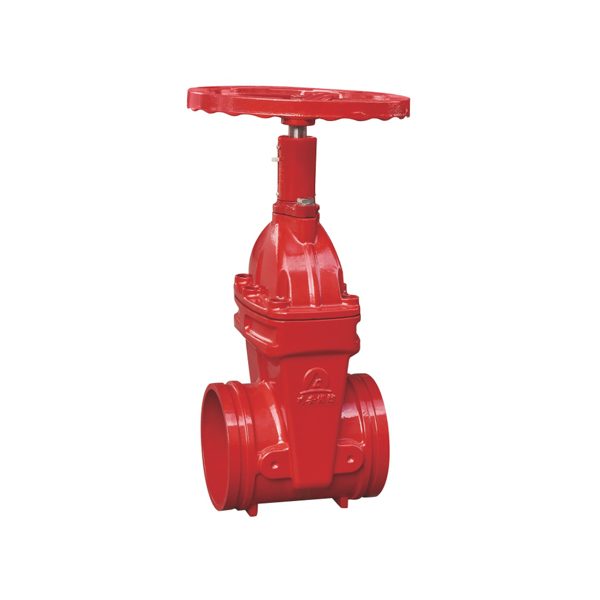
Resilient Wedge Gate Valve —
Grooved End, Rubber-Seated, DN50–DN300
The CA-FIRE resilient wedge gate valve combines a fully rubber-encapsulated resilient gate with grooved end connections for fast, tool-free installation on fire protection pipework. The vulcanised rubber coating on the wedge conforms precisely to the valve seat under closing force, delivering a tight bi-directional zero-leakage seal without metal-to-metal contact — eliminating the wedge seizure and corrosion problems associated with traditional solid wedge designs. Available in DN50–DN300 (2"–12") with ANSI/AWWA C606 roll-grooved ends compatible with Victaulic-style mechanical couplings.
What Is a Resilient Wedge Gate Valve?
A resilient wedge gate valve — also called a resilient seated gate valve or rubber-seated gate valve — is a gate valve in which the closing element (the wedge or gate) is fully encapsulated in vulcanised rubber. When the handwheel is turned to close, the rubber-coated wedge presses against the smooth, epoxy-lined valve seats. The rubber flexes and conforms to the seating surface, achieving a positive watertight seal without the mechanical precision required by metal-to-metal contact.
This fundamental difference in sealing mechanism gives the resilient wedge design several key advantages over the traditional solid wedge gate valve in water and fire protection applications: it will not seize, it maintains sealing integrity even with minor seat wear or thermal movement, and the epoxy-lined body and rubber wedge together resist internal corrosion — extending service life in wet fire protection pipelines.
Resilient Wedge vs. Solid Wedge — Key Differences
Resilient Wedge Gate Valve — Technical Specifications
| Parameter | Specification |
|---|---|
| Valve Type | Resilient Wedge Gate Valve — Grooved End |
| Nominal Pressure | 1.6 MPa (PN16) |
| Nominal Diameter | DN50 – DN300 (2" – 12") |
| Strength Test Pressure | 6.4 MPa |
| Seal Test Pressure | 3.2 MPa |
| Body Material | Ductile iron — fusion-bonded epoxy (FBE) coated internally & externally |
| Wedge | Ductile iron core, fully encapsulated in vulcanised EPDM rubber |
| Rubber Compound | EPDM (Ethylene Propylene Diene Monomer) — potable water grade |
| Seat | Epoxy-lined ductile iron body seat — no separate seat ring |
| Stem | Non-rising, stainless steel |
| End Connection | Roll-grooved — ANSI/AWWA C606 (Victaulic-style compatible) |
| Sealing | Bi-directional zero-leakage (rubber-to-epoxy seat) |
| Applicable Medium | Water, foam fire suppression mixture |
| Medium Temperature | -20 – 70 °C |
| Certifications | ISO 9001, CE, WRAS (potable water) |
Size & Face-to-Face Dimensions
| DN | Inch | Face-to-Face (mm) | Groove OD (mm) |
|---|---|---|---|
| DN50 | 2" | 143 | 60.3 |
| DN65 | 2½" | 165 | 73.0 |
| DN80 | 3" | 178 | 88.9 |
| DN100 | 4" | 190 | 114.3 |
| DN125 | 5" | 216 | 141.3 |
| DN150 | 6" | 216 | 168.3 |
| DN200 | 8" | 241 | 219.1 |
| DN250 | 10" | 292 | 273.1 |
| DN300 | 12" | 330 | 323.9 |
Key Features
Fire Protection Applications
Fire Sprinkler System — Grooved Piping Isolation
The resilient wedge gate valve with grooved ends is the standard zone isolation valve for fire sprinkler branch mains and cross mains in grooved-piping systems. The zero-leakage rubber seat eliminates the slow weeping that can occur with worn solid-wedge valves in wet-pipe systems, maintaining system pressure integrity between inspection periods.
Standpipe & Hose Systems
Used on standpipe risers and hose station branch connections where grooved pipework is specified. The resilient wedge design's reliable tight shut-off makes it well suited for standpipe isolation valves that may remain closed for extended periods and must open freely during fire brigade operations.
Fire Hydrant Supply Mains — Grooved Connection
Installed on grooved fire hydrant supply mains and underground service connections where the combination of grooved installation speed and rubber-sealed reliability is required. The EPDM wedge's corrosion resistance is particularly valuable in partially buried or damp environments.
Retrofit & System Extensions
When extending or modifying an existing grooved fire protection system, the resilient wedge gate valve allows new isolation points to be added without cutting the existing pipe — the grooved coupling installs around the existing pipe groove. Replacing old solid-wedge valves that have seized or are leaking is a common retrofit application.
Gate Valve Wedge Types — Which to Specify?
| Criterion | Resilient Wedge (This product) |
Solid Wedge | Flexible Wedge |
|---|---|---|---|
| Sealing method | ✅ Rubber-to-seat — zero-leakage | Metal-to-metal — precision dependent | Metal-to-metal — flexible gate |
| Seizure risk | ✅ None — no metal contact | High — especially after long closure | Medium — less than solid wedge |
| Closing torque | ✅ Low — rubber conforms easily | High — metal seating force needed | Medium |
| Suitable for water / fire | ✅ Preferred choice | Acceptable | Acceptable |
| Suitable for steam / high temp | No — rubber degrades above 70°C | ✅ Yes | ✅ Yes |
| End connection (this range) | Grooved (DN50–DN300) | Flanged or grooved | Flanged |
Frequently Asked Questions — Resilient Wedge Gate Valve
-
Q1 What is a resilient wedge gate valve?A resilient wedge gate valve — also called a resilient seated gate valve — is a gate valve where the wedge (gate) is fully encapsulated in vulcanised rubber. The rubber coating conforms to the valve seat under closing force, providing a tight bi-directional seal without metal-to-metal contact. This eliminates the risk of wedge seizure and allows reliable sealing even with minor seat irregularities or thermal expansion. Resilient wedge valves are the standard choice for water supply and fire protection pipework.
-
Q2 What is the difference between a resilient wedge and a solid wedge gate valve?A solid wedge gate valve uses a rigid metal gate that must seat precisely against metal valve seats — requiring high closing torque and prone to seizure if overtightened or subject to thermal expansion or corrosion. A resilient wedge gate valve has a rubber-encapsulated gate that flexes to conform to the seat under low closing force, providing a positive zero-leakage seal without metal contact, eliminating seizure risk entirely, and maintaining sealing performance regardless of temperature variation or minor seat wear.
-
Q3 Are resilient wedge gate valves suitable for fire protection systems?Yes — resilient wedge gate valves are the preferred design for fire sprinkler systems, standpipe systems and fire hydrant supply mains. The rubber-encapsulated wedge provides a reliable zero-leakage seal suitable for wet-pipe systems that maintain constant system pressure. The full-bore flow path ensures negligible pressure drop for hydraulic calculations. The no-seizure characteristic is particularly important for fire protection valves that may remain in the open position for long periods and must operate instantly when needed.
-
Q4 What is the difference between a resilient wedge and a flexible wedge gate valve?A resilient wedge gate valve has a gate fully encapsulated in vulcanised rubber — the rubber itself is the seating surface, providing rubber-to-seat contact. A flexible wedge gate valve has a metal gate with a split or flexible design that allows slight angular deflection for better seating against non-parallel seats, but still uses metal-to-metal seating contact. Resilient wedge valves deliver tighter shut-off, require less closing force, and resist corrosion better — making them the preferred choice for water and fire protection service up to 70°C.
-
Q5 What sizes does the CA-FIRE resilient wedge gate valve come in?The CA-FIRE resilient wedge gate valve is available in DN50–DN300 (2 inch to 12 inch) with grooved end connections to ANSI/AWWA C606, suitable for Victaulic-style and equivalent grooved mechanical couplings. For larger sizes or flanged end connections, see our OS&Y flanged gate valve (DN50–DN400) which also uses resilient wedge sealing.