
Portable Foam Fire Extinguishing System — PY Series
Self-Contained Mobile Foam Suppression · 8 Models · 4 & 8 L/s · 10–36 Min Discharge · 3% or 6% Ratio · No Electricity · Deploy in < 5 Minutes · GB / ISO 9001 / CE
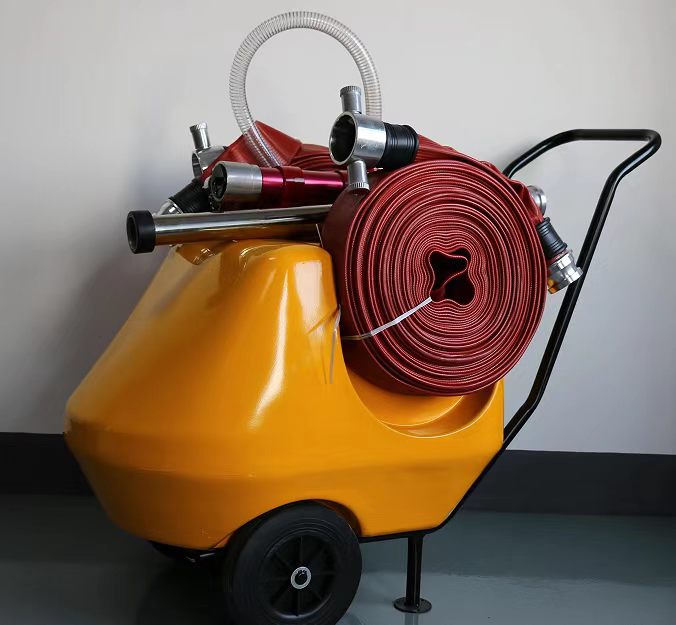
Portable Foam Fire Extinguishing System
A self-contained, wheeled foam suppression unit that stores foam concentrate in an integrated bladder tank and delivers a precisely proportioned foam solution to any compatible discharge device — foam gun, foam generator or foam monitor. No fixed pipework, no civil works, no electrical connection. Eight models covering Class B and Class A+B fires per NFPA 11 and GB 50151. Deployable by a single operator in under 5 minutes.
Technical Specifications — Working Parameters
| Working Pressure Range | 0.6 – 1.0 MPa |
| Foam Concentrate Mixing Ratio | 3% or 6% (model dependent) |
| Flow Rate | 4 L/s or 8 L/s (model dependent) |
| Foam Injection Duration | 10 – 36 minutes (model dependent) |
| Applicable Fire Types | Class B — flammable liquids, petroleum products, solvents; Class A+B combined fires |
| Compatible Discharge Devices | Foam guns · Foam generators (low / medium / high expansion) · Foam monitors |
| Compatible Foam Concentrates | AFFF · FFFP · Protein foam · AR-AFFF (at rated 3% or 6% mixing ratio) |
| Power Requirement | None — fully hydraulic, water supply pressure drives proportioner |
| Frame Type | Wheeled or skid-mounted carbon steel frame — single-operator deployment |
| Applicable Standards | NFPA 11 · GB 50151 · GB 15308 |
| Certifications | GB standard · ISO 9001 · CE |
PY Series — 8 Models at a Glance
Eight models cover 3% and 6% mixing ratios, 4 L/s and 8 L/s flow rates, and foam injection durations from 10 to 36 minutes. Select the model that provides sufficient discharge duration for the fire risk area and hazard size.
| Model | Mixing Ratio | Flow Rate (L/s) | Foam Injection Time (min) | Proportioner | Working Pressure (MPa) | Fire Types |
|---|---|---|---|---|---|---|
| PY4/100 (3%) | 3% | 4 | 12 | PQ4 | 0.6–1.0 | Class B / A+B |
| PY4/200 (3%) | 3% | 4 | 24 | PQ4 | 0.6–1.0 | Class B / A+B |
| PY4/300 (3%) | 3% | 4 | 36 | PQ4 | 0.6–1.0 | Class B / A+B |
| PY8/300 (3%) | 3% | 8 | 18 | PQ8 | 0.6–1.0 | Class B / A+B |
| PY8/400 (3%) | 3% | 8 | 24 | PQ8 | 0.6–1.0 | Class B / A+B |
| PYB/300 (6%) | 6% | 4 | 13 | PQ8 | 0.6–1.0 | Class B / A+B |
| PYB/500 (6%) | 6% | 4 | 16 | PQ8 | 0.6–1.0 | Class B / A+B |
| PY8/400 (6%) | 6% | 8 | 10 | PQ8 | 0.6–1.0 | Class B / A+B |
| Model number format: PY = portable foam unit · number after slash = concentrate volume (litres) · percentage = mixing ratio. Contact CA-FIRE for free model selection guidance based on your hazard area, required flow rate and discharge duration. | ||||||
How to Select the Right PY Model — 3 Steps
8 L/s: Larger monitors and generators — covering medium bund areas and process equipment fires where greater foam throw distance is needed.
Example: 4 L/s × 3% ratio × 1,200 sec (20 min) = 144 L concentrate → select PY4/200 (3%) at 200 L capacity.
6% models for protein foam and concentrates requiring 6% mixing ratio. Always match the system ratio to the concentrate manufacturer's specification.
How the Portable Foam Fire Extinguishing System Works
The PY series operates on the same fully hydraulic bladder tank proportioning principle as CA-FIRE's fixed PHY and PHYM series — no electricity, no diesel engine, no electronic controls. Ready the moment water pressure is applied.
Typical Applications — Portable Foam Fire Extinguishing System
Deployment Procedure — 4 Steps to Full Suppression
The PY series portable foam system is designed for deployment by site personnel without specialist fire-fighting training. Follow these four steps from standby to active suppression.
Maintenance Schedule
Regular inspection and maintenance ensures the portable foam fire extinguishing system is ready for immediate deployment at all times. Record all inspection findings in the equipment maintenance log.
| Frequency | Task |
|---|---|
| Monthly | Inspect tank exterior, frame, wheels and handle for corrosion, mechanical damage or deformation. Check all hose connections, valves and proportioner body for leaks or deterioration. Verify concentrate level indicator shows a full charge. Confirm unit is stored in its designated location, accessible and unobstructed. |
| Quarterly | Compare concentrate volume indicated against original fill volume — any unexplained reduction may indicate bladder leakage. Inspect proportioner inlet and outlet connections for scale, debris or corrosion. Test water supply connection and verify supply pressure is within 0.6–1.0 MPa operating range. |
| Annual | Proportioning accuracy test — connect to a calibrated flow measuring arrangement and verify foam-to-water ratio is within ±3% of the rated mixing ratio at both minimum and maximum rated flow. Inspect bladder condition through tank inspection port. Pressure test the tank to 1.5× working pressure. Document all findings in the maintenance log. |
| Every 3–5 Yrs | Preventive bladder replacement regardless of apparent condition — or earlier if inspection reveals cracks, stiffening or chemical attack. CA-FIRE supplies replacement bladders for all PY series models with full installation guidance and technical support. |
Frequently Asked Questions — Portable Foam Fire Extinguishing System
Tell us your hazard type, risk area size and required discharge duration — CA-FIRE identifies the right PY model and returns a price within 24 hours.