

Conventional sprinklers are designed to control a fire — they limit its spread and keep it from overwhelming the structure until the fire brigade arrives. An ESFR (Early Suppression Fast Response) fire sprinkler does something fundamentally different: it delivers enough water, fast enough, to suppress a high-challenge fire in high-piled storage before it reaches full involvement — often eliminating the need for costly in-rack sprinkler systems entirely.
ESFR achieves this through three simultaneous engineering advantages: a very large K-factor (K14.2 to K25.2) delivering significantly higher flow rates than standard sprinklers, a fast response glass bulb (RTI ≤50) that activates early in fire development, and a deep-penetrating spray pattern specifically shaped to drive water through the turbulent thermal column above a rack-storage fire and reach the burning commodity at shelf level.
CA-FIRE manufactures three ESFR K-factor series — ESFR-202 (K14.2), ESFR-242 (K17.0), and ESFR-363 (K25.2) — in upright (U) and pendent (P) orientations, covering ceiling heights from 9.0 m to 13.5 m and storage heights up to 12.0 m. All models are GB 5135 CCCF type approved; NFPA 13 documentation available for international submittals.
For conventional stored-goods protection at lower ceiling heights, see: Standard Response Sprinkler → · Quick Response Sprinkler →
How ESFR Suppression Differs from Conventional Control
Fast Activation
The 3mm fast-response glass bulb (RTI ≤50) shatters very early in fire development — before the thermal column reaches full strength. This is the same bulb used in Quick Response sprinklers, but here it triggers a dramatically higher flow rate.
High-Volume Discharge
At the minimum design pressure, an ESFR-363 (K25.2) delivers over 3× the flow of a standard K5.6 sprinkler. This volume of water is needed to penetrate the intense thermal updraft above a high-challenge rack fire and reach burning commodities at lower levels.
Suppression, Not Just Control
Conventional sprinklers aim to prevent fire spread. ESFR is designed to achieve fire suppression — reducing heat release rate below the threshold needed for sustained burning, even with high-piled or rack-stored commodities up to 12 m high.
Choosing the Right K-Factor: K14.2, K17.0, or K25.2
The K-factor determines how much water an ESFR head delivers at a given pressure. Higher K-factors are used at greater ceiling heights and greater storage heights, where more water volume is needed to overcome the stronger thermal column above a larger fire. The selection is governed by the specific ceiling height, storage height, and commodity class for the project — and must follow NFPA 13 Table 20.X or GB 50084 ESFR tables exactly.
ESFR Sprinkler Models — ESFR-202 / ESFR-242 / ESFR-363
All ESFR models use a fast-response glass bulb (RTI ≤50). Available in upright (U) and pendent (P) orientations. Activation temperatures: 68°C, 74°C, 82°C, 100°C depending on series and orientation.
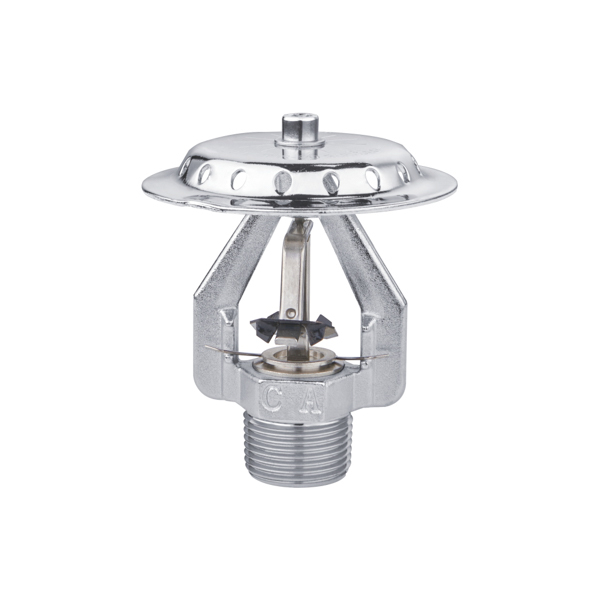
ESFR-202 68°C / 74°C U
Upright · K14.2 · ESFRK14.2 upright ESFR. For ceiling heights 9.0–10.5 m, storage up to 9.0 m. Mounts above branch pipe — suited to exposed-pipe systems and situations where pendent installation is not possible.
| K-factor (intl.) | K14.2 (K202) |
|---|---|
| Activation temps | 68°C / 74°C |
| Max ceiling | 10.5 m |
| Max storage | 9.0 m |
| Thread | R:3/4 (BSP) |
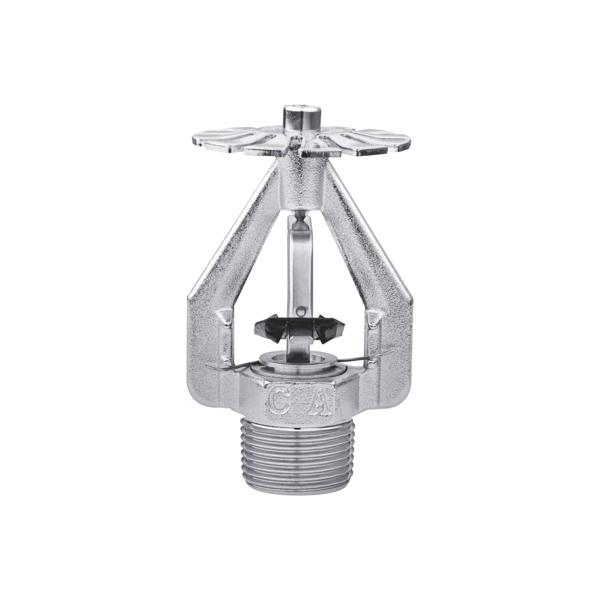
ESFR-202 68°C / 74°C / 100°C P
Pendent · K14.2 · ESFRK14.2 pendent ESFR. Hangs below branch pipe. Broader temperature range including 100°C for high-ambient areas. Ceiling 9.0–12.0 m, storage up to 10.5 m at appropriate pressure.
| K-factor (intl.) | K14.2 (K202) |
|---|---|
| Activation temps | 68°C / 74°C / 100°C |
| Max ceiling | 12.0 m |
| Max storage | 10.5 m |
| Thread | R:3/4 (BSP) |
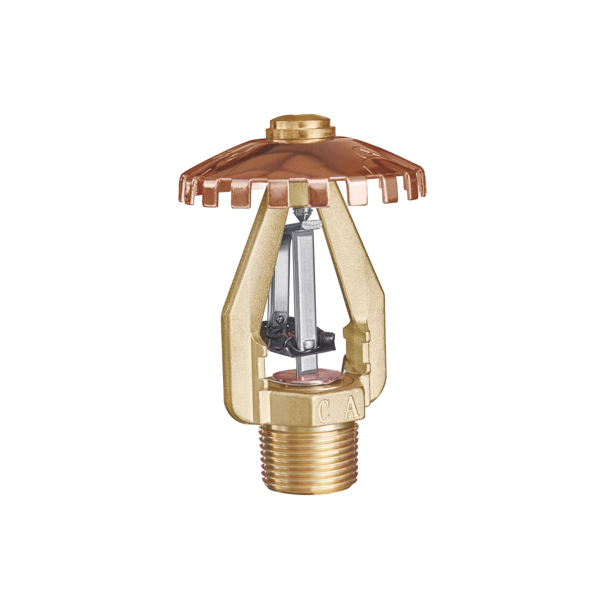
ESFR-242 74°C U
Upright · K17.0 · Most SpecifiedThe most widely specified ESFR model. K17.0 upright for ceiling heights 9.0–10.5 m, storage up to 9.0 m. Achieves suppression at lower minimum pressures than K14.2 for the same ceiling height.
| K-factor (intl.) | K17.0 (K242) |
|---|---|
| Activation temps | 74°C |
| Max ceiling | 10.5 m |
| Max storage | 9.0 m |
| Thread | R:3/4 (BSP) |
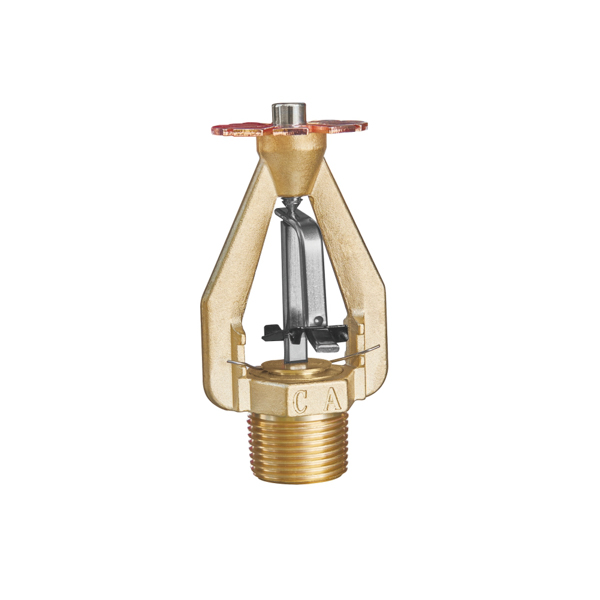
ESFR-242 74°C P
Pendent · K17.0 · Most SpecifiedK17.0 pendent ESFR. For ceiling heights up to 12.0 m, storage up to 10.5 m. The pendent orientation is preferred in concrete deck construction where drainage from upright heads is a concern.
| K-factor (intl.) | K17.0 (K242) |
|---|---|
| Activation temps | 74°C |
| Max ceiling | 12.0 m |
| Max storage | 10.5 m |
| Thread | R:3/4 (BSP) |
ESFR-363 74°C / 82°C / 100°C U
Upright · K25.2 · High-BayHighest K-factor ESFR. Upright installation for exposed-pipe high-bay facilities. Ceiling up to 13.5 m, storage up to 12.0 m. Lowest minimum design pressure of any ESFR series at equivalent heights.
| K-factor (intl.) | K25.2 (K363) |
|---|---|
| Activation temps | 74°C / 82°C / 100°C |
| Max ceiling | 13.5 m |
| Max storage | 12.0 m |
| Thread | R:1 (BSP) |
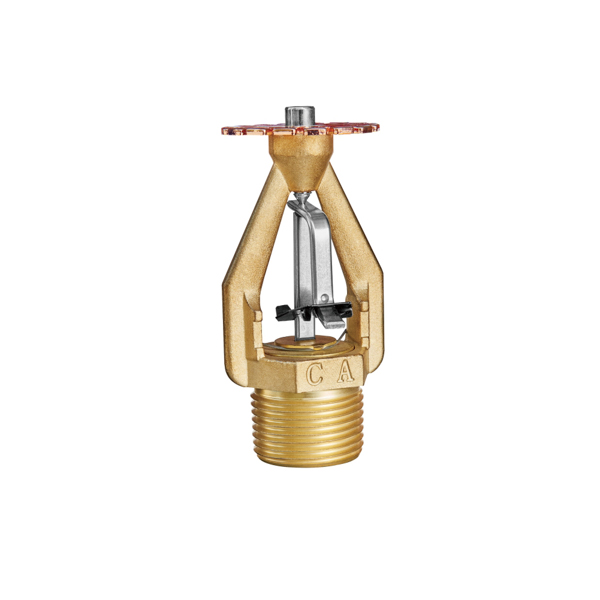
ESFR-363 74°C / 82°C / 100°C P
Pendent · K25.2 · High-BayK25.2 pendent for concrete deck high-bay distribution centres. Ceiling up to 13.5 m, storage up to 12.0 m. Delivers the highest flow rate per head of any ESFR in the CA-FIRE range.
| K-factor (intl.) | K25.2 (K363) |
|---|---|
| Activation temps | 74°C / 82°C / 100°C |
| Max ceiling | 13.5 m |
| Max storage | 12.0 m |
| Thread | R:1 (BSP) |
Complete ESFR Design Parameters Table
Select model based on maximum clear ceiling height (to underside of roof structure) and maximum storage height. Minimum working pressure must be verified by hydraulic calculation for the specific installation — values below are the NFPA 13 / GB 50084 minimum listed pressures for each configuration.
| Model | K-factor (intl.) | Installation | Max Ceiling Height | Max Storage Height | Min. Working Pressure | Spacing Range | Thread |
|---|---|---|---|---|---|---|---|
| ESFR-202 · K14.2 (K202) · 68°C / 74°C / 100°C · Fast Response | |||||||
| ESFR-202/68°C U | K14.2 | Upright | 9.0 m | 6.0 m | 0.35 MPa | 2.4–3.7 m | R:3/4 |
| ESFR-202/74°C U | K14.2 | Upright | 9.0 m | 6.0 m | 0.35 MPa | 2.4–3.7 m | R:3/4 |
| ESFR-202/68°C P | K14.2 | Pendent | 9.0 m | 6.0 m | 0.35 MPa | 2.4–3.7 m | R:3/4 |
| ESFR-202/74°C P | K14.2 | Pendent | 10.5 m | 9.0 m | 0.50 MPa | 2.4–3.7 m | R:3/4 |
| ESFR-202/82°C P | K14.2 | Pendent | 12.0 m | 10.5 m | 0.50 MPa | 2.4–3.7 m | R:3/4 |
| ESFR-202/100°C P | K14.2 | Pendent | 12.0 m | 10.5 m | 0.50 MPa | 2.4–3.7 m | R:3/4 |
| ESFR-242 · K17.0 (K242) · 74°C · Fast Response · Most Specified | |||||||
| ESFR-242/74°C U ★ | K17.0 | Upright | 9.0 m | 6.0 m | 0.25 MPa | 2.4–3.7 m | R:3/4 |
| ESFR-242/74°C P ★ | K17.0 | Pendent | 9.0 m | 6.0 m | 0.25 MPa | 2.4–3.7 m | R:3/4 |
| ESFR-242/74°C U (10.5 m) | K17.0 | Upright | 10.5 m | 9.0 m | 0.35 MPa | 2.4–3.7 m | R:3/4 |
| ESFR-242/74°C P (10.5 m) | K17.0 | Pendent | 10.5 m | 9.0 m | 0.35 MPa | 2.4–3.7 m | R:3/4 |
| ESFR-242/74°C P (12.0 m) | K17.0 | Pendent | 12.0 m | 10.5 m | 0.50 MPa | 2.4–3.7 m | R:3/4 |
| ESFR-363 · K25.2 (K363) · 74°C / 82°C / 100°C · Fast Response · High-Bay | |||||||
| ESFR-363/74°C U | K25.2 | Upright | 9.0 m | 6.0 m | 0.15 MPa | 2.4–3.0 m | R:1 |
| ESFR-363/74°C P | K25.2 | Pendent | 9.0 m | 6.0 m | 0.15 MPa | 2.4–3.0 m | R:1 |
| ESFR-363/82°C U (10.5 m) | K25.2 | Upright | 10.5 m | 9.0 m | 0.20 MPa | 2.4–3.0 m | R:1 |
| ESFR-363/82°C P (10.5 m) | K25.2 | Pendent | 10.5 m | 9.0 m | 0.20 MPa | 2.4–3.0 m | R:1 |
| ESFR-363/100°C U (12.0 m) ★ | K25.2 | Upright | 12.0 m | 10.5 m | 0.35 MPa | 2.4–3.0 m | R:1 |
| ESFR-363/100°C P (12.0 m) ★ | K25.2 | Pendent | 12.0 m | 10.5 m | 0.35 MPa | 2.4–3.0 m | R:1 |
| ESFR-363/100°C P (13.5 m) | K25.2 | Pendent | 13.5 m | 12.0 m | 0.35 MPa | 2.4–3.0 m | R:1 |
★ Most commonly specified configurations. Min. pressure = minimum design pressure at the sprinkler — actual system demand depends on hydraulic calculation including pipe friction losses. All models GB 5135 CCCF certified. NFPA 13 submittals available on request.
Key System Design Requirements for ESFR
ESFR systems place significantly higher demands on the water supply and distribution system than conventional sprinkler systems. The following parameters must be verified at the design stage — they cannot be retrofitted economically after installation.
ESFR vs Conventional Ceiling + In-Rack System
| Parameter | Conventional Ceiling + In-Rack | ESFR Ceiling-Only |
|---|---|---|
| Fire objective | Control — limit spread, protect structure | Suppression — extinguish or reduce below sustaining threshold |
| In-rack sprinklers required | Yes — typically every 2–3 rack levels | No — eliminated in qualifying configurations |
| K-factor at ceiling | K5.6–K8.0 (standard response) | K14.2–K25.2 (ESFR) |
| Response type | Standard Response (5mm bulb) or QR | Fast Response (3mm bulb · RTI ≤50) |
| Water demand | Lower per ceiling head; high total when rack heads included | High per head; lower total (12 heads only) |
| Installation complexity | High — ceiling + rack pipe networks, multiple zones | Lower — ceiling-only pipe network |
| Rack re-configuration flexibility | Low — changing rack layout requires re-piping rack sprinklers | High — rack layout can change without re-piping ceiling system |
| Maintenance | Higher — rack sprinklers are vulnerable to forklift damage | Lower — ceiling sprinklers only, no rack exposure |
| Max ceiling height | Effectively unlimited with in-rack levels | Up to 13.5 m (K25.2 models) |
| Eligible storage types | Class I–IV, Group A plastics, all commodities | Class I–IV, limited Group A plastics — verify commodity class with designer |
Typical ESFR Applications
ESFR sprinklers are specified wherever high-piled or rack-stored commodities are held in facilities with ceiling heights that exceed the practical limit for standard sprinkler systems. The common thread in all ESFR applications is a high-bay building with regular rack or pallet storage and the ability to maintain clear ceiling conditions.
High-bay distribution and fulfilment centres with pallet or selective rack storage up to 12 m. The most common ESFR application globally.
Purpose-built high-bay stores with ceiling heights 10–13.5 m. ESFR-363 eliminates the need for multi-tier in-rack sprinkler networks.
Large-format retail warehousing and stockrooms with rack storage. ESFR enables flexible rack layouts that can be reconfigured without re-piping.
Chilled and frozen storage with racking — where ambient temperatures are low but stored commodities may present significant fire hazard.
Third-party logistics hubs handling mixed commodity types with frequently changing rack layouts — where ESFR's layout flexibility is a key advantage.
Wholesale trade stores with high-bay shelving — ceiling-only ESFR avoids rack sprinklers in areas where product accessibility is important.
Frequently Asked Questions
Can ESFR sprinklers protect any type of stored commodity?
No — ESFR systems are approved for Class I through Class IV commodities and some Group A plastics configurations under NFPA 13. They are generally not permitted for storage of aerosols, flammable liquids, certain plastics, or commodities with unusual packaging that significantly increases fire hazard beyond the tested categories.
The specific commodity class, packaging type, storage arrangement, and aisle configuration must all be verified against the NFPA 13 ESFR tables for the K-factor and ceiling height being used. A fire protection engineer must confirm eligibility before specifying ESFR for any project.
What is the difference between upright (U) and pendent (P) ESFR models — which should I specify?
Both achieve the same suppression performance. The choice between upright and pendent depends on the building structure and the piping system design:
Upright (U) models mount above the branch pipe with the deflector facing upward. They are preferred in facilities with exposed steel structure where the pipe is run along the underside of roof purlins. Upright installation also aids drainage — water drains from the pipe back through the sprinkler body when the system drains, which matters for dry-pipe or pre-action systems.
Pendent (P) models hang below the branch pipe. They are commonly used in facilities with flat concrete decks or suspended ceilings where the pipe is run above. Some ESFR pendent models are available at higher temperature ratings (e.g. 100°C) not available in the upright format, providing greater flexibility at higher storage heights.
Why does the minimum pressure change with ceiling height?
The minimum listed pressure for an ESFR sprinkler is determined by full-scale fire testing at each specific ceiling height and storage configuration. At greater ceiling heights, the fire has more time to grow before the sprinkler activates, producing a more powerful thermal column above the fire. More pressure — and therefore more flow — is required to drive water through that stronger updraft and reach the burning commodity at storage level.
This is why a K25.2 (ESFR-363) at 9 m ceiling height requires only 0.15 MPa, while the same K25.2 head at 12 m ceiling height requires 0.35 MPa. The suppression mechanism requires the water to physically penetrate the plume — higher plume energy requires higher discharge momentum.
Can ESFR sprinklers be used with a dry-pipe or pre-action system?
ESFR sprinklers are strongly preferred with wet-pipe systems. Dry-pipe and pre-action systems introduce a delay between sprinkler activation and water delivery — during this delay, the fire continues to grow and the thermal column strengthens. NFPA 13 permits ESFR with dry-pipe systems only under restricted conditions and with tighter spacing requirements, because the delayed water delivery means the system must deliver even more water to achieve suppression once flow begins.
For cold-storage applications where freezing makes wet pipe impractical, a glycol-charged wet-pipe system or an anti-freeze loop is typically preferred over dry-pipe with ESFR. Consult your system designer for the appropriate solution for your specific environment.
Our facility ceiling is 8 m. Can we use ESFR?
The minimum ceiling height for ESFR eligibility under NFPA 13 and GB 50084 is 9.0 m clear height (to the underside of roof structure). Below 9 m, the distance between the sprinkler deflector and the top of the storage is insufficient for the ESFR spray pattern to fully develop before it reaches the commodity. At 8 m ceiling height, a conventional standard response or quick response ceiling system — potentially with in-rack sprinklers if storage height is substantial — is the appropriate solution. See our Standard Response Sprinkler page for options.
How do I convert between K202 / K242 / K363 (domestic) and K14.2 / K17.0 / K25.2 (international)?
The conversion factor is ÷ 14.28: the domestic K-factor number (in L/min / (MPa)½ units) divided by 14.28 gives the international K-factor (in gpm / (psi)½ or L/min / (bar)½ depending on regional convention).
- K202 ÷ 14.28 = K14.2
- K242 ÷ 14.28 = K17.0
- K363 ÷ 14.28 = K25.2
When requesting NFPA 13 submittals or export documentation, CA-FIRE uses international K-factor designations. For GB 50084 submittals, domestic K-factor numbers are used.
Related Products
ESFR-202 (K14.2) · ESFR-242 (K17.0) · ESFR-363 (K25.2) · Upright & Pendent
GB 5135 CCCF Certified · NFPA 13 documentation available · Technical support included · 24 hr quote
sales@ca-fire.com · WhatsApp +86 18150362095
Send Inquiry →