

A standard sprinkler head protects a maximum of around 20 m² of floor area — meaning a 1,000 m² hotel ballroom needs at least 50 heads, 50 branch pipe connections, and a hydraulic system designed to supply all of them simultaneously. An extended coverage fire sprinkler solves this with a larger, purpose-engineered deflector that distributes water over up to 36 m² per head — reducing head count, branch pipework, and installation cost by up to 40% compared to standard spacing, while maintaining full code compliance for Light and Ordinary Hazard occupancies.
CA-FIRE's EC series — EC-ZSTX (pendent), EC-ZSTZ (upright), and EC-ZSTBS (sidewall) — uses a 3mm German glass bulb (RTI ≤50) and is available in K5.6 (K80) and K8.0 (K115) at five activation temperatures from 57°C to 141°C. All models are produced at our Fujian factory with GB 5135 CCCF type approval; NFPA 13 documentation is available for international project submittals.
Quick Response series (standard coverage): Quick Response Fire Sprinkler → · Pendent → · Sidewall →
36 m² vs 20 m² — What Extended Coverage Means in Practice
The defining characteristic of an EC sprinkler is its maximum protection area per head, which under NFPA 13 and GB 50084 can reach 36 m² — 80% more than a standard sprinkler's typical 20 m² maximum. The head achieves this through a specially shaped large-radius deflector that throws water further from the centre while maintaining the minimum discharge density required for the hazard classification.
~4.6 m × 4.6 m spacing
up to 6.0 m × 6.0 m spacing
Project Economics — Extended Coverage vs Standard
The cost advantage of EC sprinklers comes from three compounding factors: fewer heads, shorter branch pipe runs, and simpler hydraulic design. These savings scale with project size and are most pronounced in large open-plan occupancies with clear ceilings.
Extended Coverage Sprinkler Series — EC-ZSTX / EC-ZSTZ / EC-ZSTBS
All EC models use a 3mm German glass bulb (imported "久保" /久保 German brand), RTI ≤50 (m·s)½ — quick response thermal element. Available in K5.6 (K80) and K8.0 (K115).
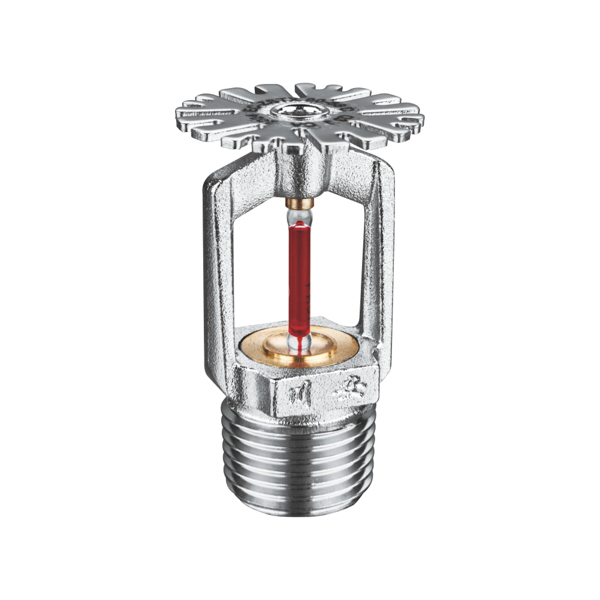
EC-ZSTX 80-68°C Q3J
Pendent · K5.6 · 68°CThe most widely specified EC model. Hangs below the branch pipe, deflector facing down. Up to 36 m² per head at maximum spacing. Hotels, shopping centres, offices, museums.
| K-factor | K5.6 (K80) |
|---|---|
| Activation | 68°C · Red |
| Max coverage | 36 m²/head |
| Max spacing | 6.0 m × 6.0 m |
| Thread | R½ (BSP) |
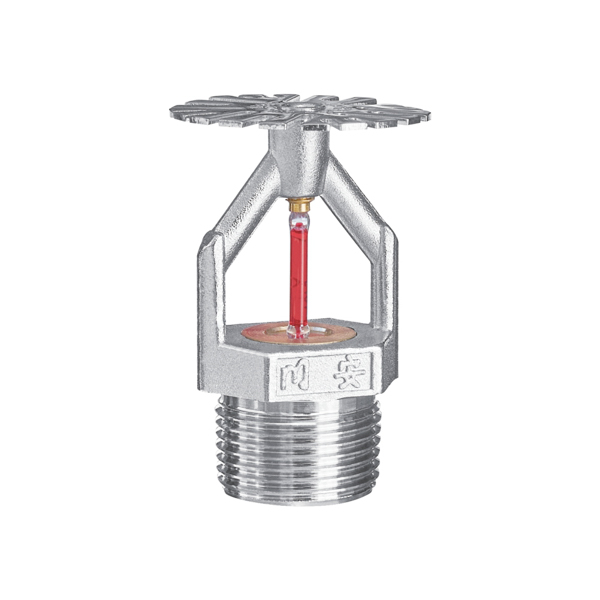
EC-ZSTX 115-68°C Q3J
Pendent · K8.0 · 68°CK8.0 (K115) pendent for Ordinary Hazard occupancies or higher ceiling heights where greater water volume is required per head. Shopping centres, large retail, assembly spaces.
| K-factor | K8.0 (K115) |
|---|---|
| Activation | 68°C · Red |
| Max coverage | 36 m²/head |
| Max spacing | 6.0 m × 6.0 m |
| Thread | R¾ (BSP) |
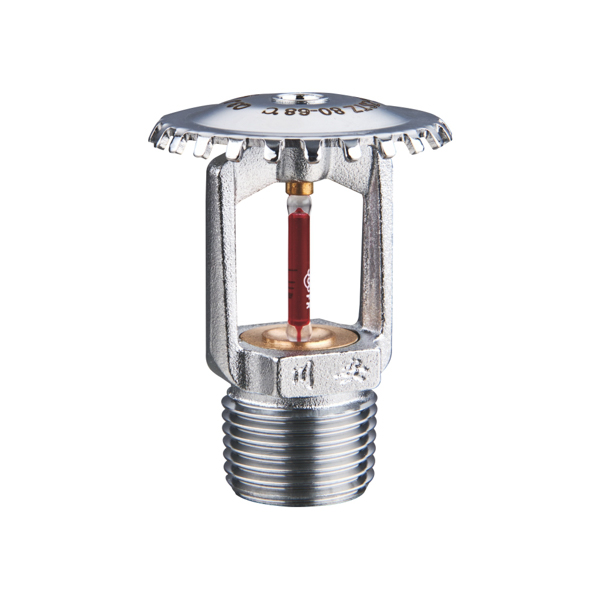
EC-ZSTZ 80-68°C Q3J
Upright · K5.6 · 68°CMounts above the branch pipe, deflector facing up. Suited to exposed-pipe systems where drainage is important. Warehouses converted to Light/Ordinary Hazard use, plant rooms with open ceilings.
| K-factor | K5.6 (K80) |
|---|---|
| Activation | 68°C · Red |
| Max coverage | 36 m²/head |
| Max spacing | 6.0 m × 6.0 m |
| Thread | R½ (BSP) |
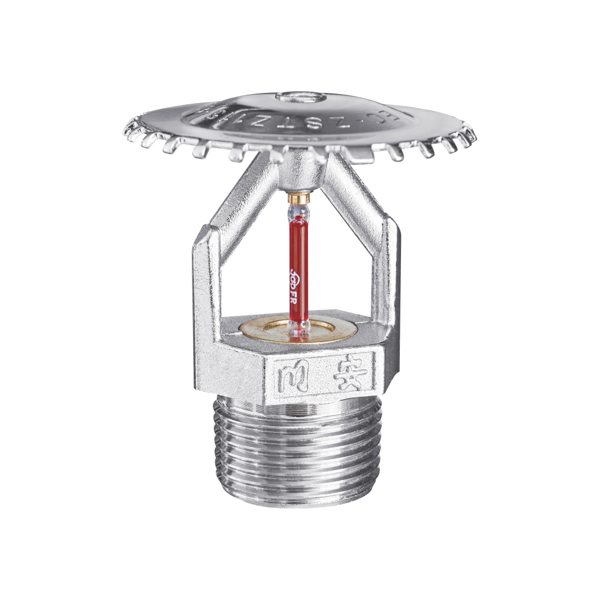
EC-ZSTZ 115-68°C Q3J
Upright · K8.0 · 68°CK8.0 upright for higher-demand exposed-pipe EC systems. Provides greater discharge density over the 36 m² protection area. Ideal for large-span open ceilings in Ordinary Hazard spaces.
| K-factor | K8.0 (K115) |
|---|---|
| Activation | 68°C · Red |
| Max coverage | 36 m²/head |
| Max spacing | 6.0 m × 6.0 m |
| Thread | R¾ (BSP) |
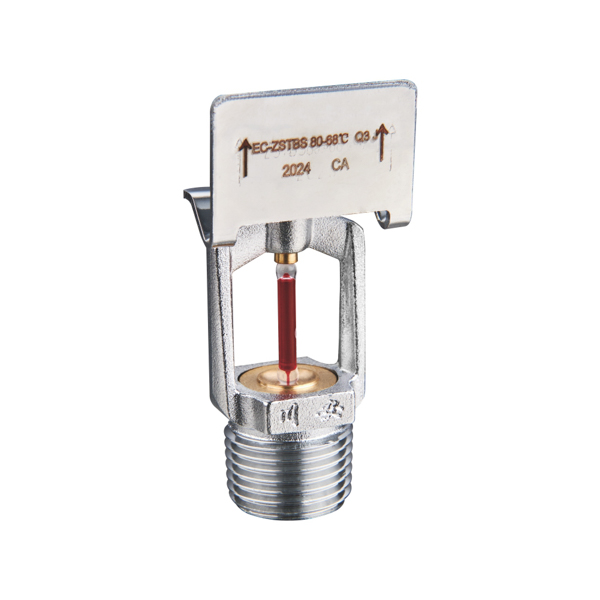
EC-ZSTBS 80-68°C Q3J
Sidewall · K5.6 · 68°CWall-mounted EC head. Covers rooms up to 6 m wide from a single sidewall head — eliminates ceiling pipe runs entirely. Hotel guestrooms, hospital corridors, office corridors and narrow atriums.
| K-factor | K5.6 (K80) |
|---|---|
| Activation | 68°C · Red |
| Max coverage | 36 m²/head |
| Max room width | 6.0 m |
| Thread | R½ (BSP) |
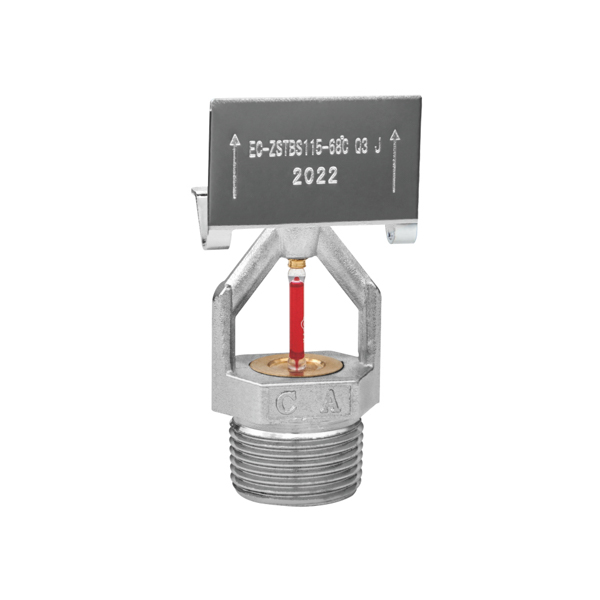
EC-ZSTBS 115-68°C Q3J
Sidewall · K8.0 · 68°CK8.0 sidewall EC for wider corridors and Ordinary Hazard rooms requiring higher discharge density from wall-mounted position. Conference rooms, meeting halls, retail corridors.
| K-factor | K8.0 (K115) |
|---|---|
| Activation | 68°C · Red |
| Max coverage | 36 m²/head |
| Max room width | 6.0 m |
| Thread | R¾ (BSP) |
Complete EC Sprinkler Model Range
All models: 3mm German glass bulb, RTI ≤50 (m·s)½ (quick response thermal element). J suffix = standard bronze/chrome finish. Available temperatures: 57°C, 68°C, 79°C, 93°C, 141°C.
| Model | K-factor | Activation | Bulb | Max Ambient | Max Coverage | Thread | Installation |
|---|---|---|---|---|---|---|---|
| EC-ZSTX — Extended Coverage Pendent | |||||||
| EC-ZSTX 80-57°C Q3J | K5.6 | 57°C | 3mm Orange | 27°C | 36 m² | R½ | Pendent |
| EC-ZSTX 80-68°C Q3J ★ | K5.6 | 68°C | 3mm Red | 38°C | 36 m² | R½ | Pendent |
| EC-ZSTX 115-68°C Q3J ★ | K8.0 | 68°C | 3mm Red | 38°C | 36 m² | R¾ | Pendent |
| EC-ZSTX 80-79°C Q3J | K5.6 | 79°C | 3mm Yellow | 49°C | 36 m² | R½ | Pendent |
| EC-ZSTX 80-93°C Q3J | K5.6 | 93°C | 3mm Green | 63°C | 36 m² | R½ | Pendent |
| EC-ZSTX 80-141°C Q3J | K5.6 | 141°C | 3mm Blue | 111°C | 36 m² | R½ | Pendent |
| EC-ZSTZ — Extended Coverage Upright | |||||||
| EC-ZSTZ 80-57°C Q3J | K5.6 | 57°C | 3mm Orange | 27°C | 36 m² | R½ | Upright |
| EC-ZSTZ 80-68°C Q3J ★ | K5.6 | 68°C | 3mm Red | 38°C | 36 m² | R½ | Upright |
| EC-ZSTZ 115-68°C Q3J ★ | K8.0 | 68°C | 3mm Red | 38°C | 36 m² | R¾ | Upright |
| EC-ZSTZ 80-79°C Q3J | K5.6 | 79°C | 3mm Yellow | 49°C | 36 m² | R½ | Upright |
| EC-ZSTZ 80-93°C Q3J | K5.6 | 93°C | 3mm Green | 63°C | 36 m² | R½ | Upright |
| EC-ZSTZ 80-141°C Q3J | K5.6 | 141°C | 3mm Blue | 111°C | 36 m² | R½ | Upright |
| EC-ZSTBS — Extended Coverage Sidewall | |||||||
| EC-ZSTBS 80-57°C Q3J | K5.6 | 57°C | 3mm Orange | 27°C | 36 m² | R½ | Sidewall |
| EC-ZSTBS 80-68°C Q3J ★ | K5.6 | 68°C | 3mm Red | 38°C | 36 m² | R½ | Sidewall |
| EC-ZSTBS 115-68°C Q3J ★ | K8.0 | 68°C | 3mm Red | 38°C | 36 m² | R¾ | Sidewall |
| EC-ZSTBS 80-79°C Q3J | K5.6 | 79°C | 3mm Yellow | 49°C | 36 m² | R½ | Sidewall |
| EC-ZSTBS 80-141°C Q3J | K5.6 | 141°C | 3mm Blue | 111°C | 36 m² | R½ | Sidewall |
★ Most commonly specified. All models: German 3mm glass bulb · RTI ≤50 · GB 5135 CCCF certified. Activation temperature selection: min. 30°C above max. normal ambient. NFPA 13 submittals available.
Extended Coverage vs Standard Sprinkler — Key Differences
| Parameter | Standard Sprinkler (K-ZSTX / K-ZSTZ) | Extended Coverage (EC-ZSTX / EC-ZSTZ) |
|---|---|---|
| Max protection area | Up to ~20 m² per head | Up to 36 m² per head |
| Max spacing (square) | ~4.6 m × 4.6 m | Up to 6.0 m × 6.0 m |
| Glass bulb diameter | 3mm (QR models) | 3mm (all EC models) |
| Response type | Quick Response (RTI ≤50) | Quick Response (RTI ≤50) |
| Deflector design | Standard radius deflector | Extended-radius deflector — wider water throw |
| Hazard classification | Light, Ordinary, Extra Hazard | Light & Ordinary Hazard only |
| Heads per 1,000 m² | ~50 heads (at 20 m²/head) | ~28 heads (at 36 m²/head) |
| Branch pipe density | Higher — more branch connections | Lower — wider spacing reduces branch runs |
| Obstruction sensitivity | Standard NFPA 13 obstruction rules | More sensitive to ceiling obstructions — requires unobstructed ceiling |
| Ceiling height limit | Up to ~9.1 m (NFPA 13 LH) | Up to ~6.1 m (verify per model listing) |
| Typical applications | All Light, Ordinary & Extra Hazard | Hotels, hospitals, museums, offices, retail |
Where Extended Coverage Sprinklers Are Specified
EC sprinklers are ideally suited to high-value, architecturally sensitive occupancies where minimising visible sprinkler heads and ceiling penetrations is important — and where the space is classified as Light or Ordinary Hazard under NFPA 13 or GB 50084.
Ballrooms, lobbies, guestroom corridors. EC sidewall eliminates ceiling pipe in guestrooms entirely.
Large sales floors benefit most from wider spacing — reduces the visible head count on feature ceilings.
Open-plan offices, reception areas, meeting rooms — where suspended ceiling aesthetics matter.
Wards, corridors, waiting areas. EC sidewall avoids ceiling intrusion in clinical areas with sensitive equipment.
Large open gallery spaces where minimising visible infrastructure is a design requirement.
High-bay terminal spaces with exposed structure benefit from upright EC at wide spacing.
Classrooms, lecture halls, sports halls — Light Hazard open spaces where cost savings are significant.
Exhibition halls, conference centres, sports complexes with large unobstructed ceilings.
Frequently Asked Questions
Can I use EC sprinklers in any building type?
Extended coverage sprinklers are approved under NFPA 13 for Light Hazard and Ordinary Hazard occupancies only. They cannot be used in Extra Hazard occupancies (heavy manufacturing, flammable liquid storage, etc.), in any application requiring ESFR sprinklers, or in locations where the ceiling obstruction rules for EC spacing cannot be satisfied.
Within those limits, EC sprinklers can be used in virtually any building type — hotels, hospitals, offices, retail, schools, museums, and similar occupancies where ceilings are relatively unobstructed and hazard classification is appropriate.
Why do EC sprinklers use a 3mm quick response bulb instead of a 5mm standard response bulb?
Extended coverage sprinklers by definition cover a larger area. If a fire started near the perimeter of a 36 m² protection zone, the activation time of a standard response head could allow the fire to grow beyond the water throw radius before the head opens — potentially leaving part of the protected area without sufficient water.
The 3mm quick response bulb (RTI ≤50) ensures the sprinkler activates earlier in fire development, before the fire can grow to a size that exceeds the extended coverage throw capability. This is why NFPA 13 requires quick response thermal elements for EC sprinklers — it is not possible to list an EC sprinkler with a standard response (5mm) bulb under current standards.
What are the ceiling obstruction requirements for EC sprinklers?
EC sprinklers are significantly more sensitive to ceiling obstructions than standard sprinklers because any beam, duct, or light fitting that interrupts the water throw pattern can create an unprotected gap that may exceed the standard's allowable limits.
NFPA 13 Section 10.2 provides detailed obstruction criteria for EC sprinklers, including maximum obstruction widths and the required clearance distances below structural elements. In practical terms, EC sprinklers work best in spaces with flat or gently sloped ceilings and minimal beam or duct penetrations. In rooms with deep beams or dense ceiling services, standard spacing should be used instead.
Always submit ceiling plans to your fire protection engineer for a formal obstruction analysis before specifying EC spacing on a project.
Can EC and standard sprinklers be mixed on the same system?
Yes — it is common to use EC sprinklers in open areas where wide spacing is achievable and standard sprinklers in areas with dense ceiling obstructions (corridors with many services, plant rooms, etc.). Each zone must be hydraulically calculated independently using its own spacing and K-factor parameters.
The key constraint is that EC and standard sprinklers should not be mixed on the same branch line unless the hydraulic design accounts for the different flow requirements of each head type. Consult your system designer to confirm the hydraulic boundary between EC and standard zones.
What is the maximum ceiling height for EC-ZSTX / EC-ZSTZ?
The maximum ceiling height for extended coverage pendent and upright sprinklers under NFPA 13 Light Hazard listings is typically 6.1 m (20 ft) for most EC models, compared to ~9.1 m (30 ft) for standard spacing. Above this height, the water from an EC deflector does not reach the floor with sufficient density, and standard spacing must be used.
Some EC models have lower maximum heights depending on the protection area selected — a model listed for 36 m² may have a lower maximum ceiling height than the same model at 25 m² spacing. Always verify the specific ceiling height limit against the product data sheet for the model and coverage area you are using.
Is the J suffix in EC-ZSTX 80-68°C Q3J significant?
The J suffix indicates standard finish (zinc-plated brass frame with standard chrome/bronze deflector). A C suffix would indicate a chrome-plated decorative finish. The J suffix is the standard specification used in virtually all commercial and industrial projects. Chrome (C) models are available on request for architectural environments where finish matching is required.
Related Products
EC-ZSTX · EC-ZSTZ · EC-ZSTBS · K5.6 / K8.0 · 57–141°C · Up to 36 m²/head
GB 5135 CCCF Certified · NFPA 13 documentation available · Mixed types welcome · 24 hr quote
sales@ca-fire.com · WhatsApp +86 18150362095
Send Inquiry →