
Pre Action Deluge Valve — 2.5MPa Piston Type, Anti-False Discharge (DN50–DN300)
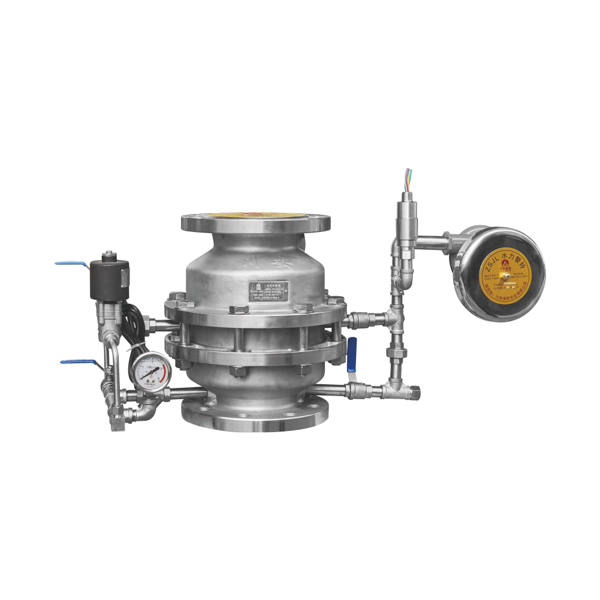
A pre action deluge valve is a normally-closed fire suppression control valve that requires confirmed dual-condition verification before releasing water into the downstream distribution pipework — preventing the accidental discharge that a standard single-signal deluge valve cannot guard against.
CA-FIRE’s ZSFS 50–300-2.5J(Ex) is a pressurised piston-type pre action deluge valve operating at 2.5 MPa working pressure, with three integrated protective functions not available on standard diaphragm deluge valves:
Anti-false discharge (防误喷) — dual-condition activation logic requires simultaneous fire signal confirmation and control circuit condition before the piston opens. A single faulty detector or transient electrical signal cannot trigger discharge.
Water hammer protection (防水锤冲击) — controlled piston opening sequence prevents the destructive pressure surge that occurs when a large deluge valve opens instantly into empty downstream pipework at 2.5 MPa.
Automatic cyclic reset (自动循环启闭) — the valve opens on fire detection and closes automatically when detection clears, then reopens on reignition — maintaining continuous protection without manual intervention between cycles.
Pre action deluge valve vs pre action alarm valve: These are different systems serving different purposes. This pre action deluge valve controls open-orifice nozzle systems — water discharges simultaneously from all nozzles across the entire protected zone on activation, providing immediate total-area coverage. The pre-action alarm valve controls closed-head sprinkler systems where individual sprinkler heads open thermally — water reaches only the heads activated by heat above a fire. Specify this valve for deluge-mode total-area suppression; specify the alarm valve for pre-action sprinkler system configurations protecting sensitive areas with individual head response.
For standard 1.6 MPa applications without anti-false discharge requirements, see the diaphragm deluge valve. For 2.5 MPa single-activation hazardous area systems without pre-action requirements, see the explosion-proof deluge valve.
Technical Specifications
Model: ZSFS 50–300-2.5J(Ex)
| Parameter | Value |
|---|---|
| Nominal Size | DN50 – DN300 (9 sizes) |
| Working Pressure | 2.5 MPa |
| Seal Test Pressure | 5.0 MPa |
| Strength Test Pressure | 10.0 MPa |
| Hydraulic Resistance | < 0.08 MPa |
| Body Material | Stainless steel / Carbon steel (per model) |
| Sealing Element | Metal piston with O-ring seals |
| Connection Type | Flanged |
| Activation Method | Electric solenoid · Pneumatic · Manual |
| Anti-False Discharge | ✓ Dual-condition activation logic |
| Water Hammer Protection | ✓ Controlled piston opening sequence |
| Auto Cyclic Reset | ✓ Automatic open/close cycling |
| Operating Temperature | −20°C to +70°C |
| Operating Medium | Water · Foam-water mixture (up to 6%) |
| Service Life | ≥ 15 years |
| Standards | GB 5135.7-2019 · IEC 60079 · NFPA 13 (on request) |
| Certifications | National fire product certification · PICC liability insurance · Ex certification |
Dimensional Data
| DN (mm) | DN50 | DN65 | DN80 | DN100 | DN125 | DN150 | DN200 | DN250 | DN300 |
|---|---|---|---|---|---|---|---|---|---|
| Height (mm) | 270 | 270 | 320 | 320 | 365 | 365 | 480 | 610 | 690 |
| Working Pressure | 2.5 MPa | 2.5 MPa | 2.5 MPa | 2.5 MPa | 2.5 MPa | 2.5 MPa | 2.5 MPa | 2.5 MPa | 2.5 MPa |
| Seal Test | 5.0 MPa | 5.0 MPa | 5.0 MPa | 5.0 MPa | 5.0 MPa | 5.0 MPa | 5.0 MPa | 5.0 MPa | 5.0 MPa |
| Strength Test | 10.0 MPa | 10.0 MPa | 10.0 MPa | 10.0 MPa | 10.0 MPa | 10.0 MPa | 10.0 MPa | 10.0 MPa | 10.0 MPa |
Dimensional drawings and CAD files available on request — sales@ca-fire.com
Piston Type vs Diaphragm Type — Selection Guide
| Feature | Piston-Type Pre Action Valve (This Product) | Diaphragm Deluge Valve |
|---|---|---|
| Sealing element | Metal piston + O-ring seals | EPDM rubber diaphragm |
| Working pressure | 2.5 MPa | 1.6 MPa |
| Anti-false discharge | ✓ Dual-condition logic built in | Not standard |
| Water hammer protection | ✓ Controlled opening rate | Not standard |
| Auto cyclic reset | ✓ Automatic | Manual reset required |
| High-temperature tolerance | ✓ Metal piston — no rubber limit | Limited by EPDM temperature range |
| Seal longevity | Metal seat — no rubber fatigue | Diaphragm replacement every 2–5 years |
| Maintenance | O-ring inspection only | Periodic diaphragm replacement |
| Typical application | High-value assets, sensitive areas, 2.5 MPa systems | Standard industrial and commercial |
| Relative cost | Higher | ✓ More economical |
Specify the piston-type pre action valve when: false discharge would cause serious operational or financial damage, water hammer at 2.5 MPa is a concern, automatic reset between fire cycles is required, or working pressure exceeds 1.6 MPa.
Specify the diaphragm deluge valve when: standard single-activation deluge performance is sufficient and cost efficiency is the priority — diaphragm deluge valve →
Key Features
Anti-False Discharge — Dual-Condition Activation Logic
False discharge is the most operationally damaging failure mode in a deluge suppression system. A single faulty detector, accidental manual contact, or transient electrical interference can open a standard deluge valve and flood an entire zone — causing water damage to inventory, equipment, or processes that may exceed the value of fire damage the system was installed to prevent.
The pressurised piston pre action deluge valve eliminates this risk through dual-condition activation: the piston remains closed until both conditions are simultaneously satisfied — a confirmed fire detection signal and the required control circuit pressure condition. Neither condition alone is sufficient to open the valve.
This makes the pre action piston valve the mandatory specification for environments where false discharge consequences are severe: aircraft hangars where water damages aircraft and triggers airside shutdown; electrical substations where water on live equipment causes arc flash and equipment destruction; cold storage facilities where water discharge causes product loss and structural freeze damage; museums, data centres, and archival storage where water damage to irreplaceable contents is catastrophic.
Water Hammer Protection — Controlled Piston Opening
At 2.5 MPa supply pressure, a standard deluge valve opening instantaneously into empty downstream pipework creates a pressure wave — water hammer — capable of fracturing open-orifice nozzle bodies, displacing pipe supports, causing joint leakage at grooved couplings, and damaging pressure gauges and instrumentation across the distribution system.
The piston mechanism controls the rate of valve opening — moving from closed to fully open in a measured sequence rather than snapping open instantly. Downstream pipework pressurises progressively, eliminating the destructive pressure transient. At 2.5 MPa, water hammer protection is an engineering requirement for system integrity, not an optional feature.
Automatic Cyclic Reset — Continuous Protection Without Manual Intervention
Standard deluge valves require manual reset after each activation: physically close the valve, re-pressurise the control chamber, drain downstream pipework, return to standby. In a fire that partially suppresses and reignites, this manual sequence leaves the protected area unprotected during the reset procedure — a critical gap in active fire events.
The automatic cyclic reset (自动循环启闭) function allows the piston valve to open on confirmed fire detection, close automatically when detection clears, and reopen immediately on reignition — repeating this cycle as many times as the fire condition demands, without any manual intervention at the valve station. This maintains continuous suppression capability throughout complex multi-stage fire events and in unmanned facilities where access to the valve room during an active fire is hazardous.
2.5 MPa Rating — Higher Flow, Longer Pipe Runs
The 2.5 MPa working pressure — validated by strength testing at 10.0 MPa (four times working pressure) and seal testing at 5.0 MPa — provides two practical system design advantages over 1.6 MPa deluge valves: higher flow rates through large nozzle arrays achieve design discharge density more rapidly; and in large facilities where the valve station is remote from the protected zone, 2.5 MPa supply pressure maintains adequate discharge pressure at the nozzles despite significant friction losses along long distribution pipe runs — a condition that would require an additional booster pump with a 1.6 MPa valve.
Metal Piston Sealing — Extended Service Life
The precision-machined metal piston with O-ring seals eliminates the rubber fatigue, thermal hardening, and time-dependent cracking that eventually require diaphragm replacement in standard deluge valves. O-ring inspection is simpler and less frequent than diaphragm replacement, reducing planned maintenance cost over the valve’s ≥15 year service life. Metal piston wear is gradual and detectable during routine inspection — unlike diaphragm failure, which can occur suddenly between maintenance intervals.
Deluge Valve Working Principle — 2.5 MPa Piston Pre Action System
Pressurised standby: The piston is held closed against the valve seat by the pressurised control circuit. Downstream pipework and all open nozzles are empty at atmospheric pressure. Loss of control circuit pressure triggers a supervisory alarm before any discharge — the pressurised circuit itself provides continuous system integrity monitoring.
Fire detection: An explosion-proof or standard fire detector identifies a fire condition and transmits a signal to the fire alarm control panel.
Dual-condition confirmation: The control panel simultaneously verifies the fire detection signal and the control circuit condition. Only when both are confirmed does the panel energise the solenoid trim valve. A detection signal alone, or a circuit change alone, cannot open the piston.
Controlled piston opening: The solenoid releases control circuit pressure. Supply pressure acts on the piston, which moves from closed to fully open in a controlled sequence — preventing water hammer in the downstream system despite 2.5 MPa supply pressure.
Simultaneous zone discharge: Water fills downstream distribution pipework and discharges simultaneously from all open nozzles across the entire protected zone — total-area suppression at 2.5 MPa supply pressure.
Alarm output: Flow through the alarm port drives the water-motor gong and alarm pressure switch, sending alarm signals to the control panel and all connected monitoring systems.
Automatic cyclic reset: When fire detectors clear, the control circuit automatically re-pressurises and the piston reseats — valve closes, discharge stops. If detectors reactivate, the valve opens again automatically. This cycle repeats without manual intervention for as long as fire conditions demand.
Manual final reset: After fire event confirmation, the system is manually isolated, downstream pipework drained, and the system returned to full supervised standby.
Applications
The 2.5 MPa piston-type pre action deluge valve is specified where false discharge prevention, water hammer protection, and automatic cyclic reset are simultaneously required — the application profile where a standard single-activation diaphragm valve creates unacceptable operational risk.
Commodity warehouses and logistics centres: Large warehouses storing paper, textiles, electronics, and packaged goods — where water discharge from a false alarm causes product losses comparable to a moderate fire. Anti-false discharge logic prevents single-detector faults from triggering discharge while maintaining fast confirmed-fire response. The 2.5 MPa rating supplies large-area nozzle arrays across long warehouse spans without pressure shortfall. Compliant with NFPA 13 pre action system requirements for the pre action sprinkler system or open-nozzle deluge configurations.
Electrical substations and switchgear rooms: High-voltage equipment where water contact during false alarm causes short circuits, equipment destruction, and arc flash events far more damaging than a contained electrical fire. Dual-condition activation prevents water from reaching live equipment from anything other than a confirmed fire event. Standard specification for transformer bay and main switchgear protection.
Aviation fuel storage and aircraft hangars: Aircraft hangars and aviation fuel tank farms where false discharge onto aircraft causes structural damage, environmental contamination, and airside operational shutdown. The 2.5 MPa pressure rating achieves required discharge density across the large unobstructed floor areas of aircraft hangars. Applicable per NFPA 409 hangar protection standards.
Tank farms and chemical storage bunds: Above-ground storage tank bunds and chemical warehouse areas where 2.5 MPa supply pressure maintains design discharge density across large protected perimeters with long distribution pipe runs, and where automatic cyclic reset maintains protection during complex multi-stage fire events involving multiple tank involvement or reignition from flammable liquid spillage. Per NFPA 30 flammable liquids protection requirements.
Factories and industrial process buildings: Manufacturing facilities with high-value production lines and machinery — where false discharge causes production shutdown, equipment damage, and extended restart downtime. Pre-action confirmation ensures suppression water reaches the production floor only on confirmed fire detection.
Airport terminal buildings and public assembly spaces: Large public facilities where false alarm discharge creates evacuation panic, injury risk, and major operational disruption. Dual-condition logic provides the confirmation layer required in high-occupancy buildings where evacuation consequences of a false alarm are themselves a safety risk.
Standards and Certifications
| Standard | Scope |
|---|---|
| GB 5135.7-2019 | Chinese national standard — deluge alarm valves |
| GB 50084 | Automatic sprinkler system design |
| GB 50151 | Foam fire extinguishing system design |
| NFPA 13 | Sprinkler system installation — pre action configurations |
| NFPA 30 | Flammable and combustible liquids |
| NFPA 409 | Aircraft hangar protection |
| IEC 60079 | Explosion-proof equipment (Ex-rated models) |
National fire product certification and PICC product liability insurance provided with every unit.
Factory Quality Control
Before shipment, every pre action piston deluge valve completes:
- Hydrostatic strength test at 10.0 MPa — four times working pressure
- Seal integrity test at 5.0 MPa — twice working pressure, zero leakage confirmed
- Functional test of dual-condition activation logic — single-condition inputs verified non-activating
- Water hammer protection verification — controlled piston opening sequence confirmed
- Automatic cyclic reset test — minimum three consecutive open/close cycles confirmed
- Dimensional inspection of flange face and connection geometry
Factory test report issued with every valve for project commissioning documentation.
Frequently Asked Questions
What is the difference between a pre action deluge valve and a standard deluge valve? A standard deluge valve opens immediately on a single fire signal — fast but vulnerable to false discharge from detector faults or accidental activation. A pre action deluge valve requires dual-condition confirmation before opening, preventing false discharge while maintaining fast confirmed-fire response. CA-FIRE’s piston-type model adds water hammer protection and automatic cyclic reset — features unavailable on standard diaphragm deluge valves — making it the correct specification where both false discharge and suppression failure are unacceptable outcomes.
What is the difference between this valve and the pre action alarm valve? These control fundamentally different systems. This pre action deluge valve controls open-orifice nozzle systems — total-area simultaneous discharge across the entire protected zone on activation. The pre-action alarm valve controls closed-head sprinkler systems where individual sprinkler heads respond thermally and open individually above the fire. Specify this valve for warehouse rack storage, tank farm, hangar, and substation protection where total-zone coverage is required. Specify the alarm valve for pre action sprinkler system configurations where individual head response and water conservation are priorities.
Why does this valve use a piston mechanism instead of a diaphragm? The metal piston with O-ring seals provides three advantages at 2.5 MPa that a rubber diaphragm cannot match: controlled opening rate for water hammer prevention; longer seal service life without periodic diaphragm replacement; and wider operating temperature tolerance. Diaphragm valves are correct for standard 1.6 MPa applications — the piston design is the appropriate specification for 2.5 MPa pre-action duty.
How does the automatic cyclic reset work in practice? When fire detectors in the protected zone clear — because the fire is suppressed or the detection threshold is no longer met — the control circuit automatically re-pressurises and the piston reseats, closing the valve and stopping discharge. If detectors reactivate, the valve opens again automatically. This cycle operates without any manual intervention at the valve station, maintaining continuous protection through complex fire events.
Can this valve be used with foam suppression systems? Yes. The metal piston and valve body are compatible with foam-water mixture at up to 6% concentrate — AFFF, AR-AFFF, FFFP, and protein foam types. The valve connects directly to balanced-pressure proportioners or bladder tank systems without modification.
What maintenance does the piston-type valve require? Quarterly visual inspection of body, trim, and gauge readings. Annual functional test of dual-condition activation, cyclic reset, and alarm pressure switch. Biennial O-ring inspection — replace if wear or deformation detected. Unlike diaphragm valves, there is no rubber diaphragm requiring scheduled periodic replacement, reducing planned maintenance cost over the valve’s service life.
Related Products
- Deluge Valve — Full Range & Selection Guide
- Pre-Action Alarm Valve — closed-head sprinkler system control, individual head response
- Diaphragm Deluge Valve — standard 1.6 MPa single-activation for cost-effective applications
- Explosion-Proof Deluge Valve 2.5 MPa — high-pressure single-activation for Zone 1/2 hazardous areas
- Stainless Steel Deluge Valve — corrosion-resistant body for coastal and chemical environments
- Deluge Valve Skid — Vertical Explosion-Proof — factory pre-assembled hazardous-area station
- Foam Bladder Tank System — foam proportioning for flammable liquid suppression
Email: sales@ca-fire.com · Mobile: +86 13400715622 · WhatsApp: +86 18150362095 · WeChat: 404863577 · www.ca-fire.com
Technical Specifications
Product Name: Pressurised Piston-Type Pre-Action Deluge Valve Model: ZSFS 50~300-2.5J(Ex)
| Parameter | Value |
|---|---|
| Nominal Size | DN50 – DN300 |
| Working Pressure | 2.5 MPa |
| Seal Test Pressure | 5.0 MPa |
| Strength Test Pressure | 10.0 MPa |
| Hydraulic Resistance | < 0.08 MPa |
| Body Material | Stainless steel / Carbon steel (per model) |
| Sealing Element | Metal piston with O-ring seals |
| Connection Type | Flanged |
| Activation Method | Electric (solenoid) · Pneumatic · Manual |
| Anti-False Discharge | ✓ Dual-condition activation logic |
| Water Hammer Protection | ✓ Controlled piston opening sequence |
| Auto Cyclic Reset | ✓ Automatic open/close cycling |
| Operating Temperature | -20°C to +70°C |
| Operating Medium | Clean water · Foam-water mixture |
| Service Life | ≥ 15 years |
| Certifications | National fire product certification · PICC liability insurance · Explosion-proof certification |
Dimension Table:
| DN (mm) | Height (mm) | Working Pressure | Seal Test | Strength Test |
|---|---|---|---|---|
| 50 | 270 | 2.5 MPa | 5.0 MPa | 10.0 MPa |
| 65 | 270 | 2.5 MPa | 5.0 MPa | 10.0 MPa |
| 80 | 320 | 2.5 MPa | 5.0 MPa | 10.0 MPa |
| 100 | 320 | 2.5 MPa | 5.0 MPa | 10.0 MPa |
| 125 | 365 | 2.5 MPa | 5.0 MPa | 10.0 MPa |
| 150 | 365 | 2.5 MPa | 5.0 MPa | 10.0 MPa |
| 200 | 480 | 2.5 MPa | 5.0 MPa | 10.0 MPa |
| 250 | 610 | 2.5 MPa | 5.0 MPa | 10.0 MPa |
| 300 | 690 | 2.5 MPa | 5.0 MPa | 10.0 MPa |