

Every sprinkler head needs a thermal sensing element — a mechanism that holds the valve closed at normal temperatures and releases it the moment a fire raises the ambient temperature past the activation threshold. The glass bulb, filled with a heat-expanding liquid, dominates modern installations. But it is not the only option, and for certain environments it is not the best one.
A fusible link sprinkler head (易熔合金洒水喷头) uses a eutectic metal alloy — a precisely formulated low-melting-point tin-lead-bismuth compound — to hold the sprinkler valve assembly closed under lever compression. The alloy is rigid at normal temperatures; at the rated activation temperature it loses structural strength and releases, freeing the lever and allowing water to flow. Because the sensing element is a solid metal solder joint rather than a liquid-filled glass vial, the mechanism tolerates mechanical shock and sustained vibration that would fatigue or fracture a glass bulb over time.
CA-FIRE's fusible link range spans all three principal orientations: ZSTZ upright (直立式), ZSTX pendent (下垂式), and ZSTBS horizontal sidewall (边墙式). Both flow factors — K5.6 (K=80, R:½ thread) and K8.0 (K=115, R:¾ thread) — are stocked. Activation temperatures are 72°C for K=80 and 74°C for K=115, both appropriate for spaces with peak ambient up to 42–44°C. The critical operational differentiator is the minimum operating temperature of 4°C — making these heads the preferred specification for underground vehicle garages, metro station platforms, railway tunnel side-walls, and cold-adjacent logistics facilities where glass-bulb performance in near-freezing conditions cannot be relied upon.
For glass-bulb standard response: Standard Response Fire Sprinkler (5mm glass bulb) → · For isolated freeze-zone pockets: Dry Sprinkler Head →
Fusible Link vs Glass Bulb — When to Specify Which
🔩 Fusible Link (易熔合金) — This Page
- Sensing element: Eutectic alloy solder joint held under lever compression. Melts at rated temperature, releasing the lever and opening the valve.
- RTI: 80–360 (m·s)½ — Standard Response. Comparable activation speed to 5mm glass SR heads.
- Minimum operating temp: 4°C. Stable near-freezing performance for underground garages, tunnels, and cold logistics facilities.
- Vibration resistance: High. Solid alloy-and-lever mechanism tolerates sustained mechanical vibration from vehicles, trains, or industrial machinery without fatigue or false activation.
- Impact resistance: Superior to glass — no fragile vial to fracture during installation or accidental tool contact.
- Visual inspection: Intact solder bond and lever position visible to naked eye. No colour coding — verify temperature rating from model stamp.
- Best for: Underground garages, metro and railway tunnels, cold-climate logistics hubs, vibration-exposed industrial floors.
💧 Glass Bulb (玻璃球) — Standard & Quick Response
- Sensing element: Sealed glass vial containing thermally expanding alcohol-glycerol solution. Bursts at rated temperature.
- RTI: 3mm ≤50 (QR) · 5mm 50–80 (SR). Tightly controlled, predictable range.
- Minimum operating temp: Typically 0°C or above. Behaviour near or below freezing depends on liquid formulation and can be unpredictable.
- Vibration resistance: Moderate. Sustained vibration can develop micro-cracks in the glass over time, particularly in rail and heavy-traffic environments.
- Impact resistance: Lower — vial fractures on hard impact during installation or transport.
- Visual inspection: Colour-coded by temperature (orange 57°C / red 68°C / yellow 79°C / green 93°C / blue 141°C). Easy visual verification of correct rating.
- Best for: Offices, hotels, retail, schools, hospitals, residential — stable ambient, no significant vibration, no freeze risk.
Three Key Advantages of Fusible Link Technology
The eutectic alloy is a solid-state element whose performance does not vary with temperature below the activation point. In underground garages with uncontrolled ventilation, metro platforms with cold air ingress from tunnel bores, or logistics facilities that approach freezing overnight in winter, the fusible link provides stable, code-compliant performance where glass-bulb reliability in near-zero conditions is harder to certify.
The lever-and-alloy mechanism distributes mechanical loads very differently from a glass vial under tension. In environments with persistent low-frequency vibration — HGV movements in distribution centres, passing trains in metro tunnels, overhead crane cycles in workshops — the fusible link element does not accumulate fatigue stress in the way repeated micro-flexing can weaken a glass vial over years of service. GB 50084 recognises fusible link heads as the preferred specification for vibration-prone underground installations.
In large underground projects — multi-storey carparks, metro stations, tunnel fire systems — sprinkler heads are installed at scale in congested, restricted-access spaces. A glass bulb fractured during installation requires immediate replacement; the solid fusible link element tolerates accidental contact with tools, conduit, or structural elements more forgivingly. For high-volume underground construction, this practical advantage reduces rework cost and programme delay.
Response Classification — Where Fusible Link Sits
CA-FIRE Fusible Link Sprinkler Models
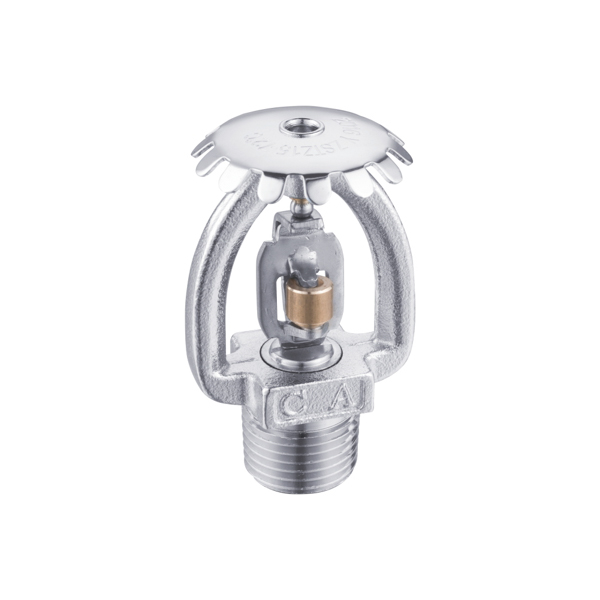
ZSTZ 80-72°C Y
Upright · K5.6 · SR · FusibleUpright fusible link, K5.6 (K=80), 72°C. The workhorse of underground carpark and tunnel systems on exposed pipe. Lever-and-alloy element visible above the deflector frame. Brass body (Y suffix). Standard orientation for open-structure ceiling installations.
| K-factor | K5.6 (K=80) |
|---|---|
| Activation | 72°C |
| Min. act. temp | 69°C |
| Max. ambient | 42°C |
| RTI | 80–360 (m·s)½ |
| Thread | R:½ |
| Min. op. temp | 4°C |
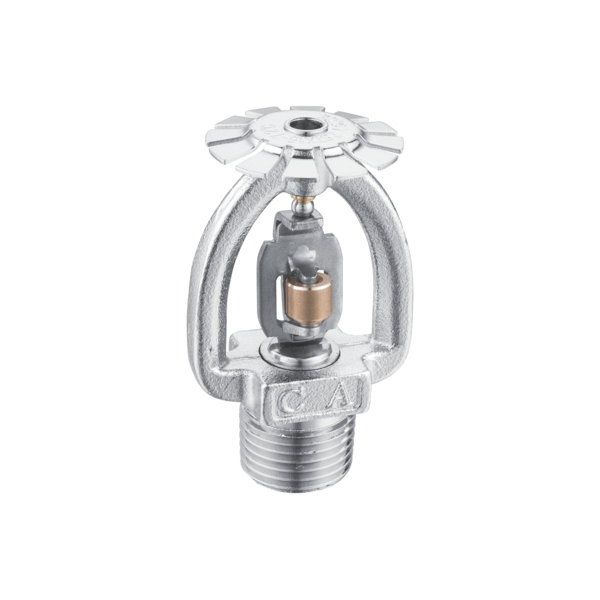
ZSTX 80-72°C Y
Pendent · K5.6 · SR · FusiblePendent fusible link, K5.6 (K=80), 72°C. For underground carparks with suspended ceilings or concrete soffit, where the pipe runs above and heads drop through. Pendent deflector directs water downward across the bay below.
| K-factor | K5.6 (K=80) |
|---|---|
| Activation | 72°C |
| Min. act. temp | 69°C |
| Max. ambient | 42°C |
| RTI | 80–360 (m·s)½ |
| Thread | R:½ |
| Min. op. temp | 4°C |
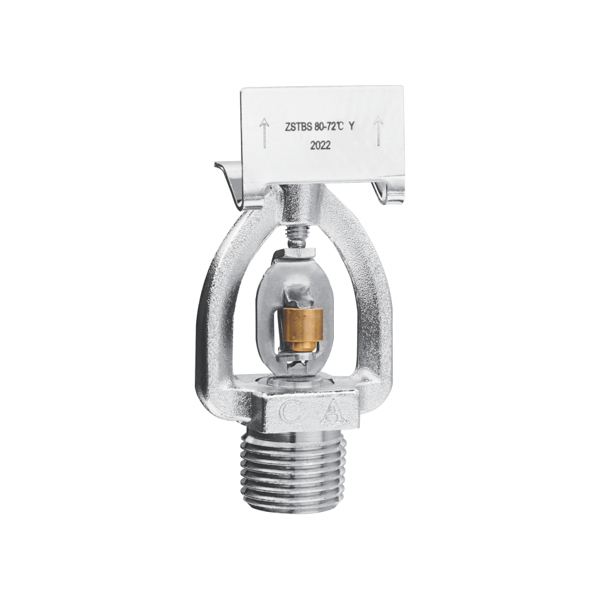
ZSTBS 80-72°C Y
Sidewall · K5.6 · SR · FusibleHorizontal sidewall fusible link, K5.6 (K=80), 72°C. For wall-pipe runs in tunnel corridors, ramp passages, and access lanes where ceiling pipe is impractical. The deflector projects a horizontal fan pattern covering the passage width from a wall-mounted head.
| K-factor | K5.6 (K=80) |
|---|---|
| Activation | 72°C |
| Max. ambient | 42°C |
| RTI | 80–360 (m·s)½ |
| Thread | R:½ |
| Min. op. temp | 4°C |
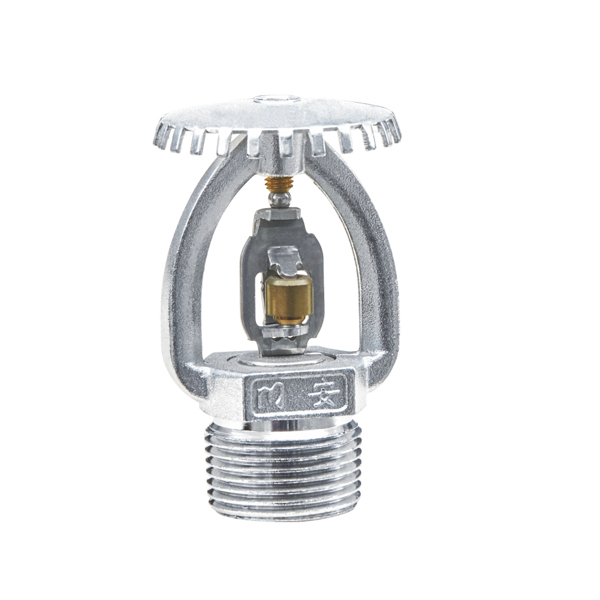
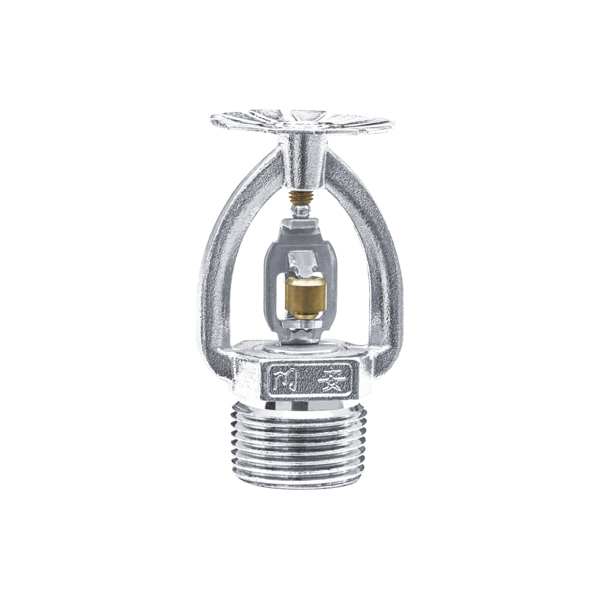
ZSTZ 115-74°C Y
Upright · K8.0 · SR · FusibleK8.0 (K=115) upright fusible link, 74°C. Delivers ~43% more water per head at the same pressure vs K5.6 — suited to extra-hazard bays: vehicle repair pits, goods-loading docks, high-fire-load logistics areas. R:¾ thread. Max ambient 44°C.
| K-factor | K8.0 (K=115) |
|---|---|
| Activation | 74°C |
| Min. act. temp | 71°C |
| Max. ambient | 44°C |
| RTI | 80–360 (m·s)½ |
| Thread | R:¾ |
| Min. op. temp | 4°C |
ZSTX 115-74°C Y
Pendent · K8.0 · SR · FusibleK8.0 (K=115) pendent fusible link, 74°C. For extra-hazard areas within underground facilities with finished ceilings. Also used in larger logistics distribution centres where K8.0 reduces overall head count vs K5.6 for the same design density requirement.
| K-factor | K8.0 (K=115) |
|---|---|
| Activation | 74°C |
| Min. act. temp | 71°C |
| Max. ambient | 44°C |
| RTI | 80–360 (m·s)½ |
| Thread | R:¾ |
| Min. op. temp | 4°C |
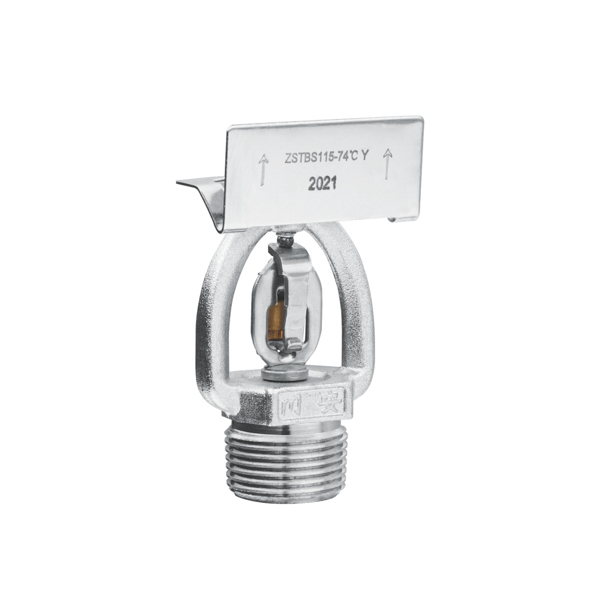
ZSTBS 115-74°C Y
Sidewall · K8.0 · SR · FusibleK8.0 (K=115) horizontal sidewall, 74°C. For wall-pipe extra-hazard spaces — EV charging halls, inspection pits, goods transfer corridors. Higher flow rate per head reduces branch pipe connections in congested wall-pipe runs requiring extra-hazard application density.
| K-factor | K8.0 (K=115) |
|---|---|
| Activation | 74°C |
| Max. ambient | 44°C |
| RTI | 80–360 (m·s)½ |
| Thread | R:¾ |
| Min. op. temp | 4°C |
Complete Technical Parameters
| Model | Orientation | K-factor | Act. Temp | Min. Act. | Max. Ambient | Element | Min. Op. Temp | RTI (m·s)½ | Thread |
|---|---|---|---|---|---|---|---|---|---|
| K5.6 (K=80) · R:½ · Activation 72°C · Max Ambient 42°C | |||||||||
| ZSTZ 80-72°C Y ★ | Upright | K5.6 | 72°C | 69°C | 42°C | Fusible alloy | 4°C | 80–360 | R:½ |
| ZSTX 80-72°C Y ★ | Pendent | K5.6 | 72°C | 69°C | 42°C | Fusible alloy | 4°C | 80–360 | R:½ |
| ZSTBS 80-72°C Y | Sidewall | K5.6 | 72°C | 69°C | 42°C | Fusible alloy | 4°C | 80–360 | R:½ |
| K8.0 (K=115) · R:¾ · Activation 74°C · Max Ambient 44°C | |||||||||
| ZSTZ 115-74°C Y ★ | Upright | K8.0 | 74°C | 71°C | 44°C | Fusible alloy | 4°C | 80–360 | R:¾ |
| ZSTX 115-74°C Y ★ | Pendent | K8.0 | 74°C | 71°C | 44°C | Fusible alloy | 4°C | 80–360 | R:¾ |
| ZSTBS 115-74°C Y | Sidewall | K8.0 | 74°C | 71°C | 44°C | Fusible alloy | 4°C | 80–360 | R:¾ |
★ Most commonly specified. Y suffix = standard brass finish. Min. working pressure 0.1 MPa; max. working pressure 1.2 MPa. Sensing element: eutectic tin-lead-bismuth alloy, lever-actuated. GB 5135 CCCF certified.
Primary Applications
Multi-storey below-grade carparks experience wide seasonal temperature swings, vehicle exhaust vibration, and drip-water exposure. Fusible link heads are the dominant specification for large underground carpark projects in northern China under GB 50016 and GB 50084.
Metro platforms and concourses have persistent low-frequency vibration from passing trains. Fusible link heads maintain element integrity through years of vibration cycles where glass bulbs risk developing micro-fractures.
Sidewall sprinkler systems in road tunnels per GB 50016. Sidewall fusible link heads on wall-pipe runs provide full-width carriageway coverage and withstand vehicle draught and tunnel temperature cycling better than glass-bulb alternatives.
Large cold-adjacent logistics hubs — connected to cold-chain zones or with loading docks open to outside in winter. The 4°C minimum operating temperature and robust K8.0 flow rate suit the large-bay ordinary-to-extra-hazard design requirements of modern distribution warehouses.
Underground EV charging halls combine battery charging heat (elevated ambient) with cold air infiltration in winter. The 72–74°C activation with 4°C minimum operating temperature covers the correct performance envelope for these thermally variable underground spaces.
Renovation of older industrial or underground facilities often involves replacing large-solder-plate legacy heads (RTI >360, non-compliant) with modern GB 5135-certified fusible link heads (RTI 80–360) — restoring code compliance without switching to glass-bulb technology unsuited to the environment.
Frequently Asked Questions
Why do fusible link heads show RTI 80–360 rather than a single fixed value?
RTI (Response Time Index) measures the thermal inertia of the sensing element — how quickly it absorbs heat and reaches activation temperature. For glass bulb heads, the RTI is tightly controlled by bulb diameter and liquid formulation: 3mm bulbs consistently achieve ≤50, 5mm bulbs 50–80. The value is narrow and predictable.
For fusible link heads, the thermal mass and heat transfer of the alloy-and-lever assembly vary across designs and manufacturers, giving a broader certified range: 80–360 (m·s)½. This entire band falls within the Standard Response classification under GB 5135. In practice, the CA-FIRE fusible link heads perform toward the lower end of this range — broadly equivalent in activation speed to 5mm standard response glass bulb heads — so they are hydraulically interchangeable with SR glass-bulb heads within the same system design zone.
Can I use fusible link sprinklers in a wet-pipe system if the space sometimes reaches 2°C in winter?
No — and this is important to understand clearly. The 4°C minimum operating temperature refers to the sprinkler element's own performance, not to the wet-pipe system as a whole. A wet-pipe sprinkler system must be maintained above 4°C throughout its entire pipe run to prevent the water in the distribution pipes from freezing, expanding, and splitting the pipe.
If your space reliably stays above 4°C but occasionally approaches that threshold (e.g., a northern China underground garage in deep winter), fusible link heads in a wet-pipe system are appropriate. If the space can drop below 4°C — unheated external plant rooms, loading docks open to outside in severe winter — a dry sprinkler head extending from a heated zone is required, not a wet-pipe system with any head type.
Are fusible link heads more difficult to inspect or maintain than glass bulb heads?
Inspection procedures are similar for both types under GB 50084 and GB 25506 — periodic visual inspection, confirmation of no corrosion or paint overspray, and replacement of any activated or physically damaged heads. There is no colour coding on fusible link heads equivalent to the glass bulb temperature colour system, so maintaining an accurate head inventory and verifying correct temperature rating from the model number stamped on the frame is more important during installation and replacement.
One practical advantage: there is no fragile element that might show hairline cracks that are difficult to detect visually. One consideration: replacement interval requirements should be confirmed with the authority having jurisdiction at the time of system commissioning, as these may differ from glass-bulb head replacement schedules.
Can fusible link heads and glass bulb heads be mixed in the same design zone?
Mixing fusible link (RTI 80–360) with quick-response glass bulb heads (RTI ≤50) in the same hydraulic design zone should be avoided. The QR heads activate significantly earlier than the fusible link heads in a fire event, reducing pipe pressure before the fusible link heads open and potentially compromising minimum design flow at the slower-responding heads. GB 50084 requires consistent response characteristics within a zone.
Mixing fusible link (RTI 80–360) with standard-response 5mm glass bulb heads (RTI 50–80) in the same zone is generally acceptable because both are Standard Response classification and their thermal response behaviour is similar. Always confirm with the system designer that hydraulic calculations account for both head types if mixing is proposed in a renovation or hybrid project.
Related Products
ZSTZ · ZSTX · ZSTBS · K5.6 (K=80) 72°C · K8.0 (K=115) 74°C · RTI 80–360 · Min. 4°C op. temp
Underground garages · Metro tunnels · Logistics centres · Vibration environments · GB 5135 CCCF Certified · 24 hr quote
sales@ca-fire.com · WhatsApp +86 18150362095
Send Inquiry →