
French Type Above-Ground Fire Hydrant — NF EN 14384 | CA-FIRE
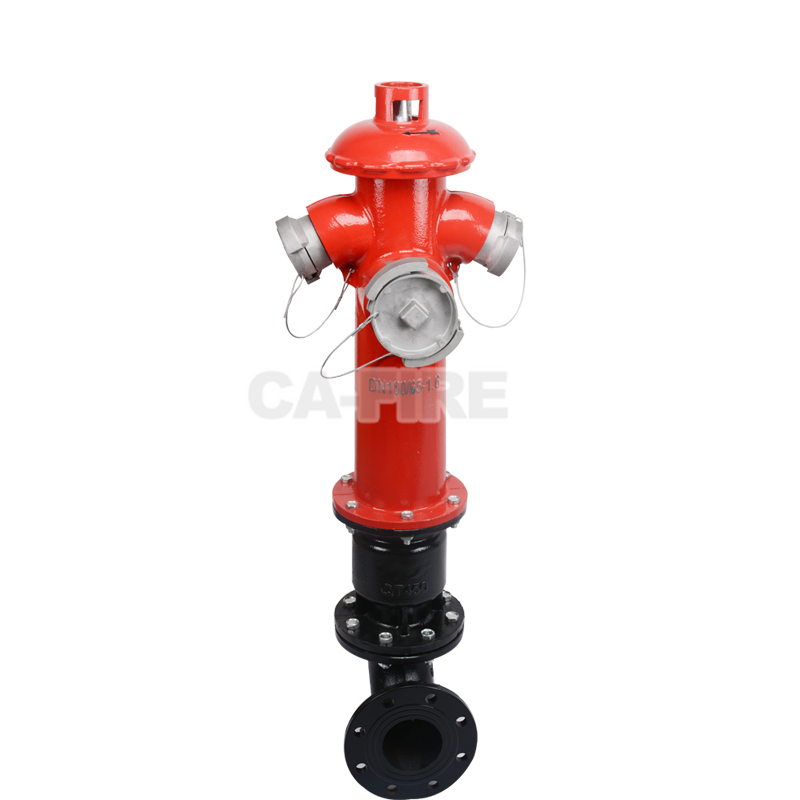
✓ NF EN 14384 Compliant✓ DN100 · PN16 · 1.6 MPa✓ 2 × 65 mm DSP Outlets✓ Ductile Iron EN-GJS-500-7✓ −25°C to +70°C✓ 25+ Year Service Life✓ CE · ISO 9001 · NF
The CA-FIRE French type above-ground fire hydrant is manufactured to NF EN 14384 — the European pillar fire hydrant standard adopted as the French national standard — and is designed for municipal water supply networks, industrial plant perimeters and commercial infrastructure across France, Francophone Africa, and any project authority specifying the French NF standard. The DN100 pillar hydrant delivers up to 75 L/s at 1.6 MPa working pressure through two 65 mm DSP-thread outlets (Demi-Storz Pompier — the French fire service coupling standard), enabling direct hose connection by French fire brigades without adaptors. The body is cast from ductile iron EN-GJS-500-7 with hot-dip galvanising (Zn ≥ 100 μm) and RAL 3000 red electrostatic powder coating, achieving a service life exceeding 25 years. The hydrant connects to existing water mains via PN16 flanges per NF EN 1092-1 and is supplied with full NF certification, CE declaration of conformity, third-party test reports, and a French/English bilingual installation manual.
Technical Specifications — NF EN 14384
| Parameter | Specification |
|---|---|
| Compliance Standard | NF EN 14384 · CE · ISO 9001:2015 |
| Nominal Diameter | DN100 (100 mm / 4 inch) |
| Working Pressure (PFA) | PN16 — 1.6 MPa (232 psi) |
| Test Pressure (Hydrostatic) | 2.4 MPa — 30-minute hold, zero leakage |
| Maximum Flow Rate | 75 L/s (1,190 GPM) |
| Outlet Configuration | 2 × 65 mm — DSP thread (Demi-Storz Pompier, French fire service standard) |
| Inlet Connection | Flange — PN16, NF EN 1092-1 |
| Body Material | Ductile iron EN-GJS-500-7 |
| Valve Core Material | Brass alloy Cu-Zn 40 |
| Sealing Material | EPDM rubber · −25°C to +80°C temperature range |
| Surface Treatment | Hot-dip galvanising (Zn ≥ 100 μm) + electrostatic powder coating RAL 3000 red (customisable) |
| Operating Temperature | −25°C to +70°C |
| Overall Height × Width | 950 mm × 320 mm (excluding flange base) |
| Net Weight | 72 kg (without accessories) |
| Standard Accessories | 2 × outlet caps · 1 × operating wrench · 1 × flange gasket · 4 × fixing bolts |
| Optional Accessories | Thermal insulation jacket · reflective marker post · GPS tracking tag · colour-coded caps |
| Service Life | 25+ years |
| Warranty | 2 years |
* Surface colour customisable on request: RAL 9003 white, RAL 7035 grey, RAL 5010 blue, or project-specific RAL. Thermal insulation jacket recommended for installations below −20°C.
Key Features
|
🇫🇷 NF EN 14384 + CE — Dual-Standard Certification NF EN 14384 is the harmonised European standard for pillar fire hydrants, published by CEN (Comité Européen de Normalisation) and adopted without modification as the French national standard. It specifies minimum requirements for dimensions, flow performance, mechanical strength, leaktightness, corrosion resistance, drainage and conformity evaluation for DN 80, DN 100 and DN 150 pillar hydrants at PN16. CE marking under this standard gives the French type fire hydrant legal market access across all 27 EU member states and associated countries recognising CE declarations. Each unit leaves the factory with a CE declaration of conformity, NF certification, and a third-party accredited test report — the complete documentation package required by French municipal and industrial project authorities for fire authority inspection and project handover. NF EN 14384 · CE · ISO 9001 · Third-Party Tested |
🔧 DSP Outlets — Direct French Fire Brigade Compatibility The two 65 mm outlets are threaded to the DSP (Demi-Storz Pompier) profile — the French national fire service coupling standard, specified in NF S 61-750 and used exclusively by French sapeurs-pompiers brigades. DSP coupling allows a quarter-turn bayonet-style connection: a firefighter can attach a charged hose line in under three seconds without tools. Both outlets are positioned symmetrically at working height for simultaneous dual-hose connection during large-scale suppression operations. The outlet caps are also DSP-profile with retention chains to prevent loss during deployment. No outlet adaptors are required when used with standard French fire service hose reels — a critical factor in reducing emergency response time. DSP Thread · NF S 61-750 · Dual 65 mm Outlets |
|
🏗️ EN-GJS-500-7 Ductile Iron — 25+ Year Outdoor Life The hydrant body is cast from ductile iron grade EN-GJS-500-7, which combines the cast iron’s excellent corrosion resistance and machinability with a minimum tensile strength of 500 MPa and 7% elongation at fracture. This toughness prevents brittle fracture under vehicle impact — a common failure mode for grey cast iron hydrants on road verges and industrial sites. The double-layer surface system — hot-dip galvanising (Zn ≥ 100 μm) forming an inter-metallic zinc-iron alloy layer, followed by electrostatic powder coating — provides two independent corrosion barriers. Salt-spray testing to ISO 9227 confirms 1,000+ hours of resistance, satisfying the NF EN 14384 corrosion performance requirement for coastal and industrial environments. EN-GJS-500-7 · Zn ≥ 100 μm · 1,000 h Salt-Spray |
🌍 Francophone Africa & Export Market Ready France’s influence on fire protection standards extends well beyond metropolitan France. The NF EN 14384 standard and DSP coupling system are specified across Francophone Africa — Senegal, Ivory Coast, Morocco, Tunisia, Cameroon, DRC and others — as well as French-governed territories in the Caribbean, Indian Ocean and Pacific, and French-influenced infrastructure projects across the Middle East and Southeast Asia. CA-FIRE’s French type fire hydrant is supplied factory-direct to fire protection contractors, municipal engineering bureaus and EPC contractors across all of these markets. Documentation is provided in French and English; project-specific certifications and country-of-origin documents are available on request for import clearance and authority submission in each destination country. France · Francophone Africa · DOM-TOM · Middle East |
How the French Type Fire Hydrant Works
The French type above-ground fire hydrant uses a globe (screw-down) valve mechanism as specified in NF EN 14384. The main valve stem is operated via a pentagonal top nut — the standardised French fire service wrench profile — ensuring only authorised personnel with the dedicated key can open or close the hydrant.
|
1
Standby — Main valve closed, outlets capped In standby the main globe valve is fully closed and both 65 mm DSP outlets are sealed with captive caps. The hydrant body between the main valve and the outlets may retain a small volume of water. In regions below −15°C, a drainage option (drain facility per NF EN 14384 §4.14) can be specified to automatically empty the hydrant body after each use. |
2
Activation — Pentagonal wrench opens main valve The French fire service operating wrench engages the pentagonal top nut. Rotating clockwise raises the globe valve disc off its seat, opening the flow path from the water main through the barrel to the outlets. NF EN 14384 specifies a maximum of 12 operating turns from fully closed to fully open, ensuring rapid water delivery in emergencies. |
|
3
Discharge — DSP quarter-turn hose connection Remove the outlet cap(s) by rotating anti-clockwise. Press the DSP coupling on the fire hose against the outlet face and rotate a quarter-turn clockwise — the bayonet locks and seals in one motion. Both 65 mm outlets can be used simultaneously for dual-line attack at maximum 75 L/s combined flow, or a single outlet for targeted suppression. Flow rate is controlled by the degree of valve opening. |
4
Shutdown — Close valve, disconnect, replace caps Rotate the operating wrench anti-clockwise to close the main valve. Disconnect hose lines by reversing the DSP quarter-turn. Replace outlet caps. If drain facility is fitted, the hydrant body self-empties automatically. If no drain facility, manually vent any residual pressure via the test port before leaving. In cold weather, confirm the hydrant body is draining or purge manually to prevent frost damage. |
Installation Guide
Pre-Installation Checklist
Before installing the French type fire hydrant, confirm the following: product model and NF EN 14384 certification match the project specification and local authority requirement; the hydrant body and flange face are undamaged after transport; all standard accessories are present; the concrete base is flat, stable and rated for ≥ 200 kg bearing load; a clearance zone of at least 1.5 m exists on all sides for fire service vehicle access; the water main is rated for PN16 / 1.6 MPa and the flange face has been cleaned. Where the hydrant serves a building, confirm compliance with French fire code minimum spacing requirements — typically one hydrant within 100 m hose lay of each building face, with hydrants at a maximum 200 m spacing along access roads.
Installation Steps
Set the hydrant on the prepared reinforced concrete plinth and verify verticality with a spirit level (tolerance ≤ 2 mm/m in all axes). Fit the EPDM flange gasket between the hydrant inlet flange and the water main flange. Align all bolt holes and insert M16 flanged bolts. Tighten in a star-pattern sequence to 40–50 N·m torque — uneven clamping on PN16 flanges causes localised gasket extrusion and leakage. Secure the hydrant to the plinth with M16 × 100 mm chemical anchor bolts. Before backfilling or surfacing, conduct the commissioning hydrostatic test: cap both outlets, fill slowly to purge air, pressurise to 2.4 MPa and hold for 30 minutes with zero observed leakage at the flange joint, valve body, stem packing and outlets. Install hydrant marker post at kerb edge if specified by local authority or project engineer.
Emergency Operation
Locate the hydrant using the marker post or pavement marking. Confirm the access zone is clear. Remove outlet caps anti-clockwise. Connect DSP hose couplings by quarter-turn clockwise. Engage the pentagonal wrench onto the top nut and rotate clockwise to open — water flows through both outlets. Adjust flow by controlling valve opening turns. After suppression: close fully anti-clockwise; disconnect DSP couplings by quarter-turn anti-clockwise; replace caps; confirm drain facility is functioning or manually purge residual water in cold conditions; inspect body and outlets for impact damage before leaving the site.
Maintenance Schedule
| Frequency | Task |
|---|---|
| Monthly | Visual inspection of hydrant body, outlet caps and surface coating for corrosion, mechanical damage, cracking or paint loss. Confirm NF EN 14384 mandatory markings (model, PN, DN, manufacturer, year) are legible. Verify marker post is upright and visible. Confirm 1.5 m clearance zone is free of obstacles, parked vehicles and vegetation. |
| Quarterly | Remove DSP outlet caps and inspect EPDM face seals for cracking, deformation or surface deterioration — replace with CA-FIRE genuine parts if degraded. Apply Molykote or equivalent food-grade grease to the pentagonal top nut and stem thread. Check flange bolts for loosening and re-torque to 40–50 N·m. If drain facility is fitted, verify it operates freely by briefly opening the main valve with no hose attached and confirming drainage within 3 minutes of closing. |
| Annual | Full hydrostatic performance test (2.4 MPa, 30 minutes). Inspect globe valve disc and seat ring for wear; replace if closing torque has increased or residual drip-leakage is observed. Repaint areas where coating has failed to bare metal. Update maintenance log with test results, inspection findings and any parts replaced. Renew hydrant marker post if faded or damaged. |
| Before winter | For installations in northern France, mountain regions, or Francophone markets with cold winters: verify drain facility is fully functional; fit polyurethane insulation jacket if ambient temperature will fall below −20°C; mark hydrant position with snow poles in areas where snow accumulation may obscure the marker post. |
Applications
|
Metropolitan France — Municipal Networks Urban and suburban road networks, residential streets and ZAC (zone d’aménagement concerté) development areas across France. French municipal engineers and SDIS (Service Départemental d’Incendie et de Secours) specify NF EN 14384 hydrants as standard for all new public water infrastructure projects. |
Francophone Africa — Infrastructure Projects Municipal water network upgrades, new city development and industrial park construction across Senegal, Ivory Coast, Morocco, Tunisia, Cameroon, DRC and other Francophone markets. French-standard fire hydrants are consistently specified in infrastructure financed by AFD (Agence Française de Développement), EIB and World Bank projects in these regions. |
Industrial & Petrochemical Sites Refinery perimeters, LNG terminals, chemical processing units and logistics parks in France and Francophone markets. Industrial fire protection engineers specify the DN100 PN16 hydrant for high-pressure process plant perimeters where maximum flow rate and pressure rating are required. |
|
French Overseas Territories (DOM-TOM) Guadeloupe, Martinique, La Réunion, French Guiana, Mayotte, New Caledonia and French Polynesia — all apply the same NF EN 14384 standard and DSP coupling system as metropolitan France. CA-FIRE supplies to contractors operating across the DOM-TOM with full CE and NF documentation. |
Commercial & Public Buildings Shopping centres, hospitals, airports and office developments in France and Francophone markets where the local Code de la Construction mandates external hydrant provision. The DN100 hydrant’s compact 320 mm width fits standard pavement and car park kerb installations without requiring special ground works. |
Middle East — French-Specification Projects EPC and infrastructure projects across the Middle East and North Africa where project specifications reference French or European standards — common in projects involving French engineering consultants (Egis, Systra, Artelia) or operating in countries with historic French administrative influence. |
Frequently Asked Questions
What is NF EN 14384 and why does it matter for specifying a French fire hydrant?
NF EN 14384 is the harmonised European standard for pillar (above-ground) fire hydrants, published by CEN and adopted as a national standard across all EU member states. In France, it is the mandatory reference standard published by AFNOR (Association Française de Normalisation) under the designation NF EN 14384. The standard defines minimum performance requirements for DN 80, DN 100 and DN 150 hydrants at PN16, including flow characteristics, leaktightness, mechanical strength, corrosion resistance, drain facility and mandatory marking.
For procurement purposes, specifying NF EN 14384 compliance ensures the hydrant has been independently tested and certified — not self-declared. French municipal authorities and SDIS fire departments will reject non-certified hydrants during project inspection. All CA-FIRE French type fire hydrants carry full NF EN 14384 certification with third-party accredited test reports included in the supply documentation.
What is a DSP coupling and why are French fire hydrants incompatible with BS or GOST hose fittings?
DSP (Demi-Storz Pompier) is the French national fire service hose coupling standard, specified in NF S 61-750. It uses a quarter-turn bayonet locking mechanism and a specific 65 mm face seal profile that differs dimensionally from the UK 2½″ instantaneous coupling (used on BS750 hydrants), the German Storz coupling, and the Russian GOST thread profile (used on Russian standard hydrants). These coupling types are not interchangeable without adaptors. Specifying the correct hydrant outlet type for your fire service’s hose equipment is critical — connecting the wrong coupling in an emergency costs time and risks leakage under pressure. Always confirm which coupling system your local fire brigade operates before specifying a hydrant.
Can the French type fire hydrant be used in Francophone African countries?
Yes — and it is the standard specified in most Francophone African markets. Countries including Senegal, Ivory Coast, Morocco, Tunisia, Algeria, Cameroon, Gabon, Congo, DRC and others have adopted French fire safety standards as their national baseline. Their fire services operate DSP coupling equipment, so French type hydrants are directly compatible. CA-FIRE regularly supplies to contractors and municipal water authorities in these markets. We provide French/English bilingual documentation, country-of-origin certificates and can advise on import documentation requirements for specific destination countries. Contact us with the project country and authority details for guidance on local submission requirements.
Is a drain facility required for French type hydrants in cold climates?
NF EN 14384 §4.14 specifies that hydrants installed in freezing conditions must be fitted with a drain facility — a passive mechanical drain that automatically empties the hydrant barrel between the main valve and the outlets after each use. CA-FIRE’s French type fire hydrant is available with this drain facility as standard for cold-climate installations. For metropolitan France, the drain facility is specified for installations above approximately 500 m altitude, in northern and eastern departments, and across the Alps and Pyrenees regions. For Francophone Africa and Middle East markets where ambient temperatures remain above 0°C year-round, the drain facility is not required but adds no functional disadvantage if specified.
How does the French type hydrant compare to BS750 and Russian standard hydrants?
All three are above-ground pillar hydrants serving the same function — providing fire service access to a pressurised water main — but they use incompatible outlet coupling profiles and flange dimensions. The French type (NF EN 14384) uses 2 × 65 mm DSP outlets and PN16 NF EN 1092-1 flanges. The BS750 (UK standard) uses 2½″ instantaneous couplings and differs in hydrant height and operating mechanism. The Russian GOST 24013-80 uses metric-threaded outlets and GOST flange dimensions. The applicable standard is determined by the country or project authority having jurisdiction — it is not a choice between equivalent alternatives. CA-FIRE manufactures all three types; confirm your project’s applicable standard before ordering.
Applicable Standards & External References
The French type above-ground fire hydrant is designed and tested to the following standards. Engineers and procurement teams can refer to the official standard publications for full technical requirements:
| Standard | Scope & Relevance |
|---|---|
| NF EN 14384 | Pillar fire hydrants — dimensions, flow performance, leaktightness, corrosion resistance, drain facility, marking and conformity evaluation. The primary certification standard for this product. Published by AFNOR (France) and CEN (Europe). |
| NF EN 1092-1 | Flanges and their joints — circular flanges for pipes, valves, fittings and accessories. Governs the PN16 inlet flange dimensions on this hydrant. |
| NF S 61-750 | French national standard for fire service hose couplings — defines the DSP (Demi-Storz Pompier) 65 mm coupling profile used on the outlets of this hydrant. |
| CEN / TC 164/WG 12 | The CEN Technical Committee responsible for EN 14384 and related water supply standards. CEN publishes the harmonised European standards adopted across all EU member states, ensuring consistent technical requirements from France to Finland. |
| ISO 9001:2015 | CA-FIRE’s quality management system certification — covers design, manufacturing, inspection and supply chain for all fire hydrant products including this model. |
Why Specify CA-FIRE’s French Type Fire Hydrant
|
✓ NF EN 14384 Independently Certified — Not Self-Declared CA-FIRE’s French type hydrant is tested by accredited third-party laboratories against the full NF EN 14384 parameter set. CE declaration of conformity and NF certification documentation ship with every order — acceptable to French SDIS, municipal authorities and project certifiers without additional verification. |
✓ DSP Outlets Precision-Machined for French Fire Service Compatibility DSP thread geometry is machined to NF S 61-750 tolerance — not approximated. Dimensional conformance is verified on every batch. This precision ensures reliable quarter-turn hose coupling engagement under field conditions, including by fire crew wearing gloves in smoke-filled environments. |
|
✓ Francophone Africa Supply Experience CA-FIRE has supplied French type hydrants to municipal and industrial projects across West Africa, North Africa and Central Africa. We understand import documentation requirements, country-specific marking preferences, and the logistics of container-load delivery to port cities from Dakar to Douala. |
✓ Factory-Direct · French & English Documentation All technical documentation — installation manual, maintenance schedule, test reports and CE declaration — is provided in French and English as standard. Factory-direct pricing eliminates distributor margin. Lead time and pricing confirmed within one business day. Single units through to full container loads supplied. |
Related Products
|
BS750 · UK & Commonwealth BS750 Above-Ground Fire Hydrant British Standard BS750 pillar hydrant with 2½″ instantaneous coupling outlets. For UK, Australia, South Africa and Commonwealth market projects requiring BS750 certification. |
GOST 24013-80 · Russia & CIS Russian Standard Above-Ground Fire Hydrant GOST 24013-80 compliant pillar hydrant with −40°C auto-drain frost protection and GOST-thread 100 mm + 65 mm outlets. For Russia, CIS and Eastern European projects. |
All Types · Full Range Fire Hydrant — Category Overview Compare all CA-FIRE fire hydrant types — French, BS750, Russian, GB above-ground, underground and foam series — with full specification comparison table and selection guide. |
Get a Quote — French Type Fire Hydrant
NF EN 14384 · DN100 · PN16 · DSP Outlets · Ductile Iron · CE Certified
France · Francophone Africa · DOM-TOM · Middle East · Factory Direct
sales@ca-fire.com
WhatsApp: +86 18150362095
+86 13400715622
WeChat: 404863577
|
Item
|
Specification
|
|---|---|
|
Product Name
|
French Type Above-Ground Fire Hydrant
|
|
Compliance Standards
|
NF EN 14384, NF S 61-300, ISO 9001:2015, CE Certification
|
|
Nominal Diameter
|
80mm (3 inches)
|
|
Working Pressure
|
1.6MPa (232 psi)
|
|
Test Pressure (Hydrostatic)
|
2.5MPa (363 psi) (30-minute holding time)
|
|
Maximum Flow Rate
|
75L/s (1190 GPM)
|
|
Outlet Configuration
|
2 x 65mm outlets (compatible with French standard fire hoses)
|
|
Body Material
|
Ductile Iron EN-GJS-500-7
|
|
Valve Core Material
|
Brass Alloy (Cu-Zn 40)
|
|
Sealing Material
|
EPDM Rubber (-25°C ~ +80°C temperature resistance)
|
|
Surface Treatment
|
Hot-Dip Galvanizing (Zn ≥ 100μm) + Electrostatic Powder Coating (RAL 3000 Red, customizable)
|
|
Installation Method
|
Flange Connection (PN16, NF EN 1092-1 standard)
|
|
Operating Temperature
|
-25°C ~ +70°C
|
|
Overall Dimensions (H x W)
|
950mm x 320mm (excluding flange base)
|
|
Net Weight
|
72kg (without accessories)
|
|
Standard Accessories
|
2 x Outlet Caps, 1 x Operating Wrench, 1 x Flange Gasket, 4 x Fixing Bolts, Standard Fire Hydrant Markings
|
|
Optional Accessories
|
Reflective Fire Hydrant Markers, GPS-Enabled Markers, Thermal Insulation Jacket, Color-Coded Caps
|
|
Warranty Period
|
2 Years (extendable to 5 years with premium maintenance package)
|