
Fire Sprinkler Alarm Valve — Temperature-Controlled Integrated Unit (DN32–DN80)
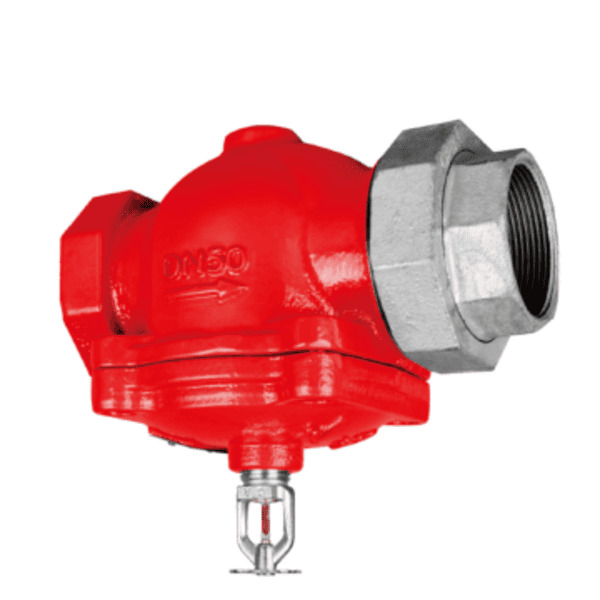
What Is a Temperature-Controlled Fire Sprinkler Alarm Valve?
A fire sprinkler alarm valve in the temperature-controlled configuration is a self-contained fire suppression unit that combines the control valve body and heat-sensitive sprinkler head into a single integrated assembly — eliminating the need for a separate deluge valve station, detection system, or control panel to trigger water discharge.
Unlike standard deluge valves that require an external electrical or pneumatic signal to open, the temperature-controlled fire sprinkler alarm valve activates autonomously when the ambient temperature at the protected location reaches the pre-set activation threshold of the integrated “Job” heat-sensitive element — at 57°C, 68°C, 79°C, or 93°C depending on the temperature rating selected.
CA-Fire’s ZSFW series temperature-controlled fire sprinkler alarm valve is engineered for a specific and important application that standard deluge valves cannot serve effectively: targeted, localised fire compartmentation and suppression at doorways, window openings, conveyor penetrations, and specific equipment locations — small defined areas where a zone-wide deluge system would be disproportionate and where autonomous thermal activation is more reliable than remote detection-triggered systems.
The integrated diaphragm vulcanisation design (一体式隔膜硫化) eliminates the joint between valve body and diaphragm — the most common leak point in conventional deluge valves — producing a simpler, more reliable assembly with fewer components and a smaller installed footprint than any equivalent separate valve-plus-sprinkler arrangement.
How This Fire Sprinkler Alarm Valve Differs from Standard Deluge Valves
Most fire suppression valves on the CA-Fire range — from the diaphragm deluge valve to the explosion-proof skid assembly — protect large zones and require external detection systems, control panels, and electrical power to activate. The temperature-controlled fire sprinkler alarm valve serves a fundamentally different purpose:
| Feature | Temperature-Controlled Fire Sprinkler Alarm Valve (This Product) | Standard Zone Deluge Valve |
|---|---|---|
| Activation method | Autonomous thermal — Job heat element melts at set temperature | External signal — detector + control panel + solenoid |
| Protected area | Small, targeted — doorway, window, single equipment item | Large zone — entire room or process area |
| Detection system required | No — self-contained thermal activation | Yes — smoke/heat detectors + panel |
| Electrical power required | No — fully mechanical/hydraulic | Yes |
| Valve + sprinkler integration | Yes — single unit | No — separate valve station + sprinkler heads |
| Installation complexity | Very low — connects directly to water supply pipe | High — valve station, trim, detection, cabling |
| Typical size | DN32–DN80 | DN50–DN350 |
| Primary application | Fire compartmentation at openings, targeted equipment protection | Zone suppression of large areas |
| False discharge risk | Very low — requires physical heat at the exact location | Higher — depends on detector reliability |
Specify the temperature-controlled fire sprinkler alarm valve when: the protected target is a small, defined opening or equipment item, autonomous activation without electrical systems is required, or the installation must function independently of the building fire alarm system.
Specify a zone deluge valve when: a large area requires simultaneous total-coverage suppression — see the deluge valve range.
Key Advantages
Integrated Diaphragm Vulcanisation Design — Fewer Components, Higher Reliability
The defining manufacturing innovation in the ZSFW series is its one-piece integrated diaphragm vulcanisation (一体式隔膜硫化) construction. In conventional deluge valves, the rubber diaphragm is a separate component clamped between the valve body and bonnet — creating a mechanical joint that is the most common source of leakage, diaphragm displacement, and seal failure over the valve’s service life.
In the ZSFW series, the diaphragm is vulcanised — chemically bonded under heat and pressure — directly into the valve body as part of the manufacturing process. The result is:
- No clamped diaphragm joint — eliminates the primary leak point of conventional diaphragm deluge valves
- Fewer total components — simpler assembly with fewer parts that can fail or require replacement
- Smaller overall envelope — the integrated construction is more compact than a separate valve body plus bonnet assembly
- Consistent diaphragm geometry — vulcanisation produces a precisely formed diaphragm profile, ensuring repeatable sealing performance across production batches
This construction is particularly valuable in the ZSFW’s application environment — installed permanently at doorways, window frames, or equipment locations where access for maintenance is limited and leakage in standby would cause immediate problems.
“Job” Heat-Sensitive Element — Four Activation Temperatures
The “Job” heat-sensitive element is the thermal activation component of the fire sprinkler alarm valve. It is a glass bulb or fusible link type element — similar in principle to a standard sprinkler head thermal element — that holds the valve closed under normal conditions and releases when ambient temperature reaches the rated activation threshold.
CA-Fire’s ZSFW series is available in four standard activation temperatures:
| Temperature Rating | Activation Temp | Colour Code | Typical Application |
|---|---|---|---|
| 57°C | 57°C | Orange | Areas with normal ambient temperature (≤38°C max ambient) |
| 68°C | 68°C | Red | Standard indoor applications (≤49°C max ambient) |
| 79°C | 79°C | Yellow | Slightly elevated ambient — boiler rooms, kitchens (≤60°C max ambient) |
| 93°C | 93°C | Green | High-ambient areas — process areas near heat sources (≤74°C max ambient) |
Selecting the correct temperature rating requires knowing the maximum ambient temperature at the installation location under non-fire conditions. The activation temperature must be at least 17–28°C above the maximum ambient to prevent accidental thermal activation during normal operations while still responding quickly to fire conditions.
The Job element activates purely thermally — no electrical signal, no pressure signal, no external trigger of any kind. This makes the fire sprinkler alarm valve fully independent of the building’s fire alarm system, detection infrastructure, and electrical supply.
Targeted Fire Compartmentation — Doorways, Windows, and Openings
The primary application of the temperature-controlled fire sprinkler alarm valve is fire compartmentation at building openings — a fire safety requirement that standard sprinkler or deluge systems cannot easily address.
Fire compartmentation requires that fire and smoke are prevented from spreading through gaps in fire-rated walls and floors — particularly doorways, window openings, conveyor belt penetrations, and pipe or cable duct openings. Traditional solutions include fire doors, fire shutters, and intumescent seals. The temperature-controlled fire sprinkler alarm valve provides a water curtain alternative — a continuous sheet of water discharged across the opening when heat is detected, creating a thermal and physical barrier to fire spread.
This water curtain approach is specified where:
- Operational requirements prevent the use of fire doors or shutters — conveyor lines that must remain open during operation
- The opening is too large or irregularly shaped for standard fire door solutions
- A deluge water curtain provides a more effective barrier than a physical door for the specific fire scenario
- The installation must function without connection to the building fire alarm system
Per NFPA 13 and GB 50084 requirements for open-head water curtain systems, the temperature-controlled fire sprinkler alarm valve provides autonomous, thermally-triggered water curtain discharge precisely at the opening requiring protection.
Dual Connection Options — Threaded and Grooved
The ZSFW series is available in two connection configurations matched to the size range:
Threaded union connection (螺纹-活接) — DN32, DN40, DN50 The smaller sizes use threaded union connections — fast to install on standard threaded pipe systems, easy to remove for inspection or replacement without cutting pipework. The union fitting allows the valve body to be disconnected from the supply pipe without disturbing the pipe installation.
Grooved connection (沟槽) — DN65, DN80 The larger sizes use grooved mechanical coupling connections — compatible with standard grooved pipe systems and providing vibration tolerance and easy maintenance access characteristic of grooved connections. See the grooved deluge control valve for more on grooved connection advantages.
Both connection types allow the ZSFW valve to be installed directly in the water supply pipework serving the protected opening — no separate valve station, no additional trim pipework, no control panel mounting space required.
Compact and Self-Contained — Minimal Installation Requirements
The ZSFW series fire sprinkler alarm valve is among the simplest fire suppression devices to install in the CA-Fire range. The entire assembly — valve body, integrated diaphragm, Job heat element, and sprinkler head — is contained within a unit measuring 150–236mm in length depending on size.
Installation requires only:
- Connection to the water supply pipe (threaded or grooved depending on size)
- Positioning at the correct location relative to the protected opening
- Selection of the correct activation temperature rating for the ambient conditions
No electrical wiring, no control panel, no detection system, no trim pipework, no separate sprinkler head installation. The valve is supplied ready to connect and commission.
This simplicity also means the fire sprinkler alarm valve can be retrofitted into existing buildings with minimal disruption — a water supply connection and a mounting bracket are the only installation requirements.
Technical Specifications
Product Name: Temperature-Controlled Fire Sprinkler Alarm Valve Model Series: ZSFW 32-1.6 / 40-1.6 / 50-1.6 / 65-1.6 / 80-1.6
| Parameter | Value |
|---|---|
| Nominal Size | DN32 / DN40 / DN50 / DN65 / DN80 |
| Working Pressure | 1.6 MPa |
| Activation Method | Thermal — “Job” heat-sensitive element (autonomous) |
| Static Activation Temperature | 57°C / 68°C / 79°C / 93°C |
| Diaphragm Construction | Integrated vulcanised diaphragm (one-piece) |
| Connection Type | Threaded union (DN32–DN50) · Grooved (DN65–DN80) |
| Body Colour | Red (RAL 3000) |
| Operating Medium | Clean water |
| Electrical Supply Required | None |
| Detection System Required | None |
| Certifications | National fire product certification · PICC liability insurance |
Dimension and Connection Table:
| Model | Nominal Size | Body Length (mm) | Connection Type | Activation Temperatures |
|---|---|---|---|---|
| ZSFW 32-1.6 | DN32 | 150 | Threaded union | 57 / 68 / 79 / 93°C |
| ZSFW 40-1.6 | DN40 | 167 | Threaded union | 57 / 68 / 79 / 93°C |
| ZSFW 50-1.6 | DN50 | 190 | Threaded union | 57 / 68 / 79 / 93°C |
| ZSFW 65-1.6 | DN65 | 200 | Grooved | 57 / 68 / 79 / 93°C |
| ZSFW 80-1.6 | DN80 | 236 | Grooved | 57 / 68 / 79 / 93°C |
How the Temperature-Controlled Fire Sprinkler Alarm Valve Works
Step 1 — Standby The “Job” heat-sensitive element holds the integrated diaphragm valve closed. Water pressure is maintained at the valve inlet from the supply pipe. No water enters the valve body or discharges from the sprinkler head. The unit requires no power, no signal, and no monitoring to maintain standby.
Step 2 — Fire or Heat Condition Develops A fire develops in the vicinity of the protected opening or equipment location. Ambient temperature at the valve location rises as heat from the fire accumulates.
Step 3 — Thermal Activation When ambient temperature reaches the rated activation threshold (57, 68, 79, or 93°C), the “Job” heat-sensitive element activates — the glass bulb shatters or the fusible link separates — releasing the restraint on the diaphragm.
Step 4 — Diaphragm Opens With the thermal element released, water supply pressure acts on the integrated vulcanised diaphragm, pushing it open. Water flows through the valve body to the sprinkler head.
Step 5 — Water Discharge The sprinkler head discharges water in the designed spray pattern — either a downward spray for equipment protection or a sideways water curtain pattern for doorway and window fire compartmentation. Discharge continues as long as water supply pressure is maintained.
Step 6 — Alarm Signal (where connected) If the valve is connected to an alarm pressure switch or water flow indicator on the supply pipework, flow activation triggers an alarm signal to the building fire alarm panel — providing notification of activation without requiring any electrical connection to the valve itself.
Step 7 — Isolation and Reset After the fire event, the water supply is isolated at the upstream isolation valve. The activated ZSFW unit is replaced with a new unit — the heat-sensitive element is a single-use component and the valve requires replacement after activation, as with standard sprinkler heads.
Application Scenarios
Doorway Fire Compartmentation The most common application. A ZSFW valve installed above a doorway opening in a fire-rated wall provides a water curtain across the opening when heat from a fire on either side reaches the activation temperature. This allows the doorway to remain operationally open — for pedestrian movement, forklift access, or process flow — while providing automatic fire barrier activation when needed. Per GB 50084 water curtain system requirements.
Window Opening Protection Windows and glazed openings in fire-rated facades are a common weak point in compartmentation design. A ZSFW valve positioned above the window provides thermal-triggered water curtain protection, preventing fire spread through the glazed opening without requiring motorised shutters or fire-rated glazing upgrades.
Conveyor Belt and Process Line Penetrations Conveyor systems passing through fire-rated walls cannot be fitted with conventional fire doors without interrupting production. A ZSFW valve at each wall penetration provides automatic water curtain activation when fire heat is detected at the opening — maintaining both operational continuity and fire compartmentation compliance.
Specific Equipment Protection Transformer bays, switchgear enclosures, CNC machine tools, printing presses, and other high-value equipment where a targeted water spray on the equipment itself is more appropriate than zone-wide suppression. The ZSFW’s small size and direct mounting allows precise positioning to direct discharge exactly where needed.
Small Defined Areas Requiring Targeted Suppression Server racks, battery storage bays, electrical distribution boards, and similar confined equipment areas where a self-contained thermally-activated suppression unit is preferred over a zone deluge system — particularly where the area is too small to justify a full deluge valve station installation.
Heritage Buildings and Sensitive Environments Historic buildings, museums, and archives where the fire suppression system must minimise water discharge volume and area. The ZSFW activates only at the specific location where heat is detected, discharging only the flow required for that location — not flooding an entire zone.
Why Specify CA-Fire’s Temperature-Controlled Fire Sprinkler Alarm Valve?
Integrated Design Reduces Failure Points
Every additional component in a fire suppression system is a potential failure point. The ZSFW series reduces the component count to the minimum required for reliable operation — valve body, integrated vulcanised diaphragm, Job element, and sprinkler head. There is no separate solenoid, no control panel, no detection wiring, and no trim pipework to fail, corrode, or require maintenance. This simplicity directly improves long-term system reliability.
Fully Autonomous — Independent of Building Systems
The ZSFW fire sprinkler alarm valve activates without any connection to the building’s fire alarm system, electrical supply, or control infrastructure. This independence means the valve continues to function correctly even if the building fire alarm system fails, the electrical supply is cut, or the fire alarm control panel malfunctions — conditions that are not uncommon in a serious fire event. According to NFPA 13, thermally-activated sprinkler systems provide inherently reliable protection precisely because of this independence from external systems.
Four Temperature Ratings for Precise Specification
The four available activation temperatures — 57, 68, 79, and 93°C — allow precise matching of the valve specification to the ambient temperature conditions at each installation location. Correct temperature selection prevents both accidental activation during normal operations and delayed activation during fire events. CA-Fire’s technical team provides activation temperature selection guidance based on your facility’s ambient temperature data.
National Certification and PICC Insurance
The ZSFW series holds national fire product certification and is covered by PICC product liability insurance — the standard compliance requirements for fire suppression equipment in China and accepted by many international insurance underwriters. Full certification documentation is provided with every order.
Frequently Asked Questions
Q: What is a temperature-controlled fire sprinkler alarm valve and how does it differ from a standard sprinkler head?
A standard sprinkler head is a discharge device only — it opens thermally and discharges water from a pre-pressurised wet-pipe system. A temperature-controlled fire sprinkler alarm valve combines a control valve and sprinkler head in one unit, installed on a normally-dry pipe. In standby, no water is present at the discharge point. When the thermal element activates, the integrated valve opens and water flows from the supply to the sprinkler head — functioning as both the control valve and the discharge device in a single compact assembly. This makes it suitable for targeted applications where a full wet-pipe system to the discharge point is not practical.
Q: How do I select the correct activation temperature?
Select an activation temperature that is at least 17°C above the maximum ambient temperature at the installation location under normal (non-fire) operating conditions. For most standard indoor environments with maximum ambient temperatures below 38°C, the 57°C rating is appropriate. For locations near heat-producing equipment, above suspended ceilings, or in high-ambient industrial areas, use 68°C, 79°C, or 93°C as the ambient conditions require. CA-Fire recommends confirming ambient temperature measurements before specifying the activation temperature for critical applications.
Q: Does this valve require connection to the fire alarm system?
No. The ZSFW fire sprinkler alarm valve activates purely thermally — it requires no electrical connection, no detection system signal, and no control panel. It operates completely independently of the building fire alarm infrastructure. If alarm notification is required when the valve activates, a water flow indicator or pressure switch can be installed on the upstream supply pipework to generate an alarm signal — but this is not required for the valve itself to function.
Q: Can multiple ZSFW valves be connected to a single water supply line?
Yes. Multiple ZSFW valves can be installed on a common supply pipe serving several protected openings or locations. Each valve activates independently when its own thermal element reaches the rated temperature — only the valve(s) at the fire location activate, not all valves on the supply line. The supply pipe must be sized to provide adequate flow and pressure to all potentially activated valves simultaneously, based on the hydraulic design of the system.
Q: What happens after the valve activates — does it reset automatically?
No. Like a standard sprinkler head, the “Job” heat-sensitive element is a single-use component. Once activated, the ZSFW unit must be replaced with a new valve after the fire event — it cannot be reset and reused. This is standard practice for thermally-activated fire suppression components. CA-Fire recommends maintaining replacement units on site for each ZSFW size installed in the facility to enable fast recommissioning after an activation event.
Q: Is this valve suitable for outdoor installation?
The ZSFW series is designed primarily for indoor and sheltered applications. For outdoor installation, the valve must be protected from freezing — water in the supply pipework and valve body will freeze at temperatures below 0°C, preventing activation. For outdoor or unheated locations in cold climates, a dry-pipe or antifreeze system configuration is required upstream of the ZSFW valve. Contact CA-Fire’s technical team with your installation conditions for a specific recommendation.
Related Products
- Deluge Valve Range Overview — zone deluge valves for large-area fire suppression
- Diaphragm Deluge Valve — standard 1.6MPa zone control valve
- Grooved Deluge Control Valve — quick-connect grooved series for fast installation
- Pre-Action Deluge Valve — 2.5MPa piston type with anti-false discharge for sensitive areas
- Deluge Valve Skid — factory pre-assembled explosion-proof vertical skid
- Open-orifice sprinkler heads and water curtain nozzles
Contact CA-Fire Protection
Email: sales@ca-fire.com
Phone: +86 13400715622
WhatsApp: +86 18150362095
WeChat: 404863577
Website: www.ca-fire.com
Response within 24 hours. Activation temperature selection guidance, technical datasheets, and PICC insurance certificates provided with every order. Volume pricing available for project quantities.
Technical Specifications
Product Name: Temperature-Controlled Fire Sprinkler Alarm Valve Model Series: ZSFW 32-1.6 / 40-1.6 / 50-1.6 / 65-1.6 / 80-1.6
| Parameter | Value |
|---|---|
| Nominal Size | DN32 / DN40 / DN50 / DN65 / DN80 |
| Working Pressure | 1.6 MPa |
| Activation Method | Thermal — “Job” heat-sensitive element (autonomous) |
| Static Activation Temperature | 57°C / 68°C / 79°C / 93°C |
| Diaphragm Construction | Integrated vulcanised diaphragm (one-piece) |
| Connection Type | Threaded union (DN32–DN50) · Grooved (DN65–DN80) |
| Body Colour | Red (RAL 3000) |
| Operating Medium | Clean water |
| Electrical Supply Required | None |
| Detection System Required | None |
| Certifications | National fire product certification · PICC liability insurance |
Dimension and Connection Table:
| Model | Nominal Size | Body Length (mm) | Connection Type | Activation Temperatures |
|---|---|---|---|---|
| ZSFW 32-1.6 | DN32 | 150 | Threaded union | 57 / 68 / 79 / 93°C |
| ZSFW 40-1.6 | DN40 | 167 | Threaded union | 57 / 68 / 79 / 93°C |
| ZSFW 50-1.6 | DN50 | 190 | Threaded union | 57 / 68 / 79 / 93°C |
| ZSFW 65-1.6 | DN65 | 200 | Grooved | 57 / 68 / 79 / 93°C |
| ZSFW 80-1.6 | DN80 | 236 | Grooved | 57 / 68 / 79 / 93°C |