
Explosion Proof Butterfly Valve for Fire Suppression Systems
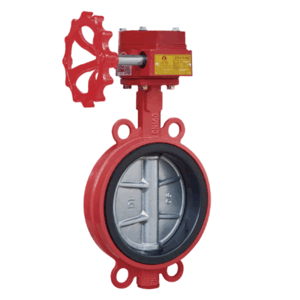
The CA-FIRE explosion proof butterfly valve (ZSXDF series) is a certified fire protection isolation valve designed for hazardous area fire suppression systems where flammable gases, vapors, or combustible dust are present. Available in wafer type (ZSXDF7) and grooved Victaulic-compatible (ZSXDF8) configurations, DN50–DN300, rated at 1.6 MPa working pressure with Ex db IIC T6 Gb and Ex tb IIIC T80°C Db dual certification.
Each explosion proof butterfly valve integrates a butterfly disc valve body with a tamper switch (supervisory switch), outputting a DC24V open/closed position signal to the fire alarm control panel — providing real-time valve supervision required by NFPA 13, NFPA 72, and GB 50116.
Note: This page covers explosion-proof signal butterfly valves (ZSXDF7/ZSXDF8) for hazardous area installations. For standard fire butterfly valves without Ex certification, see the Gear Operated Butterfly Valve page or the Grooved Butterfly Valve page.
Key Features of the ZSXDF Explosion Proof Butterfly Valve
- Ex db IIC T6 Gb + Ex tb IIIC T80°C Db dual certification — covers Zone 1/2 flammable gas and Zone 21/22 combustible dust environments. IIC gas group includes hydrogen, the most demanding classification.
- IP66 weatherproof enclosure — suitable for outdoor petrochemical plants, offshore topsides, and tank farms exposed to rain, hose-down, and salt spray.
- Integrated tamper switch (supervisory switch) — DC24V 0.5A signal output for direct connection to fire alarm control panels. Meets NFPA 72 Chapter 17 supervisory signal requirements without additional components.
- Two connection types in one product family — wafer (between flanges) and grooved (Victaulic-compatible). Both share identical Ex certification, pressure rating, and signal output.
- Stainless steel SS316 or cast iron GGG40 body — select based on media corrosivity and project specification. SS316 recommended for foam concentrate and offshore seawater exposure.
- Quarter-turn operation — worm gear (涡轮) or lever handle (手柄) actuated for fast manual isolation. Full open to full closed in under 90°.
- Water and foam-water mixture service — rated for use with AFFF, AR-AFFF, and protein foam concentrates at full system operating pressure.
- GB 5135.13 and IEC 60079 compliant — factory tested to 6.4 MPa strength test pressure. Each unit ships with test certificate.
Technical Specifications
Both the wafer signal butterfly valve (ZSXDF7) and the grooved signal butterfly valve (ZSXDF8) share the following specifications. The only difference is the pipe connection method.
| Parameter | Wafer Type — ZSXDF7 | Grooved Type — ZSXDF8 |
|---|---|---|
| Model Number | ZSXDF7-Q-50-300-16-Ex | ZSXDF8-Q-50-300-16-Ex |
| Nominal Diameter | DN50 / DN65 / DN80 / DN100 / DN125 / DN150 / DN200 / DN250 / DN300 | DN50 / DN65 / DN80 / DN100 / DN125 / DN150 / DN200 / DN250 / DN300 |
| Working Pressure | 1.6 MPa | 1.6 MPa |
| Strength Test Pressure | 6.4 MPa | 6.4 MPa |
| Seal Test Pressure | 3.2 MPa | 3.2 MPa |
| Applicable Media | Water, foam-water mixture | Water, foam-water mixture |
| Explosion-proof Mark | Ex db IIC T6 Gb / Ex tb IIIC T80°C Db | Ex db IIC T6 Gb / Ex tb IIIC T80°C Db |
| Switch Electrical Rating | DC24V 1.5A | DC24V 1.5A |
| Signal Output | DC24V 0.5A (open / closed position) | DC24V 0.5A (open / closed position) |
| Protection Rating | IP66 | IP66 |
| Rated Voltage | AC250V / AC220V / AC125V / DC250V / DC220V / DC125V / DC24V | AC250V / AC220V / AC125V / DC250V / DC220V / DC125V / DC24V |
| Rated Current | ≤ 16A | ≤ 16A |
| Media Temperature | 4–70°C (signal switch version: 0–80°C) | 4–70°C (signal switch version: 0–80°C) |
| Body Material | Stainless steel SS316 / Cast iron GGG40 | Stainless steel SS316 / Cast iron GGG40 |
| Connection Type | Wafer (between flanges) | Grooved (Victaulic-compatible) |
Structural Dimensions
Wafer Signal Butterfly Valve — ZSXDF7 Face-to-Face Length
| DN (mm) | 50 | 65 | 80 | 100 | 125 | 150 | 200 | 250 | 300 |
|---|---|---|---|---|---|---|---|---|---|
| Face-to-Face (mm) | 45 | 50 | 50 | 55 | 60 | 60 | 65 | 70 | 80 |
Grooved Signal Butterfly Valve — ZSXDF8 Face-to-Face Length
| DN (mm) | 50 | 65 | 80 | 100 | 125 | 150 | 200 | 250 | 300 |
|---|---|---|---|---|---|---|---|---|---|
| Face-to-Face (mm) | 80 | 80 | 80 | 95 | 102 | 110 | 120 | 160 | 165 |
How the Explosion Proof Butterfly Valve Works
Understanding the working principle of this explosion proof butterfly valve helps engineers specify the correct supervisory wiring and installation orientation. The ZSXDF series operates as follows:
Step 1 — Normal open position: The butterfly disc sits parallel to the pipe bore. Flow resistance across the valve is minimal. The supervisory switch inside the IP66 housing outputs a continuous “OPEN” signal (DC24V) to the fire alarm control panel (FACP), confirming the water supply path is unobstructed.
Step 2 — Tamper detection: If the valve disc is rotated — whether deliberately by maintenance personnel or accidentally by vibration — the supervisory switch changes state after 1–2 turns of the worm gear operator. A “TAMPER” alarm is immediately transmitted to the FACP per NFPA 72 supervisory signal requirements. The system flags the impaired water supply before any fire event occurs.
Step 3 — Emergency closure: During maintenance, system draining, or emergency isolation, the worm gear operator or lever handle rotates the disc 90° to the fully closed position. The tamper switch outputs a “CLOSED” signal and the FACP logs the valve status change. Seal test pressure is 3.2 MPa — zero leakage at working pressure.
Step 4 — Hazardous atmosphere protection: The Ex-certified enclosure functions as a flameproof (“d”) housing per IEC 60079-1. Any internal electrical arc from switch contact operation is contained entirely within the housing. Hot surfaces do not exceed T6 temperature class (85°C), well below the ignition temperature of IIC gas group substances including hydrogen (500°C AIT). For dust environments, the “t” enclosure prevents dust ingress and limits external surface temperature to T80°C.
Step 5 — Signal wiring: The tamper switch connects to the FACP via a 2-wire supervised circuit. Terminal connections are accessible through the Ex-rated cable entry (M20 × 1.5 thread). The switch is rated DC24V 0.5A — compatible with all major fire alarm panel brands including Siemens, Notifier, Hochiki, and EST.
Applications
The explosion proof butterfly valve for fire protection is specified wherever fire suppression system pipework passes through or supplies a hazardous classified area. Typical project types include:
- Petroleum refineries and petrochemical plants — Zone 1/2 classified process areas where fire water ring mains and foam suppression headers require Ex-certified isolation valves with FACP supervision.
- Offshore oil and gas platforms — topsides fire water main isolation requiring IP66 protection against salt spray, wash-down, and tropical rain. Stainless steel SS316 body specified for all offshore applications.
- Tank farms and flammable liquid storage terminals — foam-water suppression systems protecting above-ground storage tanks (ASTs) per NFPA 30. The grooved ZSXDF8 version is commonly used on modular tank farm suppression skids.
- Paint spray booths and solvent handling facilities — Zone 21/22 combustible dust environments. Ex tb IIIC T80°C Db rating covers the highest combustible dust category including metal dusts.
- Chemical plants and pharmaceutical API manufacturing — hazardous atmosphere isolation on foam suppression and water mist systems where process vapors create classified zones.
- LNG terminals and gas compressor stations — IIC gas group (hydrogen / acetylene) environments requiring the highest explosion-proof category. The ZSXDF7/ZSXDF8 Ex db IIC rating is the most stringent classification available.
- Underground mining operations — methane (IIA gas group) environments where fire suppression valve supervision is mandated by mining safety regulations.
- Aircraft hangars with fuel systems — IIA/IIB gas group environments. The ZSXDF series is suitable for foam suppression systems protecting jet fuel storage and dispensing areas.
Wafer vs. Grooved: How to Choose the Right Connection Type
Both the ZSXDF7 wafer and ZSXDF8 grooved explosion proof butterfly valve models offer identical performance. Connection type is the only selection criterion:
Choose Wafer Type (ZSXDF7) when:
- The fire suppression system uses flanged pipe to ANSI 150, DIN PN16, or GB PN16 standard
- The valve station has a tight face-to-face envelope — wafer type is 15–85 mm shorter than the grooved equivalent depending on size
- The project specification states “wafer type butterfly valve, installed between flanges”
- A cost comparison favors wafer: wafer installation requires only two bolts per flange pair vs. grooved coupling hardware
Choose Grooved Type (ZSXDF8) when:
- The system uses Victaulic-compatible or ISO 6182-12 compliant grooved pipe — standard in modular fire suppression systems and offshore platform fire mains
- Fast field assembly, disassembly, and future replacement is a priority — grooved couplings require no hot work and reduce installation labor by up to 40% compared to flanged joints
- The pipeline contractor specifies grooved mechanical joints throughout the entire fire main to minimize installation time
- The system will be subject to vibration or thermal movement — grooved couplings provide angular deflection that flanged joints do not
Frequently Asked Questions
What is an explosion proof butterfly valve?
An explosion proof butterfly valve is a butterfly disc valve with a tamper switch housed inside an Ex-certified enclosure. The flameproof (“db”) housing prevents any internal electrical arc from igniting the surrounding explosive atmosphere, while the dustproof (“tb”) enclosure prevents combustible dust ingress. In fire suppression applications, the integrated supervisory switch monitors valve position and transmits open/closed/tamper signals to the fire alarm control panel. The ZSXDF series holds Ex db IIC T6 Gb and Ex tb IIIC T80°C Db dual certification, covering both gas and dust hazardous area classifications.
What does the butterfly valve tamper switch do?
The tamper switch (supervisory switch) monitors the open/closed status of the fire water supply valve in real time. When the valve is in its normal fully-open position, it sends a continuous “OPEN” supervisory signal to the FACP. If anyone rotates the valve handle even partially — whether for maintenance, testing, or unauthorized access — the switch changes state within 1–2 turns and transmits a “TAMPER” supervisory alarm. This is required by NFPA 72 Chapter 17 (Initiating Devices) and GB 50116 for all electrically supervised water supply control valves. Without tamper supervision, a partially-closed valve could reduce flow to the sprinkler system below design density without triggering any alarm.
What is the difference between ZSXDF7 and ZSXDF8?
ZSXDF7 is the wafer type explosion proof signal butterfly valve (对夹式防爆信号蝶阀) — it installs between standard pipe flanges. ZSXDF8 is the grooved type explosion proof signal butterfly valve (沟槽式防爆信号蝶阀) — it uses a Victaulic-compatible grooved mechanical coupling. Both share identical Ex db IIC T6 Gb certification, 1.6 MPa working pressure, 6.4 MPa strength test pressure, DC24V tamper switch output, and DN50–DN300 size range. The sole selection criterion is the pipe connection standard specified in the project design.
Should I specify stainless steel or cast iron body?
Cast iron GGG40 (ductile iron) is sufficient and cost-effective for most onshore fire suppression systems using fresh water or standard AFFF foam. Specify stainless steel SS316 when: (1) the suppression agent is foam concentrate, sea water, or brackish water, (2) the installation is offshore, coastal, or in a high-humidity tropical environment, (3) the project specification requires stainless steel body per API 6D, NORSOK S-001, or similar standards. Both body materials carry the same Ex db IIC T6 Gb certification and 1.6 MPa pressure rating.
Does this explosion proof butterfly valve comply with NFPA 13?
Yes. NFPA 13 requires all water supply control valves on sprinkler systems to be supervised. The ZSXDF tamper switch satisfies the electrical supervision requirement of NFPA 13 Section 8.16. The Ex certification additionally satisfies the hazardous location installation requirements referenced in NFPA 13 Annex provisions for special occupancies. For projects also subject to NFPA 30 (flammable liquids) or NFPA 409 (aircraft hangars), the IEC 60079 Ex db IIC rating of the ZSXDF series meets the electrical classification requirements of those standards as well.
What size explosion proof butterfly valve do I need?
The ZSXDF series covers DN50 (2″) through DN300 (12″) — the full range used in commercial and industrial fire suppression systems. Valve size is determined by the fire system hydraulic calculation, not the valve itself. Your fire protection engineer will size the pipe and valve based on the required flow rate (gpm or L/min), system pressure, and hazard density per NFPA 13 or local equivalent. As a reference, most sprinkler system risers use DN100–DN150; tank farm foam headers typically use DN150–DN300.
Standards & Compliance References
The CA-FIRE ZSXDF explosion proof butterfly valve is designed, manufactured, and tested in compliance with the following international and Chinese national standards. We recommend engineers review the applicable standard for the specific project jurisdiction:
- NFPA 13 — Standard for the Installation of Sprinkler Systems — Section 8.16 covers supervision requirements for water supply control valves. The ZSXDF tamper switch satisfies electrical supervision per this section.
- NFPA 72 — National Fire Alarm and Signaling Code — Chapter 17 defines supervisory signal initiating device requirements. The ZSXDF tamper switch output meets the supervisory signal definition and wiring requirements.
- NFPA 30 — Flammable and Combustible Liquids Code — Referenced for tank farm foam suppression system valve specifications. The ZSXDF Ex IIC rating covers Zone 1 areas around Class I flammable liquid storage.
- IEC 60079-0 / 60079-1 / 60079-31 — Explosive Atmospheres — IEC 60079-1 defines flameproof (“d”) enclosure requirements. The ZSXDF housing is certified to this standard by a third-party notified body.
- GB 5135.13 — Fire Protection Valves, Part 13: Signal Butterfly Valves — Chinese national standard governing fire protection butterfly valve construction, testing, and marking requirements.
Not Sure Which Valve You Need?
If explosion-proof certification is not required for your project zone classification, the standard fire butterfly valve series offers the same tamper switch supervision at lower cost:
| Requirement | Recommended Product | Key Difference |
|---|---|---|
| Wafer, no Ex needed, gear operated | Gear Operated Signal Butterfly Valve | No Ex certification, lower cost |
| Grooved, no Ex needed, gear or lever | Grooved Butterfly Valve | Victaulic-compatible, no Ex |
| Explosion-proof, current page | ZSXDF7 / ZSXDF8 (this page) | Ex db IIC T6 Gb, IP66 |
Contact Information
- Email: sales@ca-fire.com
- Mobile: +86 13400715622
- WhatsApp: +86 18150362095
- WeChat: 404863577
- Website: https://www.ca-fire.com
| Parameter | Wafer Signal BFV (ZSXDF7) | Grooved Signal BFV (ZSXDF8) |
| Model | ZSXDF7-Q-50-300-16-Ex | ZSXDF8-Q-50-300-16-Ex |
| Nominal Diameter (DN) | 50 / 65 / 80 / 100 / 125 / 150 / 200 / 250 / 300 | 50 / 65 / 80 / 100 / 125 / 150 / 200 / 250 / 300 |
| Working Pressure | 1.6 MPa | 1.6 MPa |
| Strength Test Pressure | 6.4 MPa | 6.4 MPa |
| Applicable Media | Water, foam-water mixture | Water, foam-water mixture |
| Explosion-proof Mark | Ex db IIC T6 Gb / Ex tb IIIC T80°C Db | Ex db IIC T6 Gb / Ex tb IIIC T80°C Db |
| Electrical Rating | DC24V 1.5A | DC24V 1.5A |
| Signal Switch Output | DC24V 0.5A (open/closed position) | DC24V 0.5A (open/closed position) |
| Protection Rating | IP66 | IP66 |
| Rated Voltage | AC250V / AC220V / AC125V / DC250V / DC220V / DC125V / DC24V | AC250V / AC220V / AC125V / DC250V / DC220V / DC125V / DC24V |
| Rated Current | ≤ 16A | ≤ 16A |
| Temperature Range | 4–70°C (signal switch version: 0–80°C) | 4–70°C (signal switch version: 0–80°C) |
| Body Material | Stainless steel SS316 / Cast iron GGG40 | Stainless steel SS316 / Cast iron GGG40 |
| Connection | Wafer (between flanges) | Grooved (Victaulic-compatible) |
Structural Dimensions
Wafer Signal Butterfly Valve — ZSXDF7 Face-to-Face Dimensions
| DN (mm) | 50 | 65 | 80 | 100 | 125 | 150 | 200 | 250 | 300 |
| Face-to-Face (mm) | 45 | 50 | 50 | 55 | 60 | 60 | 65 | 70 | 80 |
Grooved Signal Butterfly Valve — ZSXDF8 Face-to-Face Dimensions
| DN (mm) | 50 | 65 | 80 | 100 | 125 | 150 | 200 | 250 | 300 |
| Face-to-Face (mm) | 80 | 80 | 80 | 95 | 102 | 110 | 120 | 160 | 165 |