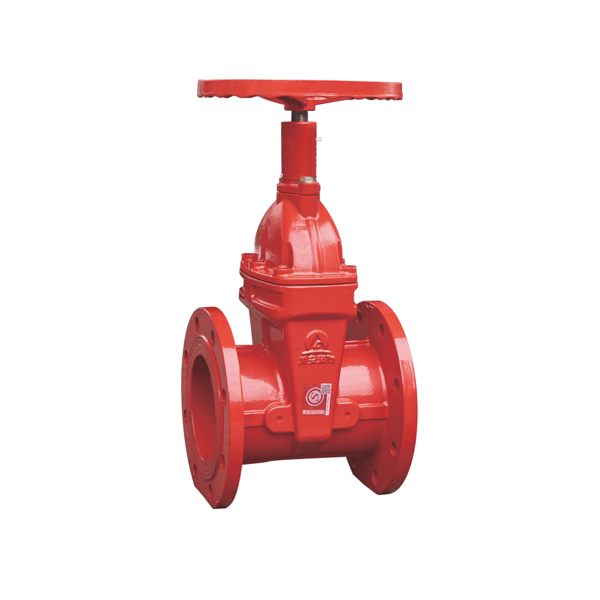
NRS Gate Valve —
Non-Rising Stem, Flanged End, DN50–DN400
The NRS gate valve — Non-Rising Stem — is the compact, space-saving control valve for underground and headroom-restricted fire protection pipelines. Unlike the OS&Y gate valve, the stem threads are internal and the stem does not move up or down during operation, keeping the overall installed height constant. CA-FIRE's NRS gate valve (Model ZSZF5-Q-50~400-16) is a flanged, ductile iron non-rising stem gate valve available in DN50–DN400, fitted with a dial position indicator to meet NFPA 13 indicating valve requirements for buried mains, valve pits and confined plant rooms.
What Is an NRS Gate Valve? (Non-Rising Stem Explained)
NRS stands for Non-Rising Stem. In an NRS gate valve, the operating stem is threaded internally — when the handwheel turns, the internal nut travels along the fixed stem to raise or lower the gate. Because the stem itself does not extend upward, the total installed height of the valve remains constant whether the valve is fully open or fully closed.
Position indication — required by NFPA 13 — is provided by a built-in dial indicator mounted on the bonnet, which clearly shows whether the valve is open, closed or partially operated. This combination of compact profile and code-compliant indication makes the NRS gate valve the standard choice for underground installations, buried fire main applications, and any location where overhead clearance is restricted.
NRS Gate Valve Technical Specifications
| Parameter | Specification |
|---|---|
| Product Model | ZSZF5-Q-50~400-16 |
| Valve Type | NRS Gate Valve (Non-Rising Stem) |
| Nominal Pressure | 1.6 MPa (PN16) |
| Nominal Diameter | DN50 – DN400 (2" – 16") |
| Strength Test Pressure | 6.4 MPa |
| Seal Test Pressure | 3.2 MPa |
| Body Material | Ductile iron (fusion-bonded epoxy coated) |
| Wedge Type | Resilient wedge, rubber-encapsulated |
| Position Indication | Dial position indicator (open / closed) |
| Applicable Medium | Water, foam fire suppression mixture |
| Medium Temperature | 4 – 70 °C |
| Connection Method | Flanged — ANSI B16.1 Class 125 / DIN 2501 PN16 |
| Certifications | GB 12736, ISO 9001, CE |
Structural Length by Nominal Diameter
| DN | Inch | Length (mm) |
|---|---|---|
| DN50 | 2" | 178 |
| DN65 | 2½" | 190 |
| DN80 | 3" | 203 |
| DN100 | 4" | 229 |
| DN125 | 5" | 254 |
| DN150 | 6" | 267 |
| DN200 | 8" | 292 |
| DN250 | 10" | 330 |
| DN300 | 12" | 356 |
| DN350 | 14" | 381 |
| DN400 | 16" | 406 |
NRS Gate Valve Key Features
Fire Protection Applications
Underground Fire Main Isolation
The NRS gate valve is the standard choice for buried and underground fire main isolation. The non-rising stem eliminates the headroom required by a rising-stem OS&Y valve inside a pit or vault, while the dial indicator satisfies the code requirement for indicating-type control valves under NFPA 13.
Valve Pit & Basement Plant Room Applications
In basement mechanical rooms, confined plant spaces, and below-grade valve pits where ceiling height is limited, the NRS gate valve's compact profile allows reliable installation and easy operation without requiring additional structural clearance. A common application on fire pump room suction mains and underground service entries.
Fire Hydrant Supply Mains — Buried Service
Used as the isolation valve on buried fire hydrant supply mains and underground standpipe feeder mains. The NRS design's fixed height and corrosion-resistant FBE coating make it well-suited for long-term in-ground service. The dial indicator allows status confirmation during inspection without excavation.
Space-Constrained Industrial Installations
In industrial facilities, warehouses and data centres where fire protection pipework runs close to structural elements or equipment, the NRS gate valve provides reliable zone isolation where there is insufficient room to accommodate the stem extension of an OS&Y valve during operation.
NRS vs. OS&Y Gate Valve — Which to Specify?
| NRS Gate Valve (Non-Rising Stem) | OS&Y Gate Valve (Rising Stem) | |
|---|---|---|
| Installed height | ✅ Fixed — compact profile | Increases when open — needs overhead clearance |
| Position indication | Dial indicator on bonnet | ✅ Rising stem — instantly visible |
| Best installation | ✅ Underground, pit-mounted, confined spaces | Above-ground, accessible plant rooms |
| NFPA 13 compliant | ✅ Yes — with dial indicator | ✅ Yes — inherently indicating |
| Confirmation method | Read dial indicator | Immediate visual — no touch needed |
Frequently Asked Questions — NRS Gate Valve
-
Q1 What does NRS stand for on a gate valve?NRS stands for Non-Rising Stem. In an NRS gate valve, the operating stem is threaded internally — the stem itself does not move up or down when the handwheel is turned. Instead, an internal nut travels along the fixed stem to raise or lower the gate. Position indication is provided by a dial indicator on the bonnet that reads open or closed. This is also referred to as a non-rising spindle gate valve or inside screw gate valve in some specifications.
-
Q2 What is the difference between an NRS and an OS&Y gate valve?The key difference is the stem behaviour and installed height. An OS&Y (rising stem) gate valve has an external stem that extends visibly upward when open — ideal for above-ground locations where direct visual confirmation is needed. An NRS (non-rising stem) gate valve keeps the stem internal, maintaining a constant height, which makes it better suited for underground pit-mounted or headroom-restricted installations. Both types are NFPA 13 compliant indicating valves.
-
Q3 Is an NRS gate valve NFPA 13 compliant?Yes. An NRS gate valve with an approved dial position indicator satisfies the NFPA 13 requirement for indicating-type control valves on fire protection systems. NFPA 13 requires that the open/closed status of the valve be determinable without operating it — the dial indicator provides this indication. The CA-FIRE NRS gate valve includes an integral dial indicator as standard.
-
Q4 Where is an NRS gate valve typically installed?NRS gate valves are typically installed in underground valve pits and vaults, buried fire main applications, basement mechanical rooms with limited overhead clearance, and confined plant spaces. Any location where a rising stem would be impractical due to space restrictions or where the valve will be installed below ground makes the NRS gate valve the appropriate specification choice. For above-ground accessible locations, the OS&Y gate valve is generally preferred.
-
Q5 What sizes does the CA-FIRE NRS gate valve come in?The CA-FIRE NRS gate valve is available in DN50–DN400 (2 inch to 16 inch) with flanged end connections, covering all standard fire protection pipeline sizes from small branch mains to large-diameter supply mains. Custom sizes and pressure ratings are available on request — please contact our technical team for project-specific requirements.