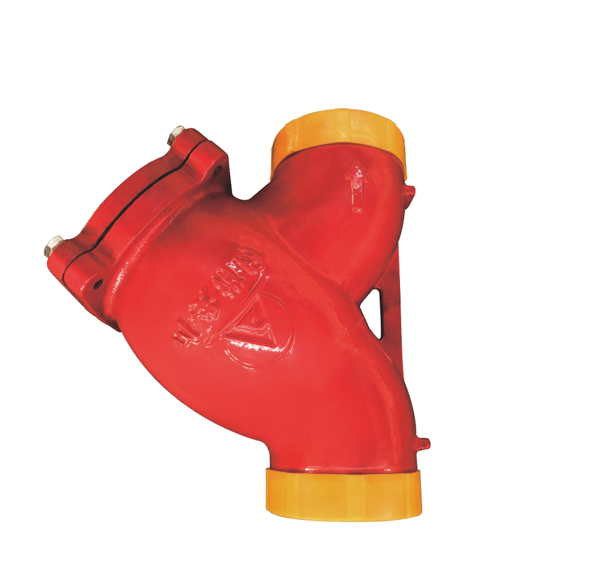
Grooved Y Strainer — Fire Protection Pipeline, DN50–DN300
The CA-FIRE grooved Y strainer is a pipeline debris filter designed for installation in fire sprinkler, standpipe and fire pump supply pipelines built with grooved piping systems. A stainless steel 304 mesh screen inside the Y-shaped body captures weld spatter, pipe scale, rust particles and construction debris before they reach sprinkler heads, deluge valves, check valves and fire pump impellers — preventing blockages and mechanical damage that could impair the fire protection system. Roll-grooved ends to ANSI/AWWA C606 allow fast Victaulic-style installation without welding, and the removable screen plug enables cleaning without removing the strainer body from the pipe.
What Is a Y Strainer and How Does It Work in Fire Protection?
A Y strainer — named for the Y-shape of its body — is an in-line pipeline filter that removes solid particulate from flowing water by passing the flow through a perforated or mesh screen. Water enters through the inlet, passes through the cylindrical screen basket seated in the angled leg of the Y body, and exits through the outlet — with particles too large to pass through the mesh openings retained inside the screen basket.
In fire protection systems, the Y strainer is installed upstream of components that are sensitive to debris: sprinkler head orifices (as small as 8 mm on standard heads), deluge valve pilots, check valve discs and seats, and fire pump mechanical seals. A single piece of weld slag or a flake of pipe scale passing through these components can jam a valve open, block a sprinkler head, or score a pump seal — causing immediate system failure or a slow, undetected leak that drains system pressure. The Y strainer eliminates this risk by capturing debris before it reaches these critical points.
Grooved Y Strainer — Component Anatomy
Mesh Size Selection Guide for Fire Protection
Mesh size determines the size of particle the strainer will capture. Finer mesh catches smaller particles but creates a higher pressure drop and requires more frequent cleaning. For fire protection systems, mesh size is selected based on the smallest orifice in the downstream components.
Technical Specifications
| Parameter | Specification |
|---|---|
| Product Type | Grooved Y Strainer — Fire Protection Pipeline |
| Nominal Pressure | 1.6 MPa (PN16) |
| Nominal Diameter | DN50 – DN300 (2" – 12") |
| Hydrostatic Test Pressure | 3.2 MPa |
| Body Material | Ductile iron — fusion-bonded epoxy coated (inside & outside) |
| Screen Material | Stainless steel 304 |
| Standard Mesh Size | 16 mesh — approx. 1.2 mm opening (other sizes available) |
| Screen Open Area | ≥ 3× pipe bore area (minimises pressure drop) |
| End Connection | Roll-grooved — ANSI/AWWA C606 (Victaulic-style compatible) |
| Clean-Out | Threaded blow-down plug (NPT or BSP, size by DN) |
| Applicable Medium | Water, foam fire suppression mixture |
| Medium Temperature | 0 – 80 °C |
| Installation | Horizontal (screen leg down preferred) or vertical — see orientation guide |
| Certifications | ISO 9001, CE |
Size & Face-to-Face Dimensions
| DN | Inch | Face-to-Face (mm) | Groove OD (mm) | Screen Leg (mm) |
|---|---|---|---|---|
| DN50 | 2" | 152 | 60.3 | 95 |
| DN65 | 2½" | 178 | 73.0 | 108 |
| DN80 | 3" | 190 | 88.9 | 120 |
| DN100 | 4" | 216 | 114.3 | 145 |
| DN125 | 5" | 241 | 141.3 | 165 |
| DN150 | 6" | 254 | 168.3 | 190 |
| DN200 | 8" | 305 | 219.1 | 240 |
| DN250 | 10" | 356 | 273.1 | 290 |
| DN300 | 12" | 406 | 323.9 | 340 |
Installation Orientation — Screen Leg Position
The Y strainer can be installed in horizontal or vertical pipelines, but the orientation of the screen leg relative to gravity affects cleaning access and debris accumulation. Follow the guidance below for optimal performance.
Key Features
Fire Protection Pipeline Applications
Upstream of Sprinkler Heads — New System Commissioning
During new system commissioning and flushing, construction debris including weld spatter, pipe shavings, thread sealant and sediment remains in the pipeline. Installing grooved Y strainers on system mains before the sprinkler heads are connected prevents this debris from blocking the 8–20 mm orifices of standard sprinkler heads during initial pressurisation and testing — a far cheaper solution than replacing blocked or damaged heads after commissioning.
Fire Pump Suction — Pump Protection
Installed on the suction side of fire pumps, the Y strainer protects the pump impeller, mechanical seal and suction check valve from damage by particulate in the water supply. Scale and debris entering a running fire pump impeller can cause rapid mechanical seal failure — the Y strainer on the suction line is a low-cost insurance against pump damage during fire events or weekly pump test runs.
Deluge System Pilot Lines — Orifice Protection
Deluge valve pilots and releasing devices operate through small-bore sensing lines with orifice openings as small as 1–3 mm. A fine-mesh Y strainer (30 mesh / 0.6 mm) on the pilot line feed prevents orifice blockage that would prevent the deluge valve from opening on demand — a critical installation in foam deluge, water-mist and pre-action suppression systems.
Existing System Maintenance — NFPA 25 Compliance
NFPA 25 requires inspection and testing of fire protection system components on a regular schedule. Adding Y strainers to existing grooved fire protection systems — particularly upstream of check valves and alarm valves that show signs of debris damage — allows the debris burden to be monitored and managed during annual inspection without system shutdown.
Y Strainer vs. Basket Strainer — Which for Fire Protection?
| Criterion | Y Strainer (This product) |
Basket / Pot Strainer |
|---|---|---|
| Body size / weight | ✅ Compact — Y body adds minimal face-to-face | Larger — pot body requires more installation space |
| Screen capacity | Moderate — cylindrical basket in angled leg | ✅ High — larger basket volume before cleaning needed |
| Pressure drop (clean) | ✅ Low — angled screen presents large area to flow | ✅ Very low — large basket with high open area |
| Installation in tight spaces | ✅ Easier — compact body | Harder — pot body needs surrounding clearance |
| Cleaning method | Plug removal or blow-down — in-line | ✅ Hinged cover — easier basket removal without tools |
| Best for fire systems | ✅ Riser mains, branch mains, pump suction — where space is limited | High-debris environments, large flow systems where frequent cleaning expected |
Frequently Asked Questions — Grooved Y Strainer
-
Q1 What is a Y strainer used for in fire protection?A Y strainer in a fire protection system removes particulate debris — weld spatter, pipe scale, rust and construction debris — from the water supply before it reaches sensitive components such as sprinkler heads, deluge valves, check valves and fire pumps. Installing a Y strainer upstream of these components prevents blockages and mechanical damage, reducing maintenance costs and ensuring the system operates reliably when activated.
-
Q2 What mesh size should a Y strainer be for fire sprinkler systems?For fire sprinkler systems, a 16-mesh stainless steel screen (approximately 1.2 mm opening) is the standard specification. This mesh size catches debris that could block standard sprinkler head orifices (typically 8–20 mm) or damage valve seats, while maintaining sufficient flow area to keep pressure drop negligible in hydraulic calculations. Finer 30-mesh screens are used on pilot lines and sensing lines for deluge valves where the orifices are smaller.
-
Q3 Why use a grooved Y strainer rather than a flanged Y strainer?A grooved Y strainer installs into grooved fire protection pipework without welding or flange bolting — the same Victaulic-style mechanical couplings used throughout the grooved piping system accept the strainer's roll-grooved ends. This makes installation faster and allows the strainer to be removed for cleaning without cutting or dismantling the surrounding pipework. In grooved piping systems, a grooved strainer is always preferred for consistent installation and maintainability. For flanged fire protection systems, see our flanged Y strainer.
-
Q4 How often should a Y strainer be cleaned in a fire protection system?Y strainers in fire protection systems should be inspected and cleaned annually as part of the regular fire system inspection program required by NFPA 25. Additional cleaning may be required after system flushing, new pipe installation, or following any work on the water supply that could introduce debris into the pipeline. The grooved Y strainer's blow-down plug allows cleaning without removing the strainer body from the pipe — the full inspection process typically takes under 15 minutes per strainer.
-
Q5 What sizes does the CA-FIRE grooved Y strainer come in?The CA-FIRE grooved Y strainer is available in DN50–DN300 (2 inch to 12 inch) with roll-grooved ends to ANSI/AWWA C606, compatible with Victaulic-style and all major grooved mechanical coupling systems. Standard mesh is 16-mesh SS304; 8-mesh and 30-mesh alternatives are available on request.