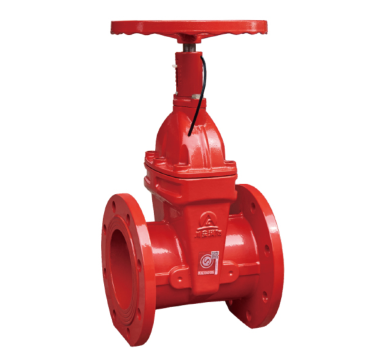
Gate Valve with
Tamper Switch — Supervisory Control Valve
The CA-FIRE gate valve with tamper switch combines a full-bore, resilient-wedge fire protection gate valve with an integrated supervisory switch in a single factory-assembled unit. The tamper switch — also referred to as a gate valve supervisory switch or gate valve limit switch — sends an immediate electrical signal to the fire alarm control panel (FACP) whenever the valve is moved from its fully open position, satisfying the NFPA 13 and NFPA 72 requirements for electronic supervision of fire protection control valves. Available in DN50–DN300 with flanged or grooved end connections, pre-wired and factory-tested before shipment.
What Is a Gate Valve Tamper Switch & How Does It Work?
A gate valve tamper switch is an electromechanical supervisory device mounted directly on a fire protection gate valve. The switch mechanism is connected to the valve stem or handwheel assembly — when the valve is fully open, the switch contacts rest in their normal state. As soon as the handwheel is turned — within two turns from fully open — the switch actuates and changes contact state, sending a supervisory alarm signal to the fire alarm control panel.
This supervisory signal alerts fire alarm monitoring services and building management that a control valve may have been moved from the fully open position, which could impair or disable part of the fire suppression system. The tamper switch does not prevent the valve from being operated — it only monitors and reports its position electronically, in real time.
Technical Specifications
| Parameter | Specification |
|---|---|
| Valve Type | Gate Valve with Integrated Tamper Switch (Supervisory) |
| Nominal Pressure | 1.6 MPa (PN16) |
| Nominal Diameter | DN50 – DN300 (2" – 12") |
| Body Material | Ductile iron (fusion-bonded epoxy coated) |
| Wedge Type | Resilient wedge, rubber-encapsulated |
| End Connection | Flanged (ANSI B16.1 / DIN PN16) or Grooved (ANSI/AWWA C606) |
| Switch Type | SPDT microswitch — Normally Open (NO) + Normally Closed (NC) contacts |
| Switch Actuation | Within 2 turns of handwheel from fully open position |
| Rated Voltage | 24 V DC / 120 V AC |
| Rated Current | 10 A (resistive load) |
| Cable Entry | ½" NPT conduit fitting (both sides) |
| Enclosure Rating | IP54 (dust-protected, splash-resistant) |
| Applicable Medium | Water, foam fire suppression mixture |
| Certifications | NFPA 13, NFPA 72, ISO 9001, CE |
Switch Wiring Terminals
NO → Normally Open (closes when valve moves from fully open)
NC → Normally Closed (opens when valve moves from fully open)
Circuit → Connect to FACP supervisory zone input (2-wire or 4-wire EOL)
Available Sizes
| DN | Inch | End Connection |
|---|---|---|
| DN50 | 2" | Flanged / Grooved |
| DN65 | 2½" | Flanged / Grooved |
| DN80 | 3" | Flanged / Grooved |
| DN100 | 4" | Flanged / Grooved |
| DN125 | 5" | Flanged / Grooved |
| DN150 | 6" | Flanged / Grooved |
| DN200 | 8" | Flanged / Grooved |
| DN250 | 10" | Flanged / Grooved |
| DN300 | 12" | Flanged / Grooved |
Key Features
Fire Protection Applications
Sprinkler System Zone Control Valves — Supervised
The most common application: each floor or zone of a fire sprinkler system has a dedicated control valve. NFPA 13 requires these valves to be either locked open or electronically supervised. Where locking is impractical or local codes require electronic supervision, the gate valve with tamper switch provides the required supervisory monitoring — with an automatic alarm to the FACP if the valve is moved.
System Riser Isolation — Building-Wide Supervision
Installed on main system risers in high-rise buildings, hospitals, hotels and data centres where continuous fire protection is critical. Any unauthorised or accidental operation of the riser isolation valve will immediately generate a supervisory alarm at the fire alarm panel and the monitoring centre, enabling rapid response.
Fire Pump Suction & Discharge — Supervised Isolation
Fire pump suction and discharge valves are critical control points that must never be inadvertently closed during a fire event. The gate valve with tamper switch provides electronic supervision of these valves, with an instant alarm if either valve is operated while the system is live.
Retrofit Supervision — Adding Monitoring to Existing Valves
Where an existing fire protection system requires upgrading to electronic supervision without replacing all pipework, the gate valve with tamper switch can be installed in place of unsupervised gate valves during system refurbishment. Available in the same DN sizes as the existing flanged or grooved pipework.
NFPA 13 & NFPA 72 Compliance
| Code Requirement | How the Tamper Switch Satisfies It |
|---|---|
| NFPA 13 — Indicating valve | Gate valve is an indicating-type control valve — open/closed status is visually and electronically determinable |
| NFPA 13 — Valve supervision | Control valves not locked open must be electronically supervised. Tamper switch provides this supervision via FACP supervisory zone |
| NFPA 72 — Supervisory signal | Switch actuates within 2 turns from fully open, generating a supervisory (not alarm) signal to the FACP — the correct signal type per NFPA 72 |
| NFPA 72 — Supervisory restore | When valve is returned to fully open, the switch contacts restore and the FACP generates a supervisory restore signal automatically |
Frequently Asked Questions — Gate Valve Tamper Switch
-
Q1 What is a gate valve tamper switch?A gate valve tamper switch — also called a gate valve supervisory switch or gate valve limit switch — is an electromechanical device mounted on a fire protection gate valve that sends an electrical signal to the fire alarm control panel (FACP) whenever the valve is moved from its fully open position. The signal alerts building management and fire alarm monitoring services that a fire protection control valve may have been closed or partially closed, potentially impairing the system. The tamper switch does not prevent the valve from being operated — it only monitors and reports its position.
-
Q2 Is a tamper switch required by NFPA 13?NFPA 13 and NFPA 72 require that fire protection control valves be electronically supervised when they are not locked in the open position. A tamper switch provides this supervision by generating a supervisory alarm signal at the fire alarm control panel within two turns of the handwheel from the fully open position. Many local codes and authorities having jurisdiction (AHJs) require electronic supervision for all fire protection control valves in commercial and high-rise buildings.
-
Q3 What is the difference between a tamper switch and a supervisory switch on a gate valve?Tamper switch and supervisory switch refer to the same device — an electromechanical switch that monitors the open/closed position of a fire protection control valve and sends a supervisory signal to the fire alarm panel on any movement from the fully open position. The terms are used interchangeably in fire protection specifications. Limit switch is another term sometimes used for the same component.
-
Q4 How does the gate valve tamper switch connect to the fire alarm panel?The tamper switch has SPDT contacts — Normally Open (NO) and Normally Closed (NC) — that connect to the supervisory input zone of the fire alarm control panel via standard 2-wire or 4-wire circuit wiring. Cable entry is via a ½" NPT conduit fitting on both sides of the switch enclosure. When the valve moves from fully open, the switch contacts change state and the FACP generates a supervisory alarm signal per NFPA 72.
-
Q5 What sizes does the CA-FIRE gate valve with tamper switch come in?The CA-FIRE gate valve with tamper switch is available in DN50–DN300 (2 inch to 12 inch) with either flanged (ANSI B16.1 / DIN PN16) or grooved (ANSI/AWWA C606) end connections. The integrated tamper switch is pre-wired and factory-tested before shipment. Contact our technical team for custom configurations or larger diameters.