CA-FIRE Protection · Foam Bladder Tank Series

Vertical Foam Bladder Tank — PHY Series

Compact Floor Footprint · 0.5–13.0 m³ · 8–120 L/s · DN80–DN250 · ±0.3% Mixing Accuracy · No Electricity · NFPA 11 / GB · Above-Ground Plant Rooms
PHY Series 8–120 L/s 0.5–13.0 m³ Compact Footprint No Electricity NFPA 11 ISO 9001
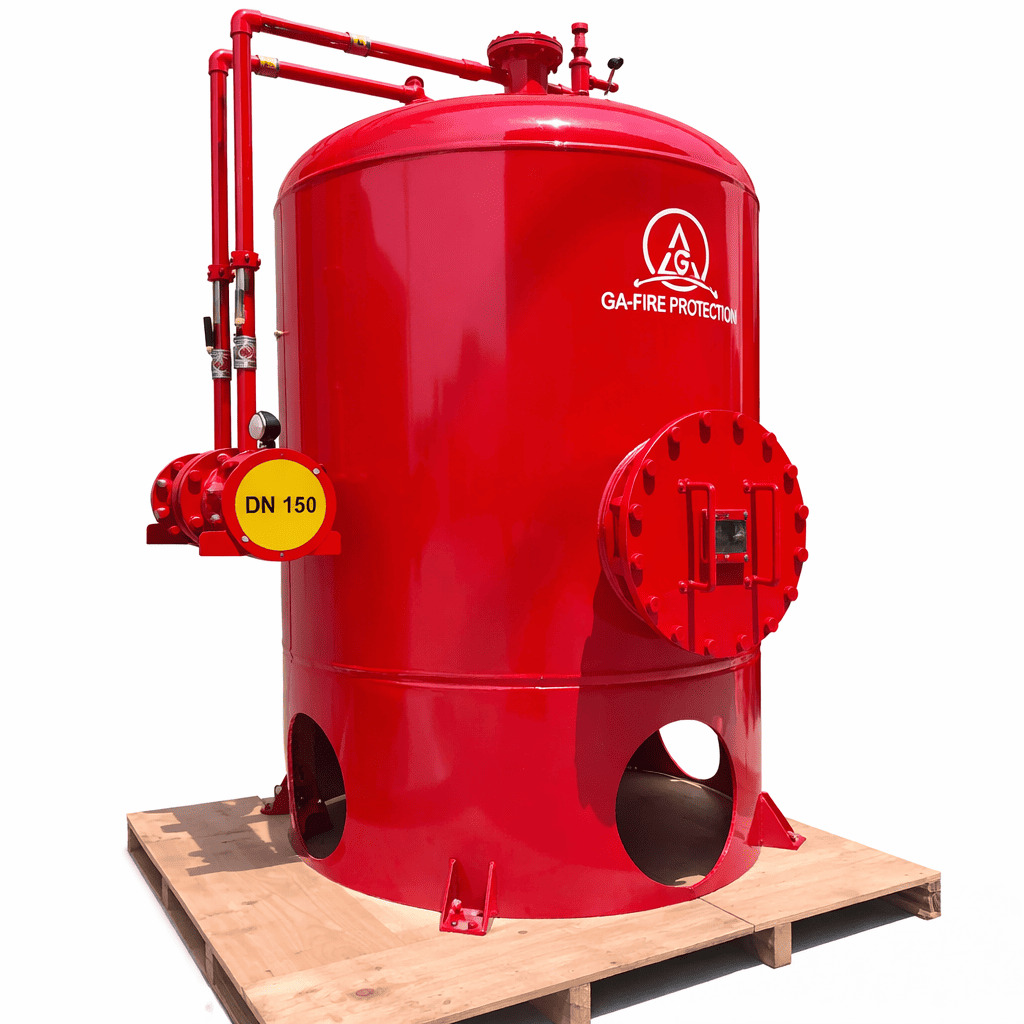
Vertical Foam Bladder Tank PHY Series — compact floor footprint pressure proportioning device for fire suppression systems
PHY Series Vertical Foam Bladder Tank — upright base-mounted configuration with minimal floor footprint
Product Overview

Vertical Foam Bladder Tank

PHY Series · Compact Footprint Pressure Proportioning

Upright pressure vessel storing foam concentrate in an internal rubber bladder — minimising floor footprint while utilising available ceiling height. The preferred vertical bladder tank for petrochemical plant rooms, refinery fire pump buildings, airport suppression equipment rooms and above-ground industrial installations where floor space is constrained. Compatible with NFPA 11, NFPA 16 and GB 50151.

Tank Volume
0.5–13.0
Flow Range
8–120 L/s
Pipe Diameter
DN80 – DN250
Working Pressure
0.6–1.2 MPa
Seal Test
1.32 MPa
Strength Test
1.5 MPa
Mix Accuracy
±0.3%
Electricity
None required
Mixing Ratio
3% or 6%
Op. Temperature
4–70 °C
NFPA 11 NFPA 16 GB 50151 ISO 9001 CE
📧 Request a Quote

Vertical Foam Bladder Tank — Technical Specifications

Product TypeVertical Foam Bladder Tank — PHY Series Pressure Proportioning Device
Working Pressure Range0.6 – 1.2 MPa
Pressure Drop≤ 0.2 MPa
Strength Test Pressure1.5 MPa
Seal Test Pressure1.32 MPa
Tank Volume0.5 m³ – 13.0 m³ (customisable to project)
Main Pipe DiameterDN80 – DN250 (customisable to project)
Proportioner Flow Range8 L/s – 120 L/s (model-dependent; customisable)
Foam Concentrate Mixing Ratio3% or 6%
Mixing Accuracy± 0.3% of rated ratio — across full flow range
Operating Temperature4 – 70 °C
Tank Body MaterialCarbon steel, internal and external anti-corrosion epoxy coating
Bladder MaterialChemical-resistant EPDM / NBR rubber — compatible with AFFF, FFFP, AR-AFFF, protein foam
Electricity RequiredNone — fully hydraulic proportioning
CertificationsGB standard · ISO 9001 · CE
Applicable StandardsNFPA 11 · NFPA 16 · GB 50151

How the Vertical Foam Bladder Tank Works

The PHY series operates on a fully hydraulic displacement proportioning principle — no electricity, no diesel engine, no pneumatic supply required at any stage of operation.

1
💧
Standby — Bladder Charged
The rubber bladder is filled with foam concentrate. The annular space between bladder and tank shell is filled with pressurised water at system standby pressure. Ready — no power needed.
2
🔥
Activation — Water Flows
On system activation, water flows through the in-line proportioner. The venturi throat creates a controlled pressure differential that draws foam concentrate from the bladder into the water stream.
3
🎯
Discharge — ±0.3% Accuracy
As concentrate is displaced, incoming water maintains equal pressure across the bladder wall. This self-regulating mechanism sustains ±0.3% mixing accuracy across the full flow range — without operator adjustment.
4
♻️
Recharge — Concentrate Preserved
Unused concentrate after a partial discharge is in full-quality condition — the bladder prevented water contact throughout. Refill, repressurise, and the system returns to standby.
Key Features
📐
Minimal Floor Footprint — Maximum Headroom Utilisation
The defining advantage of the vertical foam bladder tank is its compact floor plan. By stacking volumes vertically, the PHY series occupies significantly less floor area than an equivalent horizontal tank — in some configurations, less than half the footprint. Critical in fire pump rooms where floor space is shared with pumps, switchgear and pipework. When ceiling height is available but floor space is limited, the vertical bladder tank is the natural specification choice.
Compact Plan · Ceiling Height Utilised
🎯
±0.3% Mixing Accuracy — Passive, Across Full Flow Range
The PHY vertical foam bladder tank maintains proportioning accuracy within ±0.3% of the rated 3% or 6% mixing ratio across the full 8–120 L/s operating flow range — passively, without electronic controls or operator adjustment. The bladder's hydraulic balance mechanism holds the ratio stable whether one sprinkler head or fifty are flowing simultaneously, far exceeding the tolerance permitted by NFPA 11.
±0.3% — Exceeds NFPA 11
🔒
Bladder Isolation — Long-Term Concentrate Preservation
The rubber bladder physically separates foam concentrate from pressurised water throughout the storage period — preventing water ingress, which is the primary cause of concentrate degradation in open-tank proportioning systems. Concentrate stored in a correctly maintained vertical foam bladder tank retains full performance for the manufacturer's rated shelf life — typically 10–25 years. Reusable after partial discharge with no concentrate loss.
10–25 yr Shelf Life · Reusable
⚙️
Fully Customisable — Free Hydraulic Sizing Support
Tank volume (0.5–13.0 m³), main pipe diameter (DN80–DN250) and proportioner flow capacity (8–120 L/s) are all adjustable — configured precisely for each project's hydraulic model. CA-FIRE's engineering team calculates the correct PHY model, tank volume and pipe sizing per NFPA 11, NFPA 16 or GB 50151 discharge duration requirements — free of charge for every project inquiry.
0.5–13.0 m³ · DN80–DN250 · Free Sizing

PHY Series — Model Parameters

Select the PHY model that matches your system design flow rate. Tank volume and pipe diameter are customisable — CA-FIRE provides project-specific hydraulic sizing at no charge.

Model Flow Rate (L/s)
3% Ratio
Flow Rate (L/s)
6% Ratio
Foam Output (L/s)
3% Ratio
Foam Output (L/s)
6% Ratio
Working Pressure (MPa) Typical Volume (m³) Main Pipe DN
PHY 4 4 4 0.120.240.6–1.20.5–2.0 DN80–DN100
PHY 8 8 8 0.240.480.6–1.20.5–2.0 DN80–DN100
PHY 1616 16 0.480.960.6–1.21.0–4.0 DN100–DN150
PHY 2424 24 0.721.440.6–1.21.5–6.0 DN125–DN150
PHY 3232 32 0.961.920.6–1.22.0–8.0 DN150–DN200
PHY 4848 48 1.442.880.6–1.23.0–10.0DN200–DN250
PHY 6464 64 1.923.480.6–1.24.0–13.0DN200–DN250
PHY 7676 76 2.284.560.6–1.25.0–13.0DN200–DN250
PHY 1001001003.006.000.6–1.20.5–13.0DN80–DN250
All tank volumes and pipe diameters are customisable to project hydraulic design. Contact CA-FIRE for model selection and free tank volume calculation per NFPA 11 or GB 50151 discharge duration requirements.

Typical Applications — Vertical Foam Bladder Tank

🛢️
Petrochemical Plants & Refineries
Process unit pump areas, storage tank bund areas and loading gantries — large-volume foam suppression in compact above-ground pump rooms per NFPA 11.
🛻
Oil & Fuel Storage Terminals
Fixed and floating-roof tank protection requiring extended discharge durations up to 65 minutes. Customisable volumes to 13.0 m³ to match NFPA 11 storage risk category requirements.
✈️
Airports & Aircraft Hangars
NFPA 409 hangar suppression systems requiring rapid 3% AFFF proportioning and large total foam volumes, installed in hangar equipment rooms with available ceiling height.
🏭
Industrial Warehouses
Flammable liquid stores and Class B material warehouses — where ceiling height is available and minimising tank floor area directly increases usable storage revenue.
Power Generation Facilities
Turbine lube oil systems and fuel oil storage in power stations — suppression systems standing dormant for years, requiring reliable long-term concentrate preservation in the bladder.
Ports & Marine Terminals
Fuel bunkering berths and cargo handling areas. Compact vertical footprint fits quayside pump rooms. Epoxy-coated tank body resists salt-air corrosive environments.

Vertical vs. Horizontal Foam Bladder Tank — Selection Guide

Both configurations deliver identical ±0.3% proportioning performance. The choice is driven entirely by your installation space constraints.

Parameter Vertical Bladder Tank (PHY) — This Product Horizontal Bladder Tank (PHYM)
Floor Footprint ✓ Compact — minimal floor area Larger — longer saddle-mounted footprint
Installed Height Higher — requires ceiling clearance ✓ Low — fits restricted headroom
Above-Ground Pump Rooms ✓ Preferred — maximises floor space Suitable
Underground / Basement Less suitable ✓ Preferred — low profile fits
Shipboard Installation Space constraints usually prohibit ✓ Standard choice for vessels
Maximum Flow Rate 8–120 L/s 4–360 L/s — widest range
Tank Volume Range 0.5–13.0 m³ 0.5–13.0 m³
Proportioning Accuracy ±0.3% ±0.3%
Mixing Ratio 3% or 6% 3% or 6%
Product Link This page ↑ View Horizontal Tank →

Maintenance Schedule — NFPA 11 Compliance

A structured maintenance programme is required by NFPA 11 Chapter 11 and GB 50281 to ensure the vertical foam bladder tank remains fully operational throughout its service life.

FrequencyTask
Monthly Visual inspection of tank body, pipework and instrumentation for leaks, corrosion or physical damage. Verify pressure gauge readings on water side and concentrate side — any unexplained differential pressure change warrants investigation for bladder leakage. Confirm all isolation valves are in correct normal positions.
Quarterly Verify concentrate level indicator against original fill record — investigate any unexplained volume reduction. Inspect all flanged joints and valve packing for signs of weeping. Test safety valve and air vent for correct manual operation.
Annual Access the bladder through the top inspection manway — inspect for cuts, stiffening, blistering or chemical attack. Full pressure and seal test to 1.32 MPa. Sample the foam concentrate and test against manufacturer's quality specification. Verify proportioning accuracy at system design flow rate.
Every 5–7 Yrs Preventive bladder replacement regardless of apparent condition. Full internal tank inspection and recoating if required. CA-FIRE supplies replacement bladders for all PHY series models with full installation guidance and technical support.
🏭
Factory Tested — Every Unit
Every PHY vertical foam bladder tank is hydrostatically tested to 1.5 MPa and proportioning accuracy verified to ±0.3% before despatch. Full test certification for authority submission.
📐
Free Hydraulic Sizing
CA-FIRE engineers calculate the correct PHY model, tank volume and pipe diameter per NFPA 11 or GB 50151 discharge duration requirements — no charge for every project inquiry.
🌍
ISO 9001 · 50+ Countries
ISO 9001 certified manufacturing, GB 5135 standard, CE marking. Over a decade supplying vertical bladder tank systems to petrochemical, aviation, marine and industrial projects globally.
🔧
Long-Term Parts Availability
Replacement bladders, proportioner cartridges and ancillary components held in stock for all current and legacy PHY series models. No obsolescence risk on long-lifecycle fire protection assets.

Frequently Asked Questions — Vertical Foam Bladder Tank

What is a vertical foam bladder tank and how does it differ from a horizontal model?
A vertical foam bladder tank is an upright pressure vessel that stores foam concentrate in an internal rubber bladder and proportions it into the fire suppression water supply on activation. The vertical orientation minimises floor footprint — ideal for above-ground fire pump rooms where ceiling height is available but floor space is constrained. The horizontal foam bladder tank has a lower installed height and larger floor footprint — preferred for underground pump rooms, basement plant rooms, shipboard systems and low-ceiling buildings. Proportioning performance is identical in both orientations.
How is the correct PHY model and tank volume calculated?
Required tank volume = system design flow rate (L/s) × foam mixing ratio (3% or 6%) × required discharge duration (seconds). Discharge duration is set by the applicable standard — typically NFPA 11 (10 to 65 minutes depending on hazard category) or the equivalent GB 50151 value. CA-FIRE's engineering team performs this calculation for every project inquiry and recommends the correct PHY model and tank volume at no charge. Contact us with your design flow rate, foam type and applicable standard.
How long does foam concentrate last inside a vertical foam bladder tank?
Concentrate stored in a correctly maintained vertical foam bladder tank retains its performance characteristics for the manufacturer's rated shelf life — typically 10–25 years depending on concentrate type and storage temperature. The rubber bladder prevents water from contacting the concentrate throughout storage. Annual quality sampling of a concentrate specimen is recommended to confirm the stored concentrate remains within specification.
Does the vertical foam bladder tank require electricity to operate?
No. The PHY vertical foam bladder tank operates entirely on water supply pressure — no electricity, no diesel engine and no pneumatic supply is required for proportioning at any stage. This makes it suitable for hazardous area (ATEX/IECEx) classifications where electrical equipment must be minimised, and for remote installations without reliable power infrastructure.
Can the vertical foam bladder tank be recharged after a partial discharge?
Yes. Concentrate remaining in the bladder after a partial discharge is in full-quality condition — the bladder prevented water contact throughout the activation. Connect a concentrate transfer pump to the bladder fill connection, refill to the original charge volume, repressurise the water side, and the system returns to standby. Partial-discharge rechargeability significantly reduces operational costs compared to atmospheric proportioning systems where water-contacted concentrate must be discarded.
What foam concentrates are compatible with the CA-FIRE vertical foam bladder tank?
The PHY series is compatible with AFFF, FFFP, protein foam, alcohol-resistant foam (AR-AFFF) and synthetic foam concentrates at 3% and 6% mixing ratios. The internal bladder material (EPDM / NBR rubber) is chemically resistant to all common concentrates. For fluorine-free foam (F3) alternatives, bladder elastomer compatibility with the specific concentrate formulation should be confirmed with CA-FIRE's technical team at the time of specification. See our download centre for technical datasheets.
Related Products
Get a Quote — Vertical Foam Bladder Tank
PHY Series · 0.5–13.0 m³ · 8–120 L/s · NFPA 11 / GB · Free Hydraulic Sizing · Factory Direct.
Send your system flow rate, discharge duration and applicable standard — CA-FIRE returns a sizing recommendation and project price within 24 hours.
📧 Send Enquiry Now
💬 WeChat: 404863577
Scroll to Top