
A water curtain nozzle (also called a drencher head or water curtain sprinkler) does not extinguish a fire directly. Its role is architectural: it forms a continuous sheet of water across an opening, surface, or gap in a fire-rated construction to prevent fire and hot gases from crossing from one fire compartment to another. Where a solid fire-rated wall or door cannot be used — because vehicles must pass through, large openings must remain accessible, or glazed screens are required — a water curtain system provides the equivalent fire separation function using a deluge of water discharged at high density across the plane of separation.
CA-FIRE's ZSTM series covers three distinct nozzle families for the two core water curtain functions: the ZSTMA-T (parabolic deflector, 150° fan) for fire separation curtains across openings and over fire roller shutters; the ZSTMB-T (flat-fan deflector, 120° arc, pendent or horizontal) for cooling protection of glazing, adjacent structures, and exposed surfaces; and the ZSTMZ (combined water curtain head, K 15–200, welded or threaded) for high-density combined curtain applications. The ZSTMB-T80/170 special variant (170° arc, with thermal element) also serves as the residential sidewall window spray head described on the Residential Fire Sprinkler page.
All ZSTM heads are open type — they have no thermal sensing element and activate simultaneously when the deluge valve controlling their zone opens. Detection and activation control is provided by an external fire detection system (smoke, heat, or manual), ensuring the entire protected opening or surface is covered instantaneously without waiting for individual heads to sense heat.
Related open-system products: Deluge Sprinkler (Open Nozzle) → · Foam Sprinkler Head → · Residential Fire Sprinkler (ZSTMB-T Window Spray) →
Two Functions — Fire Separation vs Cooling Protection
🔥 Fire Separation (防火隔断)
- What it does: Forms a dense water screen across an opening, doorway, conveyor penetration, or large unprotected gap in a fire compartment boundary.
- How it works: The continuous water curtain absorbs radiant heat, cools convected smoke and gases, and prevents flame spread across the plane of the opening.
- With fire roller shutters: Water curtain nozzles are installed on both sides of a fire curtain or roller shutter — they keep the shutter cool during a fire, preventing thermal distortion that would otherwise allow hot gases past the shutter's edge seals.
- Code basis: GB 50084, GB 50016 (Fire Code), NFPA 13 Section 19 all recognise water curtain systems as equivalent fire separation measures for specific opening types.
- Head type: ZSTMA-T (150°) or ZSTMZ (combined) — high-flow, wide fan angle, continuous overlapping coverage.
💧 Cooling Protection (防护冷却)
- What it does: Continuously wets a surface — glazing, metal cladding, timber structure, or an adjacent building face — to prevent it from reaching the temperature at which it would fail, ignite, or transmit radiant heat to occupants on the other side.
- How it works: A thin film of water running down a surface absorbs the heat flux from a fire on the other side. As long as the water film is maintained, the surface temperature remains close to ambient even in severe fire exposures.
- For glazing: Ordinary float glass fails rapidly under radiant heat. A drencher system over a glass facade allows architects to use large glass areas in fire-rated positions that would otherwise require solid-wall construction.
- Head type: ZSTMB-T (120°) — moderate flow, flat-fan pattern, close spacing for continuous film coverage on vertical surfaces.
Spray Screen Angle — Choosing the Right Pattern
Standard curtain angle for surface cooling applications. The 120° flat fan spreads water evenly along the head's axis for continuous film coverage on vertical glazing, walls, and roller shutter faces. Pendent or horizontal mounting. Heads spaced 1.8–2.5 m centres along the protected surface.
Wide-angle parabolic deflector for fire separation curtains. The 150° arc covers a wider horizontal span per head than ZSTMB-T, allowing wider head spacing across large openings. Pendent mounting only. Generates a denser water curtain screen for fire and gas barrier applications.
Maximum-spread residential window spray variant. The 170° arc approaches a full half-circle discharge, enabling a single head to cover the full width of a residential room from a sidewall mounting position. Also used in narrow corridor curtain applications. Available with thermal element (68°C) for residential closed-head use.
ZSTM Series Water Curtain Nozzle Models
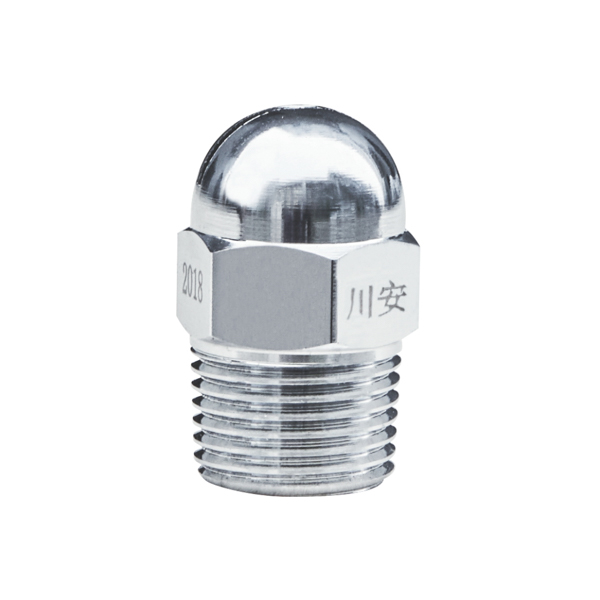
ZSTMA-T10 / T21.5
Fire Separation · 150° · PendentParabolic-deflector water curtain head for fire separation screens across openings, doorways, and above fire roller shutters. Two flow sizes: T10 (K=10, light openings) and T21.5 (K=21.5, wide or tall openings requiring higher density). Pendent-only mounting.
| Spray angle | 150° |
|---|---|
| Flow factor K | 10 (T10) / 21.5 (T21.5) |
| Connection | R:½ |
| Mount | Pendent (下垂) |
| Function | Fire separation curtain |
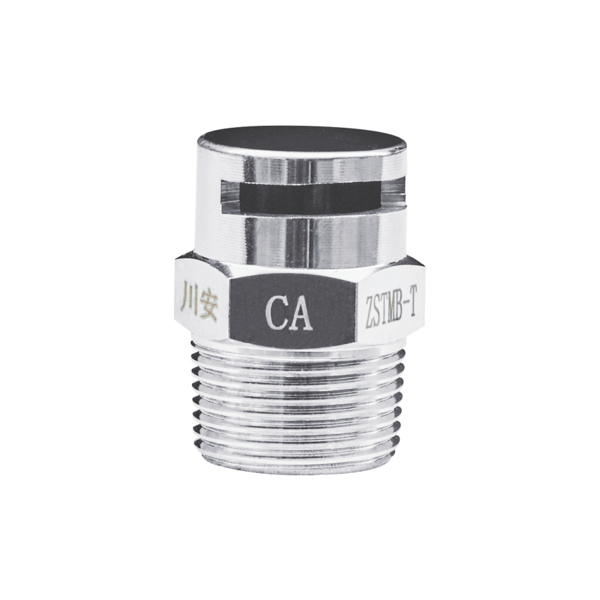
ZSTMB-T8 / T18 / T28 / T35 / T50
Cooling Protection · 120° · Pendent / Horiz.Flat-fan drencher nozzle for surface cooling. Five flow sizes from K=8 to K=50 cover a wide range of surface areas and water density requirements. Pendent or horizontal mounting — horizontal mounting used for downward drench of vertical glazing installed close to the nozzle line. Min. working pressure 0.1 MPa across the range.
| Spray angle | 120° |
|---|---|
| Flow factor K | 8 / 18 / 28 / 35 / 50 |
| Connection | R:½ (K8/18) · R:¾ (K28/35/50) |
| Mount | Pendent or horizontal |
| Min. pressure | 0.1 MPa |
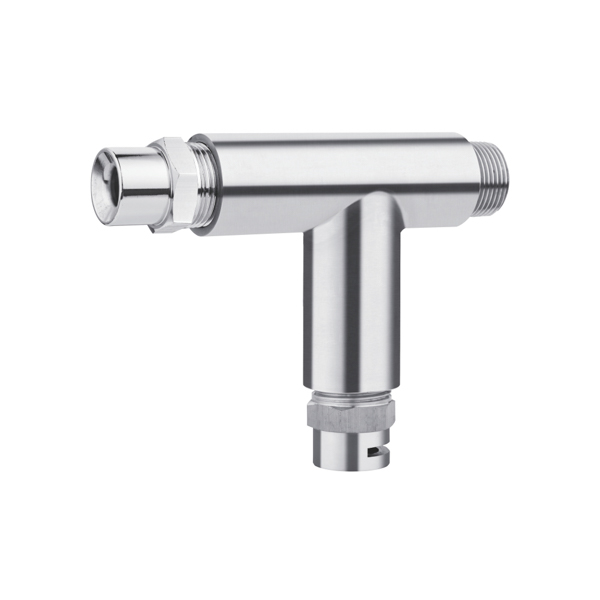
ZSTMZ — Combined Water Curtain
Combined Curtain · 120° · UprightHigh-capacity combined water curtain head. Wide K range (15–200 via orifice selection) allows a single head model to serve vastly different flow demands in the same system design. R:1 threaded or welded connection for heavy-flow mains. Upright mounting. 0.35 MPa minimum working pressure.
| Spray angle | 120° |
|---|---|
| Flow factor K | 15–200 (orifice selected) |
| Connection | R:1 or welded |
| Mount | Upright (直立) |
| Min. pressure | 0.35 MPa |
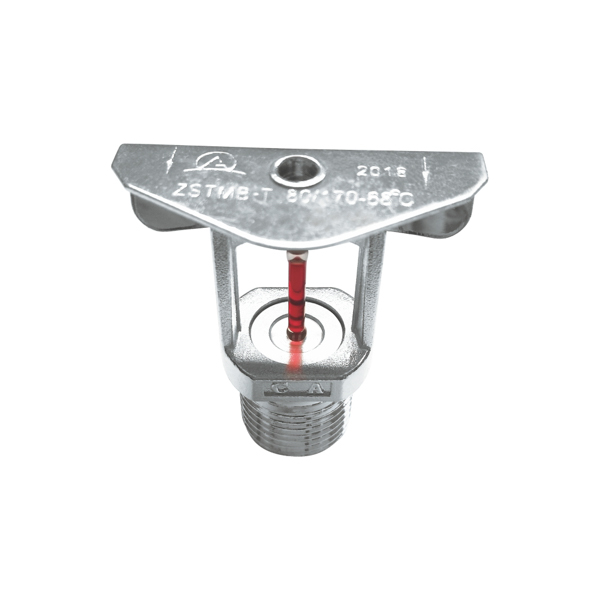
ZSTMB-T80/170-68°C
Window Spray · 170° · Sidewall / Horiz.Special wide-angle variant with 170° discharge arc. The T80 suffix (flow factor K=80) and 170° spread make this the widest-coverage head in the ZSTMB range. Includes a 68°C thermal sensing element — can be used as a closed-head residential sidewall sprinkler. Also used in water curtain applications across narrow corridors and small window openings.
| Spray angle | 170° |
|---|---|
| Flow factor K | 80 |
| Activation | 68°C (thermal element) |
| Connection | R:½ |
| Mount | Pendent or horizontal |
Complete ZSTM Series Technical Parameters
| Model | Function | Mount | Connection | Flow Factor K | Spray Angle | Min. Pressure (MPa) | Thermal Element |
|---|---|---|---|---|---|---|---|
| ZSTMA-T — Parabolic Deflector · Fire Separation Curtain · 150° | |||||||
| ZSTMA-T10/150 | Fire separation | Pendent | R:½ | 10 | 150° | — | None (open) |
| ZSTMA-T21.5/150 ★ | Fire separation | Pendent | R:½ | 21.5 | 150° | — | None (open) |
| ZSTMB-T — Flat Fan Deflector · Cooling Protection · 120° · Pendent or Horizontal | |||||||
| ZSTMB-T8/120 | Surface cooling | Pendent / Horiz. | R:½ | 8 | 120° | 0.1 | None (open) |
| ZSTMB-T18/120 ★ | Surface cooling | Pendent / Horiz. | R:½ | 18 | 120° | 0.1 | None (open) |
| ZSTMB-T28/120 ★ | Surface cooling | Pendent / Horiz. | R:¾ | 28 | 120° | 0.1 | None (open) |
| ZSTMB-T35/120 | Surface cooling | Pendent / Horiz. | R:¾ | 35 | 120° | 0.1 | None (open) |
| ZSTMB-T50/120 | Surface cooling | Pendent / Horiz. | R:¾ | 50 | 120° | 0.1 | None (open) |
| ZSTMB-T80/170-68°C | Window spray / Curtain | Pendent / Horiz. | R:½ | 80 | 170° | — | 68°C (closed head) |
| ZSTMZ — Combined Water Curtain Head · 120° · Upright · High-Flow (K 15–200) | |||||||
| ZSTMZ (K15–200) ★ | Combined curtain | Upright | R:1 or welded | 15–200 | 120° | 0.35 | None (open) |
★ Most commonly specified. All open-type models have no thermal sensing element — activation is controlled by an external deluge valve system. ZSTMB-T80/170-68°C is the only closed-head (thermal element) variant in the range. All models GB 5135 CCCF certified. NFPA 13 documentation available on request.
Head Spacing and Coverage Design
Water curtain nozzle spacing is determined by the spray angle, the mounting height above the protected surface, and the required water density (L/min/m of opening width or m² of surface area). The table below gives indicative maximum head spacing for ZSTMA-T and ZSTMB-T heads at typical installation heights — confirm with hydraulic calculations for your specific project.
| Model | Spray Angle | Install Height (m) | Max Head Spacing (m) | Coverage Width per Head (m) | Primary Use Case |
|---|---|---|---|---|---|
| ZSTMA-T10/150 | 150° | 0.3–0.5 | 2.0–2.5 | ~2.5 | Light openings, narrow doorways, above roller shutters |
| ZSTMA-T21.5/150 | 150° | 0.3–0.5 | 2.0–2.5 | ~2.5 | Wide openings, high-flow fire separation, vehicle access doors |
| ZSTMB-T8/120 | 120° | 0.2–0.3 | 1.5–2.0 | ~1.8 | Small glazed panels, narrow window strips |
| ZSTMB-T18/120 | 120° | 0.2–0.4 | 1.8–2.5 | ~2.0 | Standard glazed facades, fire roller shutter face cooling |
| ZSTMB-T28/120 | 120° | 0.3–0.5 | 2.0–3.0 | ~2.5 | Large glazed curtain walls, atrium glass, external wall cooling |
| ZSTMB-T50/120 | 120° | 0.3–0.5 | 2.5–3.5 | ~3.0 | Extra-wide glazing bays, high-flow surface cooling |
| ZSTMZ (K15–200) | 120° | 0.3–0.6 | 1.5–3.0 | ~2.0–3.0 | Combined curtain systems, large openings, bespoke designs |
All spacing values are indicative only. Final head layout must be determined by hydraulic calculation per GB 50084 or NFPA 13. Spacing must ensure complete overlap of adjacent spray patterns at the protected surface with no dry gaps. In high-wind outdoor locations, reduce spacing by 20–30% to compensate for wind deflection of the curtain.
Typical Applications
Nozzles on both sides of a fire-rated roller shutter keep the shutter face cool, preventing thermal distortion and maintaining the integrity of the compartment boundary. GB 50016 requires shutter cooling in many configurations.
Drencher heads mounted at the head of a glazed facade section maintain a continuous water film over the glass, enabling large glass areas to substitute for fire-rated solid walls under GB 50016 or local authority approval.
Large openings in fire walls for fork-lift or truck access cannot be closed by roller shutters during working hours. A water curtain system provides the code-required fire separation across the opening when activated by the fire detection system.
Multi-storey atriums with open upper levels. Water curtain nozzles at each gallery level form horizontal fire separation planes to limit vertical fire and smoke spread through the atrium void.
The proscenium arch water curtain separates the stage from the auditorium. A drencher system across the full width of the proscenium opening is required by GB 50016 for theatres above a defined seating capacity.
Open frontages between retail units and covered mall walkways. Where the mall walkway counts as a fire-protected means of escape, the retail frontage opening must be separated by a fire curtain, roller shutter, or water curtain system.
Equipment, vessels, and structural steelwork exposed to potential pool fire or jet fire radiation. A drencher system provides cooling water to prevent steel from reaching critical failure temperature during the fire development period.
Closed-head sidewall application in individual residential rooms where ceiling pipe cannot be installed. The 170° arc covers the full room width from a single wall-mounted head. Full details on the Residential Fire Sprinkler page.
Frequently Asked Questions
What is the difference between a water curtain system and a standard deluge sprinkler system?
Both use open-type heads and a deluge valve, but their purpose and nozzle design are completely different. A standard deluge system uses open spray nozzles (or open sprinkler heads) arranged in a ceiling array to discharge water onto a horizontal protected area below — the goal is to wet fuel surfaces and cool the fire. A water curtain system uses flat-fan or parabolic-deflector nozzles arranged in a line above an opening or surface to form a vertical sheet of water — the goal is to create a fire and heat barrier across a gap in the compartment boundary.
Water curtain nozzles (ZSTMA-T, ZSTMB-T) are not interchangeable with standard deluge spray nozzles. The spray pattern, K-factor, and hydraulic design of the two are calibrated for entirely different functions. Installing deluge nozzles where water curtain nozzles are required (or vice versa) will not achieve the intended protection and may not comply with the relevant code.
Can a water curtain system replace a fire-rated wall or door in all situations?
No — not in all situations. Water curtain systems are accepted as an equivalent measure for fire separation in specific circumstances defined by GB 50016, GB 50084, and local authority requirements. The key conditions typically include: the water curtain must be activated automatically (not manual only), there must be a reliable water supply capable of sustaining the required flow for a minimum duration (typically 1 hour for fire separation curtains), and the water curtain must cover the full width and height of the unprotected opening with no gaps.
Water curtain systems are generally not accepted as a substitute for fire-rated construction in high-risk areas, areas where a water supply failure could cause catastrophic consequences, or in occupancies where specific fire-rated construction requirements are mandated regardless of suppression systems. Always confirm the acceptability of a water curtain solution with the authority having jurisdiction before including it in a design.
Do water curtain nozzles need to be replaced after activation?
The open-type ZSTMA-T and ZSTMB-T nozzles have no consumable element — the brass orifice and deflector do not change on activation. After a system discharge, the nozzles should be inspected for debris blockage and cleaned, then the system can be restored to service. There is no requirement to replace the heads themselves after activation (unlike closed-head sprinklers, where the glass bulb or fusible link must be replaced after each operation).
The ZSTMB-T80/170-68°C is the exception — it contains a 68°C glass bulb thermal element. If this head has been activated by heat, the bulb has burst and the head must be replaced before the system can be restored, exactly as with a standard closed-head sprinkler.
After any activation, the deluge valve, detection system, and water supply should also be inspected and restored per the system maintenance schedule. Document the activation and notify the relevant authority as required by local regulation.
Which nozzle should I use over a fire roller shutter — ZSTMA-T or ZSTMB-T?
The choice depends on the function required. If the water curtain is primarily providing fire separation — acting as the fire barrier itself while the shutter descends or when the shutter alone is not sufficient — use ZSTMA-T21.5 (150° wide fan, higher K-factor for denser screen). If the water curtain is providing cooling protection for the shutter face to prevent thermal distortion and edge-seal failure during a fire — use ZSTMB-T18 or ZSTMB-T28 (120° flat fan, positioned close to the shutter face to produce a film-flow effect).
In many fire roller shutter installations, both functions are required simultaneously: a ZSTMA-T line on the fire side of the shutter provides the fire separation screen, while a ZSTMB-T line on the shutter face itself provides structural cooling. This combined approach is common in large-span industrial fire walls. Confirm the specific design requirement with the fire engineer before selecting the head type.
How long must a water curtain system sustain discharge — what is the required duration?
Under GB 50084 (China), the water supply duration for water curtain systems used as fire separation measures is typically 60 minutes (1 hour) for systems substituting for fire-rated walls, and may be reduced for systems providing cooling protection only — confirm the specific requirement with your local fire authority.
Under NFPA 13, deluge systems providing exposure protection are generally designed for a minimum duration determined by the occupancy hazard and the fire scenario being protected against — commonly 30 to 60 minutes. The designer is responsible for justifying the design duration to the authority having jurisdiction.
Water curtain systems typically have significantly higher flow rates than standard sprinkler systems for the same protected area, so the required water tank or reservoir volume can be substantial. Confirm the required duration, flow rate, and storage volume at project inception — these significantly affect tank size and pump selection.
Related Products
ZSTMA-T · ZSTMB-T · ZSTMZ · 120° / 150° / 170° · K 8–200 · Open type & closed-head variants
GB 5135 CCCF Certified · GB 50084 / NFPA 13 system documentation · Fire separation & cooling designs · 24 hr quote
sales@ca-fire.com · WhatsApp +86 18150362095
Send Inquiry →