
The standard response fire sprinkler is the most widely installed sprinkler type in commercial and Ordinary Hazard fire protection. With an RTI of 80–350 (m·s)½ and a 5mm glass bulb, it activates more deliberately than a quick response head — and that measured response is a design feature, not a drawback. In higher-challenge fire environments, controlled activation limits the number of heads that open simultaneously, maintaining adequate water pressure and flow at each operating sprinkler.
CA-FIRE manufactures standard response sprinklers across all three exposed-pipe installation orientations — pendent (ZSTX), upright (ZSTZ), and sidewall (ZSTBS) — in K5.6 (K80) and K8.0 (K115), covering eight activation temperatures from 57°C to 260°C. The 260°C black-bulb model is unique to the standard response range and is designed for extreme high-temperature environments such as drying ovens and kilns where quick response heads are not available. All models are produced at our Fujian factory with GB 5135 CCCF type approval. NFPA 13 documentation is available for international submittals.
Browse by installation type: Pendent → · Upright → · Sidewall → · Need quick response? QR Sprinklers →
What Is a Standard Response Sprinkler — and Why Choose It?
Every automatic sprinkler is classified by its Response Time Index (RTI) — a number that quantifies how quickly the heat-sensitive glass bulb responds to rising air temperature. Standard response sprinklers have an RTI of 80–350 (m·s)½, using a 5mm glass bulb that heats up more slowly than the 3mm bulb in quick response models.
The Full Temperature Range — Including High-Temperature Models up to 260°C
The most significant advantage of CA-FIRE's standard response range over quick response is the extended high-temperature coverage. While quick response models top out at 141°C, standard response models are available up to 260°C (black bulb) — essential for high-temperature process environments where ambient temperatures routinely exceed 150°C. See our High-Temperature Sprinkler page for the full 182°C and 260°C range.
Purple and black models are exclusive to the standard response range — not available in quick response.
CA-FIRE Standard Response Sprinkler Series
CA-FIRE's standard response range covers three installation orientations. All SR models are identified by their 5mm glass bulb and "Q5" designation in the model code — no "K-" prefix, no "J" suffix.
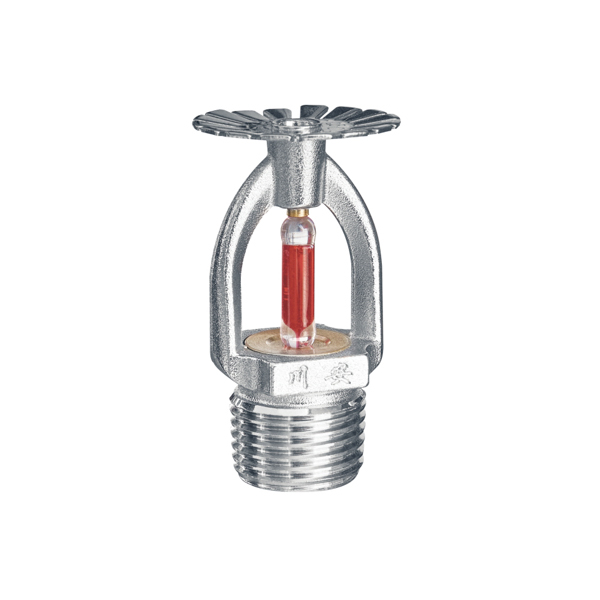
ZSTX Series
The most widely deployed standard response sprinkler globally. Hangs below the branch pipe, deflector facing down. For offices, retail, car parks, plant rooms, and Ordinary Hazard occupancies. Full temp range 57–260°C in K5.6 (K80) and K8.0 (K115).
View Pendent →
ZSTZ Series
Mounts above the branch pipe, deflector facing up. The natural choice for exposed-pipe systems where pipe drainage matters — plant rooms, car parks, and any space where a dry-pipe system may be required. Drainage advantage prevents freeze damage in cold environments. Full temp range 57–260°C.
View Upright →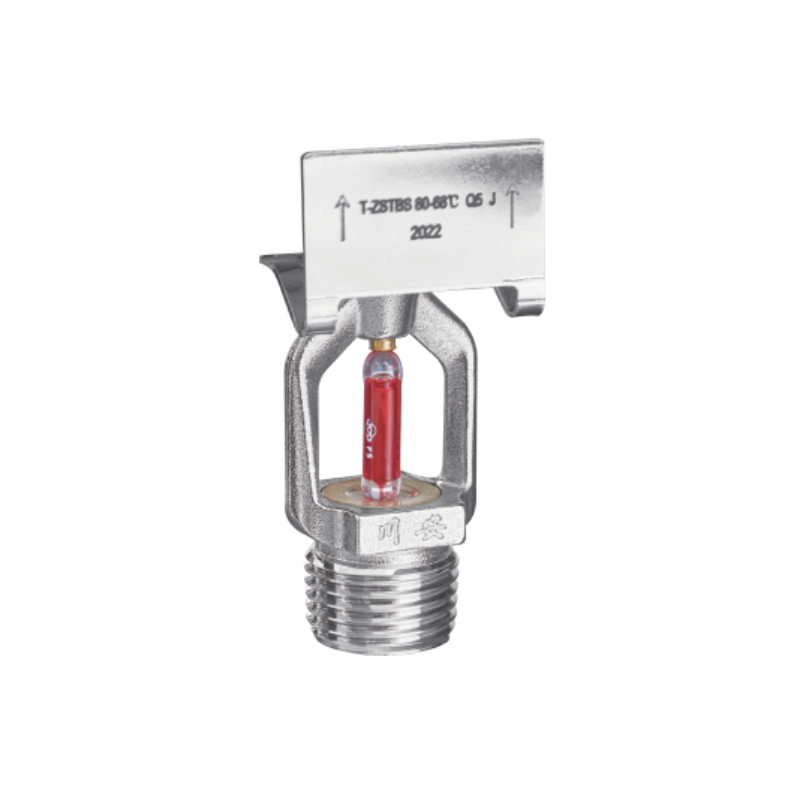
ZSTBS Series
Wall-mounted near the ceiling — eliminates ceiling pipe runs. For offices, retail, corridors, and Ordinary Hazard spaces where SR is acceptable under code. Covers rooms up to ~4.8 m wide from a single head. Temp range 57–141°C.
View Sidewall →Complete Standard Response Model Range
All models below use a 5mm glass bulb, RTI 80–350 (m·s)½, minimum operating temperature 4°C. K5.6 = metric K80, K8.0 = metric K115.
| Model | K-factor | Activation | Bulb Color | Max Ambient | Thread | Installation | Typical Use |
|---|---|---|---|---|---|---|---|
| ZSTX — Standard Response Pendent | |||||||
| ZSTX 80-57°C Q5 | K5.6 | 57°C | Orange | 27°C | R½ | Pendent | Unheated / cold-climate buildings |
| ZSTX 80-68°C Q5 ★ | K5.6 | 68°C | Red | 38°C | R½ | Pendent | Most common SR pendent — offices, retail, car parks |
| ZSTX 115-68°C Q5 ★ | K8.0 | 68°C | Red | 38°C | R¾ | Pendent | Higher flow — Extra Hazard occupancies |
| ZSTX 80-79°C Q5 | K5.6 | 79°C | Yellow | 49°C | R½ | Pendent | Attics, warm roof spaces |
| ZSTX 80-93°C Q5 | K5.6 | 93°C | Green | 63°C | R½ | Pendent | Hot utility rooms, plant rooms |
| ZSTX 80-141°C Q5 | K5.6 | 141°C | Blue | 111°C | R½ | Pendent | Steam rooms, commercial laundries |
| ZSTX 80-182°C Q5 | K5.6 | 182°C | Purple | 152°C | R½ | Pendent | Boiler rooms, high-temp process |
| ZSTX 80-260°C Q5 | K5.6 | 260°C | Black | 230°C | R½ | Pendent | Drying ovens, kilns, extreme heat |
| ZSTZ — Standard Response Upright | |||||||
| ZSTZ 80-57°C Q5 | K5.6 | 57°C | Orange | 27°C | R½ | Upright | Unheated / cold-climate exposed pipe |
| ZSTZ 80-68°C Q5 ★ | K5.6 | 68°C | Red | 38°C | R½ | Upright | Exposed-pipe systems, plant rooms, car parks |
| ZSTZ 115-68°C Q5 ★ | K8.0 | 68°C | Red | 38°C | R¾ | Upright | Higher flow upright — Extra Hazard occupancies |
| ZSTZ 80-79°C Q5 | K5.6 | 79°C | Yellow | 49°C | R½ | Upright | Warm roof spaces, elevated ambient |
| ZSTZ 80-93°C Q5 | K5.6 | 93°C | Green | 63°C | R½ | Upright | Hot utility spaces, plant rooms |
| ZSTZ 80-141°C Q5 | K5.6 | 141°C | Blue | 111°C | R½ | Upright | Steam rooms, laundry upright |
| ZSTZ 80-182°C Q5 | K5.6 | 182°C | Purple | 152°C | R½ | Upright | Boiler rooms, process plant upright |
| ZSTZ 80-260°C Q5 | K5.6 | 260°C | Black | 230°C | R½ | Upright | Drying ovens, kilns — upright |
| ZSTBS — Standard Response Sidewall | |||||||
| ZSTBS 80-57°C Q5 | K5.6 | 57°C | Orange | 27°C | R½ | Sidewall | Cold-climate / unheated rooms |
| ZSTBS 80-68°C Q5 ★ | K5.6 | 68°C | Red | 38°C | R½ | Sidewall | Offices, retail, corridors |
| ZSTBS 115-68°C Q5 ★ | K8.0 | 68°C | Red | 38°C | R¾ | Sidewall | Larger rooms, higher hazard |
| ZSTBS 80-79°C Q5 | K5.6 | 79°C | Yellow | 49°C | R½ | Sidewall | Kitchens, warm-climate corridors |
| ZSTBS 80-93°C Q5 | K5.6 | 93°C | Green | 63°C | R½ | Sidewall | Hot utility rooms |
| ZSTBS 80-141°C Q5 | K5.6 | 141°C | Blue | 111°C | R½ | Sidewall | High-ambient sidewall |
★ Most commonly specified. 182°C and 260°C models available in pendent and upright only — SR exclusive, not available in QR.
Where Standard Response Sprinklers Are Specified
Standard response is the correct choice wherever the fire hazard is Ordinary or Extra Hazard under NFPA 13 and GB 50084, or where ambient temperatures exceed the capability of quick response models.
Ordinary Hazard Group 1 & 2 — SR specified for controlled activation in high-challenge environments
Open racking, bulk storage — SR upright or pendent maintains pressure integrity across large areas
Ordinary Hazard Group 2 — SR standard for multi-storey car parks, underground garages
Purple bulb SR — prevents false activation in spaces with ambient temperatures up to 152°C
Black bulb SR — extreme high-temp applications up to 230°C ambient. SR exclusive model
141°C blue bulb — hot humid environments; SR chosen for greater ambient tolerance
Machinery spaces, compressor rooms, generator rooms — Extra Hazard SR specified
Anywhere ambient exceeds 38°C — yellow, green, blue, purple, or black bulb SR models available
Standard Response vs Quick Response — Choosing the Right Type
| Factor | Standard Response (ZSTX / ZSTZ / ZSTBS) | Quick Response (K-ZSTX / K-ZSTZ / K-ZSTBS) |
|---|---|---|
| RTI | 80–350 (m·s)½ | ≤ 50 (m·s)½ |
| Glass bulb | 5mm — deliberate, controlled activation | 3mm imported — faster thermal response |
| Max activation temp | 260°C (black bulb) — unique to SR | 141°C maximum — no purple or black bulb |
| Simultaneous head opening | Fewer heads open — better pressure maintenance | More heads may open simultaneously |
| NFPA 13 requirement | Required for Ordinary & Extra Hazard occupancies | Required for Light Hazard occupancies |
| Primary protection objective | Property protection — controlled suppression in Ordinary and Extra Hazard environments | Life safety — rapid suppression for occupant egress |
| Typical occupancies | Ordinary Hazard and Extra Hazard occupancies — offices, retail, car parks, plant rooms, process facilities | Hotels, hospitals, offices, schools, residences, airports |
| Unit cost | Lower — 5mm domestic bulb | Slightly higher — 3mm imported bulb |
| Mixing with QR | Generally not permitted in the same fire compartment — consult NFPA 13 Section 6.2.4 | |
Frequently Asked Questions
Why is standard response preferred for Ordinary Hazard and Extra Hazard occupancies?
In Ordinary and Extra Hazard occupancies — such as car parks, retail back-of-house, plant rooms, and process facilities — a fire can grow before the ceiling temperature reaches the sprinkler activation point. If quick response heads were installed, several sprinklers in the vicinity could activate almost simultaneously, opening many heads at once and potentially reducing water pressure at each one below the minimum design value.
Standard response heads activate more selectively. Fewer heads open at any one time, the hydraulic system maintains adequate pressure and flow at each operating head, and the total water application is more targeted to the actual fire area. This is why NFPA 13 specifies SR for Ordinary Hazard Group 2 and Extra Hazard occupancies. For high-piled storage applications, ESFR sprinklers are the appropriate solution.
What is the highest temperature available in a standard response sprinkler?
CA-FIRE standard response sprinklers are available up to 260°C (black bulb), suitable for ambient environments up to 230°C. This is a standard response exclusive — quick response models are not available above 141°C.
The 260°C model is specified for extreme-temperature environments such as drying ovens, ceramic kilns, and paint curing ovens where ambient temperatures in normal operation may exceed 150°C. The correct temperature rating must always be selected to ensure the sprinkler does not activate at ambient temperature during normal operation, and does activate promptly in a fire event.
How do I choose the correct activation temperature for my application?
The activation temperature must be selected to be sufficiently above the maximum expected ambient temperature in the protected space, while remaining low enough to activate early in a genuine fire. The standard guideline (NFPA 13 Table 8.4.1.1) is:
Max ambient up to 38°C → 68°C (Red)
Max ambient 39–49°C → 79°C (Yellow)
Max ambient 50–63°C → 93°C (Green)
Max ambient 64–111°C → 141°C (Blue)
Max ambient 112–152°C → 182°C (Purple)
Max ambient 153–230°C → 260°C (Black)
Always verify against your specific system design and local code requirements.
How do I identify a standard response sprinkler on site?
In CA-FIRE's range, SR models are identified by:
1. No "K-" prefix — SR models are ZSTX, ZSTZ, ZSTBS (not K-ZSTX, K-ZSTZ, K-ZSTBS)
2. "Q5" designation in the model code
3. 5mm glass bulb — visibly thicker than the 3mm bulb on QR heads
4. No "J" suffix — SR pendent/upright/sidewall models end in "C" (chrome) or have no finish suffix
Always verify from the project installation record before ordering replacements — never rely on visual identification alone.
Can standard response and quick response sprinklers be used in the same building?
Yes — but generally not in the same fire compartment or on the same branch line. A building with both a hotel section (QR required) and a plant room or back-of-house area (SR specified) can use different response types in those separate fire areas.
What is not permitted under NFPA 13 in most cases is mixing SR and QR heads in the same room or on the same section of pipe — the hydraulic imbalance caused by one type activating before the other can compromise system performance. Consult your system designer and refer to NFPA 13 Section 6.2.4 for specific rules.
What does the "Q5" suffix mean in CA-FIRE model codes?
"Q5" in the CA-FIRE model code refers to the 5mm glass bulb used as the heat-sensitive element, which corresponds to the standard response RTI classification (80–350 (m·s)½). It distinguishes SR models from:
Q3 / J — 3mm glass bulb = Quick Response (RTI ≤50)
Q5 — 5mm glass bulb, RTI 80–350 = Standard Response
Q5 (T-series) — 5mm glass bulb, RTI 50–80 = Special/Intermediate Response
Browse by Installation Type
ZSTX · ZSTZ · ZSTBS · K5.6 / K8.0 · 57–260°C · RTI 80–350 (m·s)½
GB 5135 CCCF Certified · NFPA 13 documentation available · Mixed models welcome · 24 hr quote
sales@ca-fire.com · WhatsApp +86 18150362095
Send Inquiry →