
Home fires are the leading cause of fire fatalities worldwide — and the vast majority of those deaths occur in the first few minutes, before emergency services arrive. A residential fire sprinkler system is the only technology that can suppress or contain a bedroom or living room fire during that critical window, buying occupants the time to escape and limiting the fire to the room of origin in over 96% of activations. Unlike commercial systems, residential sprinklers are engineered specifically for the domestic environment: lower operating pressures compatible with residential water supplies, smaller pipe diameters that fit inside standard wall and ceiling cavities, and discrete heads designed to blend with interior finishes rather than dominate them.
CA-FIRE supplies a complete residential sprinkler head range covering every room type and ceiling finish in a residential building — flush (ZSTDQ) for flat-ceiling living spaces, concealed (ZSTDY) for high-finish rooms where complete invisibility is required, horizontal sidewall (ZSTMB) for rooms where ceiling pipe cannot be run, and standard pendent (ZSTX) for utility areas, basements, and garage spaces. All models use a 3mm quick response glass bulb (RTI ≤50) and are designed to be supplied from standard domestic cold-water pressure at 0.05–0.10 MPa minimum working pressure.
For commercial building coverage, see: Quick Response Sprinkler → · Concealed Fire Sprinkler Head → · Sidewall Fire Sprinkler Head →
Why Residential Sprinklers — Three Critical Facts
NFPA data shows residential sprinklers control or extinguish a fire in the room of origin in over 96% of activations — preventing spread to the rest of the building.
In the vast majority of residential fires, only 1 to 2 sprinkler heads activate — meaning water damage is limited to the room of origin, not the entire building.
Modern furnished rooms can reach flashover (total fire involvement) in as little as 3 minutes. A residential sprinkler activates in under 2 minutes — before flashover can occur.
Four Head Types for Every Room in the Home
Flush / Recessed
Sits flush with ceiling. Body above ceiling, only escutcheon plate and glass element below. Most popular for living rooms, bedrooms, corridors.
Concealed
Flat cover plate, completely flush with ceiling surface. Cover releases on activation. Premium finish for show apartments and high-specification interiors.
Horizontal Sidewall
Wall-mounted. Eliminates ceiling pipe entirely in individual rooms. Preferred in bathrooms, utility rooms, and rooms with obstructed or inaccessible ceilings.
Standard Pendent
Hangs below branch pipe. Used in basements, garages, loft spaces and utility areas where aesthetics are secondary to function.
Flush Sprinkler Head (ZSTDQ) — The Residential Standard
The flush sprinkler head is the definitive residential sprinkler type for finished living spaces. The entire sprinkler body mounts above the ceiling line — only the small circular escutcheon plate and the glass bulb element project below the ceiling surface. This near-invisible profile overcomes the main aesthetic objection to residential sprinklers without compromising the thermal sensitivity that matters most: the sensing element remains fully exposed below the ceiling where the hot gas layer accumulates.
- Full thermal exposure: The glass bulb hangs below the ceiling in the hot gas layer — no insulating cover plate to delay activation.
- Faster response: RTI ≤50 (m·s)½ — identical to commercial Quick Response heads, but with a residential-listed spray pattern.
- No cover plate drop delay: Concealed heads must melt the solder on a cover plate before the bulb activates — flush heads have no cover, so nothing delays water delivery.
- Lower cost than concealed: Simpler construction, same protection performance for most residential rooms.
- Escutcheon covers installation gap: The adjustable escutcheon accommodates ceiling finish variations without exposing the pipe thread.
- K-ZSTDQ — German 3mm glass bulb, RTI ≤50 (m·s)½. This is the Quick Response flush head — the standard specification for all new residential installations.
- ZSTDQ (no K prefix) — Standard response (fusible alloy element). Used in retrofit situations or where the design code permits standard response in residential buildings.
- Both types available in K5.6 (K=80, R:½ thread) and K8.0 (K=115, R:¾ thread).
- Temperature ratings: 57°C (orange bulb, max 27°C ambient) and 68°C (red bulb, max 38°C ambient). 68°C is the standard residential specification for most rooms; 57°C is used in rooms with very low ambient temperatures.
Residential Sprinkler Head Models
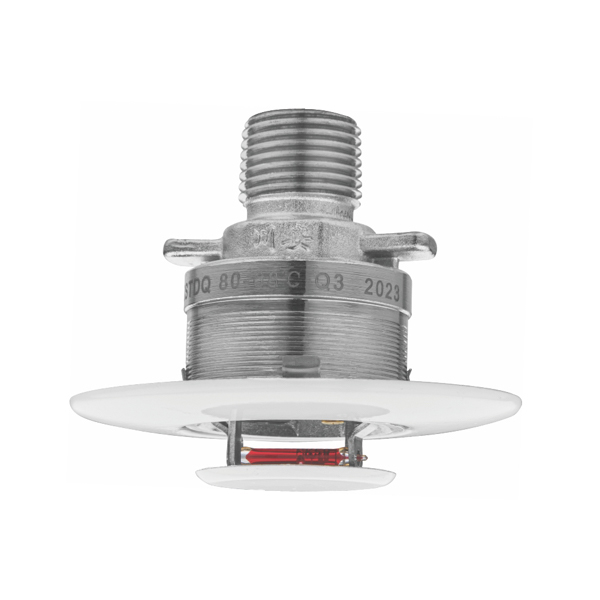
K-ZSTDQ 80-68°C Q3 / Y
Flush · K5.6 · QR · Most SpecifiedThe standard residential flush head. 3mm German glass bulb, RTI ≤50. Sits flush with finished ceiling. Covers up to 12 m² per head at standard residential spacings. Bedrooms, living rooms, dining rooms, corridors.
| K-factor | K5.6 (K80) |
|---|---|
| Activation | 68°C · Red |
| Response | RTI ≤50 · 3mm QR bulb |
| Max ambient | 38°C |
| Thread | R:½ (BSP) |
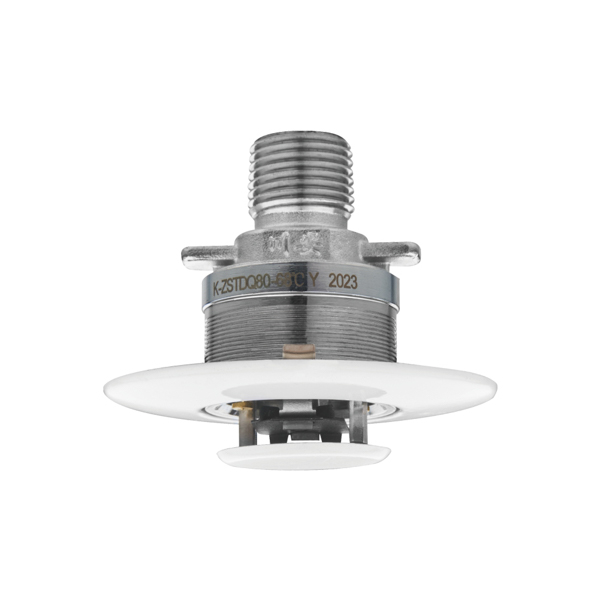
K-ZSTDQ 80-57°C Q3 / Y
Flush · K5.6 · QR · 57°C57°C flush head for cooler residential environments — suitable for rooms where ambient temperature rarely exceeds 27°C. Unheated corridors, stairwells, and rooms in cold climates where 68°C activation would be too slow.
| K-factor | K5.6 (K80) |
|---|---|
| Activation | 57°C · Orange |
| Response | RTI ≤50 · 3mm QR bulb |
| Max ambient | 27°C |
| Thread | R:½ (BSP) |
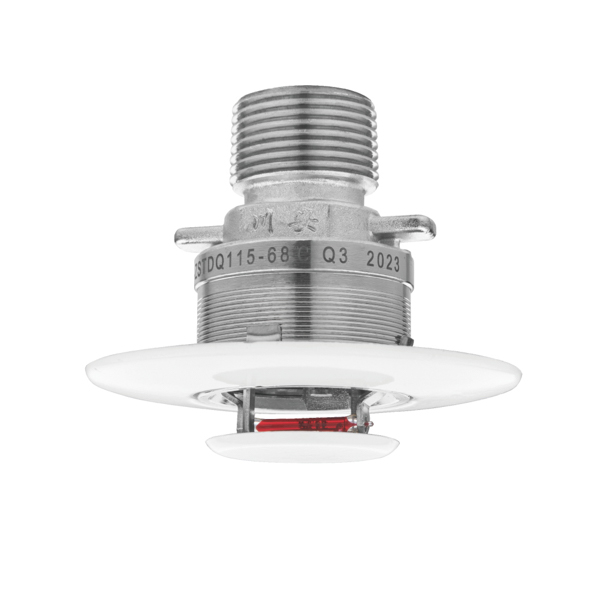
K-ZSTDQ 115-68°C Q3 / Y
Flush · K8.0 · QRK8.0 flush head for larger rooms or higher ceilings where greater water volume is required. Suitable for open-plan living areas, large master bedrooms, and multi-function spaces where K5.6 spacing cannot achieve the required density.
| K-factor | K8.0 (K115) |
|---|---|
| Activation | 68°C · Red |
| Response | RTI ≤50 · 3mm QR bulb |
| Max ambient | 38°C |
| Thread | R:¾ (BSP) |
ZSTDQ 80-68°C / 74°C / 82°C / 100°C
Flush · K5.6 · Fusible AlloyFusible alloy element flush head. Standard response. Available across a wider temperature range — 68°C, 74°C, 82°C, 100°C — for use in retrofit systems or where the design permits standard response elements. Kitchens, utility rooms, attic spaces.
| K-factor | K5.6 (K80) |
|---|---|
| Temps available | 68°C / 74°C / 82°C / 100°C |
| Sensing element | Fusible alloy link |
| Response | Standard response |
| Thread | R:½ (BSP) |
K-ZSTDQ 80-68°C Q3 (Concealed / Cover Plate)
Concealed · K5.6 · QRComplete concealed assembly — flush head body plus decorative cover plate. Cover plate surface sits perfectly level with ceiling; plate falls away on activation exposing the sprinkler. Show apartments, premium residential interiors, hotel guestrooms.
| K-factor | K5.6 (K80) |
|---|---|
| Activation | 68°C · Red bulb |
| Cover plate | Drops at ~57°C solder |
| Finish | White / chrome (specify) |
| Thread | R:½ (BSP) |
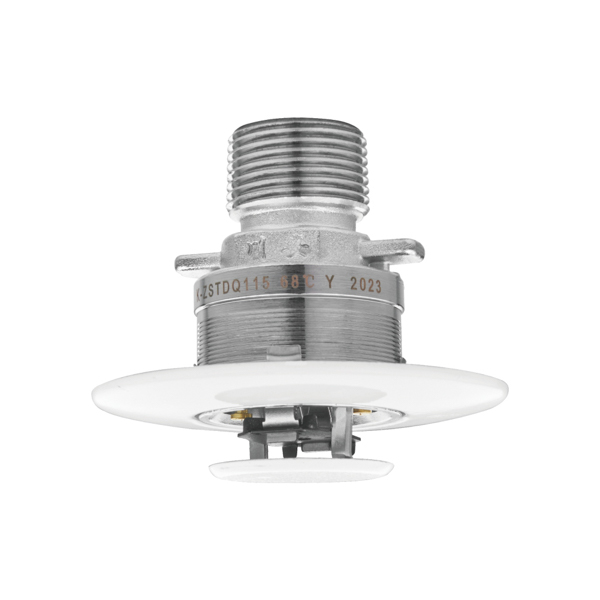
ZSTMB-T80/170-68°C
Sidewall · Window Spray · K5.6Horizontal sidewall head (窗喷 — window spray type) for residential rooms where ceiling pipe cannot be installed. Mounts on wall near window or door. 170° throw angle covers the full room width from a single wall position. Bathrooms, ensuites, narrow bedrooms.
| K-factor | K5.6 (K80) |
|---|---|
| Throw angle | 170° |
| Activation | 68°C |
| Mount | Horizontal sidewall |
| Thread | R:½ (BSP) |
Complete Residential Sprinkler Model Range
| Model | Type | K-factor | Sensing Element | Activation | Response | Max Ambient | Thread |
|---|---|---|---|---|---|---|---|
| ZSTDQ Flush — Quick Response Glass Bulb (3mm · RTI ≤50) | |||||||
| K-ZSTDQ 80-57°C Q3 | Flush Pendent | K5.6 | 3mm glass bulb | 57°C | QR · RTI ≤50 | 27°C | R:½ |
| K-ZSTDQ 80-68°C Q3 ★ | Flush Pendent | K5.6 | 3mm glass bulb | 68°C | QR · RTI ≤50 | 38°C | R:½ |
| K-ZSTDQ 115-68°C Q3 ★ | Flush Pendent | K8.0 | 3mm glass bulb | 68°C | QR · RTI ≤50 | 38°C | R:¾ |
| K-ZSTDQ 80-68°C Y | Flush Pendent | K5.6 | 3mm glass bulb | 68°C | QR · RTI ≤50 | 38°C | R:½ |
| K-ZSTDQ 115-68°C Y | Flush Pendent | K8.0 | 3mm glass bulb | 68°C | QR · RTI ≤50 | 38°C | R:¾ |
| ZSTDQ Flush — Fusible Alloy Element (Standard Response) | |||||||
| ZSTDQ 80-68°C | Flush Pendent | K5.6 | Fusible alloy | 68°C | Standard Response | 38°C | R:½ |
| ZSTDQ 80-74°C | Flush Pendent | K5.6 | Fusible alloy | 74°C | Standard Response | 44°C | R:½ |
| ZSTDQ 80-82°C | Flush Pendent | K5.6 | Fusible alloy | 82°C | Standard Response | 52°C | R:½ |
| ZSTDQ 80-100°C | Flush Pendent | K5.6 | Fusible alloy | 100°C | Standard Response | 70°C | R:½ |
| ZSTDQ + Cover Plate — Concealed Flush (Full Flat-Ceiling Profile) | |||||||
| K-ZSTDQ 80-68°C Q3 + Cover ★ | Concealed | K5.6 | 3mm glass bulb | 68°C | QR · RTI ≤50 | 38°C | R:½ |
| K-ZSTDQ 115-68°C Q3 + Cover | Concealed | K8.0 | 3mm glass bulb | 68°C | QR · RTI ≤50 | 38°C | R:¾ |
| ZSTMB-T — Horizontal Sidewall / Window Spray (Residential) | |||||||
| ZSTMB-T80/170-68°C ★ | Horiz. Sidewall | K5.6 | Glass bulb / Fusible | 68°C | Standard Response | 38°C | R:½ |
★ Most commonly specified for residential projects. Q3 suffix = 3mm glass bulb (quick response). Y suffix = standard finish glass bulb. All models GB 5135 CCCF certified. NFPA 13D/13R documentation available on request.
Room-by-Room Specification Guide
Selecting the right sprinkler head type for each room in a residential building depends on ceiling finish, access for piping, ambient temperature, and aesthetic requirements. The guide below covers the most common residential room types.
Flush head, 68°C. Standard specification. Sits flush with plasterboard ceiling; minimal visual impact on bedroom finish.
Flush head, 68°C. For large open-plan living areas, K8.0 (K-ZSTDQ 115) may be needed to achieve required density at wider spacing.
74°C or 82°C fusible alloy head. Cooking heat means 68°C glass bulb risks false activation — higher activation temperature is essential in kitchens.
Sidewall window spray — no ceiling pipe required. Mounts on wall behind door. 170° coverage angle handles most bathroom widths from a single head.
Full concealed assembly. Flat white or chrome cover plate sits flush with ceiling surface. No visible hardware in finished state — ideal for high-specification sales presentations.
57°C flush head — suitable for cooler unheated or semi-heated circulation spaces where ambient temperature is consistently below 27°C.
Standard pendent or upright head in utility finish. Aesthetics secondary to function in garage and basement spaces; standard commercial QR head is appropriate.
74°C fusible alloy for roof void spaces where summer ambient temperatures may approach the limit of glass bulb models. Check ambient temperature range before specifying.
Residential vs Commercial Sprinklers — Key Differences
| Parameter | Commercial Sprinkler (NFPA 13) | Residential Sprinkler (NFPA 13D/13R) |
|---|---|---|
| Design objective | Protect structure, prevent fire spread between spaces | Protect occupants — provide escape time, prevent flashover |
| Test scenario | Generic fire scenarios, various hazard classes | Furnished residential room fire — couch, bedding, curtains |
| Min. operating pressure | Typically 0.05–0.10 MPa (K5.6 at standard spacing) | 0.05–0.10 MPa — designed for domestic water supply pressure |
| Water supply | Dedicated fire pump and storage tank required | Can use domestic water supply in many configurations (NFPA 13D) |
| Rooms requiring coverage | All rooms throughout building | All habitable rooms (bathrooms ≤ 5 m² may be exempt under 13D) |
| Pipe material | Steel, CPVC, copper | CPVC, copper, and multi-layer pipe permitted — fits in wall/ceiling cavities |
| Number of heads in design | Full hydraulic area (varies) | NFPA 13D: design for just 2 heads simultaneously — lower pump/storage requirement |
| Head type | Standard pendent, upright, concealed, sidewall | Flush (ZSTDQ), concealed (with plate), sidewall window spray, standard pendent |
Frequently Asked Questions
Will my home water pressure be sufficient to run a residential sprinkler system?
In most cases, yes — for NFPA 13D single-family and two-family homes. The standard design basis for NFPA 13D requires only two sprinkler heads to operate simultaneously, and the required flow rate from a K5.6 head at 0.05 MPa is approximately 34 L/min per head — less than a typical domestic shower flow rate.
The suitability of the domestic water supply depends on the static pressure available at the highest sprinkler in the building, the pipe diameter used, and the number of fixtures running simultaneously. A plumbing engineer should verify the available pressure and flow at the point of connection before finalising the system design. In most modern residential buildings with municipal water supply, no separate pump or storage tank is required for NFPA 13D compliance.
For NFPA 13R (low-rise multi-family, up to 4 storeys), a dedicated water supply is typically required because the design basis covers more heads and higher flow rates.
Do I need to put a sprinkler in every room — including bathrooms and closets?
Under NFPA 13D, small bathrooms of 5 m² (55 ft²) or less are exempt from the sprinkler requirement, as fires in very small bathrooms are less likely to threaten occupant escape. Closets of 0.84 m² or less and less than 914 mm in any dimension are also exempt.
All other habitable rooms — bedrooms, living rooms, kitchens, dining rooms, home offices, play rooms, and all corridors used as part of the means of escape — require coverage. The intent is to ensure that a fire in any occupied space can be controlled before it reaches the corridor and cuts off the escape route.
GB 50084 (China) has slightly different exempt room rules — confirm with your local fire protection authority before finalising the scope.
Why use 68°C in most rooms but 74°C or 82°C in the kitchen?
The selection of activation temperature is governed by the maximum normal ambient temperature rule: activation temperature must be at least 30°C above the maximum normal ambient temperature in the room. A kitchen can regularly reach 38–44°C during cooking — if a 68°C head were installed, the 30°C margin would not be maintained, creating a risk of accidental activation from cooking heat alone.
At 74°C, the margin is 30°C from a 44°C maximum ambient — the minimum permitted. At 82°C, the margin is comfortable for kitchens that regularly see peak temperatures up to 52°C. Most residential kitchens in temperate climates specify 74°C; commercial kitchens and residential wok kitchens typically use 82°C or higher.
The tradeoff is that a higher activation temperature means the head waits slightly longer before opening in an actual kitchen fire — but the overall system still achieves flashover prevention well within acceptable NFPA 13D/13R performance criteria at 74°C or 82°C in kitchens.
What is the difference between the ZSTDQ flush head and a concealed head (ZSTDY)?
Both types mount their body above the ceiling — the difference is what you see from below:
Flush (ZSTDQ): A small circular escutcheon plate (typically 70–80 mm diameter) sits at ceiling level. The glass bulb and frame are visible below the escutcheon — they project perhaps 8–12 mm below the ceiling surface. The thermal element is fully exposed in the room's hot gas layer, giving maximum response speed. Most homeowners find this profile unobtrusive.
Concealed with cover plate (ZSTDQ + Cover): A flat circular cover plate sits perfectly flush with the finished ceiling surface. The plate is held in place by a fusible solder — when the room temperature rises, the solder melts, the cover drops away, and the glass bulb is exposed to activate. This creates a completely smooth ceiling with no hardware visible in normal conditions. The trade-off is a slight activation delay while the cover plate solder melts (typically a few additional seconds) before the glass bulb begins to respond.
For most residential bedrooms and living rooms, the flush head provides adequate aesthetics at lower cost. Specify the concealed cover-plate assembly only when the project brief specifically requires a flush-ceiling appearance — show flats, hospitality accommodation, or premium residential development.
Can residential sprinklers be connected to the same pipe as the domestic hot and cold water system?
Under NFPA 13D, a combined sprinkler and domestic water supply system is explicitly permitted — this is one of the code's key cost-reduction provisions for single-family homes. The sprinkler branch pipes share the domestic cold-water supply, and the continuous water flow through the sprinkler pipe (because it serves domestic outlets too) helps prevent stagnation and water quality issues in the sprinkler lines.
The key requirement is that the domestic system must be capable of providing the sprinkler demand (flow and pressure for two simultaneous heads) even when other fixtures are in use, and the pipe sizing must account for simultaneous domestic and sprinkler use. In China under GB 50015 combined system provisions, similar combined approaches are permitted subject to local authority review.
For multi-family buildings (NFPA 13R / GB 50084 residential provisions), a separate dedicated sprinkler supply is typically required.
Can sprinklers cause more water damage than the fire itself?
This is a common concern and the data consistently shows it is unfounded. In residential sprinkler activations, only 1 to 2 heads typically activate — the head nearest the fire opens, delivers water, and controls the fire before neighbouring heads reach their activation temperature. The total water discharged in a typical residential activation is between 200–600 litres — comparable to a single bathtub.
By contrast, a fire that reaches flashover without suppression fills the room with water from fire brigade hoses — typically thousands of litres — plus the structural water damage from fire itself. Insurance industry data consistently shows that sprinkler-protected residential fires result in substantially lower total loss (property + water damage combined) than unprotected fires.
Related Products
ZSTDQ Flush · Concealed Cover Plate · ZSTMB-T Sidewall · K5.6 / K8.0 · QR & Standard Response
GB 5135 CCCF Certified · NFPA 13D/13R documentation available · Mixed types welcome · 24 hr quote
sales@ca-fire.com · WhatsApp +86 18150362095
Send Inquiry →