
A quick response fire sprinkler activates faster than a standard response sprinkler at the same heat exposure — not because it runs hotter water through the pipe, but because its smaller, more thermally sensitive glass bulb responds more rapidly to the rising heat of a fire. This earlier activation means water reaches the fire sooner, keeping it smaller, limiting smoke production, and giving building occupants more time to evacuate safely.
CA-FIRE manufactures quick response sprinklers across all four installation orientations — pendent (K-ZSTX), upright (K-ZSTZ), sidewall (K-ZSTBS), and concealed (ZSTDY Q3) — covering K5.6 (K80) and K8.0 (K115) flow coefficients and six activation temperatures from 57°C to 141°C. All models use German-imported 3mm glass bulbs (RTI ≤50 (m·s)½) and are produced at our Fujian factory with GB 5135 CCCF type approval. NFPA 13 documentation is available for international submittals.
Browse by installation type: Pendent → · Upright → · Sidewall → · Concealed →
What Makes a Sprinkler "Quick Response"? — RTI Explained
The performance difference between quick response and standard response sprinklers is measured by the Response Time Index (RTI) — a number that quantifies how quickly a sprinkler's heat-sensitive element responds to a rise in air temperature around it. The lower the RTI, the faster the response.
RTI is calculated from plunge-test data and expressed in units of (m·s)½. The key variable is the mass and surface area of the glass bulb: a 3mm diameter bulb has far less thermal mass than a 5mm bulb, so it heats up — and bursts — much more quickly in rising hot gases.
CA-FIRE Quick Response Sprinkler Series
CA-FIRE's quick response range covers every installation orientation under a consistent naming convention: all QR models carry the "K-" prefix (for glass bulb) and "J" suffix (indicating quick response). The concealed QR version uses the standard ZSTDY body with a 3mm bulb, designated "Q3".
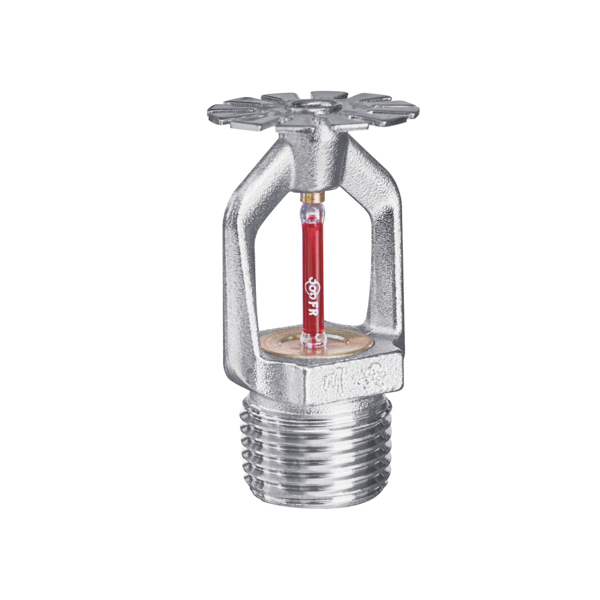
K-ZSTX Series
The most widely used QR sprinkler globally. Hangs below the branch pipe with deflector facing down. For offices, hotels, schools, healthcare, and any space with a ceiling void. K5.6 (K80) and K8.0 (K115), 57–141°C.
View Pendent →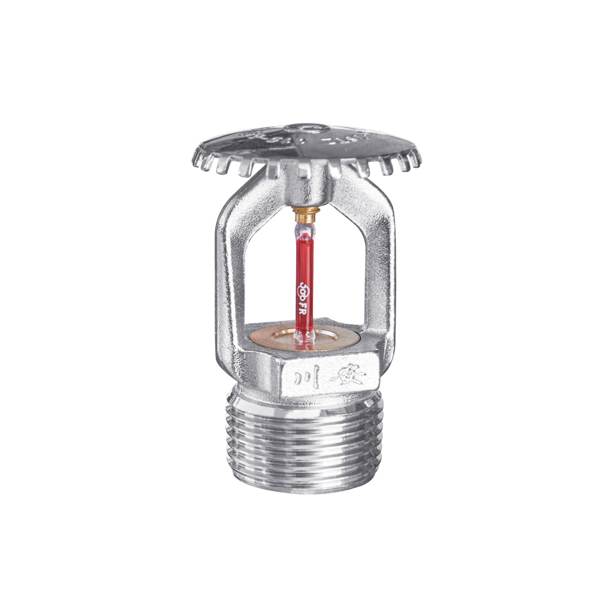
K-ZSTZ Series
Mounts above the branch pipe with deflector facing up — preferred for exposed-pipe systems and dry-pipe systems. Warehouses, cold-storage, logistics facilities. K5.6 (K80) and K8.0 (K115), 57–141°C.
View Upright →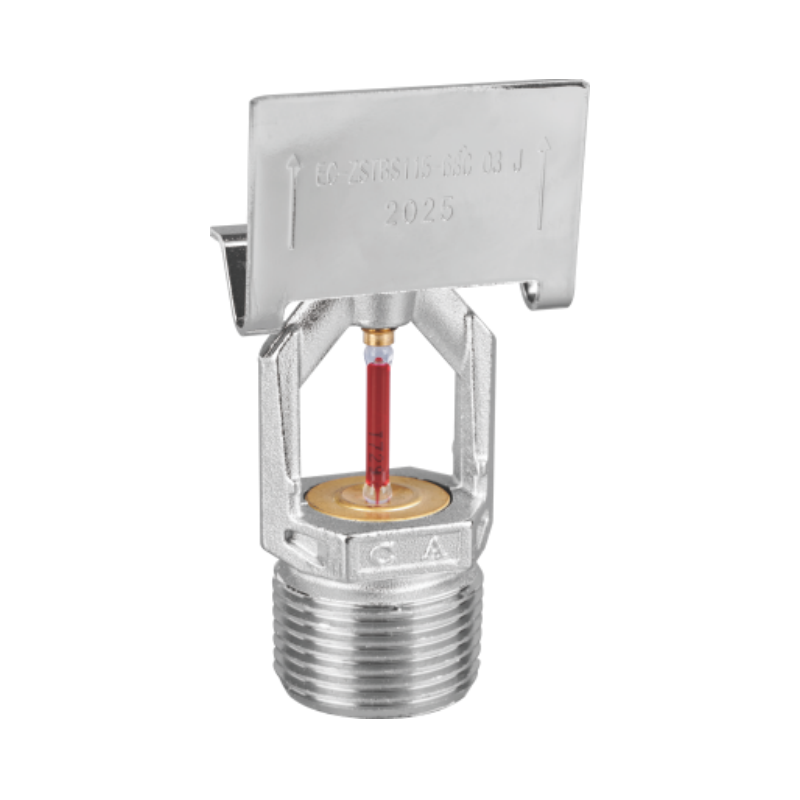
K-ZSTBS Series
Wall-mounted near the ceiling — no ceiling pipe run required. The QR sidewall is the standard choice for hotel guest rooms and corridors, hospital wards, and residential apartments. K5.6 / K8.0, 57–141°C.
View Sidewall →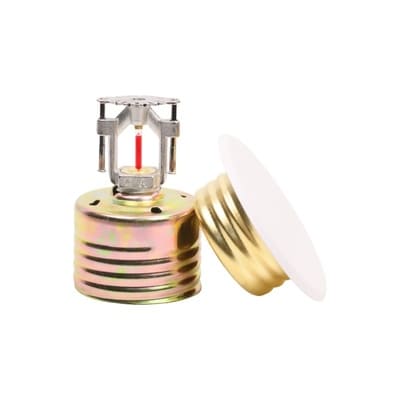
ZSTDY Q3 Series
Fully hidden above the ceiling with a decorative flat cover plate. QR concealed is mandatory for light-hazard interiors where aesthetics and life safety must both be satisfied — hotels, luxury residences, airports. K5.6 / K8.0, 57–141°C.
View Concealed →Complete Quick Response Model Range
All models below use a German-imported 3mm glass bulb, RTI ≤50 (m·s)½, minimum operating temperature 4°C. K5.6 = metric K80, K8.0 = metric K115.
| Model | Series / Type | K-factor | Activation | Max Ambient | Thread | Installation |
|---|---|---|---|---|---|---|
| K-ZSTX — Quick Response Pendent | ||||||
| K-ZSTX 80-57°C Q3 J | K-ZSTX | K5.6 | 57°C | 27°C | R½ | Pendent |
| K-ZSTX 80-68°C Q3 J ★ | K-ZSTX | K5.6 | 68°C | 38°C | R½ | Pendent |
| K-ZSTX 115-68°C Q3 J ★ | K-ZSTX | K8.0 | 68°C | 38°C | R¾ | Pendent |
| K-ZSTX 80-79°C Q3 J | K-ZSTX | K5.6 | 79°C | 49°C | R½ | Pendent |
| K-ZSTX 80-93°C Q3 J | K-ZSTX | K5.6 | 93°C | 63°C | R½ | Pendent |
| K-ZSTX 80-141°C Q3 J | K-ZSTX | K5.6 | 141°C | 111°C | R½ | Pendent |
| K-ZSTZ — Quick Response Upright | ||||||
| K-ZSTZ 80-57°C Q3 J | K-ZSTZ | K5.6 | 57°C | 27°C | R½ | Upright |
| K-ZSTZ 80-68°C Q3 J ★ | K-ZSTZ | K5.6 | 68°C | 38°C | R½ | Upright |
| K-ZSTZ 115-68°C Q3 J ★ | K-ZSTZ | K8.0 | 68°C | 38°C | R¾ | Upright |
| K-ZSTZ 80-79°C Q3 J | K-ZSTZ | K5.6 | 79°C | 49°C | R½ | Upright |
| K-ZSTZ 80-93°C Q3 J | K-ZSTZ | K5.6 | 93°C | 63°C | R½ | Upright |
| K-ZSTZ 80-141°C Q3 J | K-ZSTZ | K5.6 | 141°C | 111°C | R½ | Upright |
| K-ZSTBS — Quick Response Sidewall | ||||||
| K-ZSTBS 80-57°C Q3 J | K-ZSTBS | K5.6 | 57°C | 27°C | R½ | Horizontal Sidewall |
| K-ZSTBS 80-68°C Q3 J ★ | K-ZSTBS | K5.6 | 68°C | 38°C | R½ | Horizontal Sidewall |
| K-ZSTBS 115-68°C Q3 J ★ | K-ZSTBS | K8.0 | 68°C | 38°C | R¾ | Horizontal Sidewall |
| K-ZSTBS 80-79°C Q3 J | K-ZSTBS | K5.6 | 79°C | 49°C | R½ | Horizontal Sidewall |
| K-ZSTBS 80-93°C Q3 J | K-ZSTBS | K5.6 | 93°C | 63°C | R½ | Horizontal Sidewall |
| K-ZSTBS 80-141°C Q3 J | K-ZSTBS | K5.6 | 141°C | 111°C | R½ | Horizontal Sidewall |
| ZSTDY Q3 — Quick Response Concealed | ||||||
| ZSTDY 80-57°C Q3 | ZSTDY | K5.6 | 57°C | 27°C | R½ | Concealed Pendent |
| ZSTDY 80-68°C Q3 ★ | ZSTDY | K5.6 | 68°C | 38°C | R½ | Concealed Pendent |
| ZSTDY 115-68°C Q3 ★ | ZSTDY | K8.0 | 68°C | 38°C | R¾ | Concealed Pendent |
| ZSTDY 80-79°C Q3 | ZSTDY | K5.6 | 79°C | 49°C | R½ | Concealed Pendent |
| ZSTDY 80-93°C Q3 | ZSTDY | K5.6 | 93°C | 63°C | R½ | Concealed Pendent |
| ZSTDY 80-141°C Q3 | ZSTDY | K5.6 | 141°C | 111°C | R½ | Concealed Pendent |
★ Most commonly specified. All QR models: 3mm German-imported glass bulb, RTI ≤50 (m·s)½, min operating temp 4°C.
Where Quick Response Sprinklers Are Required
Both NFPA 13 and GB 50084 specify where quick response sprinklers are mandatory. The common thread is occupant life safety — spaces where people sleep, receive care, study, or congregate require the fastest possible suppression to allow safe egress.
Guest rooms, corridors, lobbies — QR mandatory under NFPA 13 Light Hazard
Patient wards, treatment rooms, corridors — occupants may be unable to self-evacuate
Living areas, bedrooms, corridors — life safety in sleeping environments is the primary objective
Open-plan offices, meeting rooms — QR specified for Light Hazard Group 1 & 2 occupancies
Classrooms, libraries, auditoriums — high occupant density requires rapid suppression
Terminals, lounges, concourses — large crowds with complex egress paths
Shops, malls, food courts — QR specified for Light Hazard merchandise areas
Residents may be unable to self-evacuate — QR provides the earliest possible suppression and the maximum safe egress time
Quick Response vs Standard Response — Key Differences
| Factor | Quick Response (K-ZSTX / K-ZSTZ / K-ZSTBS) | Standard Response (ZSTX / ZSTZ / ZSTBS) |
|---|---|---|
| RTI | ≤ 50 (m·s)½ | 80–350 (m·s)½ |
| Glass bulb size | 3mm — smaller, less thermal mass | 5mm — larger, more thermal mass |
| Activation speed | Typically 30–60 seconds faster in fire tests | Slower — designed for controlled, deliberate activation |
| Fire size at activation | Smaller fire — better control, less water damage | Larger fire before activation — often still adequate where property protection rather than life-safety egress is the primary design objective |
| Smoke production at activation | Less smoke — better visibility for evacuation | More smoke by activation time |
| NFPA 13 requirement | Mandatory for Light Hazard occupancies | Acceptable for Ordinary Hazard and Extra Hazard |
| Typical applications | Hotels, hospitals, offices, residences, schools, airports | Ordinary Hazard and Extra Hazard occupancies where property protection is the primary design objective |
| Unit cost | Slightly higher — 3mm imported bulb | Lower — 5mm domestic or imported bulb |
| K-factor / temperature range | Identical — same K5.6/K8.0, same 57–141°C range available in both SR and QR | |
Frequently Asked Questions
What does "quick response" mean for a fire sprinkler?
A quick response (QR) sprinkler has an RTI ≤50 (m·s)½, meaning it activates significantly faster than a standard response sprinkler at the same heat exposure. The key is the 3mm glass bulb — its smaller diameter gives it less thermal mass, so it heats up and bursts more rapidly in a fire plume.
Importantly, QR does not mean the sprinkler is more sensitive to accidental activation — the activation temperature (e.g. 68°C) is the same as a standard response model with the same colour bulb. QR simply activates faster once the rated temperature is reached.
Is quick response always better than standard response?
Not always — it depends on the application. For life-safety occupancies (hotels, hospitals, residences, offices), QR is superior because earlier activation limits fire growth during the critical evacuation window. NFPA 13 mandates QR for these occupancies.
For high-challenge fire scenarios in high-piled or racked storage, standard response is generally preferred. Faster activation in a large open bay can mean more sprinklers opening simultaneously — potentially overwhelming the water supply before the fire is controlled. SR's slower, more deliberate activation opens fewer heads and maintains adequate pressure at each one, making suppression more effective. For storage-specific solutions, see our ESFR Fire Sprinkler page.
How do I identify a quick response sprinkler on site?
In CA-FIRE's range, QR models are identified by:
1. Model code prefix "K-" — e.g. K-ZSTX, K-ZSTZ, K-ZSTBS
2. "Q3" or "J" suffix — Q3 for concealed (ZSTDY), J for pendent/upright/sidewall models
3. 3mm glass bulb — visibly thinner than the 5mm bulb on standard response heads
4. Submittal tag / installation record — always verify from project documentation
Never rely on visual identification alone when replacing sprinklers on an existing system — always match the exact model code from the original installation record.
Can I mix quick response and standard response sprinklers in the same system?
Generally no — NFPA 13 Section 6.2.4 and GB 50084 prohibit mixing QR and SR sprinklers in the same compartment or fire area in most cases. The reason is hydraulic: a QR head activates earlier, while nearby SR heads are still closed. If they are on the same branch line, the already-open QR head may divert flow away from the SR heads when they eventually activate, compromising overall system performance.
Exceptions exist — consult your system designer and refer to NFPA 13 for specific permitted scenarios. CA-FIRE can provide project-specific technical support for mixed-occupancy buildings.
What is the difference between K-ZSTX, K-ZSTZ, and K-ZSTBS?
All three are CA-FIRE quick response sprinklers with RTI ≤50 — the difference is installation orientation:
K-ZSTX — Pendent (下垂). Hangs downward from branch pipe below the ceiling. Most common QR type globally.
K-ZSTZ — Upright (直立). Mounts above the branch pipe, deflector facing up. For exposed-pipe and dry-pipe systems.
K-ZSTBS — Sidewall (边墙). Wall-mounted near ceiling level, no ceiling pipe needed. For corridors and hotel rooms.
Deflectors are not interchangeable between types — always install the correct orientation for your pipe routing.
What is the minimum operating pressure for CA-FIRE quick response sprinklers?
The minimum design pressure at the sprinkler is 0.10 MPa (1 bar / 14.5 psi) for all K5.6 (K80) and K8.0 (K115) QR models. At 0.10 MPa, a K5.6 head flows approximately 80 L/min and a K8.0 head flows approximately 115 L/min.
Maximum working pressure is 1.2 MPa for standard glass bulb models. Hydraulic calculations should be performed by a qualified fire protection engineer to verify pressure requirements at the most hydraulically demanding sprinkler in the system.
Browse by Installation Type
K-ZSTX · K-ZSTZ · K-ZSTBS · ZSTDY Q3 · K5.6 / K8.0 · 57–141°C · RTI ≤50 (m·s)½
GB 5135 CCCF Certified · NFPA 13 documentation available · Mixed models welcome · 24 hr quote