
In any space where the ambient temperature can fall below 0°C — a freezer warehouse, unheated loading dock, car park, roof void, or an external canopy — a standard wet-pipe sprinkler will freeze and become inoperable. Draining the branch pipe back to a heated space is one solution; a dry sprinkler head is another, and often the more practical one. A dry sprinkler head extends a sealed, air-filled tube from the heated wet-pipe main down into the cold space, keeping water behind a valve at the warm side of the wall or ceiling until the moment of activation.
CA-FIRE manufactures three dry sprinkler head configurations: the T-ZSTGX standard dry pendent for open exposed ceilings, the T-ZSTGDY dry concealed pendent for finished ceilings requiring a flush profile, and the ZSTGX extended-barrel version used with ESFR systems (including the ESFR-363-74°C P(DT) — a dry-type ESFR head). All share the same operating principle: a dry extension tube keeps the sprinkler deflector and sensing element in the cold zone while the water-filled section stays in the warm zone on the other side of the thermal envelope.
Extension tube length is custom-ordered from 80 mm to 1500 mm, allowing a single head model to serve wall assemblies from a thin partition to a 1.5 m deep insulated cold-store panel. K-factors range from K5.6 (K=80) to K25.2 (K=363), and sensing elements include both 3mm quick-response glass bulbs (RTI ≤50) and standard 5mm glass bulbs, as well as fusible alloy links for the K25.2 (K=363) series.
For spaces that can be served by standard wet-pipe systems, see: Pendent Fire Sprinkler Head → · Concealed Fire Sprinkler Head → · ESFR Fire Sprinkler →
How a Dry Sprinkler Head Works
- Wet-pipe branch pipe (warm zone): The main pipe runs inside the heated building envelope. Water is present at system pressure at all times — no risk of freezing here.
- Inlet valve / seat (at the thermal envelope): A factory-set valve at the top of the extension tube holds water back from the tube itself. The tube interior is air-filled at atmospheric pressure, matching the dry-pipe side of the thermal barrier.
- Extension tube (spanning the cold zone): The stainless steel or brass tube passes through the insulated wall, ceiling, or floor structure. Its length is custom-matched to the construction depth — 80 mm to 1500 mm. Air or inert gas fills this tube; no water is present in the cold zone at any time.
- Deflector and sensing element (cold zone): The glass bulb or fusible link hangs in the protected space at the correct temperature-sensing position. When a fire raises the ambient temperature above the activation threshold, the element releases, the inlet valve opens, water travels down the tube, and the sprinkler discharges normally.
- Isolated cold pockets only: When only a small portion of a building is unheated — a single loading dock, a canopy, or a freezer room within a larger heated facility — converting the entire system to dry-pipe adds complexity and cost that is disproportionate to the area served. A dry head handles the cold pocket while the rest of the system remains wet.
- Faster water delivery than dry-pipe: A full dry-pipe system requires the entire pipe network to depressurise before water can flow. A dry sprinkler head only needs to drain its own extension tube — typically a fraction of a second — so it delivers water to the fire much faster than a dry-pipe system would.
- Simpler maintenance: Dry heads are self-contained. No separate accelerators, exhausters, low-point drains, or full-system trip tests are required for the cold zone coverage.
- Length flexibility: Tube length is specified at order — 80 mm increments from 80 mm to 1500 mm — so the same catalogue model covers a 100 mm hollow ceiling void and a 600 mm insulated cold-store wall equally well.
When to Specify a Dry Sprinkler Head
Cold Zones Within a Heated Building
- Freezer rooms and cold stores embedded in a distribution centre
- Blast-freezing tunnels at −30°C to −40°C
- Unheated loading docks and covered bays attached to a heated warehouse
- Refrigerated display halls in food retail buildings
- Plant rooms with exposure to outdoor temperatures
Penetrating Insulated Constructions
- Cold-store panel walls 100–300 mm thick
- Insulated roof decks over unheated spaces
- Concrete slabs with deep below-slab spaces
- Raised access floors with large void depth
- Balconies and external covered walkways
Outdoor & Semi-Outdoor Spaces
- Multi-storey car park decks open to weather
- External sprinkler protection under roof canopies
- Covered outdoor storage yards
- Bridge-link corridors between buildings
- Smoke extract shafts with seasonal freezing risk
Custom Extension Tube Length: 80–1500 mm
The extension tube length is specified at the time of order and factory-set. It equals the total distance from the inlet connection (at the warm-side branch pipe tee) to the correct deflector position in the cold space. The length must account for: ceiling/wall construction thickness + required deflector-to-ceiling clearance on the cold side (typically 75–150 mm per NFPA 13). Common lengths ordered:
Dry Sprinkler Head Models
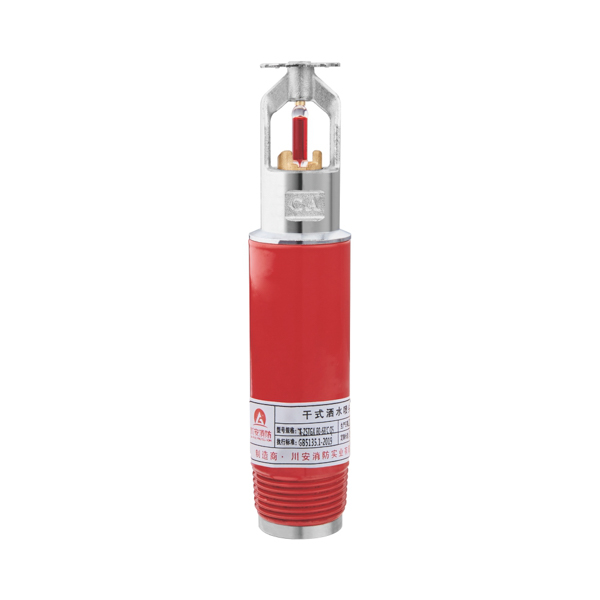
T-ZSTGX 80-68°C Q5
Dry Pendent · K5.6 · StandardThe most widely used dry sprinkler head. K5.6 standard dry pendent with 5mm glass bulb (SR, RTI 50–80). Red alloy barrel with brass deflector. Suits light and ordinary hazard cold zones. Length 80–1500 mm to order.
| K-factor | K5.6 (K=80) |
|---|---|
| Activation | 68°C · Red · 5mm |
| RTI | 50–80 (m·s)½ |
| Thread | R:1 (BSP) |
| Length | 80–1500 mm |
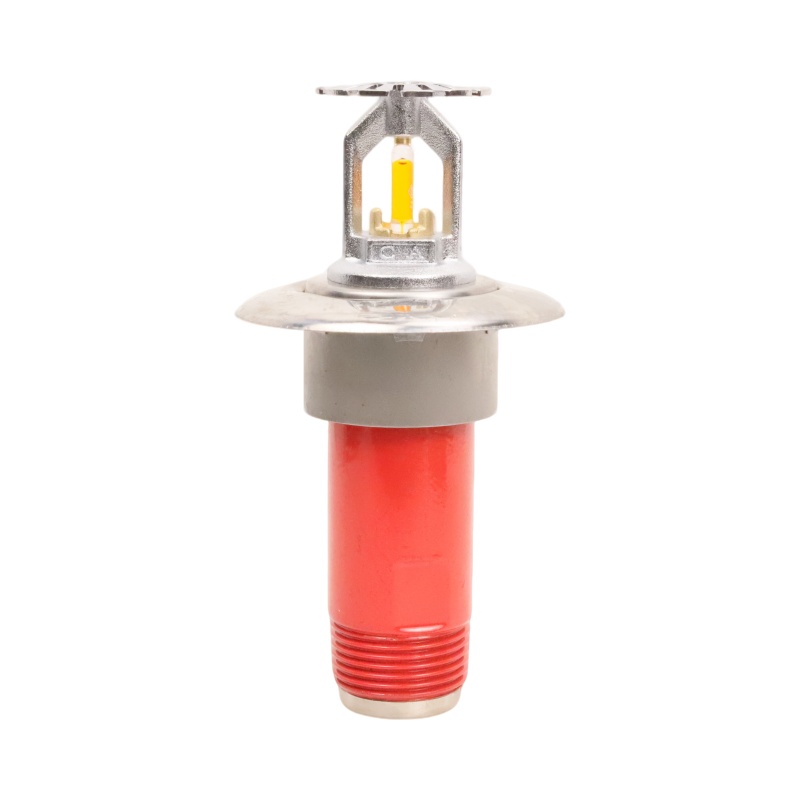
T-ZSTGX 80-57°C Q5
Dry Pendent · K5.6 · 57°C57°C orange bulb dry pendent for deep-freeze environments where ambient temperature is consistently well below zero. Activates earlier in fire development than 68°C models — appropriate for blast-freezer tunnels and ultra-low-temperature cold stores.
| K-factor | K5.6 (K=80) |
|---|---|
| Activation | 57°C · Orange · 5mm |
| Max ambient | 27°C (cold-side air) |
| Thread | R:1 (BSP) |
| Length | 80–1500 mm |
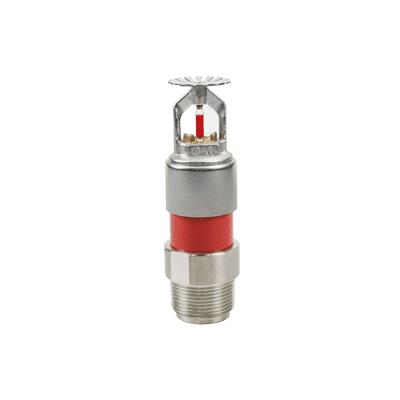
T-ZSTGX 115-68°C Q5
Dry Pendent · K8.0 · 68°CK8.0 dry pendent for ordinary and extra hazard cold zones requiring higher flow at wider spacing. Commonly used in freezer warehouses with rack storage where greater water volume per head is needed. 5mm glass bulb, SR.
| K-factor | K8.0 (K=115) |
|---|---|
| Activation | 68°C · Red · 5mm |
| RTI | 50–80 (m·s)½ |
| Thread | R:1 (BSP) |
| Length | 80–1500 mm |
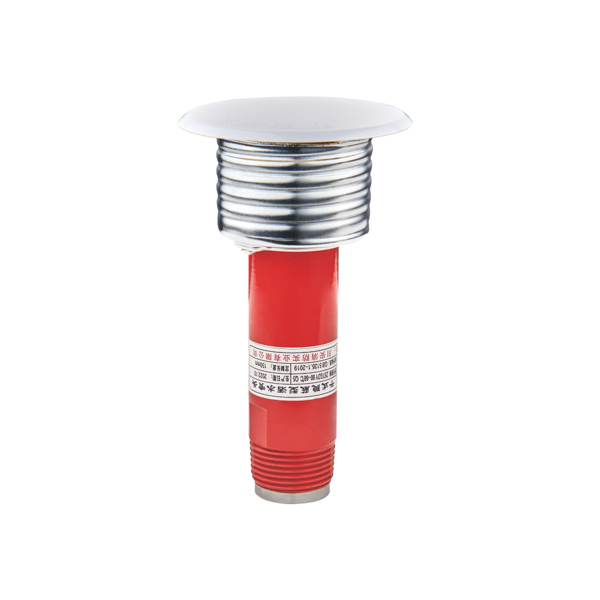
T-ZSTGDY 80-68°C Q5
Dry Concealed · K5.6 · FlushDry concealed pendent — the only dry head with a full flush-ceiling profile. Chrome escutcheon and white cover plate sit flat against the finished ceiling surface. Activates when cover plate solder melts, then glass bulb discharges. Ideal for refrigerated hospitality spaces, cold-prep kitchens, and supermarket chilled halls with finished ceiling.
| K-factor | K5.6 (K=80) |
|---|---|
| Activation | 68°C · Red · 5mm |
| Profile | Flush / concealed |
| Thread | R:1 (BSP) |
| Length | 80–1500 mm |
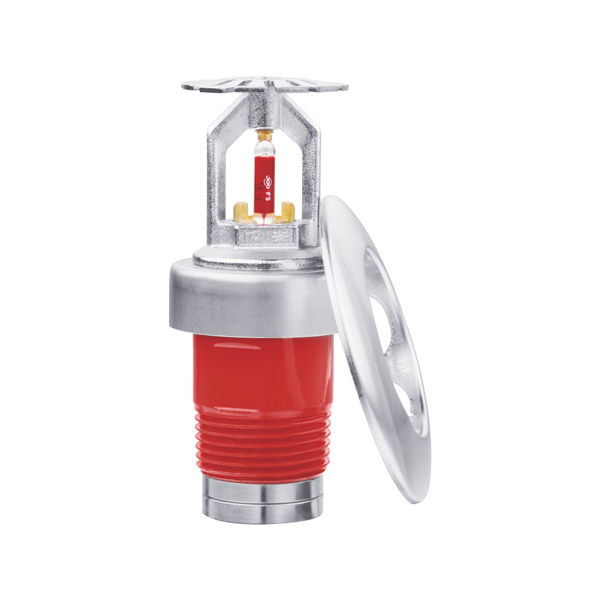
T-ZSTGX 80-68°C Q5 CC (Socket-End)
Dry Pendent · K5.6 · Socket承插式 (socket/spigot) connection variant. The CC suffix denotes a smooth-bore socket end that slides into a matching coupling rather than threading directly to the branch pipe. Used in grooved-pipe and push-fit sprinkler systems common in large cold-store facilities and retrofit projects.
| K-factor | K5.6 (K=80) |
|---|---|
| Activation | 68°C · Red · 5mm |
| Connection | Socket-end (CC) |
| Thread at head | R:1 (BSP) |
| Length | 80–1500 mm |
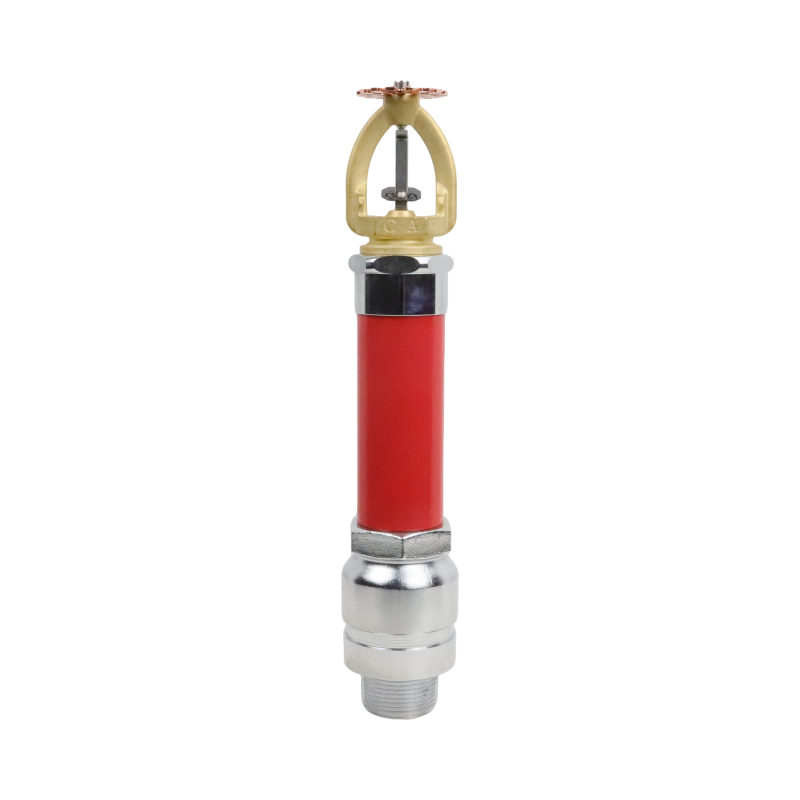
ESFR-363-74°C P(DT) — Dry ESFR
ESFR · K25.2 · Dry-TypeThe large-K25.2 ESFR head in a dry-tube configuration (DT = Dry Type). For high-bay freezer warehouses and cold-store distribution centres where ESFR ceiling-only suppression is required but a conventional wet-pipe main cannot be run into the refrigerated space. Uses fusible alloy sensing element in K=363 series.
| K-factor | K25.2 (K=363) |
|---|---|
| Activation | 74°C · Fusible alloy |
| Type | ESFR suppression mode |
| Thread | R:1 1/4 (BSP) |
| Length | 80–1500 mm |
Complete Dry Sprinkler Head Technical Parameters
| Model Series | K-factor | Activation Temp. | Max Ambient (cold-side) | Sensing Element | RTI | Connection | Install |
|---|---|---|---|---|---|---|---|
| T-ZSTGX · Standard Dry Pendent · K5.6 (K=80) & K8.0 (K=115) · Glass Bulb · Length 80–1500 mm | |||||||
| T-ZSTGX 80-57°C Q5 | K5.6 | 57°C · Orange | 27°C | 5mm glass bulb | 50–80 (m·s)½ | R:1 | Pendent |
| T-ZSTGX 80-68°C Q5 ★ | K5.6 | 68°C · Red | 38°C | 5mm glass bulb | 50–80 (m·s)½ | R:1 | Pendent |
| T-ZSTGX 80-79°C Q5 | K5.6 | 79°C · Yellow | 49°C | 5mm glass bulb | 50–80 (m·s)½ | R:1 | Pendent |
| T-ZSTGX 115-68°C Q5 ★ | K8.0 | 68°C · Red | 38°C | 5mm glass bulb | 50–80 (m·s)½ | R:1 | Pendent |
| T-ZSTGX 115-79°C Q5 | K8.0 | 79°C · Yellow | 49°C | 5mm glass bulb | 50–80 (m·s)½ | R:1 | Pendent |
| T-ZSTGX · Standard Dry Pendent · K5.6 / K8.0 · 3mm Quick Response Glass Bulb (RTI ≤50) · Length 80–1500 mm | |||||||
| T-ZSTGX 80-68°C Q3 | K5.6 | 68°C · Red | 38°C | 3mm glass bulb | ≤50 (m·s)½ | R:1 | Pendent |
| T-ZSTGX 115-68°C Q3 | K8.0 | 68°C · Red | 38°C | 3mm glass bulb | ≤50 (m·s)½ | R:1 | Pendent |
| T-ZSTGX · Dry Pendent · K11.3 (K=161) / K14.2 (K=202) / K17.0 (K=242) · Glass Bulb SR & QR · Length 80–1500 mm | |||||||
| T-ZSTGX 161/202/242-68°C Q5 | K11.3–K17.0 | 68°C · Red | 38°C | 5mm glass bulb | 50–80 (m·s)½ | R:1¼ | Pendent |
| T-ZSTGX 161/202/242-79°C Q5 | K11.3–K17.0 | 79°C · Yellow | 49°C | 5mm glass bulb | 50–80 (m·s)½ | R:1¼ | Pendent |
| T-ZSTGX 161/202/242-68°C Q3 | K11.3–K17.0 | 68°C · Red | 38°C | 3mm glass bulb | ≤50 (m·s)½ | R:1¼ | Pendent |
| T-ZSTGX · Dry Pendent · K25.2 (K=363) · Fusible Alloy Link · Grooved-End Available · Length 80–1500 mm | |||||||
| T-ZSTGX 363-68°C (fusible) | K25.2 | 68°C | 38°C | Fusible alloy link | 80–360 (m·s)½ | R:1¼ or Grooved | Pendent |
| T-ZSTGX 363-74°C (fusible) | K25.2 | 74°C | 44°C | Fusible alloy link | 80–360 (m·s)½ | R:1¼ or Grooved | Pendent |
| T-ZSTGX 363-93°C (fusible) | K25.2 | 93°C | 63°C | Fusible alloy link | 80–360 (m·s)½ | R:1¼ or Grooved | Pendent |
| T-ZSTGX 363-141°C (fusible) | K25.2 | 141°C | 111°C | Fusible alloy link | 80–360 (m·s)½ | R:1¼ or Grooved | Pendent |
| T-ZSTGDY · Dry Concealed Pendent · Flush Ceiling Profile · K5.6 (K=80) & K8.0 (K=115) · Length 80–1500 mm | |||||||
| T-ZSTGDY 80-68°C Q5 ★ | K5.6 | 68°C · Red | 38°C | 5mm glass bulb | 50–80 (m·s)½ | R:1 | Concealed pendent |
| T-ZSTGDY 115-68°C Q5 | K8.0 | 68°C · Red | 38°C | 5mm glass bulb | 50–80 (m·s)½ | R:1 | Concealed pendent |
| T-ZSTGX CC · Socket-End (承插式) · K5.6 / K8.0 · For Grooved / Push-Fit Systems · Length 80–1500 mm | |||||||
| T-ZSTGX 80-68°C Q5 CC ★ | K5.6 | 68°C · Red | 38°C | 5mm glass bulb | 50–80 (m·s)½ | Socket-end (CC) | Pendent |
| T-ZSTGX 115-68°C Q5 CC | K8.0 | 68°C · Red | 38°C | 5mm glass bulb | 50–80 (m·s)½ | Socket-end (CC) | Pendent |
| ZSTGX (ESFR-DT) · Dry-Type ESFR · K25.2 (K=363) · Fusible Alloy · High-Bay Cold Store | |||||||
| ESFR-363-74°C P(DT) ★ | K25.2 | 74°C | 44°C | Fusible alloy link | 80–360 (m·s)½ | R:1¼ | Pendent · ESFR |
★ Most commonly specified. Custom length 80–1500 mm specified at order in mm increments. All models GB 5135 CCCF certified. NFPA 13 submittals available. For intermediate temperature ratings or non-standard K-factors, contact sales@ca-fire.com.
Typical Applications
−30°C to −40°C operating temperature. 57°C activation head ensures thermal margin is maintained in the sub-zero environment. Custom tube lengths span typical 150–300 mm insulated ceiling panels.
−18°C to −25°C chilled stores. T-ZSTGX 68°C with 5mm glass bulb provides standard response protection. ESFR-DT available for high-bay frozen stores with ceiling height ≥ 9 m.
Dock bays attached to heated warehouses. Socket-end (CC) version suits grooved-pipe branch lines common in new-build logistics facilities. Short tube lengths (80–200 mm) for ceiling void.
Supermarket chilled halls and refrigerated food prep rooms with finished ceilings. T-ZSTGDY concealed dry head delivers flush ceiling profile with no visible hardware — full fire protection without compromising the retail or kitchen finish.
Deck levels exposed to outdoor temperatures in cold climates. Dry heads on short tube lengths (80–150 mm) hang from the heated concrete slab above, protecting the outdoor deck surface without risk of freeze damage to the branch pipe.
Large automated frozen DCs with ceiling heights 9–13.5 m. ESFR dry-type (DT) provides early suppression performance in a single ceiling-only system, eliminating in-rack sprinklers even in the cold zone.
Frequently Asked Questions
How is the correct tube length calculated for my cold-store ceiling?
The total tube length = construction depth (thickness of insulated panel, slab, or void) + deflector standoff below the finished cold-side ceiling surface. NFPA 13 requires the deflector to be positioned 75–150 mm below the ceiling surface (or below obstructions) in the cold zone to allow the spray pattern to fully develop.
For example: a 200 mm thick insulated cold-store ceiling panel with a 100 mm deflector standoff below the cold face requires a total tube length of 300 mm. Add any escutcheon recess depth at the warm-side end to get the final order length. If in doubt, round up to the next 50 mm increment — tube length does not affect hydraulic performance.
Can a dry sprinkler head be used pointing upward (upright orientation)?
No. Dry sprinkler heads in the CA-FIRE T-ZSTGX and T-ZSTGDY range are designed exclusively for pendent (downward) installation. The internal valve mechanism relies on gravity and water pressure acting downward — inverting the head to an upright position would prevent the valve from seating correctly and could allow water to enter the tube in a non-activation state.
For spaces requiring upright installation in a cold zone (such as sub-floor sprinkler protection beneath a raised access floor), a dedicated dry-pipe or pre-action system covering that zone is the appropriate solution, rather than an individual dry sprinkler head.
What is the difference between a dry sprinkler head and a dry-pipe system?
A dry-pipe system replaces the entire pipe network with pressurised air or nitrogen. When any sprinkler activates, the air pressure drops, a dry-pipe valve trips, and water fills the entire network before flowing from the activated head. This involves significant equipment (dry-pipe valve, air compressor, accelerator, low-point drains) and the water delivery delay can be 30–60 seconds or more, depending on pipe volume.
A dry sprinkler head is a single component. Only the individual head's extension tube contains air — the branch pipe and all main pipes remain wet and pressurised. When the head activates, water only has to travel down the tube of that one head (typically 80–1500 mm), so water delivery time is essentially the same as a standard wet-pipe head — far faster than a full dry-pipe system.
Dry heads are the preferred solution when the cold zone is small (a single room, a loading dock, or a canopy) within an otherwise wet-pipe protected building. Full dry-pipe systems are appropriate when the entire facility is sub-zero or when the code requires a complete dry-pipe system for the occupancy type.
Can the tube length be changed on site after delivery?
No — dry sprinkler heads must not be cut, extended, or modified on site. The tube length is factory-set and the internal valve and sealing components are assembled and tested at that specific length. Modifying the tube length in the field would void the product certification and invalidate the CCCF type approval.
If the required length changes between order and installation (due to revised construction details, for example), contact CA-FIRE to confirm whether a replacement at the correct length can be supplied before proceeding with installation.
Is the 5mm or 3mm glass bulb better for cold-store dry heads?
For most cold-store and freezer applications, the 5mm standard response glass bulb (RTI 50–80) is the standard and more common specification. The 3mm quick response bulb (RTI ≤50) is available in the K5.6 and K8.0 T-ZSTGX series for applications where NFPA 13 or the design authority requires quick response — for example, in residential cold zones or where the occupancy hazard classification mandates QR heads.
For the K25.2 (K=363) series and the ESFR dry-type (DT) models, a fusible alloy link is used rather than a glass bulb. The fusible alloy provides reliable activation across the wide temperature range seen in heavy industrial cold stores, and its RTI characteristics (80–360) are appropriate for the large-K, high-flow-rate applications these heads serve.
Related Products
T-ZSTGX · T-ZSTGDY · ESFR-DT · K5.6 to K25.2 · Custom length 80–1500 mm · Glass bulb & fusible alloy
GB 5135 CCCF Certified · NFPA 13 documentation available · Custom lengths ship in 5–7 days · 24 hr quote
sales@ca-fire.com · WhatsApp +86 18150362095
Send Inquiry →