
A deluge sprinkler — more precisely, an open sprinkler nozzle (雨淋喷头/开式喷头) — is structurally a sprinkler head without its thermal sensing element. There is no glass bulb, no fusible alloy, no mechanism that needs to melt or shatter before water flows. The valve seat is permanently open. Water flows the instant the system's deluge valve opens.
This design is intentional. In occupancies where fire spreads so rapidly that individual head actuation — even quick-response heads — would allow the fire to advance beyond control before the necessary heads have opened, the entire design area must be wetted simultaneously from the first moment of system activation. Deluge systems achieve this by replacing closed-head sprinklers with open nozzles throughout the protected zone, and controlling flow with a single zone-level deluge valve that opens on command from an external detection circuit. Every open nozzle in the zone discharges water at the same instant — no waiting for heat to activate individual heads.
CA-FIRE's B-DSXC series open sprinkler nozzles are pendent-mounted open heads available in five flow ratings: B-DSXC-142, B-DSXC-202, B-DSXC-242, B-DSXC-281, and B-DSXC-360. The number in the model code is the Chinese flow factor K (L/min·bar½); the internationally equivalent K-factors (gpm·psi½, ÷14.28) are K10.0 / K14.2 / K17.0 / K19.7 / K25.2 respectively — the same international K values used across the CA-FIRE sprinkler range. Rated working pressure is 0.25 MPa; the operating range is 0.1–0.7 MPa. Installation heights from 3 m up to 18 m are covered across the range, with coverage radii from 4.0 m (B-DSXC-360) to 6.0 m (B-DSXC-142/202) per head.
For other open-system nozzles, see: Water Mist Sprinkler (ZSTW — Transformers & Equipment) → · Foam Sprinkler Head (PT Series — Class B Fires) → · Water Curtain Nozzle (ZSTMA/ZSTMB — Fire Separation) →
How a Deluge System Works
A fire detection circuit — flame detectors (UV/IR), heat detectors, or linear heat detection cable — senses the fire and sends a signal to the deluge valve solenoid or releases the pneumatic trip. The deluge valve opens immediately, admitting pressurised water to the distribution piping. No sprinkler head needs to activate individually.
Because every B-DSXC nozzle in the zone has no thermal element blocking it, water flows from all heads the instant the pipe fills. The entire design area — which may be a stage, a loading bay, a paint spray booth, or a turbine hall — receives simultaneous water application within seconds of valve opening. Fire growth is arrested before any single head could have responded thermally.
After the fire is extinguished and the system is inspected, the deluge valve is manually closed and the zone is drained. Because open nozzles have no component that activates or is consumed in operation, they can be reused after a discharge — unlike glass bulb or fusible link heads which must be replaced. The zone is reset by closing the deluge valve and restoring detection circuit readiness.
Open Nozzle vs Closed Sprinkler — Key Differences
⚡ Open Nozzle / Deluge (B-DSXC) — This Page
- Thermal element: None — permanently open orifice. Water flows immediately when deluge valve opens.
- Activation: Entire zone activates simultaneously via external detection system (flame, heat, or manual). No head-by-head response.
- System type: Deluge system or pre-action (double-interlock) system. Pipe is normally dry; fills instantly on valve opening.
- Fire scenario: Rapidly spreading, ultra-hazardous fires where simultaneous zone flooding is required — flammable liquids, aircraft hangars, stage sets, process vessels.
- Water use: All heads in zone discharge simultaneously — high flow rate, high water volume. Requires larger pump and water supply than equivalent closed-head system.
- After discharge: Nozzles can be reused. Only replace if physically damaged. Drain and reset the deluge valve.
- Best for: Flammable liquid storage, aircraft hangars, paint spray booths, ammunition depots, stage and film sets, high-hazard process areas.
🔒 Closed Sprinkler Head (ZSTX/ZSTZ etc.)
- Thermal element: Glass bulb or fusible link holds valve closed. Only opens when that head's immediate environment reaches activation temperature.
- Activation: Individual heads activate independently as the fire's heat plume reaches them. Typically only 1–4 heads open in a controlled fire scenario.
- System type: Wet-pipe, dry-pipe, or pre-action system. Automatic operation.
- Fire scenario: Ordinary and extra hazard occupancies where fire spread is controllable by suppressing the initial ignition zone — offices, retail, warehouses, industrial buildings.
- Water use: Only heads over the fire discharge — targeted water application, minimal collateral water damage to unaffected areas.
- After discharge: Activated heads must be replaced before system reset. Relatively fast replacement if spare heads are stocked.
- Best for: The vast majority of building occupancies — offices, hotels, factories, warehouses, schools, hospitals.
Three Key Advantages of Open Nozzle Design
In a flammable liquid fire, a pool fire can reach flashover within 30–60 seconds of ignition. No individual closed-head sprinkler can respond fast enough across a large area to prevent flashover. The deluge system's simultaneous zone activation — triggered by a UV flame detector responding in milliseconds — delivers water across the entire hazard area before flashover occurs. This is why deluge is mandatory for aircraft hangars (NFPA 409), paint spray booths (NFPA 33), and similar ultra-fast fire scenarios.
Open nozzles have no consumable element. After a deluge discharge, inspecting and drying the nozzles is all that is needed before system reset — no individual head replacement required. In high-frequency test environments (aircraft engine test cells, training facilities, process industry facilities with regular maintenance shutdowns), the reusability of open nozzles significantly reduces long-term maintenance cost compared to repeatedly replacing glass bulb heads.
Closed-head sprinkler systems can experience inadvertent single-head discharge from mechanical damage, corrosion, overheating from a non-fire source, or manufacturing defect. In a deluge system with open nozzles, there is no individual head mechanism that can fail and cause an unplanned discharge. System activation requires the deluge valve to open — a controlled event that cannot be triggered by a single nozzle failure. This makes deluge systems preferred in environments where an uncontrolled water discharge would itself cause significant damage (aircraft hangars, data halls with deluge backup, heritage collections).
B-DSXC Series Models
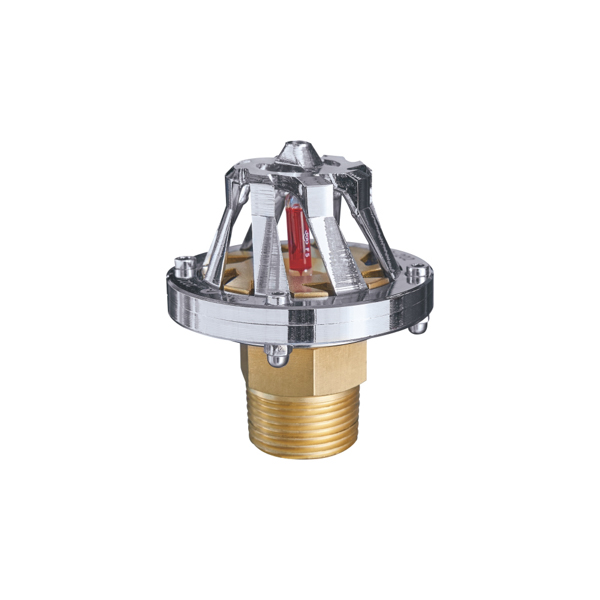
B-DSXC-142
K10.0 (K=142) · R:¾ · Largest CoverageHighest coverage radius in the range: 6 m per head, 6 m spacing. Installation height 3–15 m. For large-area deluge zones where maximising the protected area per nozzle reduces total head count and pipe complexity. Ordinary hazard-equivalent design density.
| K-factor | K10.0 (K=142) |
|---|---|
| Coverage radius | 6.0 m |
| Head spacing | 6.0 m |
| Install height | 3–15 m |
| Rated pressure | 0.25 MPa |
| Thread | R:¾ |
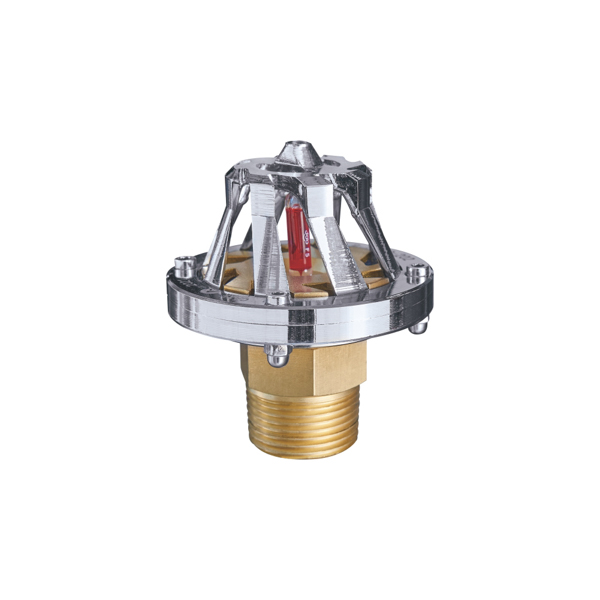
B-DSXC-202 ★
K14.2 (K=202) · R:¾ · Most SpecifiedThe most widely specified model in the B-DSXC range. 6 m coverage radius, 6 m spacing, installation height 3–18 m. Balances flow rate against head count for the widest range of deluge zone designs under GB 50084. The standard specification for aircraft hangars, loading bays, and general industrial deluge zones.
| K-factor | K14.2 (K=202) |
|---|---|
| Coverage radius | 6.0 m |
| Head spacing | 6.0 m |
| Install height | 3–18 m |
| Rated pressure | 0.25 MPa |
| Thread | R:¾ |
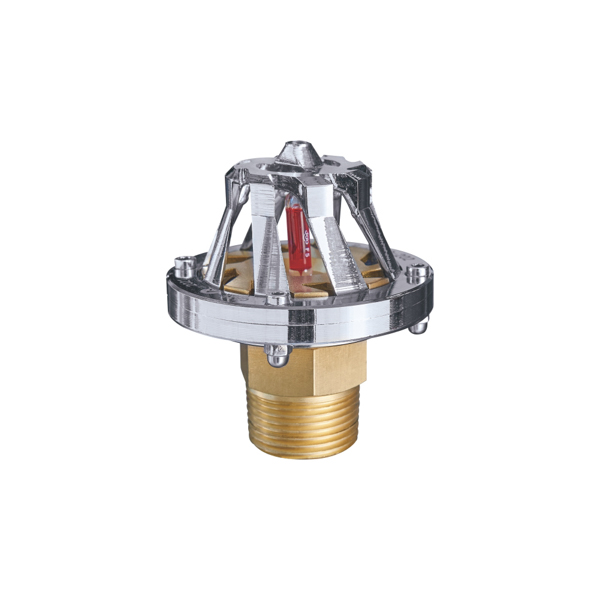
B-DSXC-242
K17.0 (K=242) · R:¾ · High DensityHigher flow K17.0 (K=242) for tighter head spacing (2.7 m) and higher water application density. Used in extra-hazard deluge zones — paint spray booths, solvent storage areas, process vessels with high fire load. Installation height 3–18 m. Distance from wall 0.1–0.25 m; distance from ceiling 0.1–1.2 m.
| K-factor | K17.0 (K=242) |
|---|---|
| Coverage radius | 5.4 m |
| Head spacing | 2.7 m |
| Install height | 3–18 m |
| Rated pressure | 0.25 MPa |
| Thread | R:¾ |
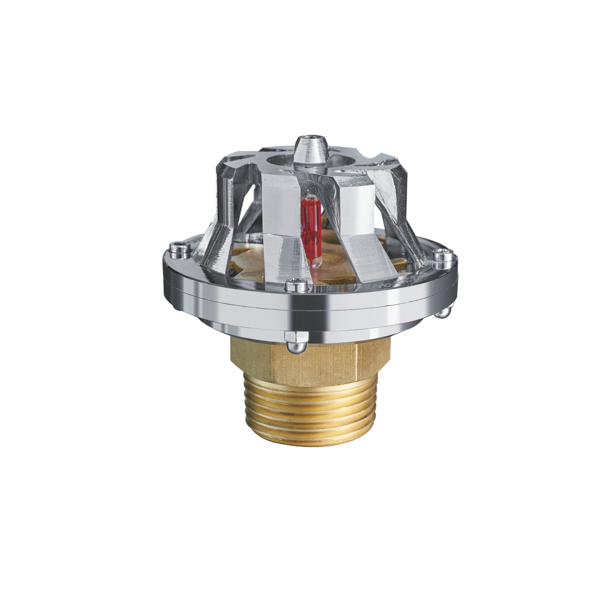
B-DSXC-281
K19.7 (K=281) · R:¾ · Extra HazardK19.7 (K=281) extra-hazard open nozzle, 4.8 m coverage radius, 2.4 m spacing. For highest-density deluge designs in extra-hazard process areas. Installation height 3–18 m. Distance from wall 0.1–0.25 m; distance from ceiling 0.1–1.2 m. R:¾ thread.
| K-factor | K19.7 (K=281) |
|---|---|
| Coverage radius | 4.8 m |
| Head spacing | 2.4 m |
| Install height | 3–18 m |
| Rated pressure | 0.25 MPa |
| Thread | R:¾ |
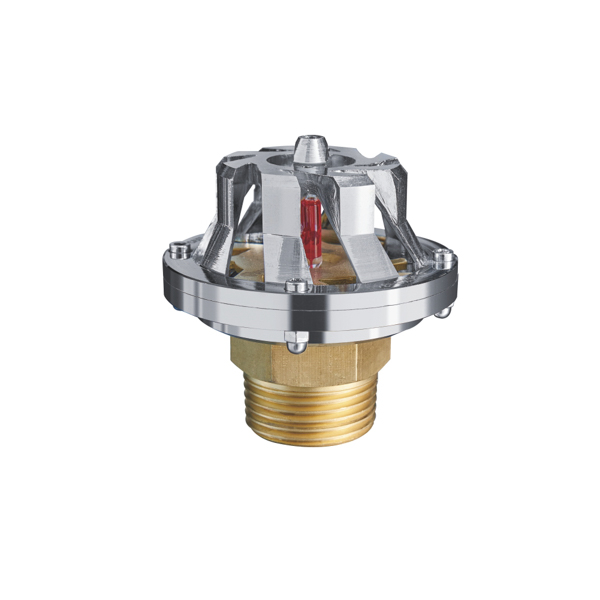
B-DSXC-360
K25.2 (K=360) · R:1 · Maximum FlowLargest flow open nozzle in the B-DSXC range. K25.2 (K=360), 4.0 m coverage radius, 2.0 m spacing. R:1 thread — the larger bore handles the highest instantaneous flow rates required by the tightest-density high-hazard deluge designs. Installation height 3–18 m.
| K-factor | K25.2 (K=360) |
|---|---|
| Coverage radius | 4.0 m |
| Head spacing | 2.0 m |
| Install height | 3–18 m |
| Rated pressure | 0.25 MPa |
| Thread | R:1 |
Complete Technical Parameters — B-DSXC Series
| Model | K-factor (Intl / CN) | Install Method | Rated Pressure (MPa) | Pressure Range (MPa) | Install Height (m) | Coverage Radius (m) | Head Spacing (m) | Dist. to Wall (m) | Dist. to Ceiling (m) | Thread |
|---|---|---|---|---|---|---|---|---|---|---|
| B-DSXC-142 | K10.0 (K=142) | Pendent | 0.25 | 0.1–0.7 | 3–15 | 6 | 6 | 3 | — | R:¾ |
| B-DSXC-202 ★ | K14.2 (K=202) | Pendent | 0.25 | 0.1–0.7 | 3–18 | 6 | 6 | 3 | — | R:¾ |
| B-DSXC-242 | K17.0 (K=242) | Pendent | 0.25 | 0.1–0.7 | 3–18 | 5.4 | 2.7 | 0.1–0.25 | 0.1–1.2 | R:¾ |
| B-DSXC-281 | K19.7 (K=281) | Pendent | 0.25 | 0.1–0.7 | 3–18 | 4.8 | 2.4 | 0.1–0.25 | 0.1–1.2 | R:¾ |
| B-DSXC-360 | K25.2 (K=360) | Pendent | 0.25 | 0.1–0.7 | 3–18 | 4.0 | 2.0 | 0.1–0.25 | 0.1–1.2 | R:1 |
★ Most commonly specified. All models: open type, no thermal element, pendent installation only. Sensing element: none. Flow Q (L/min) = K × √P (bar). GB 5135 CCCF certified. For B-DSXC-142 and B-DSXC-202, the distance-to-ceiling requirement is not fixed — refer to design standard and hydraulic calculation. All models suitable for deluge and double-interlock pre-action systems.
Typical Applications
Aviation fuel fires can spread at 1–2 m/s across a hangar floor. NFPA 409 and GB 50284 mandate deluge systems for hangars housing aircraft with fuel capacity above defined thresholds. Open nozzles ensure simultaneous floor-level wetting before flashover regardless of where ignition originates on the hangar floor.
Spray paint booths contain explosive atomised solvent vapour that can flash instantaneously across the entire booth volume. GB 50016 and NFPA 33 require deluge systems for booths using flammable solvents. Tighter head spacing (2.4–2.7 m) delivers the higher application density required for solvent fires.
Tank truck and rail car loading/unloading gantries for petrol, diesel, solvents, and other flammable liquids. A spill-and-ignition event can engulf the entire gantry within seconds. Deluge activation by UV/IR flame detection provides simultaneous coverage of the entire gantry structure.
Chemical reactors, distillation columns, and process vessels handling flammable or reactive materials. Deluge protects the equipment structure itself against fire exposure and prevents escalation to adjacent vessels. High-K nozzles (K19.7/K25.2) achieve the extra-hazard application rates required by GB 50084 process hazard design rules.
Stage areas contain large quantities of highly combustible scenery, drapes, and props. GB 50016 and theatre fire codes require deluge (雨淋) systems above stage areas — not standard wet-pipe systems — because the simultaneous zone wetting prevents fire from involving the entire fly tower before any significant suppression has occurred.
Rolling stock maintenance facilities handling diesel fuel, lubricants, and cleaning solvents. Deluge systems protect maintenance pits and fuelling bays where the fire scenario is a rapid flammable liquid pool fire rather than a slower-developing solid-fuel fire controllable by individual sprinkler actuation.
Deluge systems for ammunition and propellant storage facilities per GB 50154 (military) and GB 50089 (civil explosive) standards. Simultaneous area flooding is mandatory where any fire must be suppressed before it can propagate to initiate a detonation event.
Category A and B flammable liquid warehouses (Class I & II flammable liquids per GB 50016) require deluge systems where the combination of high fire load and rapid fire spread rate means conventional sprinkler control is not achievable. Higher-K nozzles provide the mandated elevated design density for these occupancies.
Frequently Asked Questions
Why does a deluge system use open nozzles instead of quick-response closed heads?
The fastest Quick Response sprinkler head (RTI ≤50, 3mm glass bulb) still requires the air temperature at the head's location to rise above 57°C (for the lowest-rated head) before it can open. In a flammable liquid fire, where the burning surface may be at 700°C and the hot gas layer can spread across a large area at near-explosive speed, waiting for air temperature at individual ceiling-level heads to reach 57°C is not a viable strategy. The fire will have grown beyond the control capacity of those heads before they open.
Open nozzles in a deluge system bypass this limitation entirely. The activation decision is made by a flame detector or heat detector at the zone level, not by individual thermal elements at ceiling level. The detector responds in milliseconds — far faster than any head-level thermal response — and the deluge valve opens, simultaneously delivering water across the entire hazard zone before the fire has advanced beyond its initial ignition footprint.
The trade-off is that deluge systems require more complex and reliable detection circuitry, use more water per activation (all heads in the zone discharge simultaneously), and need larger water supply infrastructure. These are accepted engineering costs for the hazard scenarios where deluge is required.
How do I select the right B-DSXC model for my deluge zone?
Model selection is driven by three design parameters: (1) the required water application density (L/min/m²) for the hazard classification, (2) the ceiling height, and (3) the acceptable head spacing for the structural grid of the building.
As a starting framework: B-DSXC-142 and B-DSXC-202 suit ordinary-to-moderate hazard deluge zones (aircraft hangars at standard density, stage areas, general loading bays) with 6 m head spacing and ceiling heights to 18 m. B-DSXC-242 and B-DSXC-281 suit extra-hazard zones (paint spray booths, solvent storage, flammable liquid process areas) where tighter spacing (2.4–2.7 m) achieves the higher required application density. B-DSXC-360 provides the highest flow per head for the tightest-density extra-hazard designs or for situations where the structural grid forces a larger head spacing that must be compensated by higher per-head flow.
The final hydraulic design — pump sizing, pipe sizing, zone head count, and pressure calculations — must be performed by a qualified fire system designer using GB 50084 (or the applicable standard for the specific occupancy type) and the CA-FIRE technical data sheet for the selected model.
Do open nozzles need to be replaced after a deluge system discharge?
No — this is one of the key operational advantages of open nozzle deluge systems over closed-head sprinkler systems. Because the B-DSXC nozzle has no glass bulb, no fusible alloy, and no mechanism that activates or is consumed during discharge, the nozzle is physically unchanged after water flows through it. After a discharge, the nozzles should be inspected for physical damage, corrosion, or contamination, and cleaned if necessary — but they do not require routine replacement solely because the system activated.
Compare this to a closed-head wet-pipe system, where every head that activates must be replaced before the system can be returned to service. In a large-area deluge zone with many nozzles, the ability to reset by closing the deluge valve (and replacing only damaged or contaminated nozzles) rather than replacing every activated head represents a significant time and cost saving in restoring fire protection after an incident.
Can B-DSXC open nozzles be used in a pre-action system?
Yes — B-DSXC nozzles are compatible with both deluge systems (single-interlock: valve opens on detection signal) and double-interlock pre-action systems (valve requires two independent events — typically a detection signal AND a supervisory pressure loss — before opening). Double-interlock pre-action systems with open nozzles are sometimes specified for high-value facilities where an accidental single water discharge would itself cause significant damage, but the hazard still requires simultaneous zone coverage rather than individual head actuation.
Note that double-interlock pre-action systems are complex and require careful engineering of the detection and supervisory circuits to ensure reliable activation in a real fire scenario while preventing false discharges. They are not a standard substitute for a deluge system in high-hazard occupancies where fast response time is critical — the additional interlock can add seconds to the response time. Confirm the appropriate system type with the authority having jurisdiction and the system designer.
Related Products
B-DSXC-142 · B-DSXC-202 · B-DSXC-242 · B-DSXC-281 · B-DSXC-360
Open pendent type · 0.1–0.7 MPa · 3–18 m ceiling · R:¾ / R:1 · GB 5135 CCCF Certified
Aircraft hangars · Paint spray booths · Process plants · Stage systems · 24 hr quote