
Warehouse Fire Protection Guide
ESFR Sprinkler vs In-Rack Sprinkler:
Which Protects Your Warehouse?
High-piled storage fires move faster and burn hotter than almost any other occupancy. Choosing between ceiling-only ESFR and in-rack protection is one of the most consequential — and most commonly misunderstood — decisions in warehouse fire protection design.
🕒 10 min read
🏭 NFPA 13 / FM Global Compliant
Warehouse fires are among the most dangerous and costliest events in the fire protection industry. High-piled commodities create chimney-like flue spaces between pallets that accelerate flame spread vertically at extraordinary speed. A modern distribution center storing Class III or IV commodities — or worse, Group A plastics — can reach flashover conditions in minutes if the fire suppression system is not precisely matched to the storage configuration.
Two fundamentally different approaches dominate warehouse fire protection: ESFR (Early Suppression Fast Response) ceiling-only sprinklers, and in-rack sprinkler systems installed within the storage racks themselves. Each has specific ceiling height limits, commodity restrictions, hydraulic demands, and operational trade-offs. This guide breaks down every variable so you can make the right call on your next warehouse project.
In This Article
- Why Warehouse Fires Are Different
- What Is an ESFR Sprinkler?
- What Is an In-Rack Sprinkler System?
- Head-to-Head Specification Comparison
- ESFR Sprinkler — Deep Dive
- In-Rack Sprinkler System — Deep Dive
- NFPA 13 & FM Global Requirements
- Decision Framework: Which System for Your Warehouse?
- Common Design Mistakes
- Frequently Asked Questions
1. Why Warehouse Fires Are Different
Standard sprinkler design for offices or retail is based on a relatively slow-developing fire with a modest heat release rate. Warehouse storage fires operate on entirely different physics. Three factors make them uniquely dangerous:
🔥
Flue Space Chimney Effect
Vertical gaps between pallets and racks act as chimneys, feeding oxygen to the base of the fire and channeling flames upward at speeds that can exceed 1 m/s. A fire that starts at floor level can reach ceiling height in under 90 seconds in a high-piled rack.
💧
Water Penetration Challenge
In high racks, ceiling sprinkler water must travel 6–13 meters before reaching the base of the fire — and it must penetrate a hot thermal column rising at high velocity. Standard ceiling sprinklers simply cannot deliver enough water to the seat of the fire before it overwhelms the system.
📦
Commodity Fuel Load
NFPA 13 classifies commodities from Class I (non-combustible) to Class IV and Group A Plastics. A pallet of Group A plastics has a heat release rate per unit area that is 3–5× higher than a comparable pallet of Class I goods — and modern logistics centers store all of them under the same roof.
It is these three factors — chimney effect, water penetration physics, and fuel load — that drive the design choice between ESFR and in-rack protection. Neither is universally superior; each is the correct answer for a specific combination of ceiling height, commodity class, and operational constraint.
2. What Is an ESFR Sprinkler?
ESFR stands for Early Suppression Fast Response. The ESFR sprinkler is a ceiling-only, upright-orientation head engineered specifically to suppress — not just control — warehouse fires from above, without any in-rack sprinklers. It achieves this through a combination of three design attributes that set it apart from every other sprinkler type:
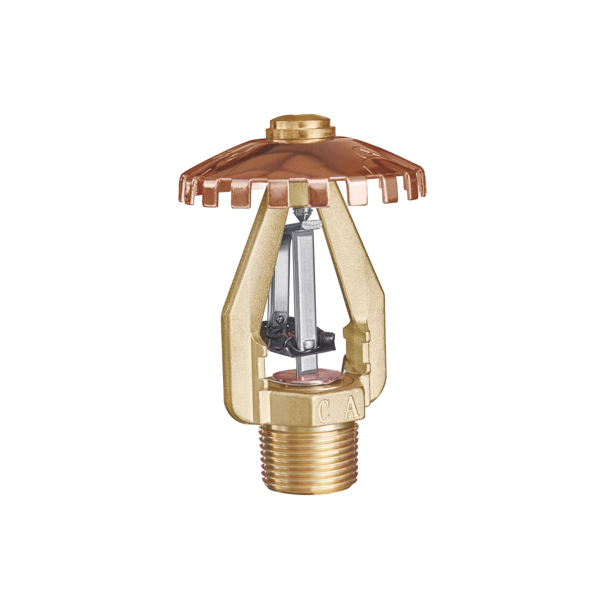
Very Large K-Factor
ESFR heads use K-factors of K=161, K=202, K=242, and K=363 (metric) — compared to K=80 or K=115 for standard commercial heads. The large orifice delivers massive water flow at relatively low pressure, producing large droplets with high momentum that can punch through the hot air column rising from the fire.
Fast Response — Small Glass Bulb
Despite delivering industrial-grade flow rates, ESFR heads use a quick-response glass bulb (RTI ≤ 28 (m·s)½ for most listings — even faster than standard QR heads at ≤ 50). This ultra-fast response ensures activation before a ceiling-level fire reaches the intensity that would overwhelm the suppression capability.
Suppression — Not Just Control
Standard warehouse sprinklers are designed for fire control — limiting fire spread until firefighters arrive. ESFR is designed for fire suppression — actually extinguishing or substantially reducing the fire with the sprinkler system alone. This distinction is fundamental: it is why ESFR systems are approved to eliminate in-rack sprinkler requirements.
3. What Is an In-Rack Sprinkler System?
An in-rack sprinkler system places sprinkler heads inside the storage rack structure itself — typically on horizontal members (load beams) at one or more levels within the rack. These heads are positioned close to the commodities, meaning they are in the fire’s thermal plume very early and can apply water directly to the burning material before the fire has grown enough to overwhelm a ceiling-only system.
In-rack systems are always used in combination with ceiling-level sprinklers — never as a standalone ceiling replacement. The warehouse sprinkler heads at ceiling level handle fire exposure from above and provide a thermal barrier, while the in-rack heads attack the base of the fire directly.
📌 Why In-Rack Is Used
When storage heights exceed the ESFR listing limits (typically beyond 10.5–12 m storage height, depending on commodity class), or when Group A plastics are stored in configurations that no ESFR head is listed to protect, in-rack sprinklers become mandatory under NFPA 13. They are also required in certain double-row rack configurations with solid shelves that block vertical water penetration from ceiling heads.
In-rack heads are typically standard pendent or upright heads — often K=80 or K=115 — because they do not need to penetrate a long water column from the ceiling. Their proximity to the fire compensates for lower flow rates. What they sacrifice in operational flexibility (rack relocation requires pipe relocation), they gain in suppression precision.
4. Head-to-Head Specification Comparison
| Parameter | ESFR Ceiling Sprinkler | In-Rack Sprinkler System |
|---|---|---|
| Sprinkler location | Ceiling only | Inside rack structure + ceiling heads required |
| K-factor (metric) | K=161 / 202 / 242 / 363 | K=80 / 115 (standard heads in rack) |
| Installation orientation | Upright only | Pendent or upright (per rack configuration) |
| Max ceiling height (system limit) | Up to 13.7 m (varies by K-factor & commodity) | No ceiling height limit — in-rack heads work at any height |
| Max storage height (typical) | Up to 10.5–12 m (K=242/363, Class I–IV) | Unlimited — heads placed at each storage tier |
| Minimum working pressure | 0.07–0.35 MPa (varies by K-factor) | 0.1 MPa (standard heads) |
| Installation spacing | 2.4–3.7 m between heads | Per NFPA 13 Chapter 17 — typically every rack bay |
| Thread connection | R:3/4 (K=161/202/242) / R:1 (K=363) | R:½ or R:3/4 (standard heads) |
| Compatible with Group A plastics? | ⚠ Limited — K=363 only, strict height limits | ✓ Yes — required for most Group A plastic storage |
| Rack relocation flexibility | ✓ High — ceiling pipe stays fixed; racks move freely | ✗ Low — pipe must be replumbed when racks relocate |
| Initial installation cost | Higher head unit cost; lower overall install cost | Lower head cost; higher install cost (pipe in rack) |
| Ongoing operational cost | Lower — no rack-level pipe maintenance | Higher — in-rack pipe subject to forklift damage & corrosion |
| Water demand | Very high — large K-factor heads at pressure | Moderate ceiling + moderate in-rack (split demand) |
5. ESFR Sprinkler — Deep Dive
The appeal of ESFR is straightforward: one pipe network at the ceiling, no pipe inside racks, and the freedom to reconfigure storage layouts without involving the fire protection contractor. For a modern distribution center that changes storage configurations quarterly, this operational flexibility is a major financial advantage over the lifetime of the building.
K-Factor Selection: The Critical Design Decision
ESFR heads come in four metric K-factor variants, each covering a different combination of ceiling height and commodity class:
| K-Factor (metric) | Max Ceiling Height | Max Storage Height | Min Working Pressure | Thread |
|---|---|---|---|---|
| K = 161 | 7.5 m | 6.0 m | 0.20 MPa | R:3/4 |
| K = 202 | 9.0 m | 7.5 m | 0.15 MPa | R:3/4 |
| K = 242 | 9.0 m | 7.5 m | 0.10 MPa | R:3/4 |
| K = 363 | 12.0 m | 10.5 m | 0.07–0.10 MPa | R:1 |
⚠ ESFR Activation Temperature: 74°C, Not 68°C
Most ESFR heads — including the K=242 model shown — are rated at 74°C activation temperature, not the 68°C standard used in most commercial pendent heads. The slightly higher activation temperature is intentional: it prevents premature activation from the high-temperature radiant heat environment near the ceiling of a high rack during normal forklift operations, while still responding quickly when a real fire establishes itself.
The Water Supply Challenge
ESFR’s greatest limitation is its water demand. A K=363 ESFR head at 0.10 MPa discharges approximately 363 L/min — more than 4× the flow rate of a standard K=80 pendent head at the same pressure. NFPA 13 requires calculating the 12 most hydraulically demanding heads in the design area simultaneously. The resulting total flow demand routinely exceeds 4,000 L/min, requiring substantial pump capacity and water storage. Buildings with limited municipal water supply must evaluate this carefully before committing to ESFR.
Obstructions: ESFR’s Achilles Heel
ESFR heads are extremely sensitive to obstructions. Any beam, duct, column, or structural element within the deflector’s spray pattern can block water from reaching the fire. NFPA 13 Chapter 25 specifies minimum clearance requirements between ESFR deflectors and obstructions that are more restrictive than for standard warehouse heads. Buildings with heavy structural steel, dense mechanical services, or roof joist configurations at close spacing may require obstruction analysis before ESFR can be approved.
6. In-Rack Sprinkler System — Deep Dive
When ESFR’s ceiling height or commodity limitations are exceeded, in-rack sprinklers move from optional to mandatory. They are also chosen proactively in situations where the water supply cannot support ESFR demand, or where FM Global property insurance requirements mandate them for certain commodity classes.
Rack Levels: Where to Place In-Rack Heads
NFPA 13 Chapter 17 specifies the required levels for in-rack head placement based on rack height and commodity class. The general rule is that in-rack heads are required at every other tier level for standard single-row and double-row racks, or at every tier for multiple-row and portable rack configurations. In practice, most designs place heads at the top tier and at intermediate levels spaced no more than 3 m apart vertically.
A critical geometric consideration: in-rack heads must be positioned to avoid being buried under commodities when the rack is fully loaded. NFPA 13 requires clear space between the top of stored goods and the deflector of the in-rack sprinkler head — typically 150 mm minimum. Violations of this clearance requirement are among the most commonly cited deficiencies during insurance and AHJ inspections.
⚠ The Forklift Damage Problem
In-rack sprinkler piping is exposed to forklift traffic during normal warehouse operations. Accidental strikes by forklifts are the most common cause of in-rack sprinkler failures and false discharges in warehouses. This is not a theoretical risk — it is a near-universal operational reality. Designs that use in-rack systems must include pipe guard rails on every horizontal run, regular inspection protocols per NFPA 25, and a clear operational protocol for any rack moves or renovations.
Water Demand Advantage
Although in-rack systems add installation complexity, they typically require less total water per tier level than ESFR, because the heads are positioned close to the fire and do not need to deliver high-momentum droplets from 12 meters above. For buildings with constrained water supply, the split demand model (ceiling heads + in-rack heads at moderate pressure) can actually result in a more manageable total water requirement than pure ESFR — especially for very tall racks or Group A plastic storage.
7. NFPA 13 & FM Global Requirements
Both NFPA 13 and FM Global govern warehouse sprinkler design. For most facilities, the AHJ will accept NFPA 13 compliance. However, many large distribution centers — particularly those insured by FM Global — must also satisfy FM Data Sheet 8-9 (Storage of Class 1, 2, 3, 4 and Plastic Commodities), which has its own, often more conservative, requirements.
NFPA 13 — Chapter 25 (ESFR)
Governs ESFR system design: specific K-factor selection tables by commodity class and ceiling height, deflector-to-ceiling clearance (100–355 mm), maximum head spacing (3.0 m × 3.0 m for most listings), and obstruction rules. ESFR heads must be used with approved deflector types per the listing.
NFPA 13 — Chapter 17 (In-Rack)
Specifies in-rack sprinkler tier placement rules, horizontal obstruction shields (required for in-rack pendent heads when commodities above could block spray), and interface requirements with the ceiling sprinkler system. Also governs design area for both systems operating simultaneously.
FM Global DS 8-9
FM Data Sheet 8-9 may require in-rack protection at lower ceiling heights than NFPA 13 permits for ESFR-only systems, particularly for Group A plastics. FM also specifies that ESFR systems must be FM Approved — not simply UL Listed — which affects head selection. Always verify FM status when insurance requires FM compliance.
8. Decision Framework: Which System for Your Warehouse?
Work through these questions in order to identify the right approach for your project:
| Scenario / Condition | Recommendation | Key Reason |
|---|---|---|
| Storage height ≤ 7.5 m, Class I–IV commodities | ESFR (K=161–242) | Within ESFR listing limits; simpler system; maximum flexibility for rack relocation |
| Storage height 7.5–10.5 m, Class I–IV commodities | ESFR (K=363) | K=363 covers up to 10.5 m storage height; verify water supply can meet high demand |
| Storage height > 10.5 m, any commodity | In-Rack Required | Beyond ESFR listing limits — NFPA 13 mandates in-rack at this height |
| Group A plastics stored in cartons, any height | In-Rack + Consult FPE | ESFR K=363 covers limited Group A plastic configurations; most require in-rack |
| Frequent rack reconfigurations expected | ESFR preferred | In-rack pipe must be replumbed every time racks move — major ongoing cost |
| Constrained water supply (e.g., low municipal pressure) | In-Rack preferred | Split demand system can be lower total flow than ESFR for tall racks |
| Dense structural obstructions at ceiling | In-Rack preferred | ESFR spray patterns obstructed by steel — in-rack positions heads away from obstructions |
| FM Global insurance requirements apply | FM DS 8-9 Review | FM requirements may be more conservative than NFPA 13 — verify FM-Approved head status |
9. Common Design Mistakes
Selecting ESFR K-factor based on ceiling height alone — ignoring commodity class
ESFR listings specify both ceiling height AND commodity class simultaneously. A K=242 ESFR head may cover 7.5 m ceiling height for Class I–III commodities, but the same ceiling height storing Class IV or Group A plastics may require K=363 or in-rack heads. Always cross-reference the full NFPA 13 Table 25.x for your specific commodity class.
Failing to account for commodity class changes after the system is installed
A warehouse may be designed for Class II commodities but later accept a plastics manufacturer’s storage contract. If the stored commodity class increases beyond the ESFR system’s listing, the building is operating with an inadequate fire suppression system — a major liability exposure. Any change in storage commodity class must trigger a re-evaluation of the sprinkler system.
Installing in-rack heads without protective guards on pipe runs
Unguarded in-rack pipe is struck and damaged by forklifts at a much higher rate than designers anticipate. Every horizontal in-rack pipe run must be protected by substantial pipe guards, and all guard installations must be maintained as part of the NFPA 25 inspection program.
Blocking ESFR deflectors with new ceiling-level obstructions after installation
Post-installation additions — new HVAC units, conduit runs, cable trays — are a common cause of ESFR obstruction violations. Any new obstruction within the ESFR deflector’s 760 mm exclusion zone requires engineering review. Warehouse facility managers must treat the ceiling area around ESFR heads as a controlled zone.
Exceeding the maximum storage height without notifying the fire protection contractor
Many warehouse operators gradually increase storage height as business grows — without realizing their sprinkler system was designed for a lower limit. If storage height exceeds the ESFR system’s listed ceiling/storage height combination, the system is non-compliant and the FM Global or AHJ approval is invalidated.
10. Frequently Asked Questions
Ready to Specify Your Warehouse Sprinkler System?
Browse our full range of UL-listed ESFR and warehouse sprinkler heads. Technical data sheets, K-factor tables, FM Approval documentation, and OEM supply for contractors and distributors worldwide.
Related Products & Resources
Authoritative Sources & Standards
- NFPA 13: Standard for the Installation of Sprinkler Systems — Chapters 17 & 25 — National Fire Protection Association
- NFPA 25: Inspection, Testing and Maintenance of Water-Based Fire Protection Systems — National Fire Protection Association
- FM Global Data Sheet 8-9: Storage of Class 1–4 and Plastic Commodities — FM Global
- UL Fire Safety Certification Resources — Underwriters Laboratories
- NFPA Research Foundation — Warehouse Fire Suppression Studies — National Fire Protection Association