CA-FIRE Protection · Fujian, China

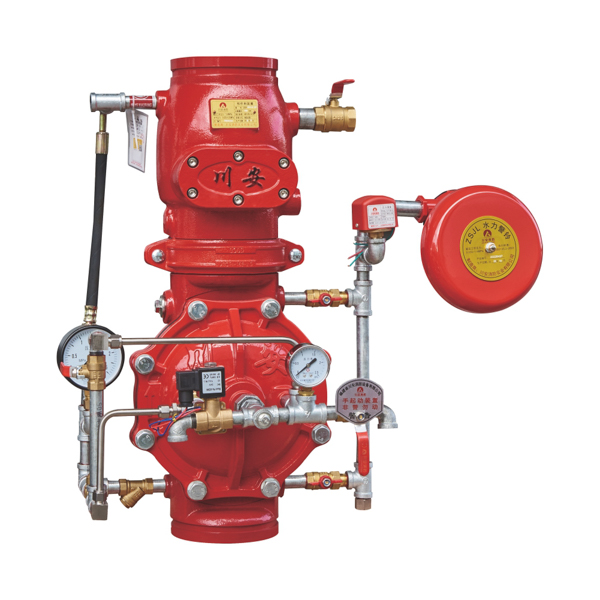
Pre-Action Alarm Valve — ZSFY Single & Double Interlock

DN80–DN250 · Electric / Pilot / Manual Release · Data Centres · Museums · Cold Stores · NFPA 13
Home Alarm Check Valve Pre-Action Alarm Valve
Pre Action Alarm Valve ZSFY series single double interlock DN80-DN250 CA-FIRE

Pre-Action Alarm Valve — ZSFY Series
DN80–DN250 · Single & Double Interlock

The pre-action alarm valve ZSFY is a dual-function system valve that combines automatic fire detection with automatic sprinkler suppression — providing an additional layer of protection against accidental water discharge that makes it the mandatory choice for water-sensitive environments. Unlike a standard wet-pipe system where water sits permanently in the distribution pipework, a pre-action system keeps the sprinkler distribution piping dry (filled with supervisory air or nitrogen). Water is only admitted to the piping when a fire detection signal releases the pre-action valve.

The ZSFY series is available in six sizes from DN80 to DN250, in three connection variants — standard flanged cast iron, stainless steel (ZSFY-Ex), and grooved (ZSFY-G) — and supports all three standard pre-action release methods: electric solenoid, wet or dry pilot line, and emergency manual release. The interlock mode can be single (one detector signal opens the valve) or double (both detection AND sprinkler activation required).

For environments without water-sensitivity concerns, see the ZSFZ wet alarm valve. For freeze-risk without detection requirements, see the ZSFC dry alarm valve. ← See all alarm check valve types

Quick Specifications
ModelZSFY 80~250-1.6A
VariantsFlanged · Grooved (-G) · SS (-Ex)
SizesDN80 · 100 · 125 · 150 · 200 · 250
Working Pressure1.6 MPa (16 bar)
Seal Test3.2 MPa
Strength Test6.4 MPa
Interlock ModeSingle interlock · Double interlock
Release MethodsElectric · Wet/Dry pilot · Manual
Supervisory MediumLow-pressure air / nitrogen
Body MaterialDuctile iron (std) / SS304/SS316L (Ex)
Temperature4°C – 70°C (below 0°C with dry pilot)
Control PanelStandard · Explosion-proof (optional)
StandardGB 12241 · GB 50084 · NFPA 13 · ISO 9001
Standard Mode
Single Interlock
The valve opens when either the fire detection system sends a signal or a sprinkler head opens thermally — one event is sufficient. Low-pressure supervisory air monitors pipe integrity. Provides significantly better false-discharge protection than a wet-pipe or dry-pipe system while remaining simpler to commission and maintain than double interlock.
Trigger: Detection signal OR sprinkler activation (one event)
✓ Specify for: Cold stores · unheated car parks · external structures · general water-sensitive areas
Electric Release
A solenoid valve on the ZSFY trim is connected to the building's fire alarm panel (FAP). When the FAP confirms a fire signal — typically from heat detectors, smoke detectors, or beam detectors — it energises the solenoid, opening the release path and allowing the valve clapper to open. Water fills the distribution pipework within seconds.
Sequence: Detector activates → FAP confirms → FAP energises solenoid → valve opens → water fills pipework → sprinklers discharge on heat activation
Wet or Dry Pilot Release
A small-bore pilot line runs from the ZSFY trim to a network of closed pilot sprinklers in the protected space. The pilot line is maintained with low-pressure air (dry pilot) or pressurised water (wet pilot). When heat opens a pilot sprinkler, the pressure drop releases the ZSFY clapper.

Dry pilot: Pilot line filled with compressed air — suitable for sub-zero cold stores and unheated spaces. Pilot sprinkler opens on heat, air bleeds off, valve releases.
Best for: Installations without a fire alarm system or where a fully independent non-electrical release is required
Emergency Manual Release
A manual release handle or push-button station at the ZSFY valve trim allows fire brigade or building response teams to manually open the pre-action valve in an emergency — bypassing the automatic detection system if it has failed or if a visible fire requires immediate system activation. The ZSFY manual release is lockable to prevent inadvertent operation.
Required by: GB 50116 and NFPA 13 both mandate a manual release capability on all pre-action systems. Use as backup/override only — all systems should have at least one automatic release method as primary.
ZSFY Series — 3 Body Variants, One System Design
Control panels, solenoid trim, supervisory air accessories, and release logic are identical across all three body variants — only the body material and connection type change.
🔩 ZSFY Flanged — Standard
Ductile cast iron body with flanged connections. Standard specification for typical heated indoor environments — data centres, museums, archives, generator rooms.
DN80 · DN100 · DN125 · DN150 · DN200 · DN250
⚡ ZSFY-Ex — Stainless Steel
SS304 / SS316L body with Ex-rated accessories. For coastal, offshore, chemical plant, or hazardous area classified installations requiring both corrosion resistance and Ex certification.
DN100 · DN150 · DN200 · Ex db IIC T6 Gb
⚙️ ZSFY-G — Grooved
Victaulic-compatible IPS groove connections. For fast-track commercial projects with grooved pipework throughout — same alarm valve functionality, faster installation.
DN100 · DN150 · DN200 · IPS / ISO groove
🖥️
Supervisory Air Integrity Monitoring — Continuous Pipe Leak Detection
The dry distribution pipework is maintained at low supervisory air pressure (0.03–0.05 MPa). A supervisory pressure switch on the ZSFY trim monitors this pressure continuously. Any pipe failure, joint leak, or sprinkler head damage that causes air loss immediately generates a supervisory alarm at the control panel — alerting maintenance staff before it escalates. This is a critical operational advantage over wet-pipe systems where pipe leaks only become evident when water visibly escapes.
🔒
Two-Event Confirmation — Maximum False Discharge Protection
In double interlock mode, the valve requires simultaneous confirmation from both the fire detection system AND physical sprinkler activation before water enters the pipework. A single detector false alarm — common in dusty or steamy environments — will not trigger water release. A mechanically damaged sprinkler head alone will not trigger water release. Only a genuine fire event activating both systems simultaneously results in discharge. For Tier III/IV data centres and museum vaults, this dual-confirmation is the defining justification for pre-action.
❄️
Freeze-Proof Distribution Piping — Dry Air Below 0°C
Because the ZSFY keeps the sprinkler distribution piping dry (filled only with supervisory air or nitrogen), the pipework itself does not freeze regardless of ambient temperature in the protected space. This makes pre-action systems with dry pilot ideal for cold stores, refrigerated warehouses, and unheated external structures — environments where both wet-pipe (water would freeze) and standard dry-pipe (no supervisory detection) may be inadequate for the required protection level.
🔧
Complete Station Supply — Valve, Panel, Air Supply, Pilot Line
CA-FIRE supplies the ZSFY as a complete pre-action station assembly: valve body, solenoid valve (24 VDC), supervisory air pressure switch, water supply pressure switch, inlet and outlet pressure gauges, main drain valve, alarm test valve, and water motor alarm gong tubing. Optional: pre-action control panel (standard or explosion-proof), air compressor / nitrogen supply unit, pilot sprinkler network components, and manual release station — available as a single quoted package.

Dimensional Data — ZSFY Flanged Series (6 Sizes)

DNOverall Height (mm)Flange PCD (mm)Bolt HolesWorking PressureSeal TestStrength Test
DN805601608-Φ181.6 MPa3.2 MPa6.4 MPa
DN1006001808-Φ181.6 MPa3.2 MPa6.4 MPa
DN1256902108-Φ181.6 MPa3.2 MPa6.4 MPa
DN1507402408-Φ181.6 MPa3.2 MPa6.4 MPa
DN20093029512-Φ221.6 MPa3.2 MPa6.4 MPa
DN250113535512-Φ261.6 MPa3.2 MPa6.4 MPa

ZSFY-Ex (SS) and ZSFY-G (Grooved) available in DN100, DN150, DN200. Heights: Ex — 600 / 740 / 930 mm; Grooved — 610 / 730 / 865 mm. Contact [email protected] for full dimensional drawings in DWG/PDF.

Pre-Action vs Wet-Pipe vs Dry-Pipe — System Selection Guide

Pre-action is always the more complex and expensive option — it is warranted when water sensitivity, freeze risk, or detection system integration requirements exceed what wet-pipe and dry-pipe systems can provide.

Factor Wet-Pipe ZSFZ Dry-Pipe ZSFC Pre-Action ZSFY (this product)
Pipe contents (standby)Water — always pressurisedPressurised air / nitrogenDry — low-pressure supervisory air
Discharge triggerSprinkler heat activation onlySprinkler activation (after air exhausts)Detection + sprinkler (double) or detection OR sprinkler (single)
Water sensitivity protectionLowModerate Maximum — two independent events (double interlock)
Freeze suitability No — below 4°C Yes — dry pipe Yes — dry supervisory air
Detection integrationOptionalOptional (accelerator only) Required — integral to release logic
Response speed Fastest — immediateSlower — air must exhaust (≤60 s)Fast — detection pre-fills pipe before sprinkler opens
System complexity SimplestModerateHighest — detection + panel + supervisory air
Ideal applicationsHotels · offices · hospitals · warehousesUnheated car parks · cold storesData centres · museums · archives · cold stores · generator rooms

Application Scenarios

🖥️ Data Centres & Server Rooms — Double Interlock
Tier II–IV data centres require the highest level of accidental discharge protection — a single false alarm triggering sprinkler discharge can cause total data centre loss, far exceeding the value of fire damage. Double interlock pre-action systems are the standard protection for raised-floor data hall and server room environments. The ZSFY double interlock mode requires simultaneous confirmation from both the VESDA/smoke detection system and a heat-activated sprinkler before any water enters the distribution piping.
🏛️ Museums, Archives & Heritage Libraries
Collections of irreplaceable artefacts, artworks, manuscripts, and archival material cannot tolerate accidental water exposure from a single sprinkler failure or false detector alarm. Pre-action systems are specifically recommended by NFPA 13 and GB 50084 for museums and archive spaces. The dry distribution piping eliminates the risk of slow pipe corrosion leading to water seepage — a significant issue in heritage buildings where pipe inspection may be difficult.
🧊 Cold Stores & Refrigerated Warehouses
Refrigerated warehouses and cold stores operate at temperatures from −30°C to +4°C — well below the freezing point of standing water in a wet-pipe system. Pre-action with dry pilot provides automatic sprinkler protection throughout the freezing temperature range. The ZSFY valve itself is installed in a heated valve room; only the distribution piping enters the cold zone, and this piping stays dry and freeze-proof.
⚡ Generator Rooms & UPS Battery Rooms
Generator rooms and UPS battery rooms in hospitals, data centres, and critical facilities are particularly sensitive to accidental water discharge — water on energised electrical equipment creates electrocution and short-circuit risks in addition to equipment loss. Pre-action systems ensure that water is only released when a confirmed fire signal is present. The ZSFY control panel integrates with the facility's BMS for full alarm status monitoring.
📚 Rare Book Libraries & Document Archives
Government archives, legal record centres, and rare book collections require fire protection that will not destroy the very records it is protecting through false activation. China's GB 50116 and NFPA 13 both specifically identify archives and libraries as applications warranting pre-action protection. The ZSFY's supervisory air monitoring also provides continuous pipe integrity monitoring — detecting any slow leak before water can reach collection storage areas.
📡 Telecom Exchange Rooms & Control Centres
Telecommunications exchange rooms, broadcast control centres, and SCADA control rooms contain mission-critical equipment where downtime cost — not replacement cost — is the primary risk metric. A false sprinkler discharge that forces a 24-hour system shutdown in a telecom exchange may cost far more in service interruption costs than the equipment replacement value. Double interlock pre-action systems are increasingly specified as the default protection type for these high-consequence technical spaces.

Standards & Certifications

StandardScope & Relevance to ZSFY Pre-Action Valve
GB 12241 安全阀 一般要求 — includes performance requirements for pre-action and deluge alarm valves. ZSFY type approval issued under this standard by China's National Fire Protection Product Quality Supervision and Inspection Center (CCCF). Type approval certificate available for project submittals.
GB 50084 自动喷水灭火系统设计规范 — Chinese national design code for automatic sprinkler systems. Chapter 6 covers pre-action system design requirements including supervisory pressure, detection system integration, and double interlock logic. ZSFY complies with all GB 50084 pre-action valve requirements for both single and double interlock configurations.
NFPA 13 ↗ Standard for the Installation of Sprinkler Systems — Section 8.3 covers pre-action system requirements. Specifies supervisory air pressure monitoring, water delivery time requirements, and single vs double interlock design criteria. ZSFY hydraulic performance and dimensional data in English available for NFPA 13 project submittals.
NFPA 25 ↗ Standard for ITM — covers annual pre-action trip test, supervisory air pressure check (weekly), solenoid valve testing (quarterly), and 5-year internal inspection requirements. CA-FIRE provides ITM-compatible documentation including clapper disassembly instructions for the ZSFY 5-year internal inspection.
ISO 9001:2015 ↗ CA-FIRE QMS — covers ZSFY solenoid valve testing (actuation voltage, seat tightness), hydraulic pressure test, supervisory pressure switch calibration, control panel factory acceptance test, and complete system function test before shipment.

Frequently Asked Questions

What is the difference between a pre-action system and a dry-pipe system? +
Both pre-action and dry-pipe systems keep the sprinkler distribution piping dry in standby — the key difference is in the release mechanism and the level of false-discharge protection they provide.

A dry-pipe system (ZSFC) releases water when a sprinkler head opens due to heat, allowing pressurised air to exhaust and trip the dry-pipe valve. There is no fire detection system involved — the sprinkler itself is the only detector and trigger. A mechanical failure causing a sprinkler to open will result in water discharge regardless of whether a fire exists.

A pre-action system (ZSFY) adds a fire detection system as a required precondition before water enters the piping. In double interlock mode, both a detector signal and a sprinkler opening are required simultaneously — making mechanical false discharge essentially impossible. Pre-action is chosen when consequences of accidental water discharge are high; dry-pipe is chosen when freeze protection is needed but false-discharge risk is lower.
Does the ZSFY pre-action valve require a dedicated fire alarm panel? +
Yes — when the electric release method is used, the ZSFY solenoid valve must be connected to a dedicated fire alarm panel or control module that confirms the fire signal before energising the solenoid. CA-FIRE supplies a matched pre-action system control panel (standard version or explosion-proof version) as part of the complete ZSFY station assembly. The panel provides: fire alarm signal input from detectors, supervisory air pressure monitoring (low-air alarm), solenoid valve output, and manual release interface.

For dry or wet pilot release mode only (no electric release), a separate fire alarm panel is not required for valve operation — the valve is released by the hydraulic differential pressure change when a pilot sprinkler opens. However, a supervisory panel is still recommended for monitoring supervisory air pressure. Contact [email protected] to discuss the correct control panel specification for your project.
Can the ZSFY be used in a cold store operating at below −20°C? +
Yes, with the correct installation configuration. The ZSFY valve body itself must be installed in a heated valve room or heated enclosure above 4°C — the valve body contains water in standby and cannot be exposed to freezing temperatures. Only the distribution piping entering the cold store needs to be freeze-proof, and this is achieved because the distribution piping is maintained dry (supervisory air or nitrogen).

For cold stores at −20°C or below, specify the dry pilot release method (not wet pilot). The pilot line running into the cold zone must also be maintained with compressed air or nitrogen. Pilot sprinkler heads rated for the target temperature class must be specified. Contact [email protected] for the ZSFY cold-store application note.
What supervisory air pressure should the distribution system be maintained at? +
For single interlock pre-action systems, GB 50084 and NFPA 13 specify a supervisory air pressure of approximately 0.03–0.05 MPa (0.3–0.5 bar, approximately 5–7 psi) — low enough that a small compressor or nitrogen cylinder can maintain it, but high enough for the supervisory pressure switch to detect pipe integrity loss reliably.

For double interlock pre-action systems, a higher supervisory pressure is typically used — often 0.1–0.14 MPa (approximately 1–1.4 bar) — because the pressurised air acts as a differential pressure latch that keeps the ZSFY clapper closed until a sprinkler opens and depressurises the system. The control panel continuously monitors supervisory pressure and generates an alarm if pressure drops below setpoint. CA-FIRE provides the ZSFY air pressure maintenance unit (small compressor + pressure switch assembly) as an optional accessory.
What trim and accessories are included with the ZSFY pre-action valve? +
CA-FIRE supplies the ZSFY as a complete pre-action station assembly, including: ZSFY valve body, solenoid valve (24 VDC standard), supervisory air pressure switch, water supply pressure switch, inlet and outlet pressure gauges, main drain valve, alarm test valve, system supervisory air inlet connection, hydraulic alarm bell connection, and water motor alarm gong tubing.

Optional accessories include: pre-action control panel (standard or explosion-proof), air compressor / nitrogen supply unit for supervisory air, pilot sprinkler network components (for wet/dry pilot release), retard chamber, and manual release station. Full station supply — valve, trim, panel, air supply, and pilot line components — is available as a single quoted package. Contact [email protected] with your DN size, interlock mode, release method, and installation environment to receive a complete station assembly quotation.
Is the ZSFY available in grooved or stainless steel variants? +
Yes. The ZSFY series is available in three body variants. The standard flanged cast iron ZSFY covers DN80–DN250 in six sizes for typical indoor installations. The stainless steel ZSFY-Ex (SS304 or SS316L, flanged) is available in DN100, DN150, and DN200 for coastal, offshore, chemical plant, or Ex-rated hazardous area installations — carrying Ex db IIC T6 Gb explosion protection certification. The grooved ZSFY-G is available in DN100, DN150, and DN200 for projects specifying Victaulic-compatible IPS groove pipework throughout.

All three body variants use identical control panels, solenoid trim, supervisory air accessories, and release logic. Contact [email protected] with your project requirements for a complete quotation.

Related Products

Get a Quote — ZSFY Pre-Action Alarm Valve
DN80–DN250 · 1.6 MPa · Single & Double Interlock · Electric / Pilot / Manual Release
Flanged · Grooved · Stainless · GB 12241 · NFPA 13 · Complete station assembly · Factory direct · 24 hr quote
📧 Send Inquiry →
Scroll to Top